Measuring employee engagement effectively is no longer a mere HR exercise; it is a critical strategic endeavor that reveals whether an organization’s workforce is genuinely invested or merely performing for the camera. When employees feel deeply connected, supported, and valued, their productivity soars, and their desire to contribute meaningfully becomes intrinsic. This profound shift from obligation to genuine commitment is a hallmark of high-performing cultures.
Recent insights underscore this evolving perspective. The Achievers’ Engagement and Retention Report highlighted a compelling statistic: 72% of employees would opt for a job where they feel valued over one that offers higher pay but lacks support or recognition. This finding suggests a significant recalibration of employee priorities, where purpose and belonging often outweigh purely financial incentives. Engagement metrics, therefore, transcend simple pulse checks; they serve as a dynamic roadmap, pinpointing areas of strength, identifying vulnerabilities, and guiding strategic interventions to ensure sustained motivation and retention, rather than just keeping individuals on the payroll.
The Evolving Landscape of Employee Engagement in the Modern Workplace
The last few years have dramatically reshaped the world of work, thrusting employee engagement into the spotlight as an undeniable business imperative. The COVID-19 pandemic accelerated the adoption of remote and hybrid work models, fundamentally altering how teams connect, collaborate, and derive meaning from their roles. This transformation brought new challenges in fostering a cohesive culture and maintaining employee morale without the benefit of daily in-person interactions.
Concurrently, phenomena like the "Great Resignation" and "Quiet Quitting" have underscored a growing disconnect between employees and their organizations. Data from Gallup’s State of the Global Workplace Report revealed a concerning trend, with employee engagement falling to 21% last year. Such statistics serve as a stark wake-up call, emphasizing the significant economic and cultural costs of disengagement, which can amount to billions annually in lost productivity, increased turnover, and diminished innovation.
In this volatile environment, understanding and actively nurturing employee engagement has moved beyond a ‘nice-to-have’ to a critical differentiator for organizational resilience and competitive advantage. Companies that prioritize engagement are better equipped to attract top talent, foster innovation, improve customer satisfaction, and navigate periods of change with greater agility. The focus has shifted from episodic, annual surveys to a continuous, real-time listening strategy that empowers organizations to be proactive rather than reactive.
Key Metrics for a Comprehensive Engagement Map
Once an organization commits to opening channels for employee feedback, the subsequent challenge lies in effectively interpreting and acting upon the deluge of incoming data. A structured approach to tracking key metrics is essential for transforming raw feedback into actionable insights.
-
eNPS (Employee Net Promoter Score): This foundational metric asks one simple yet powerful question: "How likely are you to recommend this company as a great place to work?" It’s a direct proxy for overall employee sentiment and cultural health, offering a rapid, reliable signal. Employees respond on a scale of 0-10, categorizing them as Promoters (9-10), Passives (7-8), or Detractors (0-6). A high eNPS indicates a workforce proud to advocate for their employer, while a low score signals underlying issues that warrant deeper investigation. It’s a quick indicator, but its true value is unlocked when paired with qualitative feedback explaining the score.
-
Recognition Frequency and Reach: Beyond mere pleasantries, recognition serves as a potent leading indicator of engagement. Tracking how often recognition occurs, who is recognizing whom, and whether appreciation circulates across all levels and teams (not just top-down) provides vital insights. High-frequency, peer-driven recognition cultivates a culture of appreciation, significantly correlating with enhanced connection, motivation, and retention. It taps into the fundamental human need to feel seen and valued, fostering a positive feedback loop that strengthens team bonds and organizational loyalty.
-
Real-time Feedback Activity: Modern "always-on" feedback tools offer a continuous pulse of employee sentiment, moving beyond the limitations of infrequent surveys. Monitoring the frequency of employee input, the speed and quality of manager responses, and the tangible actions taken as a result of feedback are crucial. High participation rates signal trust in the feedback process and confidence that voices are heard and acted upon. Conversely, low participation often indicates a lack of trust or a perception that feedback falls into a void, serving as a critical warning sign.
-
Sentiment Trends Over Time: Individual data points can be interesting, but consistent trends are actionable. Whether analyzing survey scores, recurring themes in open comments, or patterns in recognition, identifying shifts over time is paramount. These trends can reveal growing confidence, escalating frustrations, or emergent areas requiring managerial attention before they develop into more significant organizational challenges. Leveraging advanced analytics and, increasingly, AI-powered sentiment analysis can help detect subtle shifts that might otherwise go unnoticed.
-
Manager Effectiveness Scores: Managers are the linchpins of the employee experience. Great managers empower and remove obstacles; less-than-great managers inadvertently become obstacles themselves. Tracking manager-specific metrics—such as clarity of communication, perceived support, coaching effectiveness, recognition practices, and follow-through on commitments—helps organizations identify areas where leadership training, additional resources, or targeted coaching are most needed. Investing in manager development directly impacts team engagement and overall performance.
-
Turnover and Retention Indicators: Engagement and retention are inextricably linked. Proactive monitoring of early warning signs, such as a decline in recognition activity, consistently lower satisfaction scores, or decreased participation in feedback channels, can signal potential turnover before it occurs. These insights empower teams to intervene and address concerns before employees begin updating their resumes "just to see what’s out there," preventing costly departures and preserving institutional knowledge. The cost of replacing an employee can range from half to twice their annual salary, making retention a significant financial consideration.
-
Participation in Development and Growth Opportunities: Engaged employees are inherently invested in their professional growth and future within the organization. Tracking sign-ups for learning programs, participation in internal mobility initiatives, and engagement in career development conversations are strong indicators of this investment. If employees actively pursue growth pathways, it signals that they envision a long-term future with the organization, valuing more than just their current paycheck. It reflects a healthy career ecosystem and a commitment to fostering internal talent.
Strategic Methodologies for Capturing Employee Sentiment
To measure employee engagement effectively and derive meaningful insights, organizations must adopt a multifaceted approach that moves beyond single, isolated data points. The goal is to create a continuous listening architecture that captures both broad sentiment and nuanced individual experiences.
-
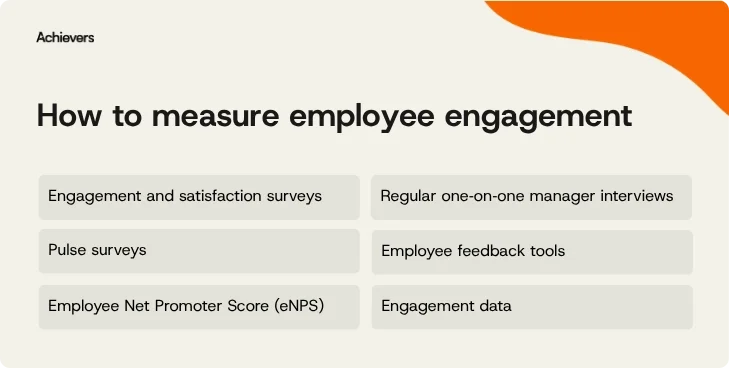
Engagement and Satisfaction Surveys: These surveys are designed to capture a comprehensive view of how employees feel about their work, leadership, and overall experience over an extended period. When expertly designed, they establish a clear baseline for cultural health and highlight where support, clarity, or recognition might be deficient. The primary challenge, however, remains the frequency of deployment. The 2026 Achievers Engagement and Retention Report found that only 38% of employees receive feedback requests at least weekly, indicating a reliance on infrequent surveys that can quickly become outdated.
- How to Use Them: Implement engagement surveys on a regular, consistent cadence (e.g., quarterly, bi-annually) and leverage the results to establish clear organizational priorities. Focus on a select number of themes identified as having the greatest impact, then utilize other, more agile listening methods to delve deeper into those specific areas. Ensure anonymity is guaranteed to foster honest responses.
-
Pulse Surveys: These are short, frequent check-ins designed to track sentiment in real-time. They are invaluable for monitoring how engagement shifts in response to specific events, organizational changes (e.g., new leadership, increased workloads), or project milestones. The true value of pulse surveys stems from their consistency and the subsequent follow-through, providing leaders with early signals and reassuring employees that their feedback genuinely leads to action.
- How to Use Them: Deploy pulse surveys strategically to monitor engagement fluctuations, particularly during periods of significant transition or uncertainty. Keep questions concise and highly relevant to immediate concerns. Transparently share high-level findings with employees and use the results to craft clear, actionable plans that are communicated across teams or the broader organization.
-
Employee Net Promoter Score (eNPS): As a methodology, eNPS specifically measures the likelihood of employees recommending the organization as an employer. It offers a swift, universally recognized indicator of overall engagement and the health of the company culture.
- How to Use It: Track eNPS as a trend over time rather than treating each score as a standalone outcome. Crucially, pair eNPS results with descriptive, qualitative feedback to understand the underlying drivers of employee sentiment. This integrated approach allows organizations to move beyond a single number and focus on the specific factors influencing it, whether positive or negative.
-
Regular One-on-One Manager Interviews: These consistent, dedicated conversations between managers and their direct reports are fundamental for building trust, providing clarity, and fostering meaningful feedback. Despite their critical importance, data from the Achievers Workforce Institute (AWI) indicates that only 20% of employees have regular one-on-one meetings with their managers. This represents a significant missed opportunity for qualitative insights and relationship building.

- How to Use Them: Establish regular one-on-one meetings as a non-negotiable expectation for all managers. Encourage leaders to integrate broader engagement insights into these discussions, focusing conversations on individual support needs, evolving priorities, career development, and addressing specific challenges.
-
Employee Feedback Tools: Modern employee feedback tools facilitate easy and integrated input sharing within the flow of the workday. These platforms often include quick polls, open comment sections, and insights derived from recognition activities, creating a rich tapestry of continuous feedback.
- How to Use Them: Integrate feedback tools directly into everyday workflows to make participation seamless and timely. Equally important is the practice of "closing the loop"—acknowledging received feedback and transparently communicating the actions being taken in response. This demonstrates that employee input is valued and acted upon, reinforcing trust.
-
Engagement Data Platforms: These sophisticated platforms aggregate and synthesize signals from various sources, including surveys, real-time feedback, recognition activity, and participation trends. By consolidating these disparate data streams, organizations can move from speculative assumptions to data-driven prioritization of actions that genuinely enhance performance, connection, and retention.
- How to Use It: Focus on identifying patterns and correlations within the aggregated data rather than fixating on isolated data points. Use engagement data to strategically prioritize where to allocate resources, which positive behaviors to reinforce, and where leaders may require additional support or development.
-
Manager Effectiveness Tools: These specialized tools measure how effectively leaders support, recognize, and coach their teams—a crucial aspect, given that managers directly shape the day-to-day employee experience. AWI data reinforces this, noting that 53% of employees report a supportive manager helps them navigate unexpected challenges.
- How to Use Them: Utilize manager effectiveness data to discern which leadership behaviors are positively influencing employee engagement and which areas require immediate attention. Share these insights with managers constructively, linking them to clear expectations around recognition, communication, and support. Then, leverage this data to guide targeted coaching, professional development plans, and ongoing check-ins, empowering managers to precisely focus their efforts on improving team engagement.
Unlocking Deeper Insights: The Essential Engagement Questions
To truly understand the factors driving or hindering engagement within an organization, the quality of the questions asked is paramount. These five fundamental questions probe critical aspects of the employee experience, helping to surface genuine sentiments and perceptions.
-
How likely are you to recommend this company as a great place to work? This is the cornerstone of the eNPS, offering a rapid diagnostic of overall employee sentiment. A consistently high score typically indicates a healthy company culture and a workforce that feels positively about their employer. Conversely, a low score signals underlying issues that demand deeper investigation. While a powerful indicator, it serves as a pulse check rather than a comprehensive diagnostic.
-
How well do you understand the company’s goals and mission? Employees inherently seek purpose and a sense of contributing to something larger than themselves. If there is a lack of clarity regarding organizational direction, it becomes exceedingly difficult for employees to remain motivated and align their efforts effectively. This question assesses strategic alignment and the effectiveness of internal communication. Companies must ensure their core values are not merely articulated in a mission statement but are visibly integrated into daily recognition and reward systems.
-
How happy are you in your role? Simple yet profoundly telling, this question delves into subjective satisfaction, which often reflects robust underlying conditions: clear expectations, meaningful work, and supportive team dynamics. If responses trend downwards, it can indicate deeper systemic issues such as burnout, role misalignment, or a pervasive lack of recognition, all of which require careful examination and intervention.
-
Do you feel valued for your contributions? The feeling of being valued is a fundamental human need and a powerful driver of employee connection and retention. When employees feel seen and appreciated—by managers, peers, and senior leadership—they are significantly more likely to remain engaged and committed to the organization. If scores in this area are lagging, it suggests a need to re-evaluate and enhance daily appreciation practices, potentially through the implementation of a modern recognition platform designed to facilitate frequent and impactful acknowledgment.
-
Do you have the support and resources you need to do your job well? This question strikes at the heart of employee empowerment and efficiency. A lack of necessary tools, clarity in roles, or adequate coaching can quickly erode engagement and foster frustration. Effective managers are those who proactively identify and remove roadblocks, rather than inadvertently creating them. Ensuring employees are fully equipped to succeed is a foundational element of strong engagement and overall organizational effectiveness.
Best Practices for Cultivating an Engaged Workforce
Given the sobering statistic from Gallup’s State of the Global Workplace Report—employee engagement fell to 21% last year—it is clear that measuring engagement is not merely a procedural task but a critical strategy for building a workplace where people genuinely thrive. Approaching this endeavor with intention and a commitment to action is paramount.
- Lead with Transparency: Foster an environment where employees trust the process. Clearly communicate the purpose of engagement surveys and feedback initiatives, explaining how the data will be used and what steps will be taken.
- Ensure Anonymity and Confidentiality: For employees to provide honest and candid feedback, they must be confident that their responses will remain anonymous and will not lead to negative repercussions. This builds psychological safety, which is crucial for authentic input.
- Actively Listen and Close the Loop: The most critical step is demonstrating that feedback is valued. This involves not only listening but also responding with concrete actions and communicating those actions back to the workforce. Ignoring feedback is more damaging than not asking for it at all.
- Communicate Results Transparently: Share aggregated results with the entire organization, highlighting key findings, areas of improvement, and the plans developed in response. This fosters a sense of shared ownership and accountability.
- Integrate Engagement Data with Business Outcomes: Connect engagement metrics with broader organizational performance indicators, such as productivity, customer satisfaction, innovation rates, and financial results. This demonstrates the tangible business impact of engagement and secures leadership buy-in.
- Embrace Continuous Listening: Move beyond the traditional annual survey model to implement a continuous listening strategy. This includes pulse surveys, real-time feedback tools, and regular one-on-one conversations, ensuring that insights are fresh and responsive to dynamic workplace conditions.
- Empower Managers as Frontline Engagement Drivers: Equip managers with the training, tools, and support they need to foster engagement within their teams. Managers have the most direct impact on the employee experience and are critical in translating organizational strategy into daily action.
- Tailor Approaches to Diverse Needs: Recognize that engagement drivers can vary across different demographics, departments, or geographic locations. Use segmented data to develop tailored interventions that address specific team needs and preferences.
- Focus on Strengths and Growth: While addressing weaknesses is important, also identify and amplify organizational strengths. Celebrate successes and use positive feedback to reinforce desired behaviors and cultural attributes.
When organizations lead with transparency, purpose, and a commitment to action, measuring engagement transcends a mere metric. It evolves into an integral part of a vibrant culture where individuals feel genuinely seen, heard, and empowered to contribute their best.
The Transformative Power of Employee Engagement Software
The adage "you can’t improve what you don’t understand" rings particularly true for employee engagement, where guesswork is simply insufficient. This is precisely where specialized employee engagement software platforms demonstrate their indispensable value.
Achievers, for instance, goes beyond conventional tools by offering a centralized, "always-on" platform. This system meticulously captures feedback from a multitude of channels—including quick polls, open comments, and recognition activity—and transforms this raw data into real-time, actionable insights. With flexible and customizable reporting capabilities, organizations gain not just data points but a comprehensive, nuanced picture of their workforce’s sentiment and experience.
What sets advanced platforms like Achievers apart:
- Holistic Data Integration: Consolidates feedback from diverse sources into a single, cohesive view, eliminating data silos.
- Real-time Insights: Provides immediate access to trending sentiment, allowing for rapid response to emergent issues.
- AI-Powered Analytics: Utilizes artificial intelligence and machine learning to uncover hidden patterns, predict potential issues, and provide prescriptive recommendations.
- Customizable Reporting: Tailors reports to specific roles (HR, managers, executives), offering relevant and actionable data for each stakeholder.
- Seamless User Experience: Designed for ease of use, encouraging higher participation rates from employees and simplifying data interpretation for leaders.
- Actionable Recommendations: Translates complex data into clear, prioritized actions that directly address engagement drivers and detractors.
The efficacy of such platforms is evident in their impact. Organizations that fully embrace and adopt Achievers’ solutions have reported up to a 5x greater impact on engagement, productivity, and retention. This profound effect is attributable to a streamlined process: feedback is effortlessly given, data is easily interpreted, and subsequent action is readily taken. In such an ecosystem, engagement evolves from a passive measurement into an actively shaped and continuously improved organizational characteristic.
The Future of Engagement: A Holistic and Action-Oriented Approach
Measuring engagement marks only the initial step in a much broader journey. The real impact, and the true competitive advantage, stems from what transpires next: the recognition of exemplary behaviors, the decisive action taken on employee feedback, and the deliberate cultivation of a culture where every individual feels seen, heard, and genuinely valued.
This is the core proposition of platforms like Achievers. By seamlessly integrating recognition and real-time feedback directly into the daily workflow, Achievers makes it effortlessly simple to uncover the true motivations of a workforce. It empowers organizations to take informed, impactful actions that resonate and stick. From sophisticated AI-powered insights that anticipate trends to a global rewards marketplace that offers meaningful appreciation, every feature is meticulously designed to strengthen connection, bolster retention, and actively shape the desired organizational culture.
Ultimately, effective engagement measurement transcends mere data collection. It transforms into an intrinsic aspect of how a company operates—every single day—making engagement not just a metric to track, but a living, breathing component of organizational success.