
The global business landscape is in constant flux, driven by rapid technological advancements and evolving market demands. At the forefront of this transformation is the pervasive discussion around reskilling, upskilling, and the accelerated adoption of Artificial Intelligence (AI). This urgent need for continuous learning was underscored during recent high-level engagements, where discussions with over 200 Chief Human Resource Officers (CHROs) in India and Singapore revealed AI readiness as the paramount concern. The central question echoing across these influential gatherings was: "How can we accelerate AI fluency and capability across all facets of our organizations?"
A comprehensive, years-long study of corporate training programs has yielded a startling revelation: the prevailing approaches, philosophies, technological stacks, and operating models for corporate learning are fundamentally outdated. This assertion, backed by extensive research, points to a critical disconnect between the current learning and development (L&D) infrastructure and the escalating demands of the modern workforce.
The Staggering Skills Gap: A Wake-Up Call for L&D
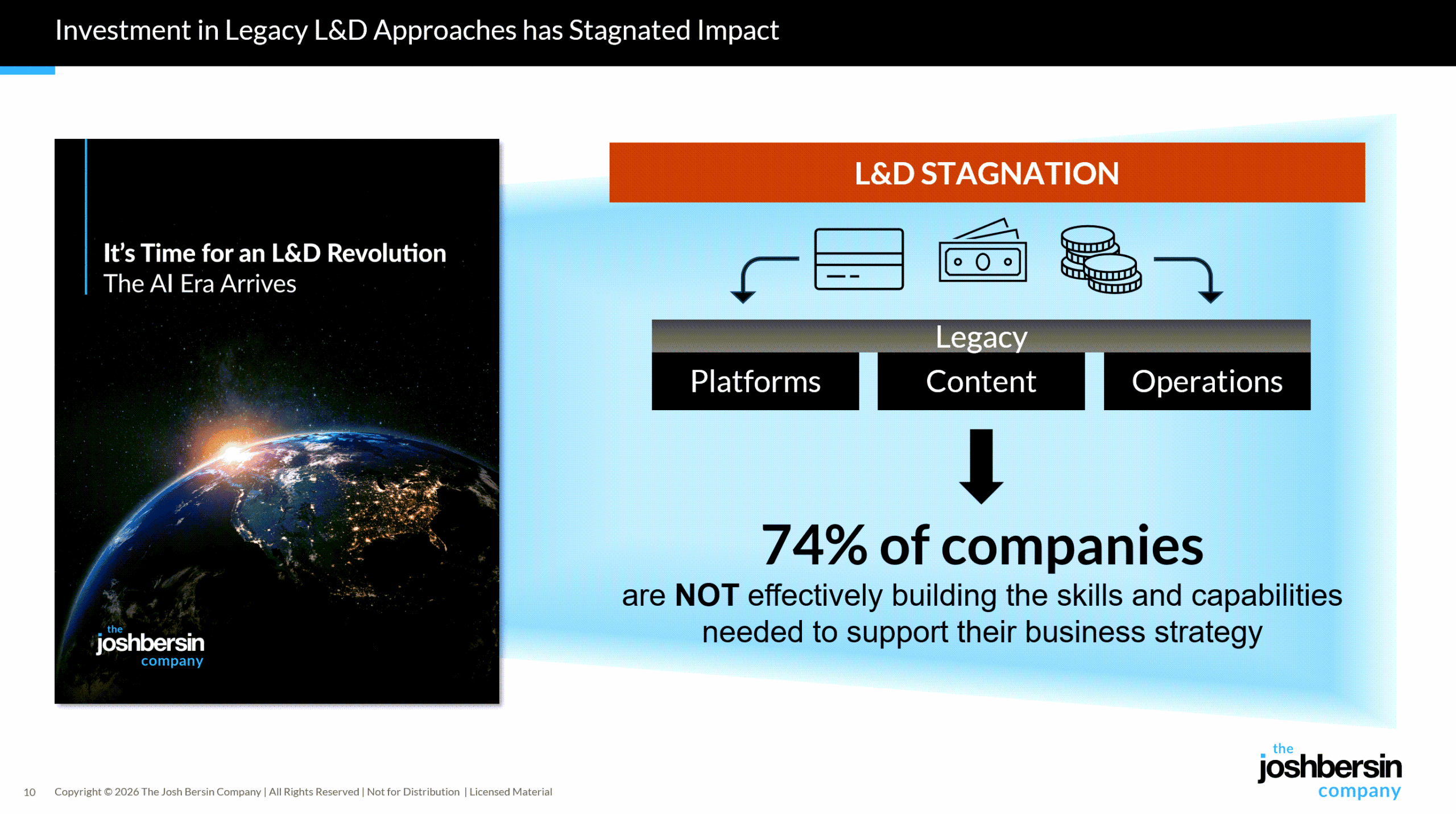
The findings of the fifth major study on corporate L&D, recently launched, present a sobering picture. A significant 74% of companies report that they are struggling to keep pace with their organization’s demand for new skills. This statistic is particularly alarming when considering the substantial global investment in corporate training, estimated at $400 billion annually. This figure encompasses expenditures on content libraries, L&D technology, dedicated trainers, and external learning consultants. The fact that three-quarters of these organizations are falling behind suggests a considerable portion of this vast financial outlay may be yielding diminishing returns.

This widespread inadequacy highlights a systemic issue: the traditional paradigm of "training" and "learning" is no longer sufficient. The core challenge lies not in the acquisition of knowledge through formal instruction, but rather in the dynamic sharing of information, fostering an environment where individuals can freely explore, question, and apply novel ideas. The rigid, pedagogical structures of conventional training are proving to be a significant impediment to progress.
Redefining the Learning Challenge: From Training to Dynamic Enablement
The research indicates a profound shift in how organizations must approach skill development. The problem is not simply about imparting knowledge; it is about creating an ecosystem that facilitates continuous, agile adaptation. This necessitates a move away from static courseware and towards dynamic, AI-powered systems capable of generating and sharing content in real-time.
The AI-Native Learning Revolution
The advent of generative AI presents a transformative opportunity for corporate learning. Unlike traditional methods that require manual design, development, and ongoing updates of courseware, AI-native systems can build and disseminate content dynamically, adapting to diverse user needs and formats. This approach promises to drastically reduce the time and resources required to create learning materials, enabling organizations to respond to emerging skill requirements with unprecedented speed.
Platforms leveraging AI-native capabilities can generate new courses in days rather than months. Crucially, as new information or topics emerge, the entire learning system can be updated instantaneously. This ensures that employees have access to the most current and relevant knowledge, allowing them to:

- Explore and discover new information: Employees can proactively seek out knowledge related to their roles and emerging trends.
- Ask questions and receive immediate answers: AI can act as an intelligent assistant, providing instant responses to queries.
- Apply new ideas and skills: The learning environment supports the practical application of acquired knowledge.
These AI-powered systems automatically categorize content into a defined skills taxonomy, and through employee interaction, they can infer and track individual skill levels. This interconnectedness of all learning objects creates a unified "intelligence system" for the organization, where the entire knowledge base is continuously updated and accessible.
The success of platforms like ChatGPT, with an estimated 60% of its 900 million weekly users engaging in learning activities, serves as a compelling testament to the effectiveness of this dynamic, user-driven approach. This level of engagement and successful knowledge acquisition has historically eluded traditional course catalogs.
Furthermore, organizations are beginning to integrate expert interviews and recordings directly into these AI platforms, further enriching the knowledge base with real-world insights, practical tips, and cutting-edge findings. This innovative application of AI is poised to unlock trillions of dollars in business improvements by enhancing operational efficiency and fostering innovation.
Navigating the Evolution: A Four-Level Maturity Model for Corporate Learning
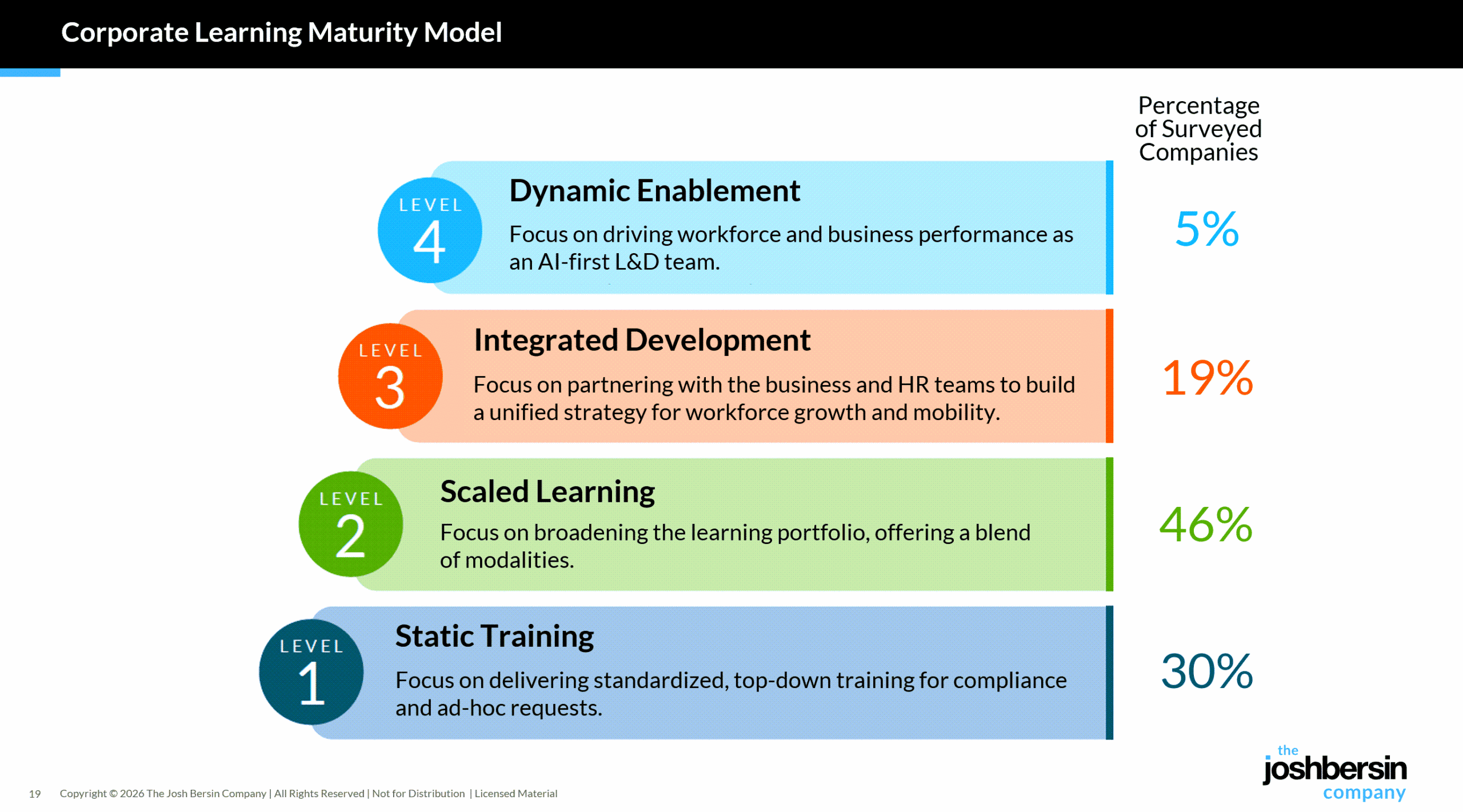
To guide organizations through this critical transition, a new Learning Maturity Model has been developed, outlining four distinct levels of progression:
Level 1: Static Training Programs
At the foundational stage, organizations typically engage in static training programs. These are often compliance-driven or mandated top-down, delivered through courses developed internally or acquired from external vendors. While cost-effective and useful for disseminating information on new products, compliance requirements, or other episodic events, Level 1 programs offer limited scope for skills-based learning. Approximately one-third of the market operates at this level, primarily focusing on maintaining currency with essential updates.
Level 2: Scaled Learning
As organizations mature, they progress to Level 2, characterized by the adoption of "Scaled Learning." This involves diversifying learning formats beyond traditional courses to include videos, audio content, job aids, and other interactive tools. While this broadens the learning portfolio and offers more options to employees, it often relies on content developed by external vendors. The onus then falls on the individual learner to navigate this expanded library and determine what is relevant and when. Prominent L&D platforms like LinkedIn Learning, Coursera, Skillsoft, and Pluralsight primarily operate within this category.
Level 3: Integrated Development
Level 3, or "Integrated Development," marks a significant advancement where companies begin to tailor learning programs around specific job roles, skills, and career paths. This shift from mere training to comprehensive "development programs" introduces considerable complexity. Organizations at this stage often grapple with multifaceted skill taxonomies encompassing technical skills, professional competencies, job roles, and hierarchical levels.
However, the dynamic nature of the modern workforce, where it’s estimated that 70% of job-related skills become obsolete annually, makes maintaining these intricate, multi-dimensional programs a formidable challenge. While this approach remains valuable for channel training, technical education, and onboarding new employees, its upkeep requires substantial investment. As organizations delve deeper into Level 3, the size and cost of L&D departments escalate, necessitating the building, maintenance, and refreshing of numerous programs, curricula, skills models, and content assets. This decentralization often leads to L&D becoming a localized function, with different business units managing their specific training needs, creating a federated, albeit complex, operational model.
Level 4: AI-Driven Dynamic Enablement
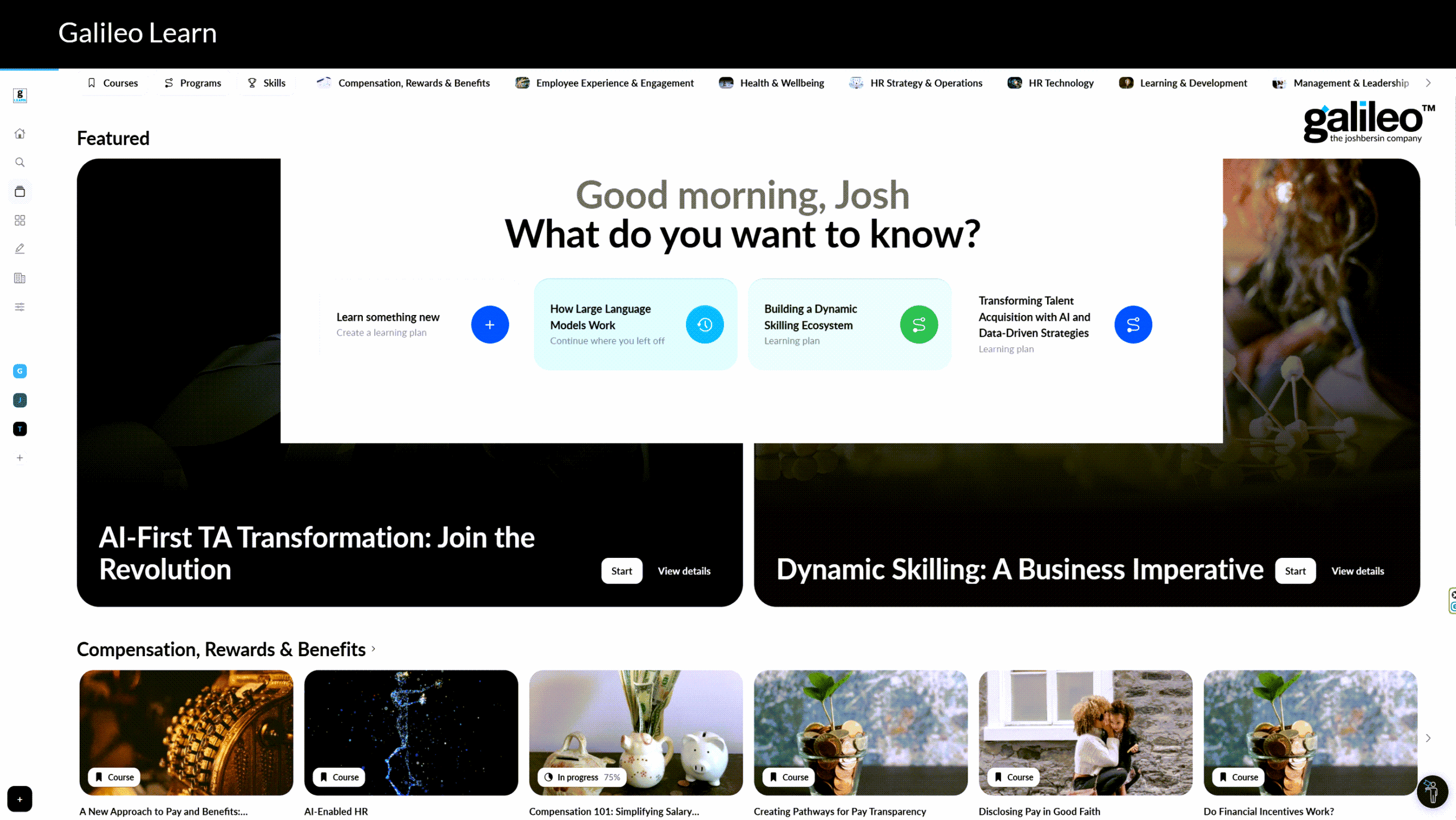
The pinnacle of this maturity model is Level 4, where AI fundamentally transforms the learning landscape. This level envisions a unified platform that houses an organization’s entire knowledge base, encompassing not only formal courses but also documents, policies, and expert interviews. This integrated system transcends the definition of a traditional learning platform, ushering in an era of "Dynamic Enablement."
AI-native learning platforms enable organizations to publish information in days, and employees can engage with this knowledge in their preferred formats and contexts. Many organizations maintain their legacy Learning Management Systems (LMS) for compliance-related activities, while new AI platforms are poised to replace Learning Experience Platforms (LXPs), learning portals, and a significant portion of content development tools. Early adopters of these AI-driven solutions are already reporting substantial reductions in internal L&D expenditure, some by as much as 40-50%.
This transformation is not merely about accelerating course creation; it involves a fundamental reimagining of how learning is delivered and consumed. It necessitates the replacement of traditional SCORM-based LMS with dynamic content systems. The roadmap to achieving Dynamic Enablement involves rationalizing existing content, transforming legacy SCORM courses into AI-native formats, and establishing new governance models for L&D.
The Tangible Impact: Savings, Innovation, and Business Alignment
The benefits of achieving Level 4 maturity are profound and far-reaching. Organizations are realizing enormous savings in both time and financial resources when delivering learning solutions, while simultaneously enhancing the employee experience. Furthermore, learning can now be seamlessly integrated into every corporate chatbot or agent, providing contextually relevant support.
Consider a scenario where an employee is completing benefits enrollment: they can ask a chatbot to compare benefit options. When entering a new sales opportunity into a CRM system, they can receive coaching on selling into that specific industry. For frontline workers, such as nurses or manufacturing personnel, chatbots can provide immediate updates on procedural changes or new departmental initiatives.
One prominent travel reservations company is leveraging call recordings from its top customer service agents to populate its learning system, enabling other agents to learn best practices and effectively handle challenging customer interactions. This capability extends across customer service, engineering, sales, and all support functions, fostering a culture of continuous improvement.
Companies are now publishing all new materials, including anonymized client interviews, into these AI-powered systems. This allows any employee to gain insights into client needs, understand specific industries, or better comprehend client requirements. This concept, termed "Dynamic Enablement," signifies a crucial shift from merely "learning" to actively "enabling" individuals to perform at higher levels and drive business growth.
Proven Returns: The Metrics of AI-Native Learning
The research consistently demonstrates a strong correlation between AI-native learning adoption and positive business outcomes. Companies operating at Level 4 are significantly more likely to be innovation leaders (ten times more likely), exceed financial targets (six times more likely), and adapt effectively to change (sixteen times more likely). As these AI-driven learning platforms mature, their impact on business performance is expected to grow exponentially.
Strategic Implications and Future Outlook
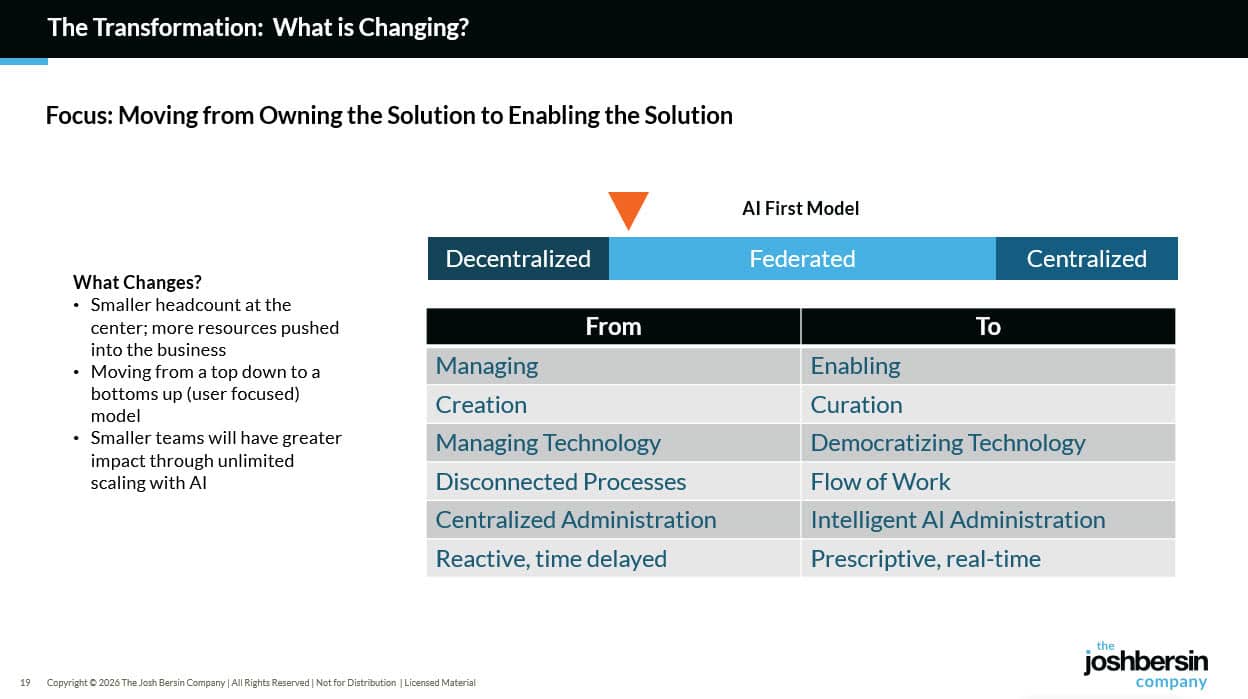
The transition to AI-native learning and Dynamic Enablement represents a fundamental evolution in how organizations manage their human capital. It promises to unlock unprecedented levels of agility, efficiency, and innovation. The ability to embed learning directly into workflows and provide personalized, on-demand knowledge support will be a key differentiator for companies seeking to thrive in the rapidly evolving global economy.
The path forward requires a strategic re-evaluation of existing L&D infrastructures and a commitment to embracing AI-powered solutions. By adopting a phased approach, prioritizing content rationalization, and fostering a culture of continuous learning and adaptation, organizations can successfully navigate this transformation and unlock the full potential of their workforce. The future of corporate learning is here, and it is undeniably AI-native.