
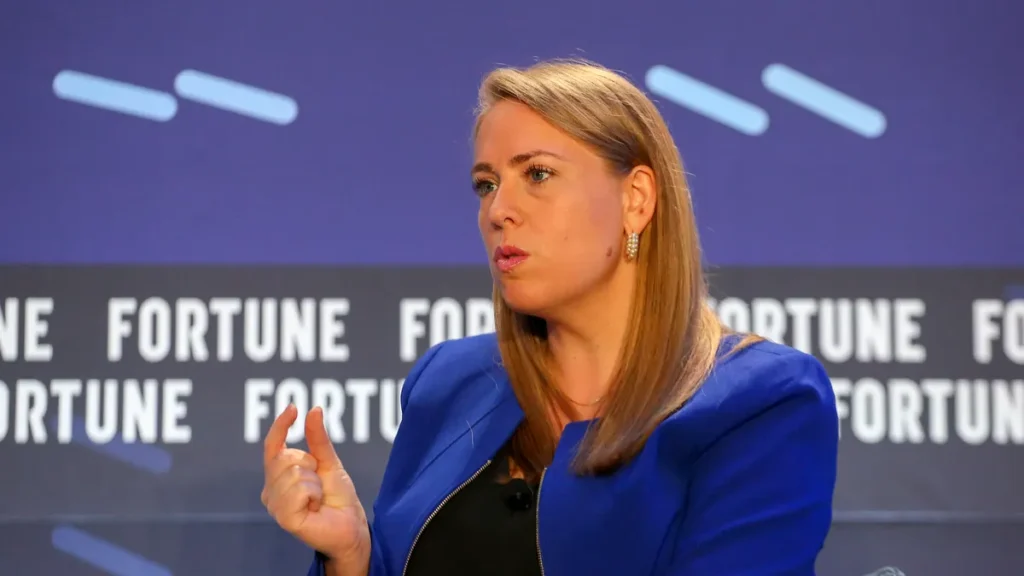
Atlanta, GA – In a significant address at the Fortune Workplace Innovation Summit on May 20, 2026, Andrea Lucas, a Commissioner and the current Chair of the U.S. Equal Employment Opportunity Commission (EEOC), vigorously defended the agency’s enforcement strategy, asserting that it is widening, not narrowing, the scope of civil rights protections. Her remarks directly confronted criticisms suggesting a shift in the EEOC’s focus under the current administration, particularly her controversial social media call for White men to bring forward discrimination claims. Lucas underscored the agency’s commitment to fighting discrimination across all demographics, emphasizing a merit-based approach to claims regardless of race or sex.
The EEOC’s Evolving Mandate Under Scrutiny
The U.S. Equal Employment Opportunity Commission is a federal agency responsible for enforcing federal laws that make it illegal to discriminate against a job applicant or an employee because of the person’s race, color, religion, sex (including pregnancy, sexual orientation, and gender identity), national origin, age (40 or older), disability, or genetic information. Established by the Civil Rights Act of 1964, the EEOC plays a pivotal role in ensuring fairness and equality in the American workplace through investigation, conciliation, and litigation. Its mandate has historically been understood to address systemic discrimination and uplift historically marginalized groups.
However, recent years have seen increased debate over the agency’s priorities, particularly concerning its approach to Diversity, Equity, and Inclusion (DEI) initiatives. Critics, often aligning with conservative viewpoints, argue that some DEI programs may inadvertently lead to "reverse discrimination" against individuals from majority groups. This sentiment has been amplified in the wake of the Supreme Court’s 2023 decision in Students for Fair Admissions v. Harvard/UNC, which effectively ended affirmative action in college admissions and sent ripples through corporate America, prompting many organizations to re-evaluate their DEI strategies. It is within this charged atmosphere that Commissioner Lucas’s statements and the EEOC’s recent actions are being closely scrutinized.
At the Fortune Workplace Innovation Summit, an influential gathering of business leaders and HR professionals, Lucas directly addressed these perceptions. "I push back. We don’t have a narrower mandate. We have a broader mandate," Lucas declared to the Atlanta audience. Her statement aimed to dispel notions that the EEOC, particularly under the Trump administration’s influence and subsequent appointments, was retreating from its core mission or exclusively focusing on certain demographics. "I understand that people have pitched that the civil rights agenda of the Trump administration has narrowed the aperture, and I would say it’s widening it," she added, signaling a proactive stance rather than a defensive one.
A Universal Approach to Discrimination Claims
Lucas articulated a vision for the EEOC that is universally inclusive in its enforcement. "We are continuing to do discrimination work on behalf of workers of every single race and both sexes, but we’re not going to only pick and choose historically underrepresented groups or only women," she explained. This principle, she argued, aligns with the fundamental tenet of civil rights law: that all forms of discrimination are equally unlawful. "We’re going to say, ‘It doesn’t matter whether you’re a man or a woman, whether you’re Black, White, Asian, Hispanic, you pick it. We are going to be fighting for you based on the merit of your claim.’"
To bolster her argument, Lucas highlighted the EEOC’s impressive financial recoveries, citing the $528 million secured in the last fiscal year through pre-litigation mediation, conciliation, and settlements. These pre-litigation efforts represent a significant portion of the agency’s work, resolving disputes without resorting to formal lawsuits, which can be costly and time-consuming for all parties involved. The substantial sum, Lucas suggested, is evidence of the agency’s expansive reach and effectiveness. "If we had narrowed the aperture, how would we recover that?" she posed rhetorically, implying that a broader focus naturally leads to a wider array of successful resolutions for a diverse claimant base. This figure represents one of the highest recovery amounts in recent history, reflecting both a robust enforcement mechanism and a high volume of successful settlements across various types of discrimination claims.
The Viral Call to White Men and Its Context
A central point of discussion during her summit appearance was her widely publicized social media post from December, where she specifically encouraged White men to report instances of discrimination. On the platform X (formerly Twitter), Lucas had written, "Are you a white male who has experienced discrimination at work based on your race or sex? You may have a claim to recover money under federal civil rights laws. Contact [EEOC] as soon as possible." This message quickly went viral, igniting considerable debate across social media, legal circles, and HR communities.
Critics viewed the post as a provocative gesture, potentially signaling a diversion of resources from the historically intended beneficiaries of civil rights protections. Some interpreted it as an endorsement of the "reverse discrimination" narrative, which they argue undermines the ongoing struggle for equity faced by marginalized groups. Conversely, supporters lauded it as a necessary reminder that civil rights laws apply to everyone, irrespective of their demographic background, and that the EEOC’s mandate is indeed universal.

Addressing the controversy directly in Atlanta, Lucas clarified her intent. "Obviously, I did a viral video saying to White men, ‘You’re welcome to file with us,’ but that doesn’t mean you get special treatment. It means that you know that you are not going to get less equal treatment," she explained. Her statement sought to reassure that while the invitation was explicit, it did not imply preferential handling of claims from White men but rather affirmed their equal standing under the law. This clarification was crucial for framing the EEOC’s approach as one of equal application rather than a shift in priorities towards any particular group.
The EEOC v. The New York Times Co. Lawsuit: A Landmark Case
Lucas further substantiated her commitment to a broad mandate by referencing recent enforcement actions. She noted that while the EEOC recovered approximately $15 million for White employees in the last fiscal year, not a single dollar, neither in the past fiscal year nor in the 10 years prior, had specifically remedied discrimination faced by White men through an EEOC-initiated lawsuit. This statistic highlights the rarity of such cases reaching the litigation stage and underscores the significance of a recent filing.
Earlier this month, the EEOC made headlines with EEOC v. The New York Times Co., a lawsuit alleging discrimination against a White male employee. This case marks the first time in a decade that the EEOC has brought a lawsuit on behalf of a White man, according to Lucas. The lawsuit accuses The New York Times of failing to promote the employee based on his race and sex, specifically alleging that the company’s Diversity, Equity, and Inclusion (DEI) initiatives led to his being passed over for advancement opportunities. The complaint details how the employee, a veteran journalist with extensive experience, was allegedly denied promotions in favor of less qualified candidates who fit the company’s diversity criteria.
In a May 5 statement regarding the New York Times lawsuit, Lucas articulated the underlying principle guiding this action: "No one is above the law — including ‘elite’ institutions. There is no such thing as ‘reverse discrimination.’ All race or sex discrimination is equally unlawful, according to long-established civil rights principles." This strong assertion directly challenges the notion that certain forms of discrimination are more permissible or less serious than others, especially when they occur within the context of DEI programs. It sends a clear message to corporations that while diversity efforts are encouraged, they must be implemented in a manner that adheres strictly to federal anti-discrimination laws.
Broader Implications for Corporate DEI and Enforcement

The EEOC’s current stance, as articulated by Chair Lucas, has significant implications for businesses and the ongoing national conversation around DEI. The explicit invitation for White men to file claims, coupled with a high-profile lawsuit against a major media company, signals a potential shift in how companies approach their diversity initiatives.
For employers, the message is clear: while fostering a diverse and inclusive workplace remains a critical goal, DEI programs must be carefully designed and implemented to avoid inadvertently creating discriminatory practices against any group. Companies are now under increased pressure to ensure that hiring, promotion, and retention policies, even those aimed at increasing diversity, are truly merit-based and do not inadvertently disadvantage individuals based on their race or sex. This could lead to a more cautious and legally scrutinized approach to DEI strategies, potentially favoring broader inclusion initiatives over numerical targets that could be perceived as preferential treatment.
Legal experts suggest that this direction from the EEOC could embolden individuals from majority groups to pursue discrimination claims, leading to an uptick in such complaints. It also signals a more aggressive enforcement posture by the agency on claims that might previously have been viewed as less central to its mission. The agency’s emphasis on "merit of your claim" suggests a rigorous, individualized assessment of each complaint, irrespective of the claimant’s background.
The political backdrop further complicates the landscape. The broader anti-DEI movement, often spearheaded by conservative legal groups, is gaining traction, challenging corporate DEI initiatives through lawsuits and legislative efforts. The EEOC’s actions, under Lucas’s leadership, align with this broader push, potentially providing federal backing to claims that previously struggled to gain traction. This alignment could be seen by some as a necessary rebalancing of civil rights enforcement, ensuring fairness for all, while others may view it as an erosion of efforts to address deeply entrenched systemic inequalities.
Ultimately, Commissioner Lucas’s statements at the Fortune Workplace Innovation Summit represent a firm declaration of the EEOC’s commitment to what she terms a "broader mandate." By emphasizing a universal application of anti-discrimination laws and demonstrating a willingness to pursue claims across all demographic spectrums, including those involving White men, the EEOC is navigating a complex and often contentious terrain. The ongoing dialogue and future enforcement actions will undoubtedly continue to shape the contours of civil rights and workplace equity in America.






