
In the increasingly competitive global talent landscape, the language used in job descriptions has emerged as a critical determinant in attracting high-caliber candidates and optimizing recruitment processes. Industry insights, particularly from talent acquisition platforms like Ongig, underscore that action verbs are not merely stylistic preferences but powerful tools that significantly enhance the clarity, inclusivity, and efficacy of job postings. This strategic linguistic choice moves beyond passive descriptions, transforming static job requirements into dynamic calls to action that resonate with prospective employees and align with modern recruitment technologies.
The Power of Precision: Why Action Verbs Matter
An action verb, by definition, expresses a physical or mental action, offering a clear and concise portrayal of responsibilities and achievements. Unlike linking verbs (e.g., "is," "was," "are") or helping verbs (e.g., "can," "should," "will"), action verbs provide specificity and energy, allowing candidates to visualize their potential contributions. For instance, stating "managed a team of five" provides a much clearer understanding of a role than "was responsible for a team of five." This distinction is fundamental to crafting job descriptions that not only inform but also inspire and filter talent effectively.
The shift towards action verbs is a direct response to the evolving demands of both job seekers and hiring managers. Candidates, often sifting through numerous postings, benefit from immediate clarity on duties and expectations. Simultaneously, recruiters and Applicant Tracking Systems (ATS) rely on precise language to identify and prioritize relevant applications. Rob Kelly, Co-Founder and CEO of Ongig, a company specializing in job description optimization, highlights this necessity: "Action verbs are the most effective when trying to attract top talent. They allow for detailed descriptions of job duties and responsibilities, helping candidates make informed decisions before applying."
A Deep Dive into Functional Categories
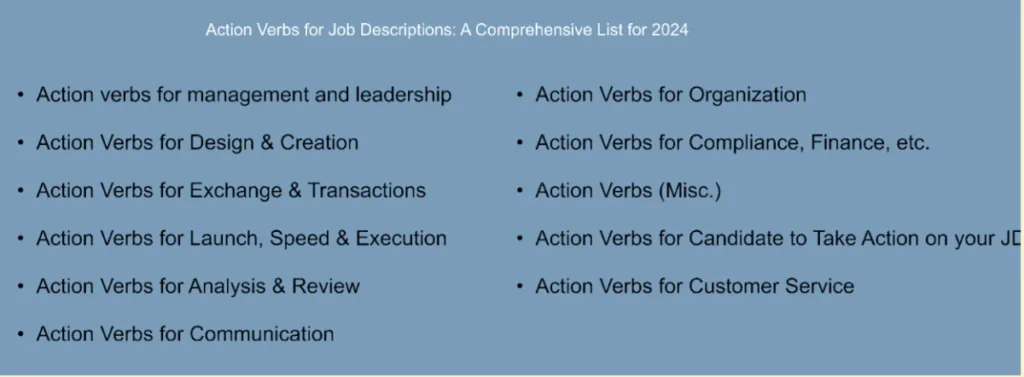
Ongig’s extensive analysis of effective job descriptions has culminated in a comprehensive categorization of action verbs, designed to cover the vast spectrum of professional roles. While there is inherent overlap, these categories serve as a valuable framework for crafting targeted and impactful language.
- Leadership & Management: Verbs such as Achieve, Advise, Architect, Authorize, Delegate, Develop, Direct, Execute, Manage, Motivate, Orchestrate, Oversee, Supervise, and Strategize convey authority, vision, and the ability to drive results. These are crucial for roles demanding significant organizational influence and team guidance.
- Design & Innovation: For creative and technical roles, verbs like Create, Code, Combine, Design, Develop, Devise, Illustrate, Invent, Program, Streamline, and Upgrade emphasize imaginative skill, problem-solving, and the ability to build or improve systems and products.
- Commercial & Transactional: Roles involving sales, procurement, and client interaction benefit from verbs like Acquire, Arrange, Budget, Buy, Collect, Deliver, Distribute, Exchange, Furnish, Negotiate, Procure, Purchase, Sell, and Solicit. These highlight capabilities in resource management, deal-making, and service delivery.
- Project Execution & Speed: In fast-paced environments, verbs that denote progress and efficiency are key. Accelerate, Activate, Deploy, Encourage, Expedite, Further, and Implement communicate a bias for action and the ability to drive initiatives forward swiftly and effectively.
- Analysis & Oversight: Analytical roles require verbs that reflect critical thinking and investigative skills. Analyze, Appraise, Ascertain, Calculate, Compare, Evaluate, Examine, Forecast, Formulate, Identify, Inspect, Investigate, Leverage, Measure, Research, Resolve, Review, Solve, Study, and Verify are essential for roles focused on data, insights, and problem diagnosis.
- Communication & Collaboration: Effective interpersonal skills are conveyed through verbs such as Adjourn, Author, Clarify, Collaborate, Correspond, Discuss, Draft, Inform, Inquire, Notify, Report, Reply, Update, and Write. These highlight the ability to articulate ideas, facilitate discussions, and work cooperatively.
- Operational Organization: For roles focused on structure and efficiency, verbs like Accumulate, Administer, Align, Arrange, Assemble, Commence, Compile, Consolidate, Coordinate, Organize, Plan, Recover, and Schedule are vital, demonstrating competence in managing processes and resources.
- Compliance & Financial Stewardship: Roles in finance, legal, and regulatory affairs demand precision and adherence to standards. Audit, Allocate, Approve, Check, Conserve, Control, Delete, Edit, Enforce, Ensure, Guarantee, Inspect, Prevent, Protect, Regulate, Restrict, and Return are crucial for conveying responsibility and accountability.
- Digital, Data, and AI Integration: Reflecting the modern technological landscape, this newer category includes verbs such as Automate, Configure, Debug, Deploy (in a tech context), Extract, Integrate, Model, Query, Scrub, and Visualize. These verbs are increasingly sought after for roles requiring proficiency in digital tools, data management, and artificial intelligence applications, signaling a company’s embrace of cutting-edge talent.
- Candidate Engagement & Customer Service: For roles focused on external interaction and support, verbs like Apply, Join, Resolve, Assist, Satisfy, Negotiate, Handle, Educate, De-escalate, Empathize, Engage, Address, Advise, and Facilitate are essential. They convey a commitment to user experience and problem resolution.
Beyond Buzzwords: The Tangible Benefits of Action-Oriented JDs
The strategic use of action verbs in job descriptions yields multiple benefits that extend across the entire recruitment lifecycle and beyond.
- Enhancing Clarity and Setting Expectations: Precise action verbs eliminate ambiguity, providing candidates with a crystal-clear understanding of the day-to-day responsibilities. Instead of vague phrases like "responsible for customer problems," an action-oriented description such as "resolve customer complaints efficiently" leaves no room for misinterpretation. This upfront clarity helps candidates self-select, reducing unqualified applications and saving valuable recruitment time.
- Fostering Inclusivity and Diversity: Traditional job descriptions sometimes inadvertently use gender-coded language or terms that subtly deter diverse applicants. By replacing these with objective, competency- and skill-based action verbs, companies can create more inclusive postings. For example, rather than seeking a "natural leader," a JD might emphasize the ability to "facilitate team meetings" or "debug complex issues." Research by Textio and others consistently shows that inclusive language can increase application rates from underrepresented groups by up to 20%.
- Boosting Candidate Engagement and Application Rates: Dynamic language actively draws candidates into the role. Phrases like "spearhead new sales initiatives" are far more engaging and inspiring than "work on sales projects." This active voice encourages applicants to envision themselves performing the tasks, fostering an immediate connection with the role and increasing the likelihood of a strong application. A LinkedIn study found that job posts with clear, concise language receive 10% more applications.
- Strengthening Employer Branding and Culture: The choice of action verbs can subtly communicate a company’s values, culture, and strategic direction. Verbs like "pioneer," "modernize," or "revolutionize" can project an image of innovation and forward-thinking, attracting talent that values progress and industry leadership. This strategic branding can significantly enhance a company’s appeal as an employer of choice, a crucial factor in retaining talent amidst market fluctuations like the "Great Resignation."
- Optimizing for Applicant Tracking Systems (ATS) and SEO: In today’s digital recruitment landscape, over 75% of large companies use ATS to filter applications. These systems are highly reliant on keyword matching. By incorporating industry-specific action verbs, job descriptions become more discoverable through online searches and more likely to pass initial ATS screenings. This ensures that qualified candidates, who often use these very verbs in their resumes, are not overlooked due to linguistic mismatches.
- Streamlining Performance Evaluation and Career Development: Well-defined action verbs in job descriptions provide a concrete foundation for performance reviews and goal setting. If a JD clearly states "develop new sales strategies" or "audit monthly expenses," it becomes straightforward to evaluate an employee’s performance against these measurable objectives. This transparency aids in career pathing, employee development, and fosters a culture of accountability and continuous improvement.
Strategic Implementation: Best Practices for Crafting Effective JDs
To leverage the full potential of action verbs, companies must adopt a disciplined approach to job description writing.
- Tailoring Verbs to Role and Industry: The universality of action verbs does not negate the need for specificity. An administrative assistant might "administer," "authorize," and "consult," while a marketing manager would "analyze," "create," and "write." This careful selection demonstrates an understanding of the role’s unique demands and helps attract candidates with the precise skill set required.
- Employing Active Voice and Present Tense: Always begin each duty and responsibility with an action verb in the present tense and active voice. For example, "oversees new sales projects" is more direct and impactful than "oversaw new sales projects" or "will be responsible for overseeing." This creates a sense of immediacy and helps candidates visualize their daily contributions.
- Structuring with Impactful Bullet Points: Starting each bullet point in the responsibilities section with a strong action verb immediately commands attention and conveys purpose. Instead of a passive statement like "Your work will involve working on software," opt for "Resolve and code backend logic to address customer problems." This structure not only makes the JD easy to scan but also prompts candidates to mirror this impactful language in their own applications and resumes.
- Avoiding Vague Language: Steer clear of weak, generic verbs such as "work on" or "handle." These terms provide little to no specific information about the actual tasks. Instead, replace them with precise verbs like "administer," "arrange," or "assemble," which clearly articulate the expected actions and outcomes.
- Aligning with Seniority Levels: The choice of action verbs should reflect the seniority and scope of the role. Entry-level positions might use verbs emphasizing learning and collaboration (e.g., "assist," "support," "learn"), while senior leadership roles might feature verbs denoting strategic impact and innovation (e.g., "revolutionize," "pioneer," "transform"). This subtle differentiation ensures the JD appeals to candidates at the appropriate career stage.
- Emphasizing Measurable Outcomes: Where possible, couple action verbs with measurable outcomes. "Boost sales growth by 30%" is significantly more compelling and actionable than "boost sales." This not only attracts achievement-driven candidates but also provides clear metrics for future performance evaluation.
The Evolving Landscape of Talent Acquisition
The emphasis on action verbs is not an isolated trend but a crucial component of a broader evolution in talent acquisition. The advent of sophisticated ATS and AI-powered recruitment platforms has transformed how applications are processed, making keyword optimization indispensable. Furthermore, the global push for Diversity, Equity, and Inclusion (DEI) has necessitated a re-evaluation of language in recruitment, moving towards bias-free and inclusive terminology. Companies like Salesforce, Yelp, GoDaddy, Verizon, Intel, and Autodesk, early adopters of advanced JD optimization tools, exemplify a growing industry recognition of these strategic imperatives. The competitive talent market, exacerbated by phenomena like the "Great Resignation," has heightened the need for compelling and efficient job descriptions that stand out.
Expert Perspectives and Industry Impact
HR and recruitment experts widely concur on the efficacy of action verbs. Dr. Emily Chang, a prominent Industrial-Organizational Psychologist, notes, "The language in job descriptions is often the first impression a candidate has of a company. Action verbs communicate professionalism, clarity, and dynamism, which are all critical for attracting top-tier talent in a discerning market." Companies that invest in refining their job descriptions are not just improving their hiring metrics; they are also strengthening their employer brand and fostering a more transparent and results-oriented culture from the outset. This commitment to precise communication extends into the employee lifecycle, providing clear benchmarks for development and performance.
In conclusion, the meticulous selection and deployment of action verbs in job descriptions is a non-negotiable strategy for modern talent acquisition. It is a fundamental practice that underpins clarity, promotes inclusivity, enhances candidate engagement, optimizes for technology, and provides a solid framework for performance management. As the talent landscape continues to evolve, companies that master this linguistic art will undoubtedly gain a significant advantage in securing the best human capital.






