The burgeoning field of artificial intelligence (AI), while promising transformative advancements, is poised for a significant and potentially steep increase in pricing, a development rooted in the colossal capital investments required for its creation and deployment. This impending price surge, though potentially disruptive, is expected to catalyze a series of profound shifts within the technology landscape and broader economy, impacting everything from enterprise software expenditures to consumer-facing digital services. The underlying economics suggest that the era of ubiquitously cheap AI is drawing to a close, ushering in a new phase characterized by higher operational costs and a reevaluation of AI’s economic value proposition.
The Immense Capital Investment Driving AI Costs
The fundamental driver behind the anticipated AI price hike is the staggering financial commitment required to develop and sustain the underlying infrastructure. While the per-token cost of AI computation might appear minuscule, it fails to encompass the vast upfront capital expenditure in hardware, research and development, and data center construction. This immense investment is being spearheaded by major technology players, with significant capital being channeled into building the computational power necessary for advanced AI models.
Hyperscaler Investments Fueling the AI Boom:
Leading the charge are the "Big Four" hyperscalers: Amazon, Alphabet (Google), Microsoft, and Meta. These tech giants are investing billions of dollars annually to expand their AI capabilities. For 2025, estimates suggest their combined capital expenditure for AI infrastructure will range between $370 billion and $410 billion. This figure, based on analyses of strict capital expenditures, finance leases, and fiscal year adjustments, highlights the scale of commitment. Furthermore, projections indicate a substantial increase, with these four entities expected to invest approximately $650 billion in 2026, a nearly 60% surge from the previous year. This aggressive investment is driven by the need to train increasingly sophisticated AI models and provide scalable AI services to a growing market.
Expanding the AI Infrastructure Universe:
Beyond the Big Four, other significant players are making substantial contributions to the AI data center ecosystem. Companies like Oracle, CoreWeave, and Elon Musk’s xAI and SpaceX are also investing heavily in AI infrastructure. When these entities are factored in, the annual investment in "AI data-center building" approaches a staggering $500 billion. Projections for 2026 indicate this figure could escalate to between $700 billion and $750 billion or more, reflecting a sustained and intensifying build-out of computational resources. While broader market commitments, such as multi-year contracts for dedicated AI capacity, represent an even larger financial landscape, the focus here is on recently annualized and projected spent capital, underscoring the immediate financial pressures.
The Hardware Backbone of AI:
The investment in AI infrastructure extends beyond data centers to the foundational hardware manufacturers. Companies such as Nvidia, TSMC (Taiwan Semiconductor Manufacturing Company), Micron, Intel, SK Hynix, and Seagate are critical to this ecosystem, producing the specialized chips, memory, and storage solutions that power AI. These hardware giants are also experiencing unprecedented demand, contributing an additional $200 billion to $300 billion in annual investment. Consequently, the total run-rate spending across the AI ecosystem for 2026 is nearing the $1 trillion mark, a testament to the immense financial resources being mobilized.

Future Projections: A Trillion-Dollar Trajectory:
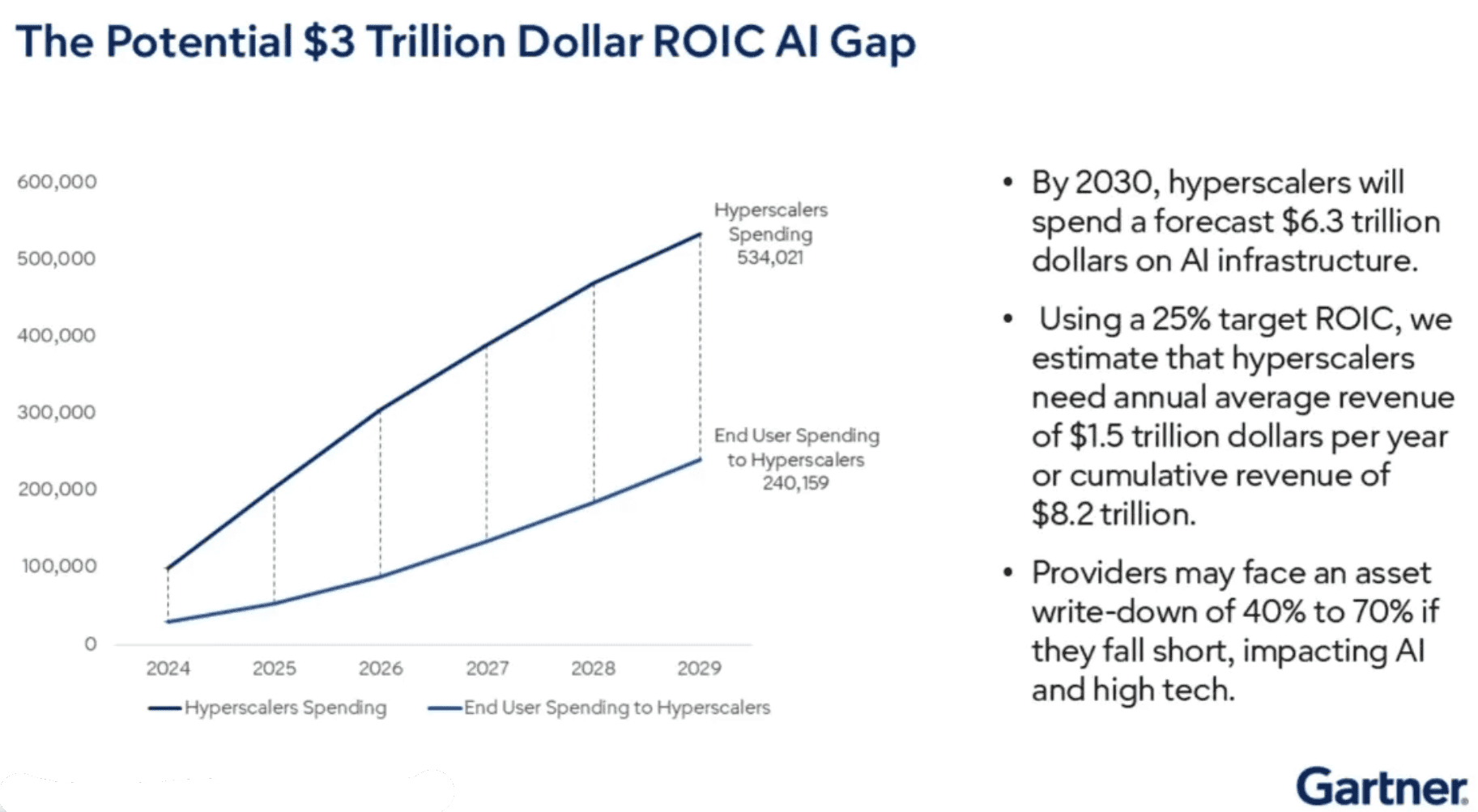
The growth trajectory of AI investment is further underscored by market research firms. Gartner, a leading technology research and advisory company, forecasts that global spending on AI will reach a colossal $6.3 trillion by 2030. This projection paints a picture of sustained, exponential growth in AI-related expenditures over the next decade.
The Economic Imperative for Price Increases
The substantial capital investments necessitate a commensurate return on investment. As many AI companies, including emerging players like Anthropic and OpenAI, prepare for or undergo public offerings, they face intense pressure from Wall Street to demonstrate profitability. This pressure translates into a need for positive gross margins, a metric that many are striving to achieve.
Companies Seeking Profitability:
With Anthropic reportedly nearing positive gross margins and OpenAI also under scrutiny, these companies are likely to leverage their pricing power. The current pricing models, which may have been designed to incentivize early adoption, are expected to evolve. Similarly, established enterprise software giants such as SAP, Workday, Oracle, Salesforce, and Adobe, which are integrating AI into their offerings, will also be keen to showcase their AI-driven revenue streams and profitability to investors. This collective drive for financial performance is a significant factor contributing to the upward pressure on AI service costs.
Shifting Pricing Models and Customer Impact:
The Information has reported on Anthropic’s strategic shift in pricing. The company has moved away from flat-fee structures for enterprise customers, opting instead for a usage-based model that charges based on the volume of AI consumed. This change, particularly for heavy users of Anthropic’s Claude products, is expected to lead to significantly higher bills. The adoption of new technologies like advanced tokenizers, which enhance the efficiency and capability of AI models, can also contribute to increased operational costs, which are then passed on to the customer.
Customer Reactions and Adaptation:
This evolving pricing landscape is already prompting businesses to re-evaluate their AI strategies. Reports indicate that Chief Information Officers (CIOs) and Chief Human Resource Officers (CHROs) are discussing the rising costs of AI tools. Some businesses are reportedly considering outsourcing AI-related tasks to regions with lower labor costs, such as India, as a direct response to escalating AI expenses.
Eric Johnson, CIO at PagerDuty, a company specializing in helping software engineers manage technical outages, expressed his anticipation of volatile costs as his 1,200 employees begin integrating AI tools from companies like Anthropic into their software development workflows. "I am preparing myself to be surprised by the bills," Johnson stated. "We believe that there’s a lot of value here. Unfortunately, it’s fairly new technology, so there’s some open questions that we’re going to be working through around its costs and getting a return on the investment." This sentiment reflects a broader industry concern about the predictability and manageability of AI expenditures.
The Price-Performance Battle:
While the trend points towards rising costs, there are also competitive forces at play that aim to offer better value. Google’s recent announcement of Gemini 3.5 Flash, touted as being significantly less expensive than competitor models like Opus 4.7, signals the beginning of a direct battle for price-performance in the AI market. This competition is crucial for businesses seeking to balance the benefits of AI with their budgetary constraints.
Quantifying the Price Surge: A Trillion-Dollar Revenue Gap
The sheer scale of investment necessitates a substantial increase in revenue generation to achieve a reasonable return. Analyses suggest that the AI industry will need to generate an additional trillion dollars in revenue annually to sustain a 15% compound return over a five-year depreciation period. This figure is considered a conservative estimate, with actual requirements potentially being higher, especially considering the profit margins AI companies aim to achieve.
Sources of New Revenue:
This massive revenue influx is expected to be sourced from various channels, including consumers and advertising, as well as businesses.
-
Consumer and Advertising: The global internet advertising market currently stands at approximately $750 billion. To meet the AI revenue demands, it is conceivable that companies might significantly increase the volume of digital advertisements, potentially doubling the current ad spend. While this is a possibility, the economic viability and consumer acceptance of such a drastic increase in ad load remain questionable.
-
Enterprise Software: Global enterprise software spending is estimated to be around $1.2 trillion, according to Gartner. The AI industry could potentially aim to double this figure through AI-powered solutions and services. This implies a significant shift in how businesses procure and utilize software, with AI becoming an increasingly integrated and potentially more expensive component.
The Economic Equation for Businesses and Consumers:
Regardless of the specific revenue streams, the economic reality points towards consumers and businesses paying substantially more for digital services. The expectation is that enterprise software costs could double, or consumers might face significantly higher costs for digital advertising and related services. While other revenue sources, such as government contracts for defense and research, and new markets for bio-research and energy, will contribute, the core burden is likely to fall on the broader consumer and business markets.

Challenging the "Moore’s Law" of Computing Costs:
The notion that computing power consistently becomes cheaper, often associated with Moore’s Law, may not hold true in the immediate future for AI. The substantial investment in specialized hardware and infrastructure suggests that the cost of accessing advanced AI capabilities will likely remain high, at least in the short to medium term.
Historical Perspective on Computing Costs:
To contextualize, the original IBM PC, released in 1981 with a price tag of $1,565 (equivalent to roughly $5,700 today when adjusted for inflation and without a hard disk), was a significant investment. Modern personal computers, while offering vastly more power and features, often retail around $3,000, and this cost is frequently bundled with smartphones and other devices. This suggests that while the cost of computing hardware has evolved, the overall "cost of computing" for an individual has not necessarily seen a dramatic decrease over the past 45 years, especially when considering the broader digital ecosystem.
The Need for Tangible Benefits:
The significant expense associated with AI necessitates demonstrable productivity gains, health improvements, or other tangible benefits that have not yet been fully realized or quantified. Companies like Oracle, Microsoft, and Workday are not merely seeking to replace existing revenue streams with AI; they are actively pursuing growth. Similarly, tech giants such as Google, Meta, SpaceX, Amazon, and Apple are all investing in AI with the explicit goal of expansion and market leadership.
The Inevitable Conclusion: Higher AI Prices
The confluence of massive capital investment, the drive for profitability among AI providers, and the economic realities of infrastructure costs strongly suggests an upward trend in AI pricing. While competition and technological advancements may offer price-performance improvements over time, the immediate future points towards a significant increase in the cost of accessing and utilizing advanced AI tools and services. Businesses and consumers alike should prepare for a landscape where AI is no longer a perpetually cheap commodity, but rather a valuable, and increasingly expensive, strategic asset. This shift will likely spur innovation in cost optimization, the development of more efficient AI models, and a critical re-evaluation of how AI’s value is measured and delivered across various sectors of the global economy. The era of accessible, low-cost AI is giving way to a more mature, and more costly, phase of its evolution.