
Artificial intelligence has fundamentally reshaped the landscape of talent acquisition by 2026. What began as AI-assisted workflow tools, designed primarily to recommend candidates, flag biases in job descriptions, or draft initial job postings, has undergone a profound evolution. The current generation of "agentic AI" tools now operates with a remarkable degree of autonomy, capable of initiating outreach to candidates, conducting preliminary screenings via sophisticated voice or chat interfaces, and even scheduling interviews without direct human intervention from a recruiter. This shift represents a significant leap from augmentation to active agency, redefining efficiency and scale in the hiring process.
This burgeoning autonomy, however, is not without its commensurate responsibilities. The rapid advancements in AI have necessitated the introduction of stringent regulatory frameworks. Landmark legislation, such as the European Union’s AI Act, alongside a mosaic of emerging U.S. state-level regulations, now comprehensively govern the ethical deployment and operational parameters of AI in critical hiring decisions. Consequently, organizations adopting these advanced tools are compelled to navigate a complex legal and ethical topography, understanding not merely the capabilities of the technology but also the precise legal boundaries within which they must operate. This dual imperative underscores a new era of accountability for HR and recruitment professionals.
The Evolution of AI in Talent Acquisition: A Brief Chronology
The journey to 2026’s agentic AI began in the early 2020s with foundational AI applications. Initially, these tools focused on streamlining administrative burdens, such as automated resume parsing, basic keyword matching, and rudimentary language analysis to identify potential bias in job advertisements. By the mid-2020s, AI had advanced to offer more sophisticated assistance, providing data-driven recommendations for suitable candidates, predicting success metrics, and automating initial candidate communications. This period saw a rise in "AI-powered assistants" that supported recruiters rather than replaced them.
The pivotal shift to "agentic AI" materialized as algorithms gained the capacity for independent decision-making within defined parameters and the ability to execute multi-step processes autonomously. This means an AI can now not only identify a potential candidate but also initiate a personalized outreach sequence, conduct a preliminary conversational screening to assess fit, and then autonomously schedule an interview based on the candidate’s and hiring manager’s availability, all while documenting the interactions for compliance. This progression highlights a move from predictive analytics and workflow automation to active, end-to-end process management.
Navigating the Regulatory Landscape: Transparency and Accountability
The acceleration of AI capabilities has naturally led to increased scrutiny from legislative bodies worldwide. The EU AI Act, a global benchmark, emphasizes high-risk AI systems, explicitly including those used in employment, worker management, and access to self-employment. Its provisions mandate strict requirements for risk management, data governance, human oversight, transparency, accuracy, and cybersecurity. For recruitment AI, this translates into obligations for clear documentation of how AI models are trained, regular bias audits, and mechanisms for human review and intervention in critical decisions.
In the United States, a patchwork of state-level legislation is emerging, with states like New York and Illinois pioneering regulations on AI in hiring, often focusing on transparency requirements, bias audits, and candidate notification. While a comprehensive federal framework is still under development, the trend is clear: organizations must be able to explain their AI’s decisions, demonstrate fairness, and provide robust audit trails. This regulatory environment necessitates that HR technology providers integrate "Governance" and "Audit-ready" features directly into their platforms, ensuring companies can comply with transparency laws and mitigate legal risks associated with algorithmic bias. The imperative is to prevent discrimination, ensure fairness, and maintain human accountability, even as AI takes on more autonomous roles.
Market Growth and Adoption: A Data-Driven Perspective
The widespread adoption of AI in HR functions is evident in recent industry reports. According to SHRM’s "The State of AI in HR in 2026" report, a significant 39% of organizations have already integrated AI into their broader HR functions. Within this landscape, recruiting stands out with the highest adoption rate, reaching 27%. This data underscores the perceived value and practical benefits AI brings to talent acquisition, making it a critical area of investment for many companies.
Furthermore, market projections reinforce this trend, indicating substantial future growth. Market Research Future has predicted that the AI recruitment industry, valued at USD 660.23 million in 2025, is on a trajectory to reach USD 1,289.13 million by 2035. This nearly doubling of market size within a decade reflects a sustained organizational commitment to leveraging AI for streamlined recruitment, enhanced candidate matching, and a significant reduction in time-to-hire metrics. The consensus is clear: AI is not merely a trend but a fundamental pillar of modern talent acquisition strategy.
Key Use Cases and Leading AI Hiring Tools in 2026
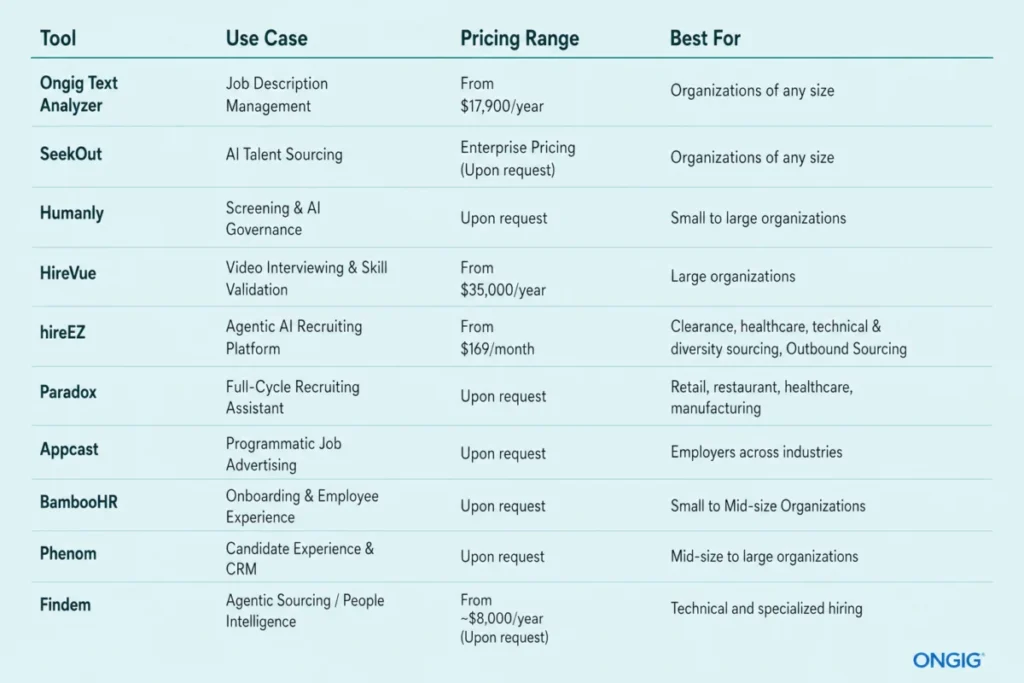
The versatility of AI in recruitment is showcased across a multitude of applications, addressing various challenges throughout the hiring lifecycle. From optimizing job descriptions to identifying niche talent and facilitating seamless onboarding, specialized AI platforms have emerged to cater to distinct organizational needs. Here, we examine ten prominent AI hiring tools making a significant impact in 2026, categorized by their primary use case:
1. Job Description Management: Ongig Text Analyzer
The challenge of crafting inclusive and effective job descriptions has been significantly simplified by tools like the Ongig Text Analyzer. This AI-powered platform excels at analyzing job descriptions for potential biases, gendered language, exclusionary terms, and industry-specific jargon, thereby enhancing clarity and appeal. Ongig’s core mission is to eliminate biased language, leveraging AI to quickly generate compliant job descriptions. Users simply input a job title, and the AI drafts a comprehensive description, ensuring it aligns with diversity and inclusion goals. The tool also identifies specific problematic phrases, such as age-biased terms, providing actionable suggestions for improvement. This focus on language integrity is crucial for attracting a diverse talent pool and ensuring equitable hiring practices across organizations of all sizes.
2. Candidate Sourcing: SeekOut
SeekOut has become an indispensable AI hiring tool for recruiting teams aiming to source qualified applicants efficiently. It boasts an expansive database comprising over 750 million public profiles, including more than 330 million underrepresented candidates and 127 million unique candidate profiles. A distinguishing feature of SeekOut in 2026 is its heavy emphasis on "Skills-Based Sourcing" and internal talent mobility, differentiating it from traditional professional networking platforms. Its "Recruit" product leverages AI to search this vast candidate pool, while "Spot" pairs AI agents with human recruiters to deliver interview-ready candidates, often within two weeks. This blend of AI-driven search and human curation ensures high-quality matches, saving recruiters substantial time and improving the caliber of hires for organizations of any size.
3. Candidate Screening: Humanly
Humanly stands out as an AI-powered, end-to-end hiring platform that covers sourcing, attraction, screening, and hiring. By 2026, it is particularly recognized for its "Governance" and "Audit-ready" records, which are vital for adhering to new global AI transparency laws. Humanly’s machine learning capabilities enable it to engage in natural conversations with candidates as part of the screening process, handling "voice-to-data" conversions for initial phone screens and summarizing these interactions directly into an Applicant Tracking System (ATS). The platform significantly reduces time spent on repetitive tasks by leveraging AI to gather insights, schedule follow-up interactions, and send reminders. Its ability to join Zoom interviews and generate notes provides valuable analytical data for recruiters across organizations of all sizes.
4. Interview Management: HireVue
HireVue maintains its position as a leading video interviewing software, particularly for large organizations with high-volume recruitment needs. In 2026, its focus has evolved to "Video Interview Analytics" that extend beyond mere transcription to "Actionable Skill Validation," allowing companies to hire based on demonstrated abilities rather than solely on credentials. The platform offers a comprehensive suite of hiring solutions, including AI-powered on-demand video interviews, video assessments, conversational AI, and advanced interview scheduling. Its "Explainable AI" features have seen significant enhancements to meet the transparency requirements of 2025/2026 global AI regulations concerning candidate scoring. HireVue’s asynchronous and live interview options provide a seamless mobile experience, complemented by job-specific interview guides developed by organizational psychologists, making it ideal for large enterprises managing complex hiring pipelines.
5. Outbound Recruiting: hireEZ
Positioning itself as an "Agentic AI Recruiting Platform" in 2026, hireEZ is an outbound hiring solution that scans over 100 million profiles to identify qualified applicants. It offers three core modules: Sourcing/CRM, Applicant Match, and Hiring Intelligence. This platform’s robust recruiting features include highly advanced market insights; by simply uploading a job description, users gain immediate access to labor market data, including candidate availability, salary ranges, and talent hotbeds. hireEZ also excels in diversity sourcing, allowing recruiters to filter for candidates from various backgrounds and identify underrepresented groups through university affiliations, diversity organization memberships, and pronoun usage. Its ability to craft targeted and automated outreach emails with high response rates makes it highly effective for specialized sourcing needs across various industries.
6. Automated Chatbots for Candidate Engagement: Paradox (Olivia)
Paradox, with its flagship product Olivia, has solidified its role as a full-cycle "Recruiting Assistant" in 2026, managing everything from initial applications to offer letters for high-volume roles. Olivia is an AI chatbot designed for natural, scalable conversations with applicants in over 100 languages. It autonomously schedules interviews across hundreds of calendars, handling complex timezone conversions without human intervention. The chatbot screens candidates against basic skills and qualifications, conducts initial interviews via web chat, SMS, Facebook Messenger, and WhatsApp, and then efficiently schedules follow-up interviews, managing rescheduling requests. Paradox’s AI carefully matches applicants with relevant job openings based on their expressed preferences and qualifications, making it invaluable for high-volume hiring in sectors like retail, healthcare, and manufacturing.
7. Programmatic Job Advertising: Appcast
Appcast is a leader in programmatic job advertising, serving over 2,000 customers. In 2026, it launched AppcastOne, an AI-powered system that predicts "Cost-per-Hire" before any advertising spend, offering unprecedented budget predictability. Appcast’s intelligent programmatic technology helps organizations identify qualified potential applicants by leveraging a comprehensive hiring marketing system. AppcastOne integrates search engines, automated advertising, traditional media, and social media to connect with both active and passive job seekers. Operating in over 100 countries and reaching more than 30,000 job boards, Appcast offers a cost-effective model where employers pay only when candidates apply, making it a flexible solution for diverse employers across various industries.
8. Employee Onboarding: BambooHR
BambooHR remains a top AI recruitment platform designed to simplify the entire hiring process, from initial recruitment to payroll and comprehensive onboarding. Its onboarding module offers extensive customization options for every new employee, breaking down workflows by specific job role, location, and department. The platform automates various onboarding tasks, assigning responsibilities to new hires, managers, and supporting colleagues. Key features include digital welcome emails, pre-boarding packages, e-signatures, and IT checklists, all complemented by robust personalization tools. This automation eliminates traditional paper-based processes, enabling new employees to become productive almost immediately, making BambooHR a valuable asset for organizations of all sizes seeking efficient and engaging onboarding experiences.
9. Talent Experience Management: Phenom
Phenom provides a unified talent experience platform that spans the entire candidate journey, encompassing career sites, AI chatbots, and a CRM. Research from CareerPlug highlights that 66% of candidates report a positive hiring experience influenced their decision to accept an offer, underscoring the importance of smooth communication. Phenom addresses common pain points like poor communication, vague job expectations, and "radio silence" between hiring stages. The platform’s career site uses AI to surface relevant roles to visitors based on their background, while its chatbot continues the conversation, screening candidates and answering questions. The integrated CRM allows recruiters to manage relationships over time, ensuring strong candidates are not lost. Phenom’s continuity across the candidate journey is crucial for hiring teams struggling with drop-offs between application and offer acceptance, benefiting organizations of any size.
10. Agentic Sourcing / People Intelligence: Findem
Findem’s "Agentic Sourcing" has emerged as the 2026 gold standard for identifying technical talent, establishing itself as a leader in People Intelligence. Findem utilizes "3D data" to track a candidate’s career trajectory and predict future performance, enabling "hyper-personalized" sourcing. The platform aggregates data from hundreds of sources to construct a comprehensive 3D view of each candidate, revealing not just their current role but their career progression and future potential. This is particularly valuable for technical roles where growth patterns often convey more insight than current job titles. Findem’s agentic sourcing autonomously identifies, scores, and ranks candidates, allowing recruiters to focus on strategic decisions rather than manual searching. The platform also facilitates more targeted outreach by providing deeper context on each candidate, leading to higher response rates for organizations with ongoing technical and specialized hiring needs.
Strategies for Successful AI Implementation in Recruitment
Integrating AI hiring tools effectively requires a strategic and measured approach. Organizations must consider several key strategies to ensure a smooth transition and maximize the benefits of these advanced technologies:
- Define Clear Goals: Before adopting any AI tool, clearly articulate the specific hiring challenges it is intended to solve. Whether it’s reducing time-to-hire, improving candidate quality, or enhancing diversity, well-defined objectives guide selection and implementation.
- Pilot Programs and Iteration: Start with pilot programs in specific departments or for particular job roles to test the AI tool’s effectiveness and identify areas for improvement. This iterative approach allows for adjustments before a full-scale rollout.
- Stakeholder Engagement: Involve recruiters, hiring managers, IT, and legal teams from the outset. Their input is crucial for successful adoption, addressing concerns, and ensuring alignment with organizational culture and compliance requirements.
- Ethical Guidelines and Bias Audits: Establish clear ethical guidelines for AI use in hiring. Regularly conduct independent bias audits of AI algorithms to ensure fairness and prevent discriminatory outcomes, aligning with regulatory mandates.
- Robust Training and Upskilling: Provide comprehensive training for recruiters and hiring managers on how to effectively use AI tools, interpret their outputs, and integrate them into existing workflows. Emphasize the importance of human oversight.
- Continuous Monitoring and Evaluation: Implement systems for ongoing monitoring of AI tool performance, tracking key metrics, and gathering feedback from users and candidates. This ensures the tools remain effective and compliant.
- Data Privacy and Security: Prioritize data privacy and security protocols, especially when handling sensitive candidate information. Ensure AI tools comply with global data protection regulations like GDPR and CCPA.
- Maintain Human Oversight: Despite the advancements in agentic AI, emphasize that the ultimate hiring decision must remain with a human. AI should augment human judgment, not replace it, ensuring empathy, nuance, and strategic alignment in hiring.
The Indispensable Human Element
As AI continues to revolutionize recruitment, the core principle of human oversight remains paramount. While AI tools excel at automating repetitive tasks, identifying patterns, and scaling processes, the qualitative assessment of cultural fit, nuanced communication, and strategic decision-making still require human intelligence and empathy. The industry consensus is clear: the most successful recruitment strategies in 2026 will integrate advanced AI capabilities with skilled human recruiters, fostering a collaborative ecosystem where technology enhances, rather than diminishes, the human touch. This ensures that organizations attract and hire not merely efficient "bots" for automated roles, but exceptional human talent capable of driving innovation and growth.






