Social Learning Theory, a cornerstone of psychological and educational frameworks, posits that individuals acquire new behaviors, skills, and attitudes primarily through the observation of others within a social context. Developed by the late psychologist Albert Bandura, this theory revolutionized the understanding of human development by suggesting that learning is not merely a product of direct experience or environmental conditioning but is deeply rooted in cognitive processes and social modeling. In the contemporary era, characterized by rapid digital transformation and decentralized work environments, Bandura’s insights have gained renewed significance, providing a blueprint for how organizations and educational institutions foster growth through peer interaction and observational modeling.
The Foundational Shift: From Behaviorism to Cognitive Social Learning
To understand the magnitude of Social Learning Theory (SLT), one must examine the psychological landscape of the mid-20th century. Before Bandura’s emergence, the field was dominated by behaviorists like B.F. Skinner, who argued that learning occurred strictly through operant conditioning—a system of rewards and punishments. Bandura challenged this narrow view, asserting that human beings possess the cognitive capacity to learn vicariously. By watching a "model"—whether a parent, teacher, or peer—individuals can internalize complex behaviors without ever receiving a direct reward or performing the action themselves.
This transition from strict behaviorism to a more nuanced cognitive-social approach allowed researchers to explain why people often adopt behaviors that have never been reinforced in their personal history. It introduced the concept that internal mental states are essential to the learning process, bridging the gap between how we perceive our environment and how we act within it.
A Chronology of Discovery: The Bobo Doll Experiment and Beyond
The empirical bedrock of Social Learning Theory was established in the early 1960s through the now-famous Bobo Doll experiments. Conducted at Stanford University between 1961 and 1963, these studies involved children observing adults interacting with an inflatable "Bobo" doll.
In the experimental group, children witnessed an adult model acting aggressively toward the doll—hitting it, shouting at it, and using a mallet. In the control group, the adult ignored the doll. When the children were later placed in a room with the same doll, those who had observed the aggressive model were significantly more likely to replicate the violent behaviors, often inventing new ways to be aggressive that the adult had not even demonstrated.
This chronology of research led to several critical conclusions that shaped modern psychology:
- Learning can occur without a change in behavior: Unlike behaviorists who believed learning only happened if a visible change occurred, Bandura proved that people could learn and retain information without immediately acting on it.
- The Role of Reinforcement: While direct reinforcement wasn’t necessary for learning, the expectation of reinforcement (vicarious reinforcement) influenced whether the behavior would be performed.
- Identification: Individuals are more likely to imitate models they perceive as similar to themselves or as possessing high status or expertise.
In 1977, Bandura published his seminal work, Social Learning Theory, which codified these findings into a comprehensive framework. By 1986, he expanded this into Social Cognitive Theory (SCT), placing a greater emphasis on the "cognitive" element—how our thoughts, beliefs, and expectations interact with our environment.
The Five Core Principles: The Mechanics of Observational Learning
Social Learning Theory operates through five essential stages that dictate whether an observed behavior will be successfully adopted. For Learning and Development (L&D) professionals, these principles serve as a checklist for designing effective training programs.
1. Observational Learning (Modeling)
This is the fundamental premise that individuals learn by watching others. In a corporate setting, this manifests as "shadowing," where a junior employee observes a senior leader’s negotiation tactics or technical troubleshooting.
2. Attention
Learning cannot occur if the observer is not focused. Bandura noted that attention is influenced by the distinctiveness of the behavior, the perceived value of the model, and the observer’s own sensory capacities. In the age of digital distraction, capturing a learner’s attention is the primary hurdle for any educational initiative.
3. Retention
Once attention is secured, the learner must store the information in their memory. This involves mental coding and symbolic rehearsal. Retention is often strengthened in modern workplaces through the use of "micro-learning" modules or follow-up discussions that force the brain to recall and reinforce the observed data.
4. Reproduction
This is the physical or mental ability to perform the behavior. A person might watch a master pianist and pay perfect attention, but without the underlying skills (manual dexterity, knowledge of scales), they cannot reproduce the behavior. In professional settings, this necessitates a transition from "watching" to "doing" under guided supervision.

5. Motivation
The final stage is the will to perform the behavior. Motivation is driven by reinforcements—either direct (a bonus for good performance), vicarious (seeing a colleague get promoted), or self-produced (internal satisfaction). If the perceived rewards do not outweigh the costs, the behavior will not be replicated.
Social Cognitive Theory vs. Social Learning Theory: Understanding the Distinction
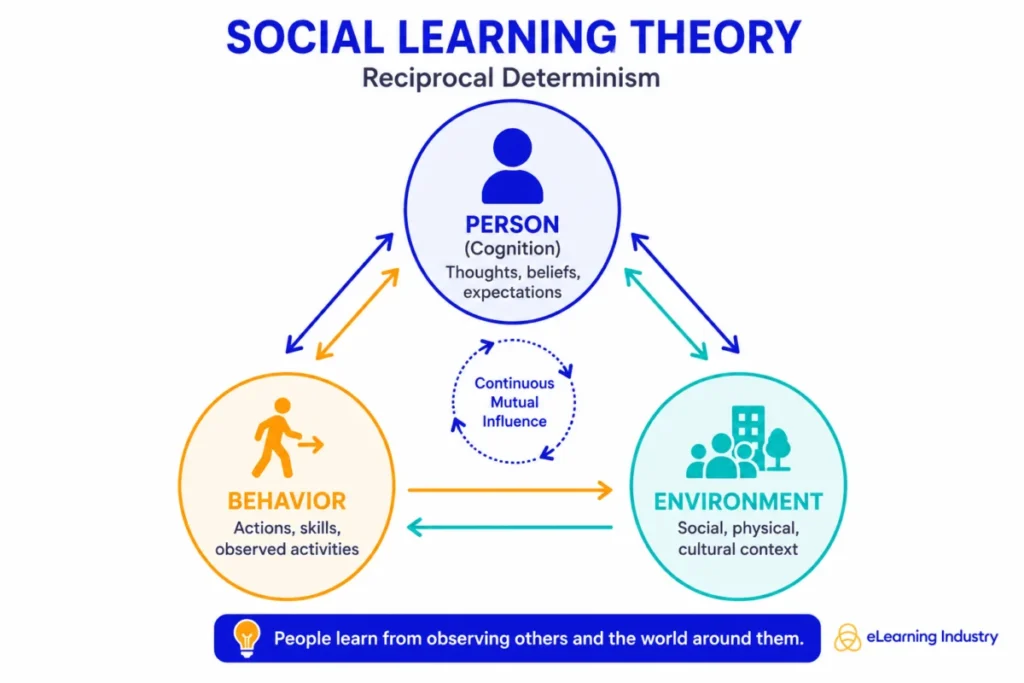
While the terms are often used interchangeably, there is a distinct evolution between Bandura’s 1977 theory and his 1986 expansion. Social Learning Theory focuses heavily on the social environment and the act of modeling. Social Cognitive Theory (SCT), however, introduces the concept of Reciprocal Determinism.
Reciprocal Determinism suggests that there is a three-way, dynamic interaction between:
- The Person: Their cognitive processes, personality, and beliefs.
- The Behavior: The actual actions performed and their consequences.
- The Environment: The physical and social surroundings.
A key component of SCT is Self-Efficacy—an individual’s belief in their own capability to organize and execute the courses of action required to manage prospective situations. High self-efficacy is a predictor of success in both academic and professional spheres, as it influences how much effort a person will expend and how long they will persist in the face of obstacles.
Industry Applications: Social Learning in the Modern Workplace
Data suggests that formal training accounts for only a small fraction of how employees actually acquire job-related skills. The "70:20:10" Model for Learning and Development—developed by Morgan McCall, Michael M. Lombardo, and Robert A. Eichinger—states that 70% of knowledge comes from job-related experiences, 20% from interactions with others (social learning), and only 10% from formal educational events.
Leadership Development
Organizations are increasingly moving away from "lecture-style" leadership retreats in favor of mentorship and coaching programs. By pairing emerging leaders with established executives, companies leverage Social Learning Theory to pass down "soft skills" such as emotional intelligence and conflict resolution, which are difficult to teach in a classroom setting.
Onboarding and Culture
New hires often experience "onboarding fatigue" when faced with hours of video modules. To combat this, many tech firms use "buddy systems." By observing how their "buddy" interacts with the team, handles Slack communications, and manages their time, the new hire absorbs the company culture through social modeling far more effectively than through a handbook.
Digital and eLearning
The rise of Learning Management Systems (LMS) that incorporate social features—such as discussion boards, "like" buttons, and peer-review capabilities—is a direct application of Bandura’s theory. In virtual spaces, seeing a peer’s insightful comment on a module serves as a model for other learners, encouraging a higher standard of engagement.
Implications and Analysis: The Challenges of a Decentralized World
As the global workforce shifts toward remote and hybrid models, the "environmental" aspect of Social Learning Theory faces new challenges. In a traditional office, "passive" social learning occurs naturally; an employee might overhear a manager de-escalating a difficult client call and subconsciously store those techniques.
In a remote environment, these "organic" modeling opportunities are lost. This has led to what some analysts call "proximity bias" or "knowledge silos." To mitigate this, forward-thinking organizations are intentionally creating digital "social spaces." This includes:
- Working in Public: Using collaborative tools like Notion or GitHub where the process of problem-solving is visible to the entire team.
- Recorded Sessions: Encouraging leaders to record their "thought processes" during complex tasks to provide a model for juniors to watch asynchronously.
- Cohort-Based Learning: Moving away from solo eLearning toward group-based courses where students must interact and observe each other’s progress.
Conclusion: The Enduring Legacy of Albert Bandura
Albert Bandura’s Social Learning Theory remains one of the most influential frameworks in the history of psychology because it captures a fundamental truth about the human condition: we are social creatures who learn by looking at one another.
Whether in a 1960s classroom with a Bobo doll or a 2024 virtual reality training suite, the mechanics of attention, retention, and motivation remain constant. By understanding that learning is a socially distributed process, educators and business leaders can move beyond the limitations of formal instruction. They can instead build environments that foster observation, encourage healthy modeling, and empower individuals through the collective wisdom of the group. As we look toward an AI-integrated future, the human element of "modeling" behavior—conveying empathy, ethics, and nuanced judgment—will likely become the most critical application of Bandura’s timeless theory.