In a striking revelation from a recent Chief Executive survey, chief executive officers across the United States are articulating a clear vision for future corporate success: a strategic pivot towards expansion into new categories, markets, and offerings. This forward-looking sentiment, however, starkly contrasts with the current reality for many, as the bulk of their revenue continues to be generated by products and services that have been part of their portfolio for at least five years. This dichotomy presents a significant challenge for businesses navigating an increasingly dynamic and disruptive global economic landscape.
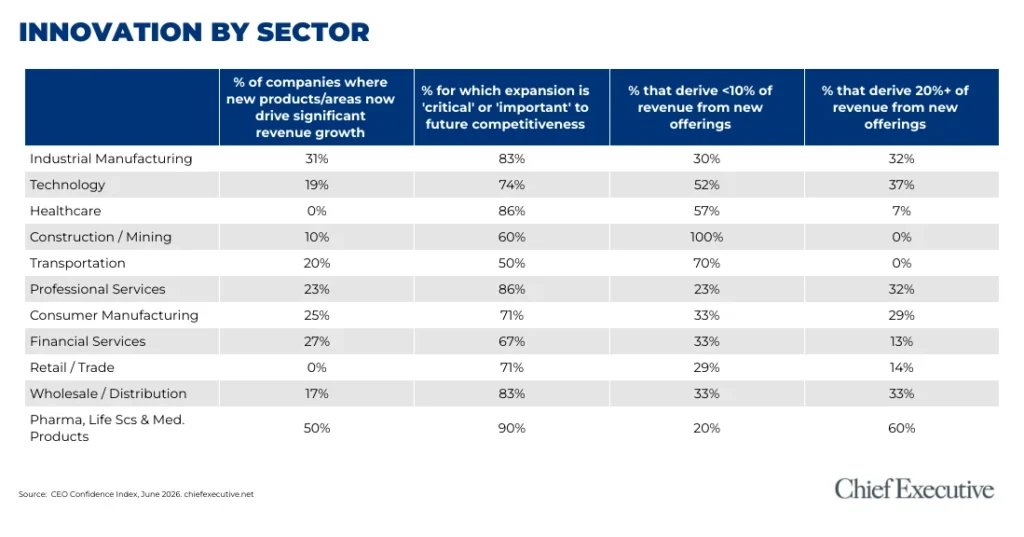
The survey, which polled 315 U.S. CEOs, found a pronounced dependence on legacy revenue streams. A substantial 58 percent of respondents indicated that less than 10 percent of their company’s current revenue originates from products or services introduced within the last half-decade. Further underscoring this trend, only about one in four CEOs reported that at least 20 percent of their revenue now stems from these newer ventures. This data suggests a widespread inertia, where established revenue models remain the bedrock of financial performance, even as leadership acknowledges the imperative for innovation.
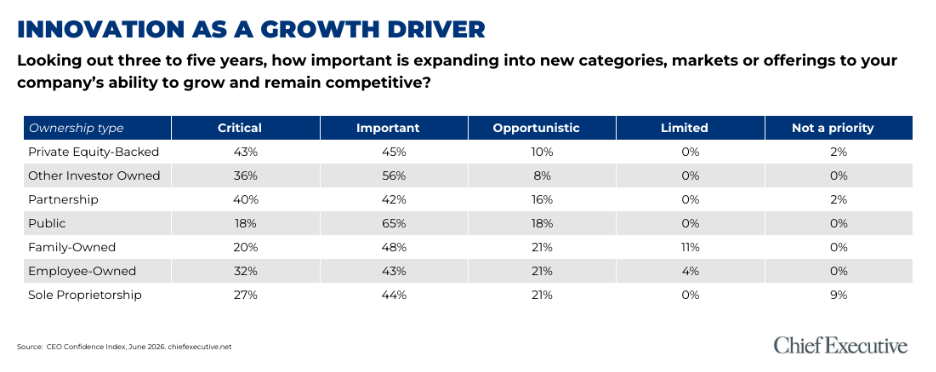
Despite this reliance on existing offerings, the aspiration for future growth is palpable among corporate leaders. Looking ahead over the next three to five years, a commanding 77 percent of CEOs identified expansion into new categories, markets, or offerings as either "critical" or "important" for their company’s ability to grow and maintain a competitive edge. Nearly 30 percent of this group elevated the urgency, deeming such expansion "critical." This indicates a strategic awareness of the evolving market demands and competitive pressures, even if the translation of this awareness into current revenue generation is lagging.
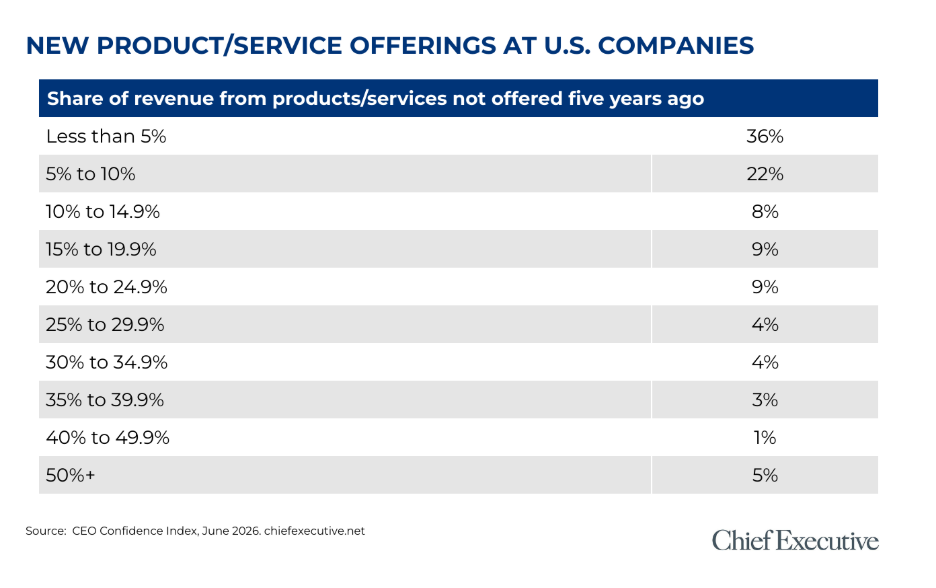
The survey also probed the actual implementation of these expansion strategies over the past five years. The findings mirrored the revenue dependency, with only 22 percent of CEOs reporting that moves into new sectors, customer categories, markets, or use cases have become a "significant source of revenue or growth." A more substantial segment, 43 percent, acknowledged entering new areas but noted that these efforts have yielded only "limited impact on revenue." This gap between strategic intent and realized revenue underscores the complexities and challenges inherent in driving meaningful innovation and diversification.
The Accelerating Pace of Disruption
The imperative for CEOs to embrace new avenues of growth is amplified by the rapidly changing technological and competitive landscape. Advancements in technologies such as artificial intelligence (AI) are not merely incremental improvements; they are fundamentally compressing product cycles and unlocking entirely new use cases that were previously unimaginable. This technological acceleration means that companies cannot afford to remain static. Competitive threats are no longer confined to direct rivals; they are increasingly emerging from adjacent industries, disruptive business models, and agile startups that redefine customer problems altogether.
Mark Grosskopf, CEO of New Resources Consulting, articulated this urgency in a statement that resonated with the survey’s findings: "AI will have a very large impact much sooner than most expect… all need a plan to address their business model." This sentiment highlights the critical need for proactive adaptation, suggesting that companies that fail to evolve their business models in response to emerging technologies like AI risk being left behind. The historical reliance on established revenue streams may become a significant vulnerability in an era of rapid technological advancement.
Investment in Innovation: A Modest but Growing Commitment
While the strategic emphasis on future expansion is clear, the financial commitment to research and development (R&D) paints a more nuanced picture. The survey reveals that R&D spending, as a percentage of net revenues, varies considerably among U.S. companies. In 2025, R&D costs averaged 8.8 percent of net revenues, with a forecast of 9.4 percent for 2026. This represents an increase from prior readings of 7 percent in 2023 and 6 percent in 2024, as detailed in Chief Executive’s Financial Performance Benchmarks Report for U.S. Companies.
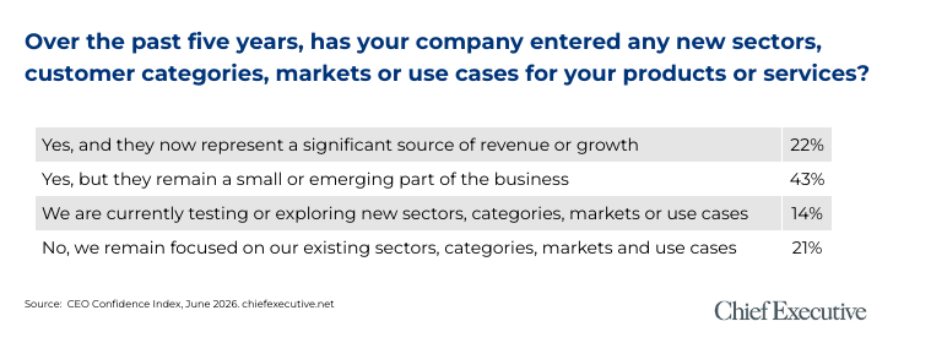
However, these averages warrant careful interpretation. They can be significantly skewed by early-stage or technology-oriented companies that, by their nature, have lower revenue bases and consequently higher development costs relative to their income. The median response, which provides a more representative figure for the typical company, was notably lower: 5 percent for both 2025 and 2026. This suggests that for a considerable number of businesses, formal R&D expenditures remain a relatively modest component of their overall revenue, potentially indicating a cautious approach to significant upfront investment in innovation.
Ownership Structure and Expansion Propensity
A significant differentiator in the survey’s findings was the type of ownership structure. Private equity (PE)-backed companies emerged as the most expansion-oriented segment. Nearly one-third of PE-backed CEOs reported that new sectors, categories, markets, or use cases have become a significant source of revenue or growth. Furthermore, an impressive 88 percent of these CEOs believe that future expansion into new categories, markets, or offerings will be critical or important for their company’s competitiveness. This aggressive stance from PE-backed firms likely reflects their inherent mandate for growth and value creation within defined investment horizons.
In contrast, family-owned companies demonstrated a more conservative approach. They were less likely to report significant revenue generation from new ventures and also less inclined to consider future expansion as critical or important. Taymi Marrero, CEO of manufacturer Ground Power Parts, voiced a concern that encapsulates this divergence: "As a small business owner for over 10 years, the biggest challenge I see in the future is big Corps taking over market share and leaving little to no opportunity for growth recovery and expansion for smaller family-owned companies. That is where our country is headed in almost every sector." This perspective highlights a potential struggle for smaller, family-owned businesses to compete with the scale and resources of larger, more expansion-focused entities, particularly in the face of evolving market dynamics.
Sectoral Variations in Innovation and Growth
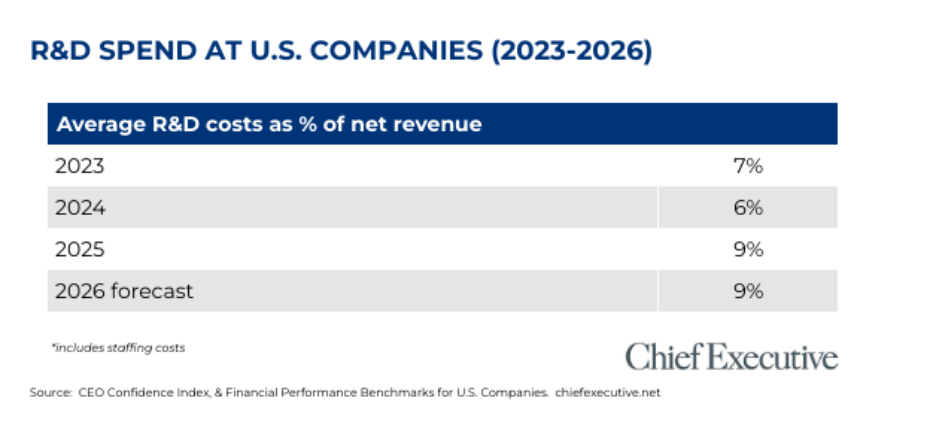
The survey also revealed distinct patterns in innovation and expansion across different industry sectors. Industrial manufacturing, the largest industry group represented in the survey, showed a notable propensity for innovation. A substantial 31 percent of CEOs in this sector reported that expansion into new areas had become a significant source of revenue or growth, surpassing the overall survey average of 22 percent. Moreover, more than eight in ten industrial manufacturing CEOs believe that future expansion is critical or important for competitiveness. This suggests a sector that is actively adapting and seeking new avenues for growth, potentially driven by global supply chain shifts and technological integration.
Companies within the technology, software, and telecommunications sectors also exhibited strong innovation metrics. These firms reported higher R&D spending as a share of revenue and were more likely than the overall group to indicate that at least 20 percent of their revenue originated from offerings introduced in the past five years. This aligns with the inherent nature of these industries, which are characterized by rapid technological advancements and a constant drive for new product development.
However, the picture in other sectors was less optimistic. In healthcare, none of the surveyed CEOs reported that expansion into new sectors, customer categories, markets, or use cases had become a significant source of revenue or growth. Despite this, a high 86 percent acknowledged that such expansion will be critical or important going forward, highlighting a significant gap between perceived future needs and current realized success. Similarly, in the construction and mining sectors, CEOs reported that less than 10 percent of their revenue comes from products or services not offered five years ago, indicating a more mature or slower-evolving market.
Implications and the Path Forward
The findings of the Chief Executive survey present a complex portrait of American business leadership. On one hand, there is a clear recognition of the strategic necessity of innovation and expansion. On the other hand, the present revenue streams remain heavily anchored in established offerings, and the translation of ambitious future plans into tangible current results is proving to be a significant challenge for many.
The widening gap between the perceived importance of future growth through new ventures and the current revenue contribution from these areas poses a critical strategic question for CEOs. Are companies investing sufficiently in the R&D and market development required to achieve these future goals? Or are they caught in a cycle of optimizing existing, profitable business lines, potentially at the expense of long-term adaptability?
The contrasting performance of different ownership structures, particularly the aggressive expansion of PE-backed firms, suggests that capital availability and a specific growth mandate can significantly influence a company’s approach to innovation. Family-owned businesses, while often possessing deep market knowledge and customer loyalty, may face unique hurdles in accessing the capital and resources needed to pivot and diversify at the pace required by today’s economy.
The sectoral variations further highlight that the challenges and opportunities of innovation are not uniform. Industries characterized by rapid technological change, like tech and manufacturing, appear to be adapting more readily, while others, such as healthcare and construction, may require more targeted strategies and potentially greater external support to foster innovation and drive future growth.
As technologies like AI continue to reshape industries at an unprecedented speed, the ability of companies to successfully navigate this period of transformation will be paramount. The survey serves as a crucial diagnostic, indicating that while the destination – future growth through expansion – is widely agreed upon, the journey and the pace of progress are still very much in flux. The coming years will likely reveal which companies have been able to bridge the gap between strategic vision and operational execution, ultimately determining their long-term viability and success in an ever-evolving global marketplace.