The efficacy of an organization’s talent acquisition strategy hinges significantly on the quality and management of its job descriptions (JDs), yet a substantial number of companies continue to grapple with inefficient, manual, and decentralized JD processes. This systemic disorganization, often characterized by JDs scattered across shared drives, outdated folders, and convoluted email threads, leads to a myriad of operational challenges, including chaotic approvals, painful collaboration, and arduous feedback loops. The consequence is not merely administrative friction but a direct impediment to attracting qualified candidates, ensuring compliance, and fostering an inclusive employer brand. Recognizing this critical gap, platforms like Ongig are emerging as essential tools to centralize and automate the entire JD lifecycle, transforming what was once a cumbersome chore into a strategic asset.
The Pervasive Challenge of Job Description Management
For many organizations, the creation and management of job descriptions remain surprisingly analog in a digital age. Recruiters and hiring managers often default to general writing tools like Google Docs or Microsoft Word, lacking the specialized functionalities required for modern talent acquisition. This manual approach inherently lacks content guidance beyond basic grammar checks, failing to flag discriminatory language or optimize for readability and search engine visibility. The result is often JDs that are vague, inconsistent, and unintentionally exclusionary, failing to resonate with desired candidate pools and instead attracting a mismatch of applicants.
Industry analyses frequently highlight the hidden costs associated with such inefficiencies. Studies suggest that recruiters can spend upwards of 20-30% of their time on administrative tasks related to JD management, diverting valuable resources from strategic candidate engagement. Furthermore, a poorly constructed JD can lead to a prolonged time-to-hire, increased recruitment costs due to repeated advertising, and a higher rate of mis-hires, which some estimates place at 1.5 to 3 times the employee’s annual salary. The absence of a central repository means version control becomes a nightmare, making it difficult to track changes, ensure consistency across similar roles, or quickly update JDs in response to evolving business needs or legal requirements.
Ongig’s Holistic Approach to JD Streamlining
Ongig positions itself as a comprehensive solution designed to address these multifaceted challenges by centralizing and automating the entire job description process. By moving beyond generic document editors, Ongig offers a specialized platform that integrates AI-powered creation, content optimization, structured workflows, and a unified library, thereby enhancing efficiency, ensuring compliance, and improving candidate attraction. The platform’s capabilities span the entire JD lifecycle, from initial drafting to final publication and ongoing maintenance, providing a single source of truth for all job-related information.
Key Pillars of Ongig’s JD Management Platform
1. Automated Creation and Content Optimization:
One of the most significant advancements offered by Ongig is its automated job description creator. Instead of starting from a blank page or a generic template, users can leverage AI to generate an initial draft based on role requirements. This foundational draft is then subjected to Ongig’s optimization features, which analyze content for clarity, conciseness, and effectiveness. Recruiters receive intelligent recommendations on sentence structure, word choice, and overall readability. For instance, the system might suggest shortening overly complex sentences, replacing jargon with more accessible terms, or refining job titles to be more descriptive and inclusive. This not only dramatically reduces the time spent on initial drafting but also ensures a higher quality output from the outset, aiming to attract a broader and more qualified candidate pool.
2. Ensuring Effective and Inclusive Language:
The language used in job descriptions profoundly impacts who applies and how an organization is perceived. Discriminatory or biased language, even if unintentional, can deter diverse candidates and undermine an organization’s commitment to diversity, equity, and inclusion (DEI). Ongig’s Text Analyzer is engineered to identify and mitigate bias related to gender, race, age, and other protected characteristics. It goes beyond simple grammar checks, flagging problematic phrases like "rockstar" or "hitting the ground running" which, while seemingly innocuous, can create ambiguity or subtly favor certain demographic groups. By providing real-time feedback and suggesting inclusive alternatives, Ongig empowers users to craft JDs that are welcoming, clear, and compelling to a diverse audience, thereby expanding the candidate pipeline and strengthening the employer brand. This proactive approach helps organizations avoid the legal pitfalls associated with non-compliant language and fosters a more equitable hiring process.
3. Controlled Approval Workflows:
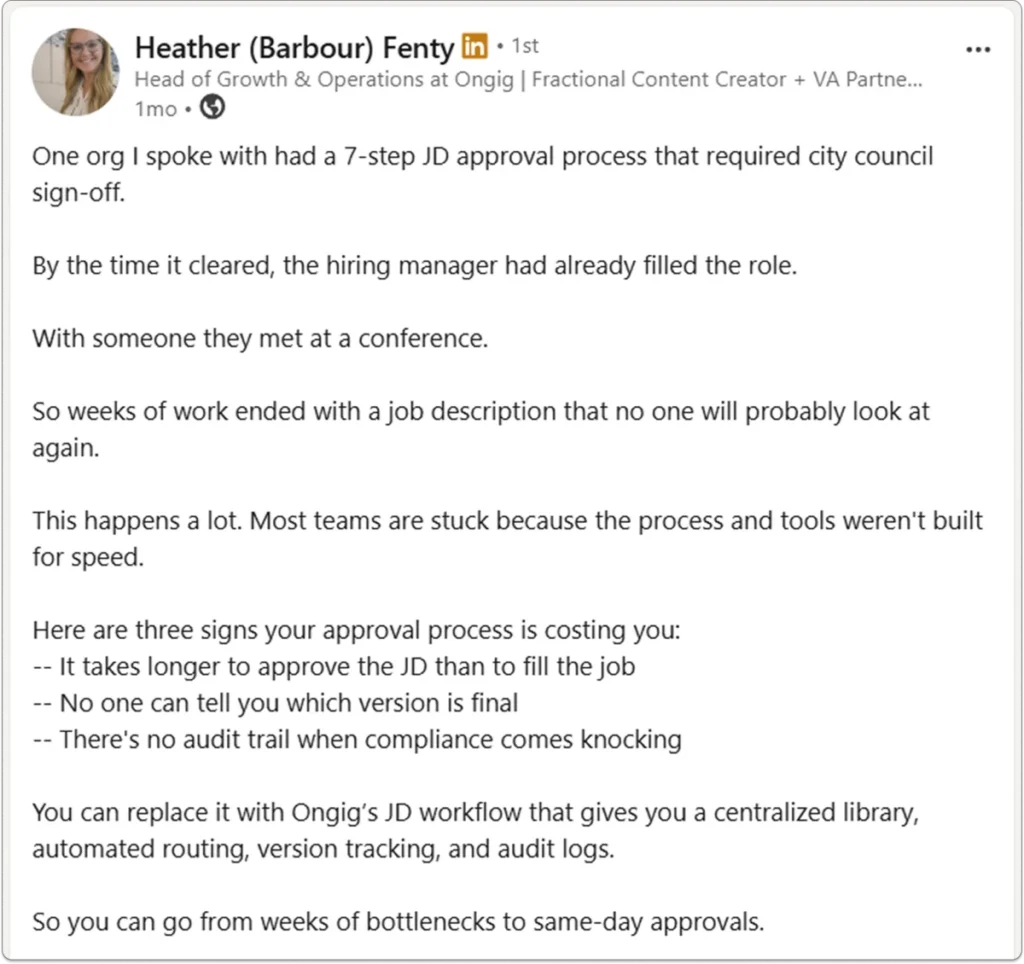
The approval process for job descriptions often involves multiple stakeholders, including recruiters, hiring managers, DEI teams, and legal compliance officers. Without a structured workflow, this can quickly devolve into a bottleneck, leading to delays and confusion. Ongig introduces a controlled JD approval process that provides clear visibility into who needs to approve, who has approved, and where the document stands in the review cycle. This transparency eliminates guesswork and ensures accountability, significantly reducing approval times. Customizable workflows can be configured to reflect an organization’s specific approval hierarchy, ensuring that all necessary checks and balances are met before a JD is published. This systematic approach minimizes the risk of unapproved content going live and ensures that all internal stakeholders have provided their necessary input, preventing costly errors or delays downstream.
4. Centralized, Searchable JD Library:
A fragmented approach to JD storage across disparate systems like Google Drive, local folders, or email attachments creates a chaotic and inefficient environment. Ongig addresses this by providing a searchable, centralized cloud library for all job descriptions. This single source of truth eliminates the need for manual searching and ensures that everyone is working from the most current and approved version of a JD. The library’s robust search functionality allows users to quickly locate JDs by role, department, keywords, or status, dramatically improving access and retrieval times. Furthermore, this centralization facilitates easier auditing and reporting, offering insights into JD creation patterns, approval bottlenecks, and overall content quality across the organization. This capability is particularly vital for large enterprises managing hundreds or thousands of unique job descriptions.
5. Enhancing Collaborative Efforts:
Job description creation is inherently a collaborative process, requiring input from various departments. Traditional methods often involve endless email chains, conflicting edits, and difficulty tracking feedback. Ongig streamlines collaboration by providing a unified platform where all communication, suggestions, and edits are consolidated. Team members can easily comment, suggest changes, and review revisions within the system, eliminating the need to toggle between different tools or decipher disparate feedback. This integrated approach ensures that all stakeholders are aligned, feedback is clear, and the JD evolves efficiently through its various stages. The platform acts as a digital workspace where collective intelligence can be harnessed to produce the most effective job descriptions.
6. Robust Version Control:
The absence of effective version control is a common pain point in manual JD management. It leads to confusion over the "latest" document, difficulty in understanding who made which changes, and challenges in reconciling conflicting edits. Ongig’s software offers robust version control capabilities, automatically tracking every change made to a job description. Users can easily view the revision history, compare different versions, and revert to previous iterations if necessary. This meticulous record-keeping ensures transparency, accountability, and accuracy throughout the JD lifecycle. It safeguards against unintended alterations, facilitates auditing, and provides a clear audit trail, which is particularly important for compliance and legal scrutiny.
7. Fostering Standardization and Consistency:
Inconsistency in job descriptions can lead to confusion for candidates, internal stakeholders, and even legal departments. Varying terminology, formatting, or even the inclusion of essential information across similar roles can dilute an organization’s employer brand and complicate talent mapping. Ongig addresses this by boosting JD standardization. The platform allows organizations to enforce consistent templates, preferred terminology, and structural guidelines across all job descriptions. This ensures a unified voice, clear expectations, and a professional presentation across all hiring efforts. Standardization also simplifies bulk updates and ensures that all JDs reflect the organization’s current values, policies, and legal requirements, fostering clarity and operational efficiency.
8. Guaranteeing Compliance and Mitigating Risk:
Non-compliant job descriptions pose significant legal and reputational risks. Issues like discriminatory language, incorrect salary ranges, or non-adherence to labor laws can lead to hefty fines, legal disputes, and damage to an organization’s reputation. Ongig plays a crucial role in enhancing the creation of compliant JDs. Its Text Analyzer proactively identifies compliance risks, such as problematic phrasing, legal ambiguities, or omissions of required disclaimers. By integrating compliance checks directly into the creation process, Ongig helps organizations stay on the right side of employment laws and industry regulations. This proactive risk mitigation not only protects the organization from potential legal challenges but also ensures that JDs are fair, transparent, and legally sound, thereby strengthening candidate trust and engagement.
Beyond the Direct Benefits: Broader Organizational Impact
The ripple effects of streamlining job description processes extend far beyond mere administrative convenience. By adopting sophisticated JD management software, organizations can anticipate:
- Improved Candidate Experience: Clear, inclusive, and well-structured JDs provide candidates with a positive first impression and a better understanding of the role, leading to higher-quality applications.
- Enhanced Diversity & Inclusion: Proactive bias detection and language optimization help attract a more diverse talent pool, aligning with broader DEI initiatives.
- Stronger Employer Brand: Consistent, professional, and compliant JDs reflect positively on the organization, enhancing its reputation as an employer of choice.
- Strategic HR Focus: By automating repetitive tasks, HR professionals can reallocate their time to more strategic initiatives like talent development, employee engagement, and long-term workforce planning.
- Data-Driven Insights: A centralized system can provide valuable analytics on JD performance, language effectiveness, and compliance trends, informing continuous improvement.
Industry Perspective and Future Outlook
HR leaders and talent acquisition specialists increasingly recognize the strategic importance of robust job description management. As the war for talent intensifies and regulatory landscapes become more complex, manual processes are no longer sustainable. The adoption of specialized software like Ongig is not just about efficiency; it’s about competitive advantage. Organizations that invest in optimizing their JD processes are better positioned to attract top talent, build diverse teams, and navigate the intricate world of employment law with confidence. The future of talent acquisition demands precision, inclusivity, and automation, making integrated JD platforms an indispensable tool for any forward-thinking enterprise.