The landscape of talent acquisition is undergoing a profound transformation, with artificial intelligence emerging as the cornerstone of effective candidate sourcing. While traditional job boards continue to generate applicant volume, the strategic imperative for organizations in 2026 is shifting towards identifying and engaging passive talent—individuals who are not actively seeking new roles but possess the precise skills and experience required. Industry benchmarks underscore this paradigm shift: according to Gem’s 2026 Recruiting Benchmark Reports, candidates identified through direct sourcing are an impressive eight times more likely to be hired compared to those applying via job boards. This compelling statistic highlights that a sole reliance on conventional application channels means companies are inevitably overlooking their most valuable prospective hires.
The evolution of recruitment in recent years has been rapid, driven by technological advancements and the increasing demand for specialized skills. The year 2026 marks a critical juncture where AI-powered candidate sourcing tools are no longer merely an advantage but an essential component of a competitive talent strategy. Referrals and internal mobility also play significant roles, but direct sourcing, augmented by sophisticated AI, provides an unparalleled ability to penetrate talent pools that remain untouched by traditional methods. This comprehensive guide delves into the leading AI candidate sourcing tools available in 2026, offering insights into their functionalities, benefits, and how they are redefining the art and science of hiring.
The Strategic Imperative for AI in Candidate Sourcing
The move away from a reactive "post and pray" approach to a proactive, data-driven sourcing strategy is critical for several reasons:
- Access to Passive Talent: The most sought-after candidates, particularly in high-demand fields like technology and specialized engineering, are often already employed and not actively browsing job boards. AI tools can identify these individuals based on their digital footprint, professional networks, and skill profiles, enabling recruiters to engage them directly.
- Enhanced Efficiency and Speed: Manual sourcing is time-consuming and prone to human error. AI automates the laborious tasks of resume parsing, profile matching, and initial outreach, drastically reducing the time-to-hire and allowing recruiters to focus on strategic engagement and relationship building.
- Data-Driven Decision Making: AI platforms provide rich analytics on talent pools, market trends, salary expectations, and diversity metrics. This data empowers organizations to make informed hiring decisions, optimize their sourcing strategies, and build more robust talent pipelines.
- Mitigation of Bias: While not entirely immune to bias, AI tools, when properly configured and continuously monitored, can help reduce human biases in the initial screening and identification phases. By focusing purely on skills, experience, and objective criteria, AI can surface a more diverse pool of qualified candidates.
- Personalized Candidate Experience: AI can analyze candidate preferences and tailor outreach messages, making interactions more relevant and engaging. This personalized approach improves response rates and enhances the candidate’s perception of the company.
In essence, AI candidate sourcing tools are enabling organizations to build a more agile, efficient, and equitable hiring process, ensuring they remain ahead of the curve in the competitive global talent market.
Leading AI Candidate Sourcing Tools for 2026
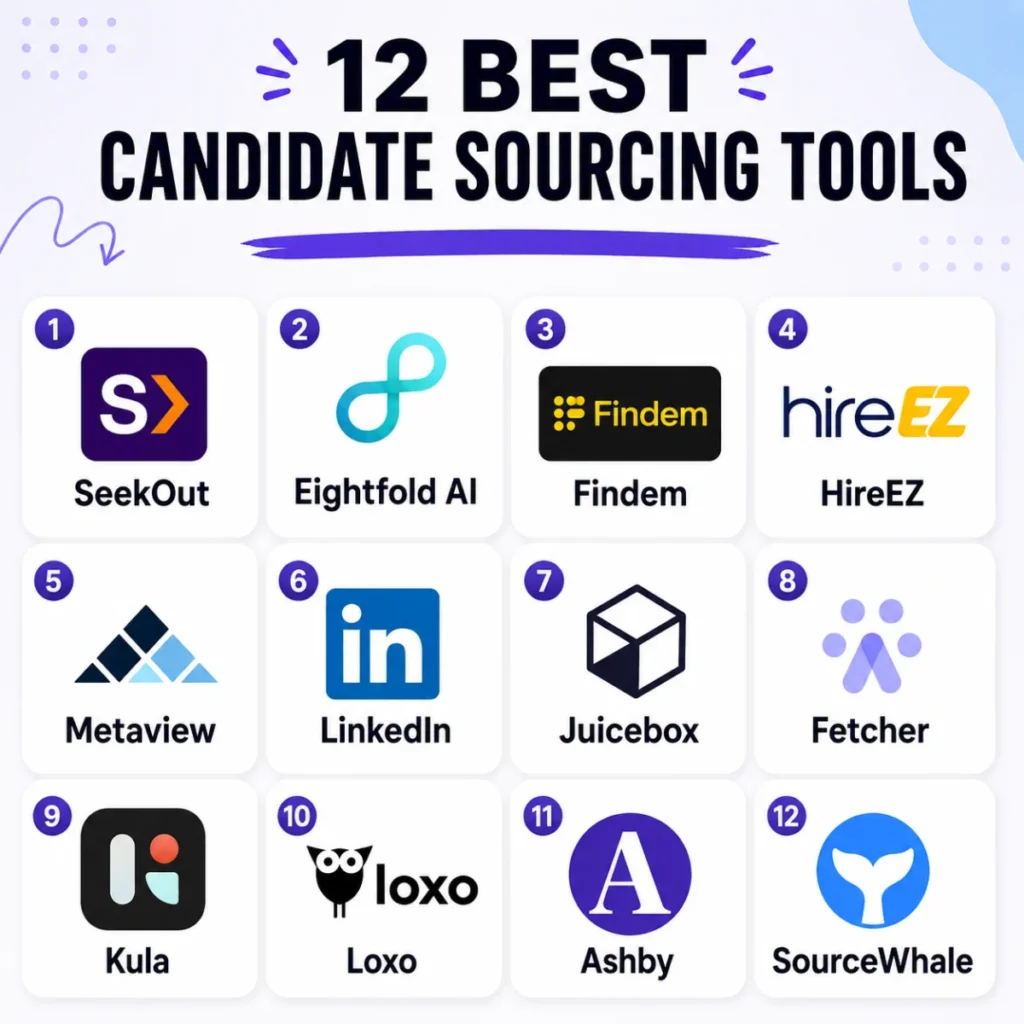
The market for AI-powered recruitment solutions is robust, with a diverse array of tools catering to different organizational needs and scales. Here’s an in-depth look at some of the best AI candidate sourcing tools for 2026:
1. SeekOut
Best for: Sourcing hard-to-find technical talent
SeekOut excels in identifying and engaging highly specialized professionals, particularly within technical domains. Leveraging advanced AI and machine learning algorithms, it scours billions of public profiles, patents, publications, and open-source contributions to pinpoint candidates with specific, niche skills. Its platform offers robust diversity filters, allowing companies to build inclusive talent pipelines by identifying underrepresented groups. SeekOut’s comprehensive insights extend to market data, compensation trends, and competitive intelligence, providing recruiters with a holistic view of the talent landscape.
2. Eightfold AI
Best for: Enterprise talent intelligence
Eightfold AI positions itself as an end-to-end talent intelligence platform, designed for large enterprises. Its core strength lies in its ability to unify internal and external talent data, providing a single view of a company’s workforce and potential hires. Utilizing deep learning, Eightfold can predict a candidate’s potential and fit for a role based on their entire career trajectory, not just their resume. This platform supports internal mobility, workforce planning, and personalized career paths for employees, making it a powerful tool for holistic talent management beyond just sourcing.
3. Findem
Best for: Diversity hiring and talent market data
Findem distinguishes itself with its attribute-based search capabilities, allowing recruiters to define candidates not just by keywords but by a vast array of attributes, including skills, experiences, academic background, and even soft skills inferred from their digital presence. Its strong emphasis on Diversity, Equity, and Inclusion (DEI) features helps organizations actively identify and target underrepresented candidates. Findem also provides rich talent market data, offering insights into competitor hiring, talent migration, and skill availability, which are crucial for strategic workforce planning.
4. HireEz
Best for: Outbound sourcing at scale
HireEz, formerly known as Hiretual, is a robust AI-powered sourcing platform designed for high-volume outbound recruitment. It boasts access to a massive database of over 700 million professionals across various platforms, allowing recruiters to quickly identify relevant candidates. Its AI engine can generate comprehensive candidate profiles, including contact information and social media links, streamlining the outreach process. HireEz also offers automated email sequences and engagement tracking, enabling recruiters to manage large-scale outreach campaigns efficiently.
5. Metaview
Best for: Autonomous AI sourcing agents
Metaview takes a novel approach by offering autonomous AI sourcing agents. Unlike traditional tools that primarily assist human recruiters, Metaview’s agents can proactively identify, engage, and even conduct initial screening conversations with candidates. This significantly reduces the manual workload, allowing recruiters to focus on later-stage interactions. While the original content highlights "Autonomous AI sourcing agents," it also includes interview intelligence features, suggesting a broader application of AI in streamlining the entire candidate journey, from initial contact to structured feedback.
6. LinkedIn Talent Insights / Recruiter AI
Best for: Teams already in the LinkedIn ecosystem
For organizations deeply integrated into the LinkedIn ecosystem, LinkedIn Talent Insights and Recruiter AI offer powerful advantages. Talent Insights provides unparalleled access to real-time data on talent pools, skills gaps, hiring trends, and competitive intelligence directly from LinkedIn’s vast professional network. Recruiter AI enhances the LinkedIn Recruiter experience by suggesting relevant candidates, optimizing search queries, and automating certain aspects of candidate engagement, making it an indispensable tool for teams already leveraging LinkedIn for their recruitment efforts.
7. Juicebox
Best for: Natural language candidate search
Juicebox simplifies the sourcing process through its natural language candidate search capabilities. Recruiters can describe their ideal candidate in plain English, and Juicebox’s AI translates these descriptions into precise search queries, surfacing highly relevant profiles. This intuitive interface reduces the learning curve and allows for more nuanced searches than traditional keyword-based systems. Its ability to understand context and intent makes it particularly effective for identifying candidates with complex or multidisciplinary skill sets.
8. Fetcher
Best for: AI sourcing with a human quality check
Fetcher combines the power of AI with a critical human element. While AI automates the initial sourcing and identification of candidates, Fetcher incorporates a human quality check to ensure the relevance and accuracy of the suggested profiles. This hybrid approach aims to deliver high-quality, pre-vetted candidate lists, minimizing irrelevant suggestions and maximizing recruiter efficiency. It also offers personalized email outreach campaigns, further streamlining candidate engagement.
9. Kula AI
Best for: AI-native end-to-end hiring
Kula AI positions itself as an AI-native solution designed to manage the entire hiring lifecycle. From initial sourcing and outreach to interview scheduling and candidate management, Kula leverages AI to automate and optimize every step. Its focus on an "end-to-end" approach means it aims to provide a seamless, integrated experience for recruiters, reducing the need for multiple disparate tools and ensuring data consistency across the hiring funnel.
10. Loxo
Best for: All-in-one sourcing and talent intelligence
Loxo offers a comprehensive all-in-one platform that combines a powerful sourcing engine with a robust Applicant Tracking System (ATS) and Customer Relationship Management (CRM) functionalities. Its AI-driven search capabilities allow recruiters to access a vast database of professional profiles and conduct highly targeted searches. The integration of ATS and CRM within the same platform ensures a streamlined workflow, from initial candidate identification to managing applications and ongoing talent relationships.
11. Ashby
Best for: Data-driven hiring teams
Ashby is tailored for organizations that prioritize data and analytics in their hiring decisions. It offers sophisticated reporting and dashboards that provide deep insights into every stage of the recruitment process, from source effectiveness to diversity metrics and pipeline velocity. While its AI-powered sourcing capabilities are strong, its true value lies in empowering data-driven hiring teams to continuously optimize their strategies, identify bottlenecks, and measure the ROI of their recruitment efforts.
12. SourceWhale
Best for: Multi-channel outreach campaigns
SourceWhale excels in automating and optimizing multi-channel outreach campaigns. It allows recruiters to engage candidates across various platforms, including email, LinkedIn, and other social channels, all from a centralized interface. Its AI helps personalize messages, schedule follow-ups, and track engagement metrics, ensuring that recruiters can maintain consistent communication with a large volume of candidates without sacrificing personalization.
Bonus Tool: Ongig – Optimizing the Foundation of Sourcing
While the above tools focus on finding and engaging candidates, the effectiveness of any sourcing effort hinges on the clarity and attractiveness of the job description itself. This is where Ongig plays a crucial role. Ongig focuses specifically on job description optimization, enabling recruiters to craft job posts that are not only compelling but also compliant and inclusive. Its platform analyzes job descriptions for:
- Gender-biased language: Identifying and suggesting neutral alternatives to attract a broader candidate pool.
- Readability and clarity: Ensuring job descriptions are easy to understand and engaging.
- Compliance: Checking for regulatory adherence and best practices in job advertising.
- Keywords and SEO: Optimizing job posts for search engines and talent platforms to improve visibility.
Ongig is perfect for busy recruiters and talent acquisition teams who need to automate their tasks and ensure precise, high-impact job descriptions. By optimizing the very first point of contact—the job description—Ongig helps companies maximize the return on investment from their AI sourcing tools, ensuring that once top talent is identified, they are genuinely interested and motivated to apply.
AI Candidate Sourcing Tools: A Comparative Overview
The market offers a range of features, but common threads include robust databases, AI-powered search, automated outreach, and ATS integration.
| Software | Database & AI Search | Automated Outreach | ATS Integration | Pricing |
|---|---|---|---|---|
| SeekOut | ✅ | ✅ | ✅ | Starts at $149/month |
| Eightfold AI | ✅ | ✅ | ✅ | Contact for pricing |
| Findem | ✅ | ✅ | ✅ | Contact for pricing |
| HireEZ | ✅ | ✅ | ✅ | Contact for pricing |
| Metaview | ✅ | Partial | ✅ | Start for free |
| LinkedIn Talent Insights | ✅ | Partial | ✅ | Contact for pricing |
| Juicebox | ✅ | ✅ | ✅ | Start for free |
| Fetcher | ✅ | ✅ | ✅ | Starts at $115/mo |
| Loxo | ✅ | ✅ | ✅ | Start for free |
| Ashby | ✅ | ✅ | ✅ | Start at $400/month |
| Kula AI | ✅ | ✅ | ✅ | Start at $4800/year |
| SourceWhale | ❌ | ✅ | ✅ | Contact for pricing |
Note: The "Database & AI Search" for SourceWhale is marked with ‘❌’ in the original table, suggesting it might primarily be an outreach tool that integrates with other sourcing platforms rather than having its own core database. This reinforces its strength as a multi-channel outreach specialist.
A review of the comparison table highlights several key trends in 2026:
- Ubiquity of AI Search and Databases: Nearly all leading tools offer robust databases combined with AI search capabilities, underscoring the foundational importance of intelligent candidate identification.
- Automated Outreach as Standard: Automated outreach features are prevalent across the board, demonstrating the industry’s shift towards efficient, personalized communication at scale. Tools like SourceWhale specialize in this, indicating a demand for dedicated outreach solutions.
- Seamless Integration: ATS integration is a non-negotiable feature for most platforms, ensuring that sourced candidates flow smoothly into existing HR workflows and systems. This emphasizes the desire for interconnected HR tech stacks.
- Flexible Pricing Models: Pricing varies significantly, from free starter tiers offered by Metaview, Juicebox, and Loxo, to enterprise-level solutions requiring direct contact for quotes (Eightfold AI, Findem, HireEZ, LinkedIn Talent Insights, SourceWhale), reflecting the diverse needs of different organizational sizes and budgets. Mid-range options like SeekOut, Fetcher, Ashby, and Kula AI provide scalable solutions for growing companies.
Broader Implications and Future Trends for 2026 and Beyond
The widespread adoption of AI in candidate sourcing is not just a technological upgrade; it represents a fundamental shift in how organizations conceptualize and execute talent acquisition. Several broader implications and trends are shaping the future:
- The Rise of Skills-Based Hiring: AI’s ability to analyze and match candidates based on specific skills, rather than solely relying on job titles or educational degrees, is accelerating the shift towards skills-based hiring. This approach broadens talent pools, promotes diversity, and ensures a better fit for evolving job requirements.
- Hyper-Personalization in Candidate Engagement: AI allows for highly personalized outreach messages, tailored content, and even customized career path suggestions. This level of personalization improves candidate experience, boosts engagement rates, and strengthens employer branding.
- Ethical AI and Bias Mitigation: As AI becomes more sophisticated, so too does the scrutiny on its ethical implications. Ensuring fairness, transparency, and accountability in AI algorithms is paramount. Leading tools are incorporating features to identify and mitigate bias, but ongoing vigilance and development are crucial to prevent the perpetuation of existing human biases.
- AI as an Augmentation, Not Replacement: The consensus among industry experts is that AI will augment, rather than replace, human recruiters. AI handles the heavy lifting of data analysis, identification, and initial outreach, freeing up recruiters to focus on high-value activities like relationship building, negotiation, and strategic talent planning. The human element remains critical for empathy, nuanced judgment, and fostering genuine connections.
- Interoperability and Ecosystem Integration: The future of HR technology points towards increasingly integrated ecosystems. AI sourcing tools will need to seamlessly connect with ATS, HRIS, CRM, and other HR platforms to create a unified and efficient talent management workflow. APIs and open standards will be key to achieving this synergy.
Chronology of Transformation
The journey to AI-driven sourcing has been incremental yet impactful:
- Early 2000s: Emergence of online job boards and basic applicant tracking systems, automating resume collection.
- Mid-2010s: Introduction of big data analytics and early machine learning in recruitment, focusing on keyword matching and basic candidate recommendations.
- Late 2010s: Development of more sophisticated AI for natural language processing (NLP) to parse resumes, and predictive analytics for candidate fit. Sourcing tools began to leverage social media data.
- Early 2020s: Rapid advancements in deep learning and AI models led to the creation of truly intelligent sourcing platforms capable of identifying passive talent, automating complex outreach, and providing robust market insights. Focus shifted to diversity and bias mitigation.
- 2026 (Present Context): AI candidate sourcing tools become mainstream and indispensable. The market matures, offering specialized solutions for various hiring challenges, with integration and ethical considerations at the forefront.
Statements and Industry Reactions
Leading HR analysts and Chief People Officers consistently emphasize the transformative power of AI in recruitment. "The shift from reactive application management to proactive, AI-driven talent discovery is the most significant change in recruitment this decade," states Dr. Anya Sharma, a prominent HR technology consultant. "Companies that fail to adopt these tools will find themselves at a severe disadvantage in attracting top-tier talent." Recruiters leveraging these platforms frequently report significant improvements in candidate quality, reduced time-to-hire, and enhanced diversity metrics, often citing specific examples of filling hard-to-find roles within weeks instead of months.
Conclusion
In 2026, AI candidate sourcing tools are no longer optional; they are essential for staying competitive in the global talent market. By leveraging the advanced capabilities of platforms like SeekOut, Eightfold AI, Findem, and others, organizations can streamline their hiring processes, significantly improve candidate quality, enhance diversity, and optimize their overall workforce strategies. The future of recruitment is intelligent, data-driven, and proactive, and companies that embrace these AI innovations will be best positioned to attract, engage, and retain the talent critical for their success. Moreover, remembering that effective sourcing begins with a compelling job description, tools like Ongig ensure that the foundational elements of recruitment are optimized, maximizing the impact of every sourced candidate.
FAQs about the Best AI Candidate Sourcing Tools
1. What is AI-powered candidate sourcing?
AI-powered candidate sourcing is the strategic application of artificial intelligence and machine learning technologies to identify, attract, and engage potential job candidates. It moves beyond traditional methods by automating the process of scanning vast databases, social media, professional networks, and proprietary talent pools to find individuals whose skills, experience, and potential align with specific job requirements. AI algorithms can analyze complex data points, predict candidate fit, personalize outreach, and even conduct initial screening, thereby making the sourcing process more efficient, accurate, and scalable than manual methods.
2. How is AI candidate sourcing different from an ATS?
An Applicant Tracking System (ATS) primarily manages candidates who have already applied for a job. It acts as a database for applications, tracks their progress through the hiring stages, and automates administrative tasks like scheduling interviews. In contrast, AI candidate sourcing focuses on proactively finding qualified candidates externally who may not be actively applying. These tools scour the wider talent market to build talent pipelines and engage passive talent. While distinct, many modern AI sourcing tools integrate with ATS platforms (like Workday, Greenhouse, SAP SuccessFactors, SmartRecruiters) to seamlessly transfer identified and engaged candidates into the application management workflow. Some advanced platforms, like Loxo and Kula AI, are beginning to offer combined sourcing and ATS functionalities, creating more unified recruitment ecosystems.
3. Do AI sourcing tools integrate with existing HR systems?
Yes, robust integration with existing HR systems, particularly Applicant Tracking Systems (ATS), is a critical feature for most leading AI sourcing tools. This interoperability ensures a smooth flow of candidate data from the sourcing platform into the company’s established hiring workflow. Common integrations include major ATS platforms such as Workday, Greenhouse, SAP SuccessFactors, SmartRecruiters, Lever, and Oracle HCM. These integrations allow recruiters to export candidate profiles, track communication, and manage the candidate’s progression through the hiring funnel without manual data entry, thereby enhancing efficiency and data consistency across the HR tech stack.
4. Can AI sourcing tools help with diversity hiring?
Absolutely, when configured and utilized correctly, AI sourcing tools can significantly enhance diversity hiring initiatives. Many platforms, such as Findem and Eightfold AI, incorporate specific features designed to identify and prioritize candidates from underrepresented groups. These features can include diversity filters, anonymized resume reviews to mitigate unconscious bias, and DEI analytics to track inclusion metrics across the entire pipeline. By focusing on skills and objective attributes rather than traditional demographic markers, AI can broaden the candidate pool and surface diverse talent that might be overlooked by human recruiters. However, it’s crucial for organizations to be mindful of potential algorithmic bias and ensure continuous monitoring and auditing of their AI tools to promote truly equitable outcomes.