The modern workplace is a landscape defined by constant flux. Leaders, tasked with steering their organizations through an ever-evolving environment, are increasingly finding their energy reserves depleted. This depletion isn’t just a personal challenge; it’s a critical factor impacting the growth and success of their teams and the organizations they lead. As artificial intelligence continues to reshape the very fabric of how we work, a fundamental truth remains: human leaders are the linchpin of organizational achievement. Despite facing a barrage of compounding obstacles that can drain motivation, these leaders possess an inherent, uniquely human superpower that acts as the invisible engine of progress. This vital resource, so deeply ingrained in our daily professional lives that its absence is keenly felt, is known as psychological capital, or PsyCap. It is both a necessity for leaders and a product of effective leadership, representing an invaluable asset in achieving what is humanly possible. PsyCap functions as the essential fuel for the organizational machine, sustaining leaders who maintain its intricate operations and preventing systemic breakdown.
Understanding the Pillars of Psychological Capital
Psychological capital is broadly defined as an individual’s positive psychological state, characterized by four foundational elements. These core components, when nurtured, form the bedrock of resilience and proactive engagement:
- Hope: This refers to the willpower and the pathways individuals perceive to achieve their goals. It’s the belief that future successes are attainable and the conviction that one can devise strategies to reach them.
- Self-Efficacy: Also known as confidence, this is an individual’s belief in their capacity to execute the behaviors necessary to produce specific performance attainments. It’s the internal conviction of one’s ability to handle specific situations effectively.
- Resilience: This is the capacity to bounce back from adversity, uncertainty, change, or even increased responsibility. It’s the ability to persevere in the face of setbacks and maintain a positive outlook.
- Optimism: This is the attributional style of positive future expectations. Optimistic individuals tend to attribute positive events to internal, stable, and global causes, while attributing negative events to external, unstable, and specific causes.
Research consistently highlights the profound impact of high PsyCap on employees. Studies reveal that individuals with elevated levels of psychological capital demonstrate greater commitment to their roles, exhibit superior performance, experience enhanced well-being, and are significantly less prone to burnout. This suggests that fostering PsyCap is not merely a desirable trait but a strategic imperative for individual and collective success.
The Indispensable Role of Psychological Capital in Leadership
Leaders with robust psychological capital often embody stronger authentic leadership behaviors. These include heightened self-awareness, genuine relational transparency, and a well-defined moral compass. Such characteristics are intrinsically linked to fostering higher levels of trust within their teams and achieving superior performance outcomes.
Leadership, fundamentally a social process, is deeply reliant on human energy, motivation, and psychological capacity. Sustaining these elements, particularly amidst escalating complexity and ambiguity, requires more than just technical skills or strategic acumen. It demands a deeper wellspring of internal fortitude. Leaders require significant mental resources to persist through challenges, adapt to unforeseen circumstances, and ultimately thrive. This is precisely where psychological capital emerges as a critical differentiator.
For decades, researchers have delved into the intricacies of PsyCap, with findings consistently indicating its predictive power for key organizational success indicators, including performance, employee engagement, and retention rates. PsyCap effectively encapsulates the uniquely human strengths that empower leaders to not only navigate disruptive forces but also to propel their organizations forward.
Crucially, psychological capital is not an immutable trait. It is a dynamic and developable resource. Through thoughtfully designed experiences, targeted coaching interventions, and supportive organizational frameworks, leaders can actively cultivate and sustain their psychological capital over time. This cultivable nature makes PsyCap an exceptionally valuable asset for long-term organizational health and a potent indicator of the return on investment yielded by leadership development initiatives.
Empirical research, including studies conducted with participants in comprehensive leadership development programs, has illuminated that PsyCap is more than just a beneficial outcome of development; it explains why development is effective. Leaders who exhibit higher levels of hope and optimism following developmental programs often report stronger goal attainment and increased team engagement. This suggests that a core objective of effective leadership development should be the intentional cultivation of leaders’ psychological capital.

Cultivating Psychological Capital Through Strategic Leadership Development
Organizations are increasingly recognizing that leadership development must extend beyond the mere acquisition of new skills. When leaders are provided with opportunities to disengage from the immediate pressures of their roles, engage in deep reflection, receive candid feedback, and experiment with novel approaches, they don’t just gain new competencies. They also acquire the essential inner fuel required to effectively deploy those skills when faced with adversity. In essence, their psychological capital grows.
A clear illustration of this phenomenon can be observed by comparing psychological capital levels before and after leadership development programs. Longitudinal studies examining custom programs for educational leaders, for instance, have consistently demonstrated significant growth in PsyCap over the course of these initiatives. In one typical cohort, the percentage of leaders reporting "high PsyCap" surged from 36% prior to the program to a remarkable 79% upon its completion.
This data prompts a crucial question: what specific elements within a development experience contribute to this enhancement of psychological capital? An in-depth examination reveals that improvements in PsyCap are not always immediate. In some intensive programs, data has shown a temporary dip in PsyCap midway through the experience. This often occurs when leaders receive challenging, yet constructive, feedback through mechanisms like 360-degree assessments, which naturally increase self-awareness. Following this phase of introspection and potential discomfort, PsyCap typically rebounds, often exceeding initial levels as leaders internalize new skills and strategies to address their identified challenges.
This temporary dip is a noteworthy observation. It underscores the reality that significant learning and personal growth can sometimes lead to a brief wobble in confidence or optimism before these attributes are ultimately strengthened. The critical factor is what transpires next, and this is where structured support becomes paramount.
The Transformative Power of Coaching in Nurturing Leader PsyCap
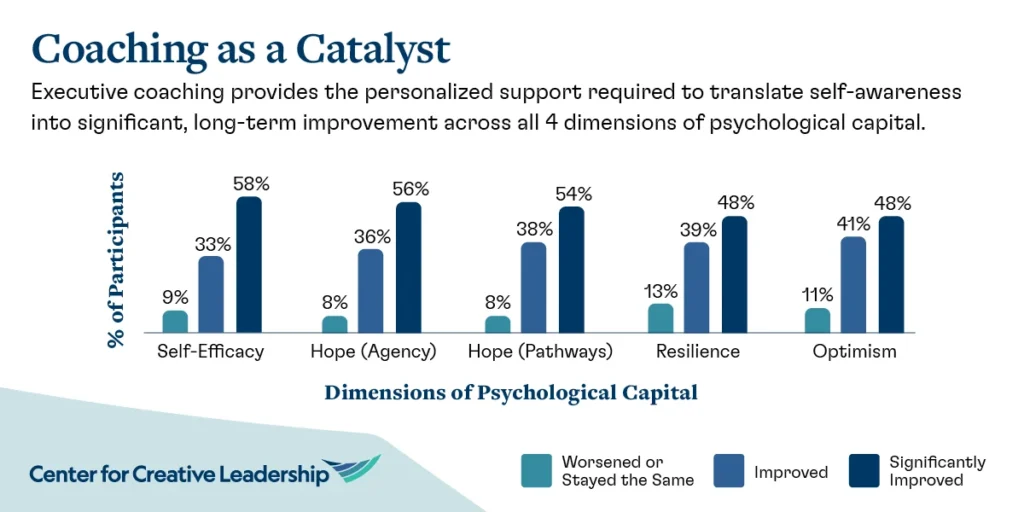
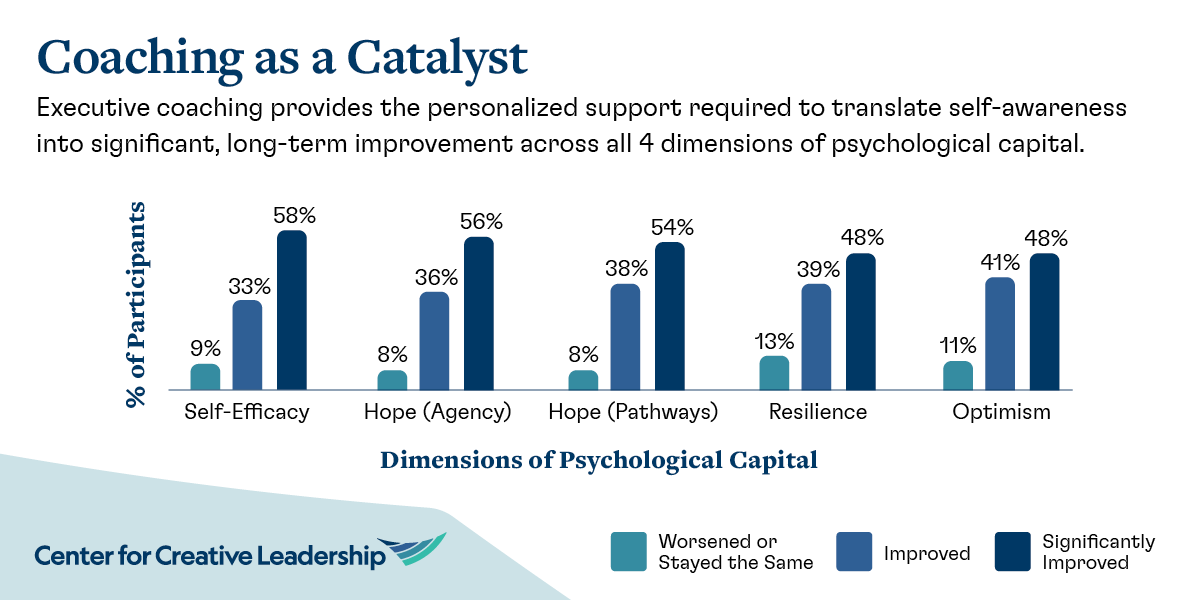
Coaching stands out as one of the most direct and effective avenues through which leaders receive intentional, personalized support. Evaluations of executive coaching services have consistently found that they provide a highly individualized pathway for leaders to address ongoing challenges, reinforce learned behaviors, and engage in goal-achieving activities that have a direct and positive impact on their psychological capital.
Even highly experienced leaders who engage in executive coaching report significant improvements in their PsyCap. This aligns perfectly with the core principles of coaching, which aim to move beyond simply imparting new skills. Coaching focuses on building the crucial self-awareness and internal work necessary for more effective leadership, while simultaneously replenishing the energy reserves of leaders who consistently practice these demanding behaviors.
The benefits of coaching are visually represented in infographics that illustrate its role as a catalyst for psychological capital. These resources often highlight how coaching helps leaders navigate complex feedback, develop coping mechanisms for stress, and build greater confidence in their ability to lead through uncertainty.
The Value of Bite-Sized Interventions for Leader PsyCap
The development of psychological capital is not solely contingent upon lengthy, immersive, in-person leadership development experiences. Encouraging evidence also suggests that PsyCap can be effectively strengthened through shorter, more targeted online leadership training initiatives, particularly when the learning is directly applicable to real-world work challenges.
Pilot programs for self-paced online courses specifically designed to build leaders’ PsyCap have yielded promising results. Leaders who completed these courses reported a statistically detectable and meaningful increase in their psychological capital. In one such pilot, average PsyCap scores rose by nearly a full point on a 1-to-5 scale (an increase of +0.74), with an impressive 86% of participants reporting overall improvement. The particular advantage of this online format lies in its focus on the leader’s key professional challenges, ensuring that personalized reflections and practice opportunities remain anchored in the tangible realities they are striving to overcome.
Understanding PsyCap Nuances: Neurodiverse Leaders
A growing body of research is highlighting the significant benefits that organizations derive from neurodiverse leadership teams and workforces. Within this context, studies have also revealed that, when compared to their neurotypical counterparts, leaders who identify as neurodivergent (such as those with Attention Deficit Hyperactivity Disorder or autism) tend to report lower overall levels of psychological capital.
These findings are not indicative of a lack of leadership potential. Instead, they underscore that leaders bring a diverse range of strengths and unique needs related to their individual psychological resources into their roles. For organizations, this reinforces the critical imperative of creating and sustaining the necessary psychological conditions that enable all leaders to maximize their impact and well-being. Infographics illustrating this disparity often emphasize that while raw potential may be present, external support structures and tailored approaches are vital for neurodiverse leaders to fully leverage their PsyCap.
Psychological Capital: The Essential Fuel for Navigating Disruption
Effective leadership development in today’s environment must transcend the mere enhancement of skills in the face of persistent disruption. It must actively provide the psychological fuel that leaders require to maintain their effectiveness amidst ambiguity, demanding workloads, and rapid change.
Psychological capital is precisely this fuel, and extensive data confirms its enhancement through strategic leadership development. Across various program formats, including immersive experiences, one-on-one coaching, and digital learning platforms, PsyCap demonstrably grows when leaders are exposed to an optimal blend of enhanced self-awareness, meaningful challenges, and supportive environments that facilitate the translation of insight into tangible action.
This growth trajectory is not always linear. It frequently involves a temporary decline, often as leaders grapple with and internalize difficult feedback. However, with the right guidance and support, this dip can serve as a crucial turning point, empowering leaders to reclaim their sense of agency, clarity, and confidence to adopt new and more effective ways of operating.
This phenomenon is not solely an individual experience; it has profound organizational implications. While leadership sets the initial tone, it is the organizational culture that ultimately channels and amplifies this vital energy. When organizations cultivate cultures that actively support PsyCap—by normalizing constructive feedback, celebrating progress, and valuing recovery as much as performance—the positive impact is multiplied. High-performing organizations foster environments where hope, self-efficacy, resilience, and realistic optimism gain momentum, radiating from leaders to their teams and extending throughout the entire organizational ecosystem.
However, it is crucial to recognize that developing psychological capital is not a panacea for systemic issues. It is not about expecting individuals to endure unhealthy workloads or toxic workplace cultures through sheer willpower. Leadership resilience and optimism achieve their full potential when complemented by robust systemic support, a pervasive sense of psychological safety at work, and the establishment of thoughtful and effective boundaries.
The ultimate objective is not to cultivate leaders who can simply endure any challenge, but rather to foster the inner resources that empower them to confront difficult realities head-on, identify viable solutions, and inspire a collective vision for a future that benefits everyone.
Taking the Next Step in Building Leader Resilience
The ongoing exploration of the human dimension of leadership remains a core commitment. Organizations and individuals are encouraged to take the next decisive step in cultivating this critical capacity, both within themselves and across their leadership ranks. Programs such as the Leadership Development Program (LDP) and executive coaching services are meticulously designed to foster the psychological capital and internal resources that enable leaders to perform at their peak, especially during periods of significant challenge. These initiatives provide the structured support and developmental opportunities necessary to build the resilience and adaptability that define effective leadership in the 21st century.