Company core values are often touted as the bedrock of organizational identity, shaping how employees experience work every day, influencing decisions, guiding behaviors, and defining the culture people feel the moment they walk through the door. Yet, despite their proclaimed importance, contemporary research by Gallup reveals a significant disconnect: a mere two in ten employees report feeling strongly connected to their company’s culture. This stark statistic underscores a critical challenge for modern organizations: values, when merely inscribed on a wall or website, fail to resonate; they only become potent when actively lived, visibly modeled by leadership, and consistently reinforced through recognition. When individuals are celebrated for embodying these values, the desired behaviors are amplified and repeated, thereby transforming abstract principles into a tangible, thriving culture. This article delves into what constitutes meaningful core values, explores a comprehensive spectrum of examples, and critically examines the indispensable role of recognition in bringing these values to life, ultimately driving both employee engagement and measurable business success.
The fundamental premise is simple yet profound: values only stick when they are lived, not just written down. They demand to be seen in action, championed by leaders, and ingrained into the organizational fabric through systematic reinforcement. This cyclical process—where values drive behaviors, behaviors build culture, and culture, in turn, fuels business results—forms a powerful chain reaction. In an increasingly competitive global landscape, where talent retention and innovation are paramount, the strategic alignment of individual actions with collective principles has never been more crucial.
The Foundational Role of Core Values in Modern Enterprise
For decades, organizations have understood the theoretical importance of defining their ethos. Early corporate pioneers often articulated mission statements and codes of conduct, laying the groundwork for what would evolve into today’s comprehensive core values. In the 21st century, particularly post-2008 financial crisis and accelerated by the digital transformation and the COVID-19 pandemic, the focus shifted from purely financial metrics to a more holistic view of organizational health, including culture, employee well-being, and social responsibility. This evolution has made core values not just aspirational declarations but operational frameworks that inform everything from hiring practices and performance reviews to strategic planning and crisis management.
Strong, well-articulated, and genuinely embraced values provide a north star for employees, especially in ambiguous situations. They foster a shared sense of purpose, transcend departmental silos, and create a common language for collaboration and decision-making. Beyond internal coherence, values also project an authentic image to external stakeholders—customers, investors, and potential talent—acting as a powerful differentiator in a crowded market. Companies with strong, positive cultures, rooted in clear values, consistently outperform their peers in areas such as employee retention, customer satisfaction, and profitability, demonstrating a direct correlation between cultural strength and commercial success.
The Disconnect: Why Values Often Fail to Resonate

The Gallup finding that only two in ten employees feel strongly connected to their company’s culture is a sobering indicator of a widespread problem. This disconnect often stems from several critical failures in how values are conceived, communicated, and integrated. One primary reason is the "wallpaper effect," where values are merely decorative slogans rather than embedded behavioral expectations. They might be prominently displayed in lobbies or on company merchandise but are rarely referenced in daily operations or leadership discourse.
Another significant pitfall is the lack of genuine leadership buy-in and modeling. If leaders do not visibly embody the stated values, employees quickly perceive hypocrisy, eroding trust and rendering the values meaningless. A 2023 survey by Deloitte revealed that 45% of employees believe their company’s stated values do not align with the reality of how decisions are made or how people are treated. Furthermore, the absence of a structured mechanism to reinforce values means that desirable behaviors often go unnoticed and unrewarded, failing to create the necessary feedback loop for cultural propagation. Without this reinforcement, employees may struggle to understand what living the values truly looks like in practice, leading to confusion and disengagement.
From Aspiration to Action: Defining Meaningful Core Value Statements
Defining core values should be an inclusive and reflective process, not a top-down mandate. The aim is to capture the authentic essence of an organization – both who it is and who it aspires to be – and translate it into a language that resonates deeply with its people. This process typically involves:
- Discovery and Reflection: Engaging employees at all levels, through surveys, focus groups, and workshops, to identify existing positive behaviors, shared beliefs, and aspirational traits. This ensures the values are organic and reflective of the collective identity, not merely imposed.
- Leadership Alignment: Senior leadership must be deeply involved, not just in endorsing the values but in shaping them, ensuring they align with the company’s strategic vision and mission. Their commitment is paramount for successful implementation.
- Clarity and Specificity: Values should be clearly defined and accompanied by behavioral examples. Vague terms like "excellence" or "integrity" need actionable interpretations to guide employee conduct. For instance, "Integrity" could be elaborated as "making ethical choices, even when challenging, and communicating transparently."
- Conciseness and Memorability: A manageable number of values (typically 3-7) that are easy to remember and communicate helps embed them in daily consciousness.
- Integration into Systems: Once defined, values must be woven into every organizational system: recruitment (hiring for values alignment), onboarding (introducing values early), performance management (evaluating against values), and learning and development (training on value-driven behaviors).
A Spectrum of Essential Core Values: Inspiring Workplace Culture
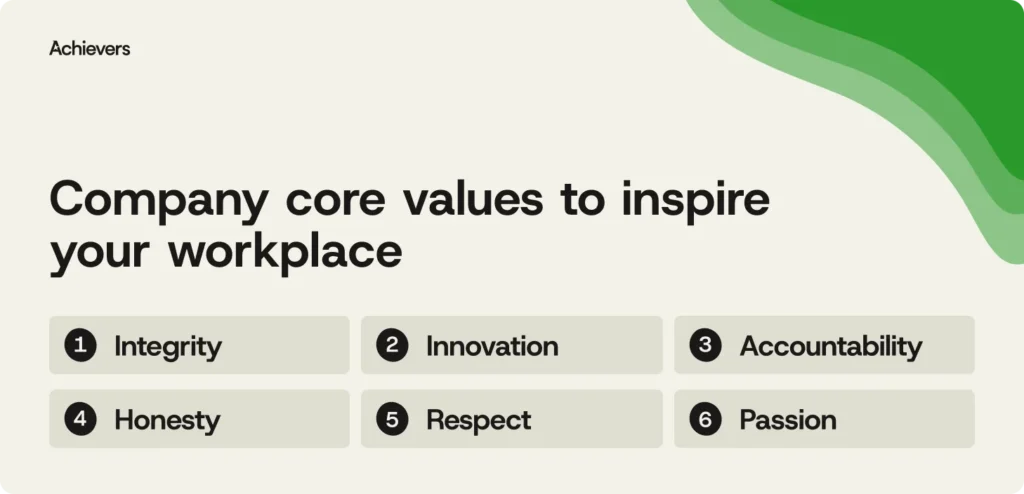
Drawing inspiration from successful organizations and established psychological principles, here are 25 core values that can profoundly shape and strengthen any workplace, each with its unique impact:
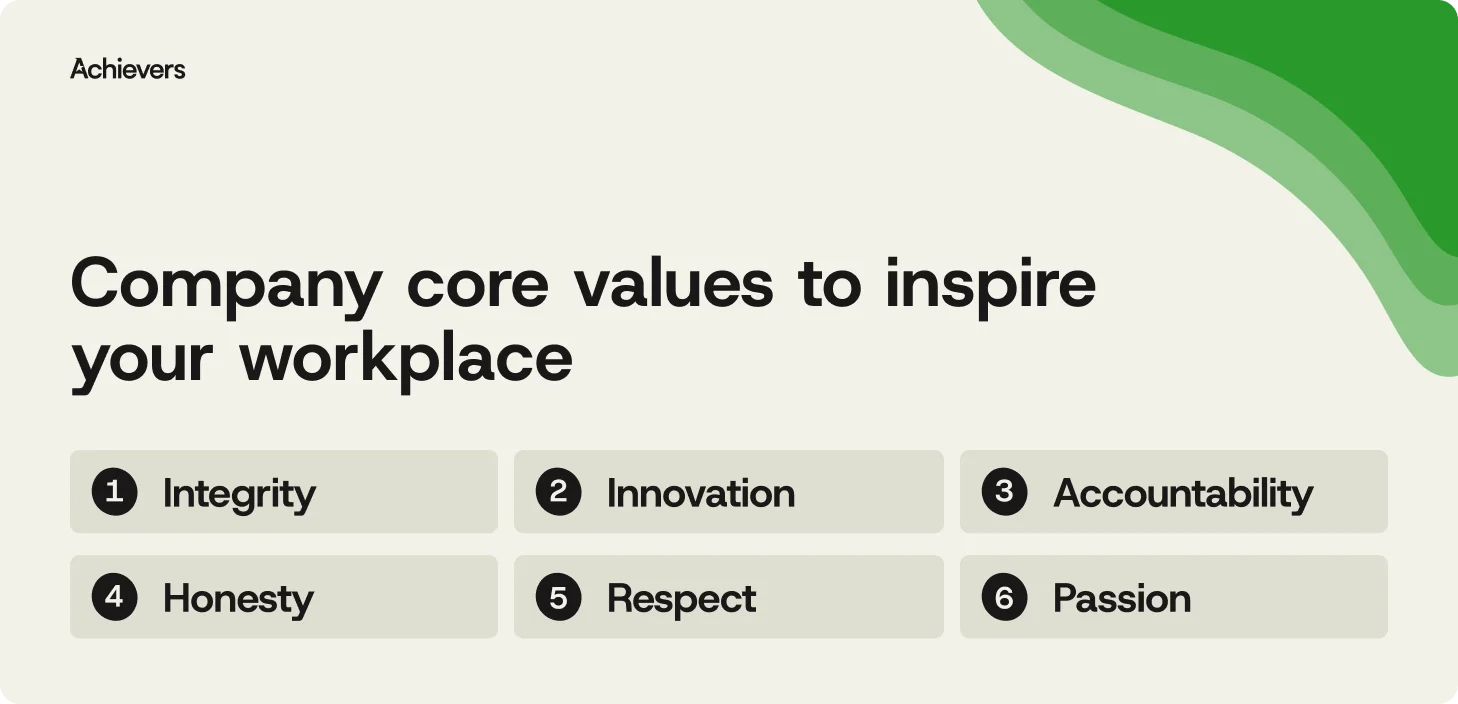
- Integrity: Doing the right thing, even when no one is looking. This builds foundational trust, ensuring honesty and accountability in every decision and action, critical for long-term credibility.
- Innovation: Challenging the status quo with curiosity and new ideas. It fosters a culture of experimentation, continuous learning, and adaptability, driving growth and competitive advantage.
- Accountability: Owning outcomes, learning from missteps, and following through. This value builds trust and demonstrates that responsibility is a cornerstone of professional conduct.
- Honesty: Being upfront, clear, and candid. An honest workplace facilitates efficient problem-solving, transparent decision-making, and constructive feedback.
- Respect: Treating everyone with dignity, regardless of role, background, or opinion. It manifests in active listening, inclusive collaboration, and equitable recognition.
- Passion: Bringing energy and purpose to your work. Passion keeps employees motivated, resilient in the face of challenges, and proud of their contributions.
- Trust: Creating an environment where people feel safe to speak up, take risks, and be themselves. Trust is the bedrock of psychological safety, open communication, and sustained engagement.
- Teamwork: Combining diverse strengths to reach collective goals. This encourages open collaboration, mutual support, and shared celebration of successes.
- Creativity: Approaching challenges with fresh eyes and exploring novel solutions. It encourages experimentation and learning from both successes and failures.
- Compassion: Empathizing with others, offering support, and showing genuine care, especially during difficult times. Compassion helps employees feel seen, valued, and supported, enhancing well-being.
- Courage: Doing what is right, even when it is uncomfortable or unpopular. Courage means speaking up, standing by values, and pushing forward through uncertainty.
- Loyalty: A deep commitment to the organization’s mission, values, and success. It transcends tenure, reflecting consistent care and dedication.
- Adaptability: Staying flexible when plans shift, markets change, or new challenges arise. This enables teams to bounce back quickly, pivot strategically, and maintain momentum.
- Dependability: Following through, showing up, and being someone others can consistently count on. Dependability translates trust into action, ensuring smooth operations and reliable outcomes.
- Excellence: Setting high standards and striving to exceed them. It cultivates pride in work, a commitment to continuous improvement, and a refusal to settle for mediocrity.
- Happiness: Cultivating a work experience that people genuinely enjoy. Happiness correlates directly with employee engagement, morale, and overall productivity.
- Health: Prioritizing both mental and physical well-being. A culture supporting health ensures employees thrive, leading to reduced burnout and sustained performance.
- Humility: Staying open to feedback, new ideas, and diverse perspectives. Humility acknowledges that learning is continuous and collective intelligence is superior.
- Kindness: Leading with empathy, patience, and generosity. Small acts of kindness foster stronger interpersonal bonds and a more supportive environment.
- Knowledge: Sharing expertise and maintaining intellectual curiosity. Knowledge flourishes when disseminated, fostering collective growth and innovation.
- Leadership: Inspiring, empowering, and guiding others toward shared goals. This value emphasizes impact over title, promoting proactive influence at all levels.
- Openness: Creating space for honest conversations, new ideas, and constructive feedback. Openness builds trust and accelerates progress by removing communication barriers.
- Commitment: Showing up with focus, care, and follow-through. It signifies belief in the work and dedication to seeing tasks to completion.
- Community: Fostering a sense of belonging that extends beyond job titles. Community nurtures shared purpose, deep connection, and the collective building of something greater.
- Diversity: Valuing different perspectives, backgrounds, and ways of thinking. Diversity is a powerful catalyst for innovation, problem-solving, and a truly inclusive environment where everyone can contribute their best work.
The Catalyst: Recognition as the Bridge to Lived Values
Even the most thoughtfully defined core values remain dormant without a robust system to bring them to life. This is where recognition becomes paramount. Recognition is not merely an act of appreciation; it is a strategic tool that transforms abstract values into tangible, repeatable behaviors. When employees are consistently celebrated for embodying specific company values, those behaviors are reinforced, becoming observable, desirable, and ultimately, ingrained in the organizational culture.
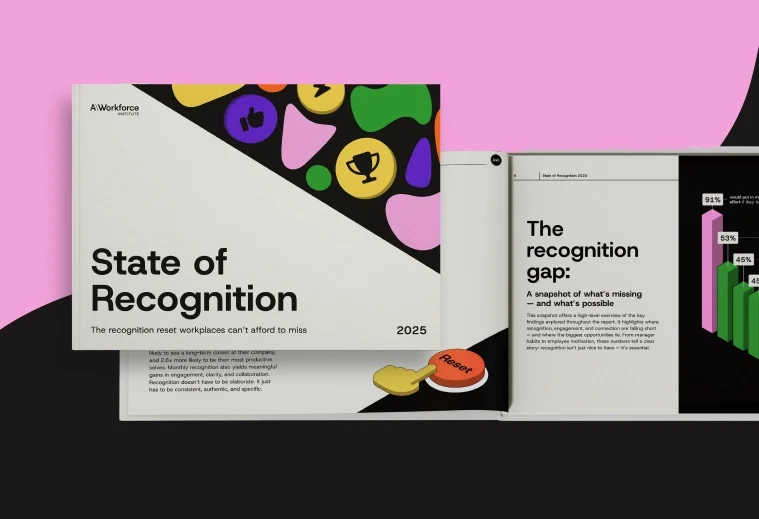
Research from the Achievers Workforce Institute (AWI) provides compelling evidence for this link. Their 2024 State of Employee Recognition Report found that 60% of HR leaders utilizing an online recognition solution observe measurable business results, compared to just 30% relying on internal, less formalized programs. This disparity highlights the effectiveness of structured recognition in driving tangible outcomes. Furthermore, the 2026 State of Recognition Report, drawing data from 3,000 global employees, reveals that those recognized weekly are an astounding 7.4 times more likely to see company values reflected in daily behavior. This constant reinforcement and appreciation make value-supported behaviors visible and pervasive across the business.
Recognition creates a clear and powerful feedback loop. Each recognition moment signals precisely which behaviors align with the company’s values, who exemplifies them, and how others can emulate them. This consistent pattern of acknowledgment builds a shared understanding of what "good" looks like in practice. When recognition is explicitly tied to core values, employees gain clarity on expected actions, understand which behaviors are valued by leadership, and see how their daily contributions connect directly to broader business priorities. This mechanism makes culture visible, repeatable, and scalable, ensuring that values are not just understood but actively lived and reinforced.
Technological Enablers: Platforms for Value-Driven Recognition
The scale and complexity of modern organizations necessitate sophisticated tools to manage and amplify value-driven recognition. Platforms like Achievers offer comprehensive solutions that facilitate this process by:
- Making Recognition Easy and Accessible: Providing intuitive interfaces for peer-to-peer and manager-to-employee recognition, ensuring that every valuable contribution aligned with values can be acknowledged instantly.
- Integrating Values into the Recognition Workflow: Allowing nominators to tag specific company values when giving recognition, thereby explicitly linking behavior to the organizational ethos.
- Creating Visibility and Social Proof: Showcasing recognition moments publicly, creating a virtuous cycle where employees see desired behaviors being rewarded, inspiring others to follow suit.
- Providing Data and Analytics: Offering insights into which values are being most frequently recognized, identifying cultural champions, and pinpointing areas where values might need further reinforcement or communication.
- Automating Rewards and Incentives: Connecting recognition to tangible rewards, ensuring that appreciation is not just verbal but also meaningful, further motivating value-aligned behavior.
These platforms move beyond simple suggestion boxes or annual awards, embedding recognition into the daily workflow and making it an integral part of the employee experience.
The Broader Impact: Business Results and Employee Experience
The sustained integration of core values through consistent recognition yields profound benefits, extending far beyond improved morale.
- Enhanced Employee Engagement and Retention: When employees feel connected to a meaningful purpose and see their contributions aligned with clear values, they are more engaged, committed, and less likely to seek opportunities elsewhere. A strong values-driven culture significantly reduces turnover costs and fosters a stable, experienced workforce.
- Improved Decision-Making: Values provide a framework for ethical and strategic decisions at all levels. They act as a filter, guiding choices that align with the company’s long-term vision and reputation.
- Stronger Employer Brand: Companies known for living their values attract top talent. A reputation for a positive, value-driven culture becomes a powerful recruitment tool, distinguishing the organization in a competitive talent market.
- Increased Productivity and Performance: Engaged employees who understand and embody company values are more motivated, collaborative, and ultimately, more productive. They take greater ownership of their work and strive for excellence.
- Greater Organizational Resilience: A strong culture built on shared values provides stability and adaptability during times of change or crisis. Employees are more likely to rally together, trust leadership, and navigate challenges effectively when united by a common purpose.
- Better Customer Experience: Employees who are engaged and connected to their company’s values are more likely to deliver exceptional customer service, leading to increased customer loyalty and satisfaction.
Challenges and Best Practices in Value Integration
While the benefits are clear, integrating core values effectively is not without challenges. Resistance to change, leadership inconsistency, and a lack of resources for continuous reinforcement can impede progress. Best practices to overcome these include:
- Ongoing Communication: Regularly revisiting and discussing values in team meetings, town halls, and internal communications.
- Leadership Development: Training leaders to not only articulate values but actively model them and provide value-based feedback and recognition.
- Employee Involvement: Continuously soliciting employee feedback on how well values are being lived and identifying areas for improvement.
- Measuring Impact: Tracking key metrics such as engagement scores, retention rates, and customer satisfaction to demonstrate the tangible impact of value integration.
Conclusion
Core values should never be relegated to static statements on a corporate website or an onboarding deck; they must be dynamic forces that permeate how people lead, collaborate, and make decisions every single day. When values are recognized in action, they transcend mere words, becoming the living, breathing essence of a company’s culture. Achievers, a leader in recognition platforms, embodies this philosophy, living by its own values—It’s the people, Be bold, Own the outcome, One team, Win with customers—and enabling other organizations to do the same. By spotlighting the everyday moments that bring company values to life, Achievers underscores a fundamental truth: what gets recognized gets repeated. This powerful mechanism is the key to building a culture that truly sticks, fostering deep employee engagement, driving innovation, and ultimately, achieving sustained business success. Making values more than words is not just a cultural initiative; it is a strategic imperative for any organization striving to thrive in the modern era.