In an increasingly competitive global talent market, organizations face a persistent and costly challenge: the phenomenon of candidate reneging. This occurs when an individual accepts a job offer but subsequently withdraws before their official start date, leaving companies scrambling to backfill critical positions. Historically, many talent acquisition programs have lacked a formalized process to address this issue, often discovering a renege only after the candidate has already gone quiet, their decision to withdraw already firm. This reactive approach frequently results in significant financial losses, operational delays, and a strain on recruitment resources. A growing body of expert opinion and practical solutions now advocates for a paradigm shift: treating engagement signals not as trailing indicators of a problem, but as crucial leading indicators of a candidate’s commitment, necessitating a proactive and data-driven engagement strategy.
The Economic and Operational Toll of Candidate Renege
The impact of candidate reneges extends far beyond the immediate inconvenience. Industry estimates suggest that the cost of a single renege can range from $10,000 to over $50,000 for professional roles, factoring in the initial recruitment expenses, interview time, background checks, offer letter generation, and the subsequent need to restart the entire hiring process. Beyond these direct financial costs, there are significant indirect consequences. Project timelines can be delayed, existing team members may face increased workloads, and team morale can suffer. Furthermore, a high renege rate can damage an organization’s employer brand, potentially making it harder to attract top talent in the future. In sectors with high demand for specialized skills, such as technology, healthcare, and engineering, the competitive landscape exacerbates this issue, with multiple offers often on the table for highly sought-after candidates. A 2023 survey by the National Association of Colleges and Employers (NACE) indicated that nearly 10% of graduating seniors renege on job offers, a figure that can be even higher in certain industries or for specific in-demand roles. This underscores the critical need for robust pre-start engagement strategies.
Shifting Paradigms: From Reactive Damage Control to Proactive Engagement
The traditional approach often involves discovering a candidate’s disengagement only when they formally rescind their offer or cease communication entirely. By this point, the opportunity for intervention has largely passed. The more effective strategy, championed by leading HR technology firms and talent acquisition experts, is to monitor and interpret candidate engagement signals continuously throughout the "pre-start period"—the crucial interval between offer acceptance and the first day of employment. This proactive stance is built on the premise that a decline in engagement is a clear precursor to a potential renege, offering a window for timely intervention.
Deconstructing the Engagement Health Scorecard: A Framework for Proactive Retention
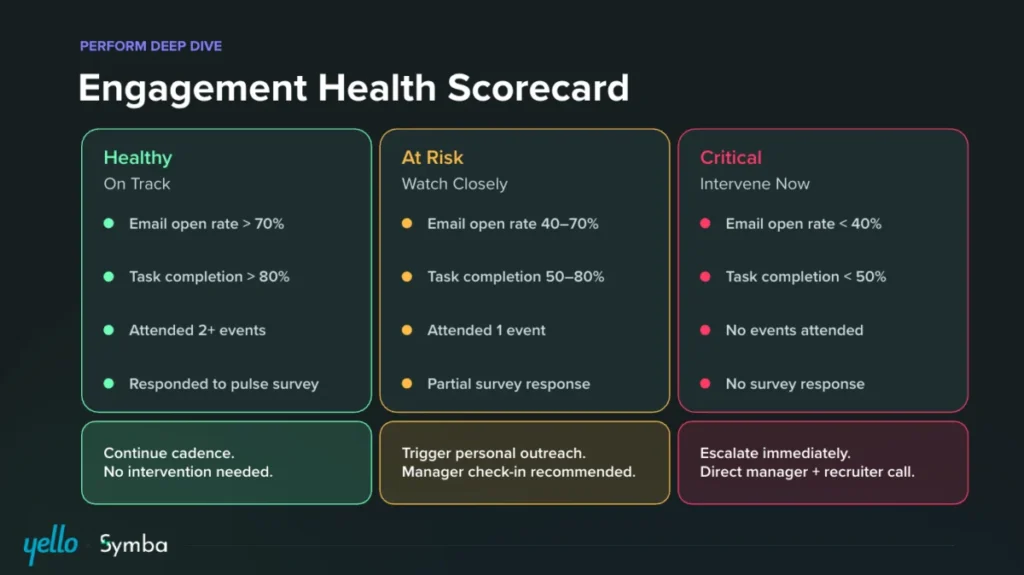
At the heart of this proactive approach is a structured system, often referred to as an "Engagement Health Scorecard." This tool categorizes candidates into distinct groups based on their observable behavior during the pre-start phase, providing clear thresholds and recommended actions for each tier. This systematic monitoring transforms what was once an opaque period into a transparent and actionable phase of the recruitment lifecycle.
1. Healthy Candidates: Sustaining Momentum
Candidates categorized as "Healthy" exhibit strong and consistent engagement. This group typically demonstrates email open rates exceeding 70%, promptly completes any requested onboarding tasks, actively participates in pre-start events (such as virtual meet-and-greets, informational webinars, or team social gatherings), and provides timely responses to surveys. Their behavior indicates continued enthusiasm and commitment to joining the organization.
- Behavioral Indicators: High email interaction, task completion, active event attendance, responsive to communications.
- Recommended Action: For healthy candidates, the strategy is to "continue the cadence and stay the course." This involves maintaining the established communication schedule, providing relevant pre-onboarding information, and ensuring they feel supported and informed without being overwhelmed. The goal is to reinforce their positive decision and nurture their excitement. This sustained engagement helps solidify their commitment and reduces the likelihood of external factors swaying their decision.
2. At-Risk Candidates: Targeted Intervention
The "At-Risk" category flags candidates who show a discernible decline in their engagement levels. Their email open rates might fall within the 40-70% range, their attendance at pre-start events may be limited, and their survey responses might be incomplete or delayed. This dip in engagement serves as a critical warning sign that the candidate might be reconsidering their options or facing external pressures.
- Behavioral Indicators: Moderate email interaction, sporadic task completion, limited event attendance, incomplete survey responses.
- Recommended Action: These candidates require swift, personal outreach within 48 hours of their engagement signals shifting into the "At-Risk" tier. The intervention should feel highly individualized rather than generic. This might include a direct message or call from the program manager, a personalized invitation to an upcoming event tailored to their interests, or a check-in from the prospective hiring manager. The aim is to re-establish a personal connection, understand any potential concerns, and address them proactively. Often, a timely, empathetic conversation can quickly re-engage the candidate and alleviate uncertainties.
3. Critical Candidates: Immediate Escalation and Root Cause Analysis
"Critical" candidates represent the highest level of concern. They exhibit almost no engagement, with email open rates dropping below 40%, no attendance at any pre-start events, no survey responses, and a complete lack of activity for three or more weeks. This profound disengagement strongly indicates that the candidate is either on the verge of reneging or has already made the decision to withdraw.
- Behavioral Indicators: Very low to no email interaction, no task completion, no event attendance, no survey responses, prolonged silence.
- Recommended Action: This tier demands immediate and high-level escalation. A direct phone call from the hiring manager is often the most impactful first step, demonstrating the organization’s genuine interest and commitment. This should be followed by a personal touchpoint from the recruiter, facilitating a genuine, open conversation about what might be happening. The goal is not just to re-engage, but to understand the root cause of their disengagement. Common reasons include competing offers, unforeseen personal circumstances, or simple uncertainty about the role or organization. By catching these issues in time, organizations can sometimes address the underlying concerns, offer solutions, or provide additional information that can sway the candidate back. For example, if a competing offer is the issue, there might be room for negotiation or a re-articulation of the value proposition. If personal circumstances are at play, flexibility or support might be offered.
The Pre-Start Period: A Critical Window for Nurturing Talent
The period between offer acceptance and the first day of employment is often underestimated in its strategic importance. It’s a time when candidates, particularly those in high demand, are still being courted by other organizations or may be experiencing "cold feet" as they transition. Failing to maintain engagement during this phase leaves a vacuum that can easily be filled by external influences or internal doubts. A well-executed pre-start engagement strategy reinforces the candidate’s decision, builds excitement, integrates them into the company culture even before their official start, and significantly reduces the likelihood of a renege. This period is not merely administrative; it is a crucial phase of relationship building and commitment solidification.
Broader Implications: Enhancing Employer Brand and Talent Stability
The implementation of a sophisticated engagement health scorecard and its associated proactive strategies has far-reaching implications beyond simply reducing reneges. It significantly enhances the employer brand, demonstrating to candidates that the organization values them from the moment they accept an offer. This level of care and attention can differentiate a company in a crowded market. Furthermore, a stable talent pipeline, free from unexpected withdrawals, allows for more predictable project planning, better resource allocation, and a smoother transition for new hires. It fosters a culture of continuous engagement, extending the principles of candidate experience beyond the interview process into the pre-onboarding phase.
According to a LinkedIn report, companies with a strong employer brand see 28% lower turnover and 50% lower cost-per-hire. Proactive pre-start engagement directly contributes to these metrics by ensuring candidates who accept offers actually start, reducing the need for costly backfills and fostering a positive initial impression that can translate into long-term retention.
Integrating Technology and Continuous Improvement
Modern HR technology platforms are increasingly integrating features that support this proactive approach, automating engagement touchpoints, tracking metrics, and flagging at-risk candidates. These systems provide the data infrastructure necessary to implement an Engagement Health Scorecard effectively. Organizations that successfully retain candidates are almost invariably those that continuously monitor data, not just react when a renege email arrives. They understand that talent acquisition is an ongoing process of relationship management, not a transactional exchange. Resources like "The KEEP Playbook," for instance, offer comprehensive guidance, including full engagement health scorecards with detailed thresholds, step-by-step intervention playbooks, and post-cycle review templates. This enables organizations to analyze what worked, what didn’t, and continuously refine their strategy with every recruitment cycle, ensuring iterative improvement in their candidate retention efforts.
In conclusion, the era of passively awaiting a candidate’s start date is over. The current talent landscape demands a proactive, data-driven approach to candidate engagement. By leveraging tools like the Engagement Health Scorecard, organizations can identify and address potential disengagement early, transforming the pre-start period into a strategic phase for nurturing talent, safeguarding investments, and building a more resilient workforce. The difference between teams that retain candidates and those that consistently scramble to backfill is almost always rooted in this fundamental distinction: continuous data-driven engagement versus reactive crisis management.