
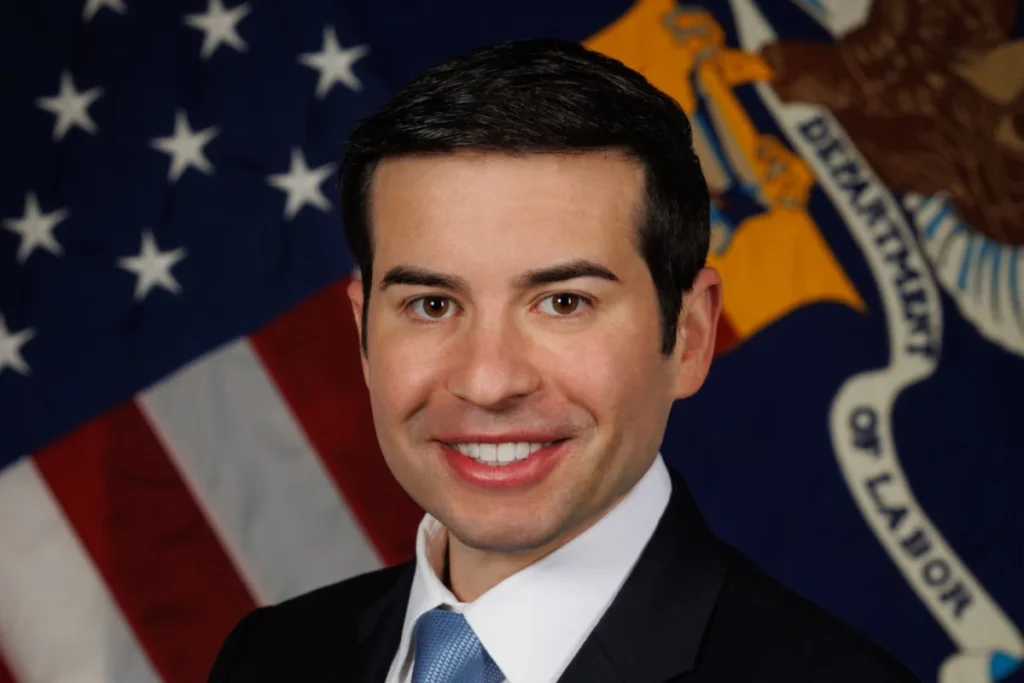
President Trump announced Monday on his TruthSocial page that he will nominate acting U.S. Secretary of Labor Keith Sonderling to the position in a permanent capacity. This move signals a continuation of the administration’s workforce policies and sets the stage for a potentially significant Senate confirmation battle in an election year. Sonderling has served in the interim role since April, following the abrupt departure of the previous Trump pick, Lori Chavez-DeRemer, amid misconduct accusations.
The announcement positions Sonderling, a figure well-known in legal and human resources technology circles for his focus on artificial intelligence and gig economy regulation, at the helm of a crucial federal agency responsible for the welfare of America’s workforce. "Throughout his career, Keith has proven his dedication to delivering strong results for the hardworking people of our country, and I know he will do an incredible job in his new role," Trump wrote, endorsing Sonderling’s capabilities to lead the Department of Labor (DOL). Sonderling’s nomination now moves to the Senate for confirmation, where he will face scrutiny from various stakeholders, including labor unions, business advocates, and technology groups.
The Department of Labor: A Pivotal Agency
The U.S. Department of Labor is a cabinet-level agency responsible for administering and enforcing over 180 federal laws. These mandates cover a wide array of workplace activities for approximately 165 million American workers and 11 million workplaces, including occupational safety and health, wage and hour standards, unemployment insurance benefits, reemployment services, and some economic statistics. With an annual budget exceeding $12 billion and a workforce of over 15,000 employees, the DOL plays a critical role in shaping the economic landscape and ensuring fair and safe working conditions across the nation.
The Secretary of Labor serves as the principal advisor to the President on labor policy and is responsible for implementing the administration’s agenda concerning worker protections, employment opportunities, and workforce development. The individual appointed to this role holds immense influence over regulations affecting everything from minimum wage and overtime rules to employee benefits and workplace discrimination. Given the current economic climate, characterized by evolving labor markets, technological disruption, and ongoing debates about worker classification, the leadership of the DOL is more critical than ever.
A Swift Transition: From Interim to Nominee
Keith Sonderling’s path to the nomination began earlier this year under unexpected circumstances. He stepped into the acting Secretary role in April after Lori Chavez-DeRemer, who had been President Trump’s initial choice for the permanent position, withdrew her nomination. Chavez-DeRemer, a former mayor and U.S. Representative from Oregon, abruptly stepped down amid unspecified misconduct accusations, leaving a vacuum at the top of the department. This sudden change underscored the challenges inherent in presidential appointments, particularly in a politically charged environment.
Before Sonderling took over the DOL on an interim basis, he served as Deputy Secretary of Labor. This prior role provided him with intimate knowledge of the department’s operations and policy objectives, facilitating a smoother transition into the acting leadership position. The Senate had confirmed him as Deputy Secretary in a 53-46 vote, indicating that he had already navigated the congressional approval process, albeit for a different capacity. This prior experience could prove advantageous during his upcoming confirmation hearings for the top post.
Upon the announcement of his permanent nomination, Sonderling expressed his gratitude and commitment. "I am deeply grateful to President Trump for his trust and confidence, for nominating me as the next United States Secretary of Labor," Sonderling wrote Monday on his LinkedIn page. He further reflected on his tenure within the administration, stating, "Serving in both of President Trump’s administrations has been one of the greatest privileges of my life." If confirmed, he articulated his eagerness to "continuing that service… and advancing the president’s agenda on behalf of America’s workers, families, unions and job creators." This statement aligns with a broader pro-business, deregulation-focused platform often associated with Trump’s policies.
Keith Sonderling’s Extensive Career and HR Connections
Sonderling’s career trajectory demonstrates a consistent engagement with labor law, regulatory policy, and emerging workplace issues. Before his role as Deputy Secretary, he served as a Commissioner with the Equal Employment Opportunity Commission (EEOC). This experience was particularly formative, making him a known entity within HR tech communities. At the EEOC, he frequently weighed in on critical issues, including the burgeoning risks associated with artificial intelligence in the workplace. His involvement extended to major industry forums, such as the HR Technology Conference, where he engaged directly with practitioners and innovators on the practical implications of AI.

His tenure at the EEOC and subsequent roles have established him as a leading voice on AI governance in employment. Sonderling has publicly criticized what he perceives as a growing patchwork of state AI laws, advocating instead for a more uniform federal approach. He has consistently emphasized the dual responsibility of employers and vendors in preventing AI-driven discrimination, asserting that the ultimate liability rests with the employer. "Whether it’s designed improperly or used improperly, employers are going to be 100% liable for whatever decisions these tools are making," Sonderling told the audience at HR Tech in 2024, underscoring his firm stance on accountability.
Beyond regulation, Sonderling has also championed initiatives aimed at preparing the American workforce for the age of AI. He has been credited with the creation of the AI Literacy Framework and an accompanying text-based AI training program for American workers. These initiatives reflect a proactive approach to addressing the skills gap and ensuring workers are equipped to thrive alongside new technologies, rather than being displaced by them. Such programs are crucial given projections that AI could automate millions of jobs while simultaneously creating new ones, necessitating a robust upskilling and reskilling infrastructure.
Shaping Policy: Gig Economy and Wage & Hour Standards
Sonderling’s influence extends significantly to the gig economy and the enforcement of the Fair Labor Standards Act (FLSA). During his time at the helm of the Wage and Hour Division (WHD) at the DOL, a period that predates his Deputy Secretary role, Sonderling authored an opinion letter classifying gig workers as employees for purposes of the FLSA. This stance was a notable departure from the prevailing narrative pushed by many gig economy companies, which typically classify their workers as independent contractors.
However, the regulatory landscape for gig workers has been a dynamic battleground. The rule classifying gig workers as employees, championed by Sonderling, was subsequently overturned when President Biden took office, reflecting a shift in administrative priorities. The Biden administration, largely supported by labor unions, generally favors broader definitions of employment to ensure workers receive benefits and protections. Under the Trump administration, however, this rule has since been revised, moving back towards a more flexible interpretation that often favors the independent contractor model. Sonderling’s re-nomination suggests a strong likelihood that a Trump-led DOL would continue to pursue policies that support this independent contractor classification, potentially easing regulatory burdens on companies that rely heavily on the gig workforce.
Another key initiative from Sonderling’s WHD tenure is the creation of the Payroll Audit Independent Determination (PAID) Program. This program aims to drive self-audit compliance with FLSA among employers by allowing them to voluntarily come forward to correct wage and hour violations without facing penalties, provided they agree to pay back wages. He again rolled out this program over the last year, indicating a preference for compliance assistance and voluntary resolution over punitive enforcement actions. This approach aligns with the "deregulation" preference noted by legal experts Bradford J. Kelley and Lorenzo Riboni at labor and employment law firm Littler, who, when Sonderling was nominated to the Deputy Secretary position, observed his inclination towards deregulation and compliance assistance as guiding principles. These principles are expected to shape the coming priorities for the DOL on AI, gig economy, and other critical labor issues.
The Senate Confirmation Process: Potential Hurdles and Outlook
Sonderling’s nomination will now undergo the rigorous Senate confirmation process. This typically involves a review by the Senate Health, Education, Labor, and Pensions (HELP) Committee, followed by a full vote by the entire Senate. Given his previous confirmation as Deputy Secretary, much of his professional background has already been scrutinized. However, the Secretary of Labor position carries significantly more weight and political visibility, especially during a presidential election year.
The HELP Committee, currently chaired by Senator Bernie Sanders (I-VT), is likely to conduct thorough hearings. Senator Sanders and other Democratic members are expected to focus on Sonderling’s stance on worker protections, union rights, minimum wage, and the classification of gig workers. His previous efforts to classify gig workers as employees could be framed by Democrats as insufficient or inconsistent with broader worker advocacy, while Republicans might highlight his later moves to revise such classifications as necessary flexibility for businesses. His views on AI regulation will also be a key topic, with some senators potentially pushing for more robust federal oversight to protect against algorithmic bias and job displacement.
Labor unions, such as the AFL-CIO and SEIU, are expected to closely monitor the confirmation process. Historically, these organizations advocate for policies that strengthen collective bargaining, expand worker benefits, and ensure robust enforcement of labor laws. A nominee with a stated preference for deregulation and a flexible approach to worker classification may face strong opposition from these groups. Conversely, business associations like the U.S. Chamber of Commerce and various tech industry lobbies might express support for a nominee perceived as promoting economic flexibility and easing regulatory burdens on employers.
The political dynamics of the Senate will play a crucial role. A simple majority is required for confirmation. In a closely divided Senate, every vote will count, and bipartisan support, even if limited, could be essential. The timing of the nomination, just months before a presidential election, also adds a layer of complexity. Both parties will likely use the confirmation hearings as a platform to articulate their broader visions for the American workforce and economy.
If confirmed, Sonderling would lead the DOL during a critical period of economic transformation. His background suggests a continued emphasis on adapting labor policy to technological advancements, fostering a flexible labor market, and promoting compliance through programs like PAID. His permanent appointment would solidify a distinct direction for the DOL, one that prioritizes employer flexibility and innovation while navigating the evolving challenges of the modern workplace, particularly in areas like artificial intelligence and the gig economy. The confirmation process will undoubtedly provide a clearer picture of the future trajectory of federal labor policy under a potential second Trump administration.







