The Equal Employment Opportunity Commission (EEOC) concluded its 2025 fiscal year on September 30, revealing a litigation landscape that has undergone a seismic shift in both volume and ideological direction. Following a year that many legal analysts initially predicted would be a "watershed" for government-led workplace enforcement, the agency instead filed just 93 merit lawsuits, marking a ten-year low and one of the quietest periods in the Commission’s three-decade history. This precipitous drop in activity follows a turbulent transition period characterized by unprecedented leadership changes, the loss of a functional quorum, and a sharp pivot in enforcement priorities under the second Trump Administration. While the agency entered the fiscal year with a robust budget and a significant backlog of charges from the Biden era, the implementation of new executive orders and a focused redirection of resources toward religious liberty and "biological truth" has fundamentally altered the federal approach to workplace discrimination.
A Year of Institutional Transformation and Leadership Upheaval
The trajectory of the EEOC’s 2025 fiscal year cannot be understood without examining the rapid administrative overhaul that took place in early 2025. Following the presidential inauguration, the Trump Administration moved with unexpected speed to reshape the agency’s leadership. In late January, President Trump elevated Andrea Lucas to Acting Chair and terminated General Counsel Karla Gilbride. In a move that legal scholars have described as unprecedented, the administration also fired Commissioners Charlotte Burrows and Jocelyn Samuels, despite both having several years remaining on their appointed terms.
These dismissals left the EEOC without a quorum, as only Acting Chair Lucas and Commissioner Kalpana Kotagal remained. Under standard agency protocols, the absence of a quorum significantly constrains the EEOC’s ability to initiate high-impact litigation. While the General Counsel retains a delegated authority to file "routine" cases, they are generally barred from initiating lawsuits involving systemic discrimination, pattern-or-practice allegations, or cases that require major expenditures of agency resources. This administrative paralysis is a primary factor behind the low filing numbers, as the agency was effectively blocked from pursuing the large-scale class actions that typically bolster its annual statistics.
Chronology of the 2025 Fiscal Year
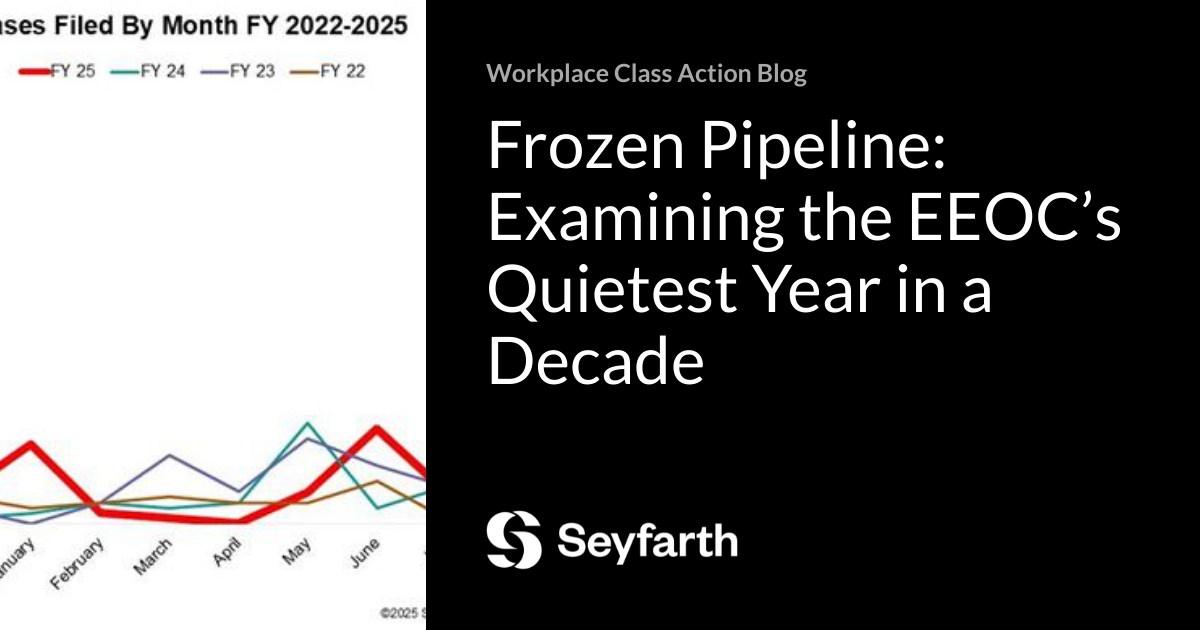
The 2025 fiscal year followed a unique monthly rhythm that reflected the political transition. Typically, the EEOC starts its fiscal year (which begins October 1) slowly, building momentum toward a massive surge in September. However, FY 2025 broke this pattern:
- October 2024 – January 2025: The agency filed 24 lawsuits in the first four months. January alone saw 15 filings, a spike attributed to enforcement personnel attempting to move cases through the pipeline before the change in administration.
- January 20, 2025: The inauguration brought an immediate shift in policy, highlighted by an executive order titled “Defending Women From Gender Ideology Extremism and Restoring Biological Truth to the Federal Government.”
- February – May 2025: Litigation activity slowed significantly as new leadership reviewed the existing docket and realigned staff priorities.
- June 2025: A brief mid-year surge saw 18 lawsuits filed, many of which focused on the new administration’s priority areas, such as religious accommodation.
- September 2025: The traditional "September Surge" resulted in only 35 filings. For comparison, the agency filed 71 lawsuits in September 2023 and 56 in September 2024.
Geographic Disparities in Enforcement Activity
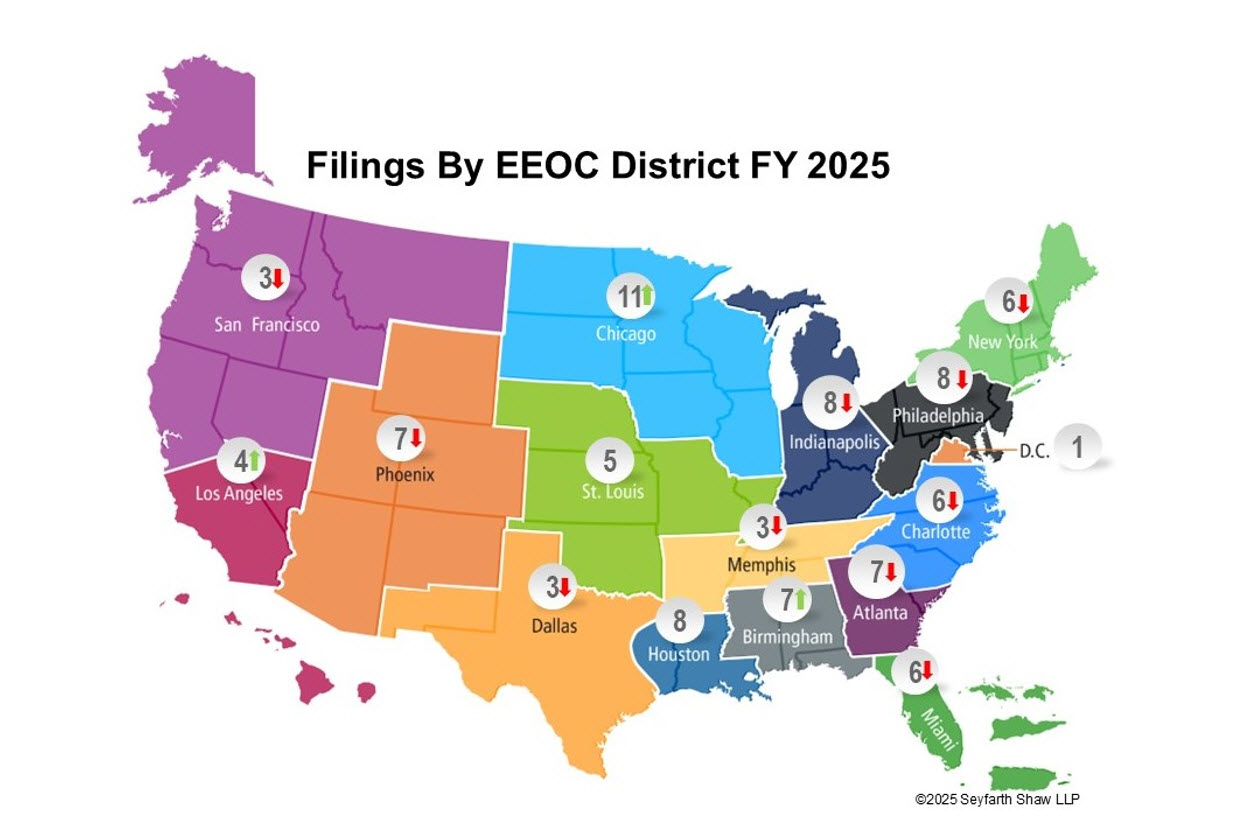
The 2025 data highlights a continuing trend of decentralization within the EEOC’s 15 District Offices. While national numbers were down, certain regions remained disproportionately active. The Chicago District Office led the nation with 11 merit lawsuits, followed closely by Philadelphia, Indianapolis, and Houston, each with eight filings.
In contrast, historically aggressive offices on the West Coast and in the Northeast saw their activity crater. The Los Angeles and San Francisco offices filed only four and three lawsuits, respectively, while the New York office filed six. This marks a stark departure from the Obama-era EEOC, where West Coast offices frequently filed dozens of lawsuits annually. Legal analysts suggest this geographic shift reflects a focus on industries more prevalent in the Midwest and South, as well as a potential reallocation of regional budgets toward districts that align more closely with the current administration’s enforcement philosophy.
Analytical Breakdown of Claim Types and Statutory Focus
An analysis of the 93 lawsuits filed in FY 2025 reveals a strategic narrowing of the EEOC’s focus. While the Americans with Disabilities Act (ADA) and Title VII remain the primary vehicles for litigation, the specific nature of the claims within those statutes has shifted.

The Americans with Disabilities Act (ADA)
Despite the overall decline in filings, the ADA remained a top priority with 34 lawsuits. However, the EEOC moved away from broad "policy-based" challenges and toward individual cases involving hearing and vision impairments. There was also a notable increase in cases involving "invisible" disabilities, such as PTSD, anxiety, and depression. This suggests that while the agency is filing fewer cases, it is targeting specific areas of accommodation that it believes are being overlooked by modern employers.
Sex and Pregnancy Discrimination
The EEOC filed 37 cases related to sex or pregnancy, a significant portion of the total docket. Much of this activity was driven by the newly enacted Pregnant Workers Fairness Act (PWFA). Acting Chair Andrea Lucas has publicly stated that protecting "biological women" in the workplace is a cornerstone of her tenure. This focus on pregnancy and traditional sex discrimination came at the direct expense of LGBTQ-related litigation.
The Retreat from LGBTQ+ Advocacy
One of the most dramatic shifts in FY 2025 was the EEOC’s reversal on gender identity and sexual orientation cases. Early in the fiscal year, under the previous administration’s guidance, the agency filed two significant lawsuits concerning transgender workers: EEOC v. Starboard Group, Inc. and EEOC v. Brik Enterprises, Inc. Following the January executive orders, the EEOC moved to dismiss both actions. While private plaintiffs intervened to continue those specific cases, the Commission has not filed a single LGBTQ-related lawsuit since the change in leadership, marking a total cessation of advocacy in this area.
Religious Freedom and the "Woke" Policy Pivot
Religious discrimination emerged as a primary growth area for EEOC litigation. In FY 2025, the Commission filed 11 lawsuits asserting religious discrimination or failure to accommodate religious beliefs. This represents a reaction to the 600% increase in religious discrimination charges that began during the COVID-19 pandemic. Acting Chair Lucas framed this shift as a restoration of "evenhanded enforcement," arguing that religious protections had previously "taken a backseat to woke policies."

Race and National Origin: A Focus on "Reverse Discrimination"
Filings asserting race or national origin discrimination plummeted to a ten-year low of just three lawsuits. Notably, two of these three cases involved theories of "reverse discrimination" or "anti-American bias." This includes EEOC v. Seward and Son Planting Co., which alleged that an employer gave preference to non-American workers over Black American citizens. This aligns with the agency’s February 2025 commitment to protecting American workers from "anti-American bias" in hiring and retention.
Official Responses and Inferred Reactions
The EEOC’s new leadership has been vocal about the rationale behind these shifts. In public statements and press releases throughout 2025, Acting Chair Lucas has emphasized a "back to basics" approach that prioritizes statutory mandates over what she characterizes as "social engineering."
Internal reactions within the agency, however, suggest a period of significant friction. Reports from field offices indicate that the loss of a quorum and the sudden dismissal of long-term commissioners created a "chilling effect" on career enforcement staff. Budget cuts, aimed at reducing the agency’s footprint, have also led to a reduction in the number of investigators, which may explain why the "pipeline" of charges—despite being full at the start of the year—did not result in a higher volume of litigation.
Industry groups and employer advocates have largely welcomed the shift toward more predictable enforcement, particularly the focus on religious accommodation and the pullback from novel gender identity theories. Conversely, civil rights organizations have expressed concern that the EEOC is abandoning its mission to protect the most vulnerable segments of the workforce.
Broader Impact and Implications for Employers
The "sluggish" nature of FY 2025 should not lead employers into a false sense of security. While the EEOC is filing fewer lawsuits, the cases it does file are highly targeted and reflect a specific ideological agenda.
- The "Follow-the-Leader" Phenomenon: Historically, the private plaintiffs’ bar monitors EEOC filings to identify lucrative areas for class-action litigation. Even if the EEOC retreats from LGBTQ+ or systemic race cases, private attorneys are likely to fill the void, using the EEOC’s previously established theories of liability.
- Focus on Healthcare and Regional Businesses: FY 2025 data shows a willingness by the EEOC to sue smaller, regional entities and healthcare providers. Employers in these sectors should be aware that they are no longer "under the radar."
- The Quorum Factor: If the Senate confirms new commissioners in FY 2026, the EEOC will regain its quorum. This would likely lead to a sudden and significant increase in systemic litigation as the agency seeks to make up for lost time.
- Compliance Priorities: Employers should immediately review their religious accommodation and pregnancy leave policies. These are the "hot button" issues that the current EEOC is most likely to litigate.
As the EEOC enters FY 2026, the agency remains a study in transition. With 93 filings, the Commission has signaled a preference for quality over quantity—or perhaps more accurately, ideology over volume. For the American business community, the message is clear: federal oversight has not disappeared; it has simply changed its face.