
The year 2026 marks a pivotal moment in talent acquisition, as artificial intelligence (AI) candidate sourcing tools have transitioned from innovative novelties to essential components of any competitive hiring strategy. While traditional job boards continue to generate a high volume of applicants, industry analysis, notably Gem’s 2026 Recruiting Benchmark Reports, reveals a stark reality: sourced candidates are an astounding eight times more likely to be hired than those who apply through conventional channels. This data underscores a fundamental shift in recruitment dynamics, where proactive, intelligent sourcing of passive talent—individuals who may not be actively seeking new roles but possess desirable skills—is now the primary driver of successful hires. The era of merely posting and praying for applications is definitively over; companies failing to embrace sophisticated AI sourcing risk leaving their most valuable potential employees untapped.
The Paradigm Shift in Talent Acquisition
For decades, the recruitment process largely revolved around reactive methods. Companies would post job openings on various boards, career sites, and newspapers, then sift through the ensuing deluge of applications. This approach, while generating high volume, often suffered from inefficiency, a high signal-to-noise ratio, and a tendency to overlook highly qualified passive candidates. The digital revolution brought online job boards and applicant tracking systems (ATS), streamlining the application process but not fundamentally altering the reactive nature of sourcing.
The emergence of AI in the early 2020s began to challenge this status quo. Initially, AI tools focused on automating routine tasks, improving resume screening, and enhancing candidate experience. However, by 2024-2025, advancements in machine learning, natural language processing (NLP), and big data analytics propelled AI into the realm of proactive candidate sourcing. These tools began to analyze vast datasets—including professional networks, public profiles, academic records, and even open-source contributions—to identify individuals whose skills, experience, and potential aligned perfectly with specific job requirements, even if they hadn’t applied.
The 2026 Gem report, which aggregated data from thousands of companies globally, solidified this trend. It highlighted that while job boards accounted for a significant portion of initial applications, the ultimate hires predominantly stemmed from referrals, internal mobility programs, and, most significantly, direct sourcing efforts powered by AI. This data suggests that the sheer volume generated by job boards often includes a higher proportion of candidates who are either not a strong fit or are applying broadly without specific interest, leading to lower conversion rates. Conversely, candidates identified through targeted sourcing are typically pre-qualified, better aligned with the company culture, and often possess specialized skills not readily available among active job seekers.
The Mechanics of Modern AI Candidate Sourcing
Modern AI candidate sourcing tools go far beyond simple keyword matching. They leverage sophisticated algorithms to perform semantic searches, understanding the nuances of job descriptions and candidate profiles. This allows them to identify "hidden gems" whose experience might not perfectly match a keyword but whose underlying skills and career trajectory indicate a strong fit. Key capabilities include:
- Semantic Search and Matching: AI interprets the meaning and context of job requirements, identifying candidates whose skills and experience align conceptually, rather than just literally, with keywords. This helps uncover talent that might be missed by traditional Boolean searches.
- Predictive Analytics: These tools can analyze historical hiring data and market trends to predict candidate fit, retention likelihood, and even potential for growth within an organization. They can also forecast future talent needs based on business objectives.
- Automated Personalized Outreach: Once suitable candidates are identified, AI systems can craft and deploy highly personalized outreach messages across multiple channels (email, LinkedIn, etc.). These messages are tailored based on the candidate’s public profile, professional interests, and career trajectory, significantly increasing engagement rates.
- Talent Pool Mapping and Market Intelligence: AI provides real-time insights into talent availability, salary benchmarks, skill gaps, and competitive landscapes. This strategic intelligence allows companies to make data-driven decisions about their hiring priorities and compensation packages.
- Diversity and Inclusion Enhancement: Many leading AI sourcing tools incorporate features designed to mitigate unconscious bias. They can identify underrepresented groups, anonymize initial candidate profiles to focus on skills, and track diversity metrics throughout the pipeline, helping companies build more inclusive workforces.
- Seamless ATS/CRM Integration: To ensure a smooth workflow, these tools integrate seamlessly with existing Applicant Tracking Systems (ATS) and Candidate Relationship Management (CRM) platforms, allowing recruiters to manage sourced candidates alongside applicants, track interactions, and move them through the hiring funnel efficiently.
Leading AI Sourcing Solutions in 2026
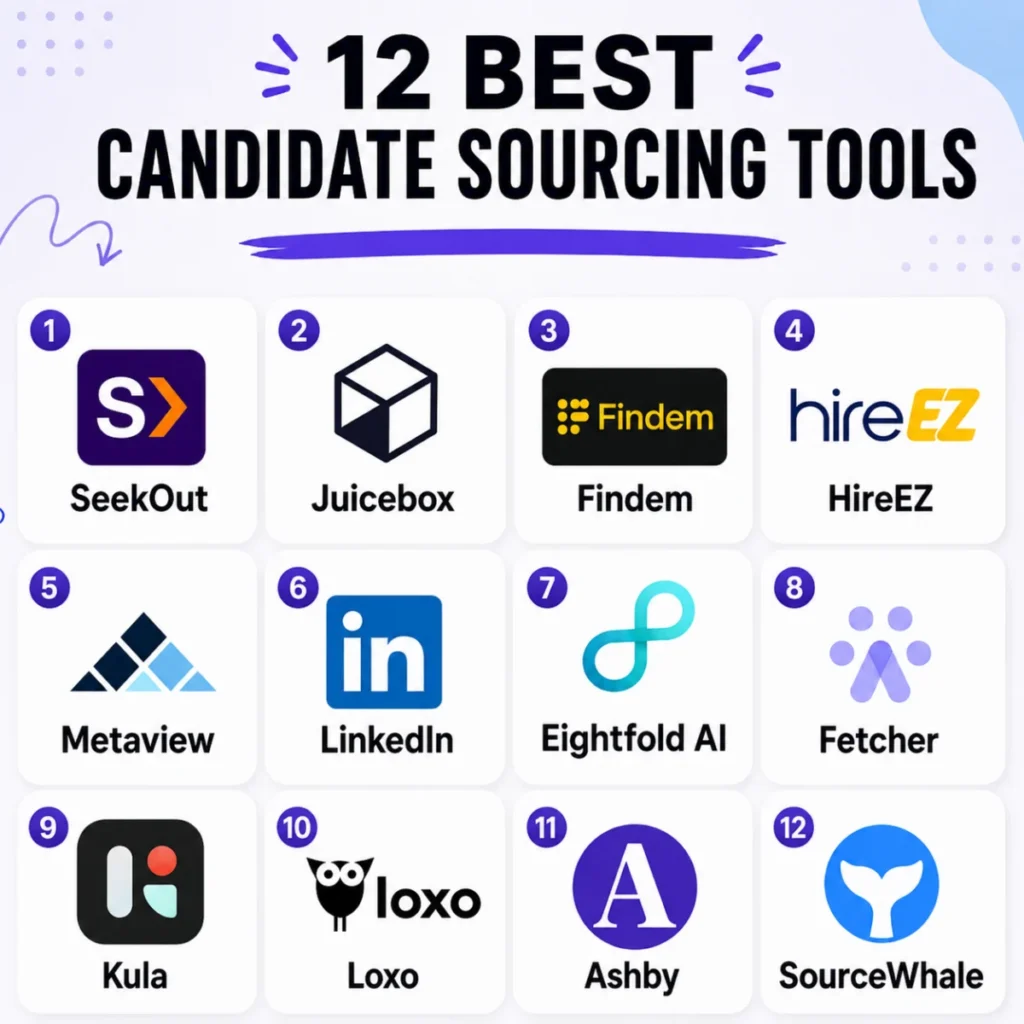
The market for AI candidate sourcing tools is dynamic and competitive, with a range of solutions catering to different organizational needs and scales. Here’s a deeper look at some of the top contenders in 2026:
- SeekOut: Renowned for its prowess in sourcing hard-to-find technical talent, SeekOut utilizes advanced AI to scour vast databases, including GitHub, Stack Overflow, and academic publications, alongside traditional professional networks. Its strength lies in deep technical skill matching, identifying individuals with niche expertise in areas like AI/ML, cybersecurity, and advanced engineering, and providing insights into their contributions and influence within developer communities. It offers robust diversity filters and powerful analytics to help companies achieve their DEI goals in tech hiring.
- Juicebox: This tool stands out for its intuitive natural-language candidate search and sophisticated automated outreach capabilities. Recruiters can use conversational queries to describe their ideal candidate, and Juicebox’s AI interprets these requests to generate highly relevant candidate lists. Its automated outreach sequences are designed to be highly personalized and adaptive, learning from engagement data to optimize future communications and improve response rates.
- Findem: A leader in diversity hiring and talent market data, Findem leverages attributes-based AI to identify candidates based on a holistic set of criteria, moving beyond keywords to assess experience, potential, and alignment with diversity objectives. It provides comprehensive talent market intelligence, allowing companies to benchmark their talent against competitors and identify strategic hiring opportunities. Its focus on bias mitigation algorithms makes it a powerful tool for building equitable talent pipelines.
- HireEZ: Specializing in outbound sourcing at scale, HireEZ empowers recruiting teams to identify, engage, and manage thousands of potential candidates efficiently. It integrates with numerous professional networks and public data sources, offering extensive candidate profiles and contact information. Its AI-driven outreach features allow for multi-channel communication, tracking engagement, and automating follow-ups, making it ideal for high-volume recruitment needs.
- Metaview: This innovative platform focuses on autonomous AI sourcing agents, effectively delegating the initial candidate identification and vetting processes to intelligent AI. Metaview’s agents can proactively search, engage, and even conduct preliminary screening conversations with candidates, presenting recruiters with a curated list of highly qualified individuals ready for deeper interaction. This frees up recruiter time for strategic engagement and relationship building.
- LinkedIn Talent Insights / Recruiter AI: As an integral part of the LinkedIn ecosystem, these tools are indispensable for teams already heavily invested in the platform. LinkedIn’s vast professional network provides unparalleled access to candidate data. Talent Insights offers rich market data, competitor analysis, and talent pool insights, while Recruiter AI enhances search capabilities, recommends relevant candidates, and automates parts of the outreach process directly within the platform.
- Eightfold AI: Positioned as an enterprise talent intelligence platform, Eightfold AI offers a comprehensive suite of tools for talent acquisition and management. Its core strength lies in its deep learning AI, which can analyze a company’s entire talent ecosystem—internal and external—to identify skills, predict potential, and match individuals to roles. It’s particularly effective for large organizations seeking to optimize internal mobility, workforce planning, and external hiring simultaneously.
- Fetcher: Combining AI sourcing with a crucial human quality check, Fetcher offers a hybrid approach that ensures accuracy and relevance. Its AI identifies potential candidates, which are then reviewed and refined by human experts before being presented to recruiters. This blend minimizes the risk of irrelevant suggestions while maintaining the scalability of AI, making it ideal for companies that prioritize precision alongside volume.
- Kula: As an AI-native end-to-end hiring platform, Kula aims to integrate sourcing, engagement, and relationship management into a single, cohesive workflow. It leverages AI across the entire candidate journey, from initial identification to automated personalized communication and scheduling, striving to create a seamless and efficient experience for both recruiters and candidates.
- Loxo: This all-in-one sourcing and talent intelligence platform provides recruiters with a powerful database, AI search capabilities, and robust CRM functionalities. Loxo’s extensive talent database, combined with its predictive AI, allows for rapid identification of ideal candidates. Its integrated outreach tools facilitate personalized communication, and its analytics dashboard offers actionable insights into recruitment performance.
- Ashby: Designed for data-driven hiring teams, Ashby offers advanced analytics and reporting capabilities alongside its AI sourcing features. It helps companies track key metrics, understand their hiring funnel, and make informed decisions based on real-time data. Its AI aids in candidate identification and pipeline management, all within an environment optimized for detailed performance analysis.
- SourceWhale: Specializing in multi-channel outreach campaigns, SourceWhale enables recruiters to engage candidates effectively across various platforms. Its AI helps in discovering contact information and personalizing messages, while its automation features ensure consistent follow-ups and nurture sequences. It’s particularly strong for building relationships with passive candidates over time.
The Role of Job Description Optimization: The Ongig Advantage
While AI candidate sourcing tools excel at identifying the right talent, the effectiveness of engagement—and ultimately, conversion—heavily relies on the initial impression conveyed by job descriptions. This is where tools like Ongig play a critical, complementary role. Ongig focuses specifically on job description optimization, ensuring that the language used is not only attractive and clear but also inclusive, compliant, and optimized for search engines and AI interpretation.
Ongig stands out by leveraging AI to analyze job descriptions for:
- Inclusive Language: Identifying and eliminating biased or exclusionary terms, ensuring job posts appeal to a diverse range of candidates.
- Readability and Engagement: Enhancing clarity, conciseness, and tone to make job descriptions more compelling and easy to understand.
- Brand Voice Consistency: Ensuring all job postings reflect the company’s brand and culture accurately.
- Compliance: Flagging potential legal or regulatory issues related to job advertising.
- SEO Optimization: Using relevant keywords and phrasing to improve visibility on search engines and job boards, attracting a broader pool of initial applicants.
By optimizing job descriptions, Ongig ensures that the carefully sourced candidates are met with messaging that resonates, improving conversion rates and candidate experience. It’s an essential layer in a holistic AI-powered recruitment strategy, maximizing the return on investment from sourcing efforts.
Broader Impact and Implications for the Future of Work
The widespread adoption of AI candidate sourcing tools in 2026 has profound implications for the talent acquisition function and the broader employment landscape.
- Elevating the Recruiter Role: Recruiters are no longer merely administrators sifting through resumes. Their role is evolving into a more strategic one, focusing on relationship building, candidate experience, negotiation, and acting as talent advisors to hiring managers. AI handles the heavy lifting of identification and initial outreach, allowing recruiters to engage in higher-value activities.
- Addressing Skill Gaps and Talent Shortages: In an increasingly specialized global economy, AI sourcing provides a critical advantage in identifying candidates with rare or in-demand skills, helping companies bridge persistent talent gaps.
- Enhanced Diversity, Equity, and Inclusion (DEI): When properly configured and monitored, AI tools can significantly reduce unconscious bias in hiring, leading to more diverse and equitable workforces. The ability to identify candidates from underrepresented groups and track DEI metrics throughout the pipeline is a game-changer for organizational culture and innovation.
- Ethical Considerations and Governance: As AI becomes more integral, ethical considerations around data privacy, algorithmic bias, and transparency remain paramount. Industry standards and regulatory frameworks are continually evolving to ensure responsible AI deployment in HR. Companies must prioritize vendors that adhere to ethical AI principles and offer transparent explanations of their algorithms.
- Continuous Talent Intelligence: The future of AI in recruitment points towards continuous talent intelligence platforms that not only source for immediate needs but also proactively monitor the talent market, identify emerging skill trends, and build evergreen talent pipelines. This allows organizations to anticipate future workforce needs and adapt swiftly to market changes.
In conclusion, the data from 2026 unequivocally demonstrates that AI candidate sourcing tools are no longer a luxury but a fundamental necessity for organizations aiming to secure top talent and maintain a competitive edge. By leveraging these advanced technologies, companies can streamline their hiring processes, significantly improve candidate quality, foster greater diversity, and optimize their overall workforce strategies. The journey to successful hires in the modern era begins not just with a job posting, but with intelligent, proactive, and data-driven sourcing.






