
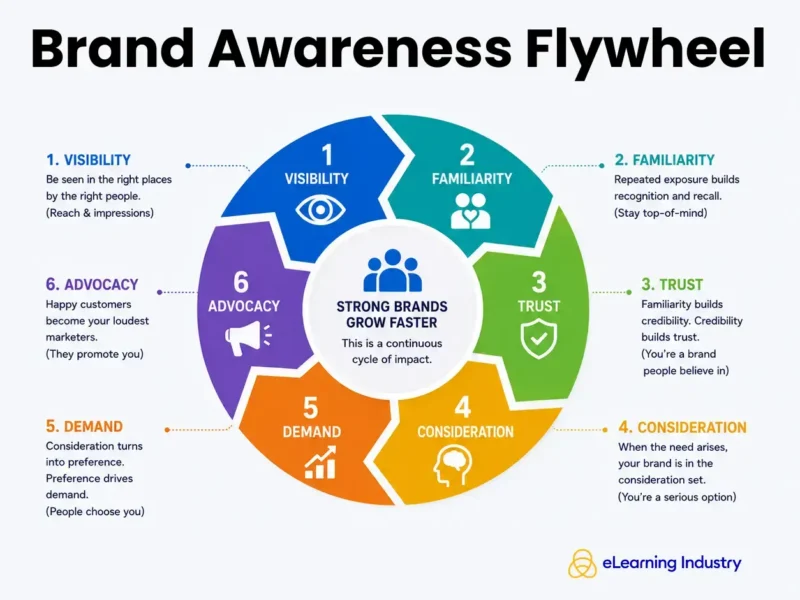
In an era where digital noise has reached an all-time high, the traditional distinction between "hard" sales metrics and "soft" brand awareness objectives is rapidly dissolving. Industry analysts and marketing executives now recognize that brand recognition is not merely a vanity metric but a foundational pillar of the B2B sales funnel. According to the 2024 B2B Buying Disconnect Report by TrustRadius, a staggering 78% of B2B buyers ultimately select products or services they were already familiar with before they even commenced their formal research process. This shift in buyer behavior underscores a critical reality: in a saturated market, being a "trusted name" is a prerequisite for being a "considered name."
The Strategic Shift: From Impressions to Mental Availability
The modern B2B landscape is characterized by increasingly long buying cycles and a growing number of stakeholders involved in every purchase decision. Consequently, the role of brand awareness has evolved. It is no longer sufficient to simply generate impressions; companies must now strive for "mental availability"—the probability that a buyer will think of a specific brand when a purchase need arises.
Market data suggests that the most successful brand awareness campaigns are those that move beyond the superficial. These campaigns focus on creating memorable experiences and strengthening the cognitive link between a company’s name and a specific solution or value proposition. By the time a prospect enters the active buying journey, a well-executed awareness strategy has already established the trust necessary to bypass competitors who are unknown to the decision-making committee.
A Chronology of Brand Building: The Evolution of Awareness Strategies
The approach to brand awareness has undergone several distinct phases over the last two decades. Understanding this timeline is essential for modern marketers looking to apply historical lessons to current strategies.
- The Broadcast Era (Pre-2010): Awareness was largely driven by high-budget television, print, and billboard advertising. Success was measured by reach and frequency, with little ability to target specific B2B decision-makers.
- The Content Revolution (2010–2018): Led by companies like HubSpot, the focus shifted to "Inbound Marketing." Brands began building awareness by providing educational value through blogs, whitepapers, and early-stage SEO.
- The Personalization and Data Era (2018–2023): Campaigns became highly targeted. Account-Based Marketing (ABM) allowed B2B firms to build awareness within specific high-value accounts using personalized digital experiences.
- The AI and Trust Era (2024–Present): With the rise of Generative AI and a saturated content market, awareness now hinges on thought leadership, "Generative Engine Optimization" (GEO), and building authentic communities that AI cannot replicate.
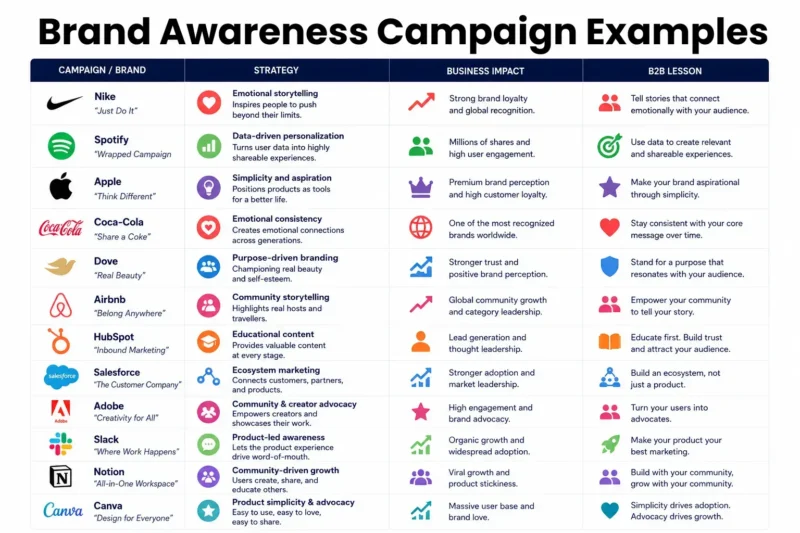
Analyzing Success: 12 Benchmark Brand Awareness Campaigns
To understand how global leaders maintain market dominance, it is necessary to analyze the specific mechanics of their awareness strategies. These examples provide a blueprint for B2B organizations seeking to scale their visibility.
1. Nike: The Power of Emotional Resonance
Nike’s strategy has long focused on "Emotional Storytelling." By aligning the brand with the universal values of ambition and perseverance rather than specific product features, Nike ensures it remains top-of-mind for anyone identifying as an "athlete." For B2B firms, the lesson is clear: connecting with the human aspirations of a client is often more effective than listing technical specifications.
2. Spotify: Data as a Social Currency
Through its "Spotify Wrapped" campaign, the streaming giant turned internal user data into a global social media phenomenon. This demonstrated that personalization is a powerful tool for organic brand advocacy. B2B companies can replicate this by providing clients with personalized industry insights or benchmarking data.
3. Apple: The Minimalism of Aspiration
Apple’s "Shot on iPhone" campaign successfully shifted the narrative from the camera’s megapixels to the creativity of the user. In the B2B world, this translates to focusing on customer outcomes rather than the mechanics of the software or service.
4. Coca-Cola: The Discipline of Consistency
Coca-Cola’s decades-long commitment to the themes of happiness and connection highlights the importance of message discipline. Brand recall is built through the relentless repetition of a core identity across every touchpoint.
5. Dove: Purpose-Driven Authority
By challenging industry norms regarding beauty, Dove built a deep emotional bond with its audience. B2B companies can achieve similar results by taking a stand on industry-wide challenges or ethical standards.
6. Airbnb: Community as the Brand
Airbnb’s focus on the stories of hosts and travelers transformed a booking platform into a community. For B2B organizations, building a user community or a partner ecosystem can create a self-sustaining awareness loop.
7. HubSpot: Education-First Marketing
HubSpot effectively "invented" the category of inbound marketing. By providing free certifications and massive amounts of educational content, they became the default resource for marketers worldwide, ensuring that when those marketers need a CRM, HubSpot is the first name they consider.
8. Salesforce: Ecosystem Dominance
Salesforce’s "Dreamforce" event and its "Trailhead" learning platform have created a global ecosystem of professionals whose careers are built on the brand. This level of integration makes the brand nearly impossible to ignore in the CRM space.
9. Adobe: Empowering the Creator
Adobe’s advocacy for creative professionals ensures the brand is synonymous with the industry itself. By showcasing user work, the brand becomes a partner in the user’s success.
10. Slack: Product-Led Viral Growth
Slack’s growth was driven by the product experience itself. By solving a specific pain point—email fatigue—and making the solution shareable, the brand achieved massive awareness through internal advocacy within organizations.
11. Notion: The Template Economy
Notion leveraged its user base to create and share templates, turning every user into a brand ambassador. This community-driven growth model is highly effective for SaaS companies looking to expand their footprint.
12. Canva: Democratizing Design
Canva’s success lies in its radical simplicity. By making design accessible to non-designers, they captured a massive segment of the market that previously felt excluded from professional design tools.
The New Frontier: SEO, GEO, and AI Visibility
As search behavior shifts, the mechanics of brand discovery are changing. Traditional Search Engine Optimization (SEO) remains vital for capturing organic traffic from Google, but a new discipline—Generative Engine Optimization (GEO)—is emerging.
With the integration of AI in search (such as Google’s AI Overviews and platforms like Perplexity or ChatGPT), brands must now optimize for "AI visibility." This involves ensuring that a company’s thought leadership and data are cited by large language models (LLMs). According to marketing technology experts, being mentioned as a recommended vendor by an AI is becoming as valuable as a top-three ranking on a traditional search results page.
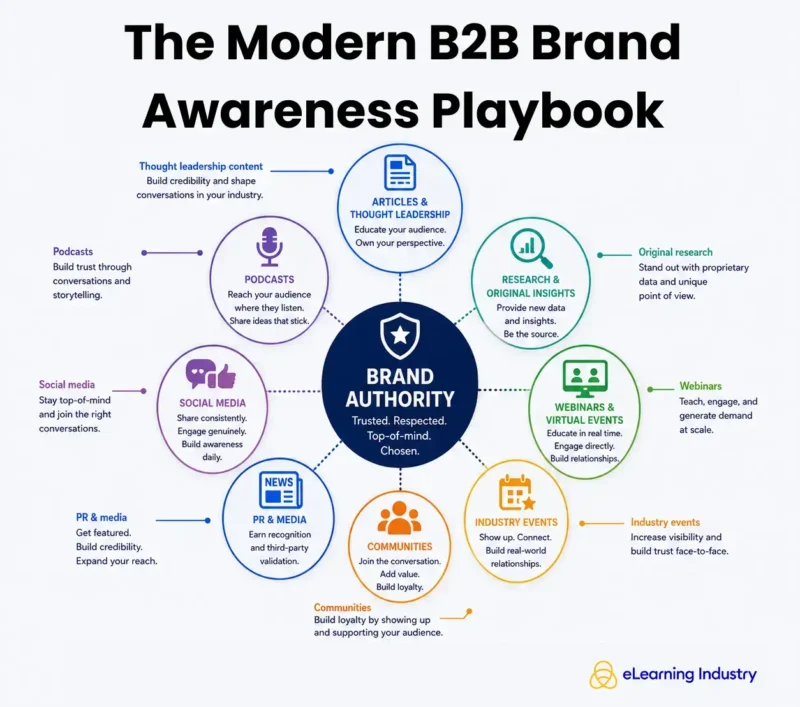
The TRUST Framework for B2B Awareness
To navigate this complex environment, organizations can adopt the TRUST framework, a systematic approach to building and maintaining brand authority:
- T – Tell a Clear Story: Define a unique value proposition that is easily understood and remembered.
- R – Reach the Right Audience: Use data-driven targeting to ensure messaging reaches decision-makers, not just a general audience.
- U – Use Multiple Channels: Diversify presence across podcasts, webinars, social media, and industry events.
- S – Stay Consistent: Maintain a unified voice and visual identity across all platforms to reinforce memory.
- T – Track Meaningful Metrics: Move beyond likes and views to track branded search volume, share of voice, and AI citations.
Expert Analysis: Implications for the 2025 Fiscal Year
Economists and market analysts suggest that as the B2B sector faces increased competition and potential economic volatility, the "brand moat" will become a company’s most valuable asset. Companies that invested in brand awareness during growth periods are showing higher resilience during market downturns.
"We are seeing a flight to quality," notes one senior industry analyst. "When budgets tighten, B2B buyers are less likely to take a risk on an unknown vendor. They return to the names they know, the names they trust, and the names that have consistently provided value through their content and community efforts."
Furthermore, the rise of "Dark Social"—the untrackable sharing of content through private messages and Slack groups—means that brand awareness is often working in ways that traditional attribution models cannot see. This necessitates a more holistic view of marketing impact, where "share of voice" is treated with the same gravity as "lead volume."
Conclusion: The Long-Term Value of the Known Brand
The evidence is clear: brand awareness is the bedrock of sustainable B2B growth. By studying the successes of global leaders and adapting to the technological shifts brought about by AI, companies can move from being a commodity to becoming an industry authority.
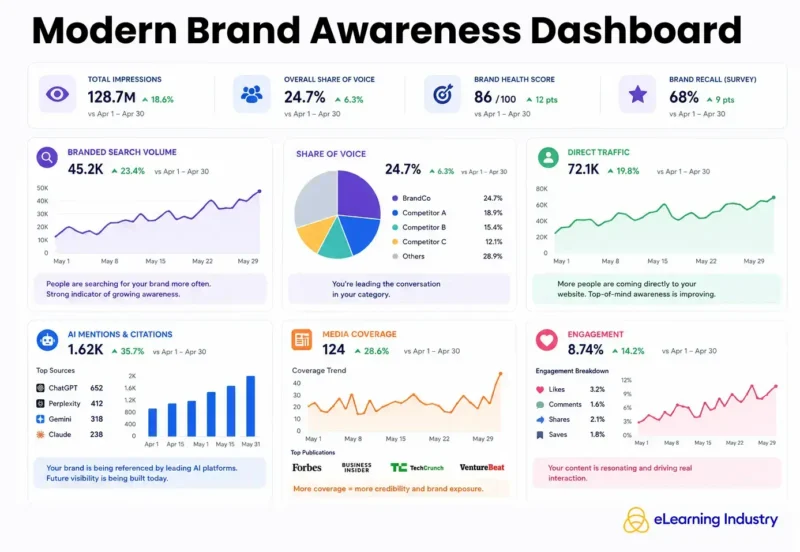
In the final analysis, the goal of a brand awareness campaign is not to make a sale today, but to ensure that when the buyer is ready to purchase tomorrow, your company is the only logical choice. As the B2B buying journey continues to migrate toward independent research and AI-assisted discovery, the value of being a "known quantity" will only continue to appreciate. Investing in a robust, multi-channel awareness strategy is no longer a marketing luxury—it is a strategic imperative for long-term commercial survival.






