
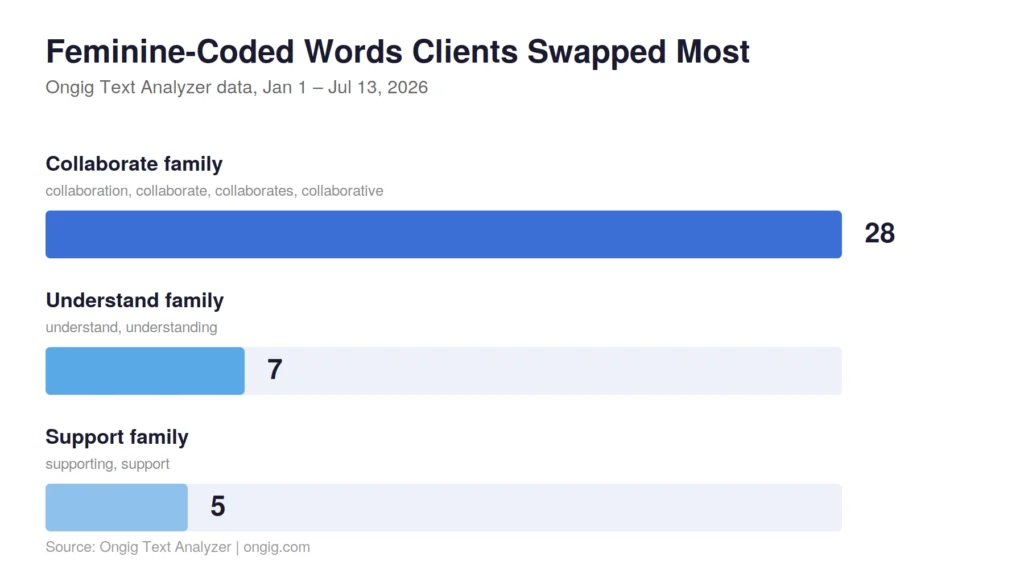
A significant shift in how recruitment technology identifies and addresses gender-biased language in job descriptions has illuminated new trends in 2026, with the "collaborate" family of words emerging as the dominant feminine-coded term actively swapped out by recruiters. This year’s analysis, conducted by Ongig using proprietary client data from January to mid-July 2026, marks a methodological departure from previous studies, focusing on direct user intervention rather than mere word frequency. The findings highlight an evolving understanding of linguistic bias in talent acquisition and underscore the ongoing efforts to foster more inclusive hiring practices globally.
The 2026 Data: A Real-Time Snapshot of Recruiter Action
For the first time, Ongig’s annual assessment of feminine-biased language moved beyond scanning vast pools of job postings for word frequency. Instead, the 2026 report leverages data from its Text Analyzer tool, tracking which specific words clients chose to replace or edit within their job descriptions. This innovative approach provides a more granular and actionable insight into the terms recruiters themselves identify as problematic and actively work to mitigate.
The "collaborate" family—encompassing "collaboration," "collaborate," "collaborative," and "collaborates"—stands out as the clear frontrunner among swapped feminine-coded words. This indicates a widespread recognition among recruiters that while teamwork is essential, the overuse of collaboration-related terms can inadvertently create a gendered impression, potentially deterring a broader range of candidates. Following closely were "understand" and "support," both consistently flagged for revision.
Interestingly, a long-standing fixture on this list, "committed," which had appeared in every Ongig report since 2019, did not make the cut in 2026. This exclusion suggests a potential shift in either the prevalence of the word in job descriptions or an increased awareness among recruiters that has led to its pre-emptive removal, demonstrating the dynamic nature of language and bias perception in the recruitment sphere.
Methodological Evolution: From Frequency to Intent
The change in data collection methodology represents a pivotal moment in the ongoing battle against unconscious bias in hiring. Previous analyses, such as those conducted by Ongig in 2019 and 2024, relied on broad scans of job postings to identify frequently occurring feminine-biased words. While valuable for mapping general linguistic patterns, this approach couldn’t distinguish between words that were merely present and those that were actively perceived as problematic by recruiters seeking to diversify their talent pools.
The 2026 data, powered by an internal Mixpanel update, offers a more direct measure of intent. By tracking user interactions within Text Analyzer—specifically, which words are highlighted and subsequently edited or swapped—Ongig provides a "mid-year snapshot" of active bias mitigation. This data reflects real-world decisions made by hiring managers and recruiters, offering a dynamic view of how they are proactively shaping their language to appeal to a wider demographic.
"This year’s shift in methodology offers an unprecedented look into the active decision-making process of recruiters," stated a representative from Ongig. "It’s no longer just about identifying words that might be biased; it’s about pinpointing the words that recruiters are actually acting upon to create more inclusive job descriptions. The prominence of ‘collaborate’ is a powerful indicator that even seemingly benign terms require careful consideration."
The Broader Context: Global Research and the Weight of Words
The localized findings from Ongig’s Text Analyzer align with broader international research on the impact of gendered language in the workforce. A comprehensive study by Lightcast and UNESCO, analyzing job postings across six English-speaking countries, revealed a stark reality: labor force participation for women is 25% lower than for men worldwide. This research meticulously demonstrated that male-coded language disproportionately appears in job descriptions for industries with wider gender gaps, particularly in STEM fields and manufacturing.
Furthermore, the Lightcast and UNESCO study highlighted that even within organizations, linguistic bias persists. Manager-level job postings consistently exhibit noticeably more masculine-coded language than non-managerial roles. This observation lends empirical weight to the concept of the "glass ceiling," illustrating how subtle language choices can perpetuate systemic barriers to women’s advancement, long after the initial hiring phase. The global study notably listed "support" and "committed" among its top female-coded terms, echoing Ongig’s historical data and underscoring the consistent nature of these linguistic patterns across different research methodologies. The disappearance of "committed" from Ongig’s 2026 swap list, while a micro-trend, could be interpreted as a positive sign of increasing awareness and proactive intervention among recruiters.
The Business Imperative: Why Gender-Neutral Language Matters
The drive to eliminate gender-coded language from job descriptions extends far beyond mere compliance or ethical considerations; it is a critical business imperative. Companies with diverse workforces consistently outperform their less diverse counterparts in areas such as innovation, employee engagement, and financial returns. Research by McKinsey & Company, for instance, has repeatedly shown that companies in the top quartile for gender diversity on executive teams are 25% more likely to have above-average profitability than companies in the fourth quartile.
Gender-coded language, even when unintentional, can subtly discourage qualified candidates from applying. Women, for example, may be less likely to apply for roles described with a high concentration of masculine-coded words (e.g., "assertive," "dominant," "leader," "driven"), perceiving a cultural mismatch or a less welcoming environment. Conversely, men might shy away from roles overladen with feminine-coded terms. By neutralizing language, organizations broaden their applicant pool, increasing their chances of finding the best talent regardless of gender, thereby enhancing competitive advantage and fostering a more equitable and inclusive workplace culture.
Practical Strategies for Mitigating Bias in Job Posts
Understanding which words are problematic is the first step; implementing effective changes is the next. Ongig’s analysis provides clear guidance for recruiters looking to refine their job descriptions:
-
De-emphasizing "Collaborate" and its Variants: When every bullet point or team description includes "collaborative environment" or "collaborates cross-functionally," the term loses its impact and risks becoming a feminized filler. The solution lies in specificity. Instead of repetition, recruiters should identify one or two key instances where teamwork is genuinely paramount, such as a specific project or a core team structure. For other instances, alternative, more neutral, and descriptive verbs can be used: "works with," "partners with," "engages with," "integrates with," or "contributes to." This approach signals genuine teamwork without over-indexing on a potentially biased term.
-
Clarifying "Understand" and "Understanding": The words "understand" and "understanding" often suffer from vagueness. While knowledge is crucial, a phrase like "understanding of SQL" is less precise than "comfortable writing SQL queries" or "ability to troubleshoot SQL databases." The latter examples provide concrete, measurable skills that candidates can directly assess against their own capabilities. This not only reduces the feminine coding but also enhances clarity for all applicants, ensuring they know exactly what proficiency is expected.
-
Making "Support" Specific and Action-Oriented: "Support" is a tricky word because it often describes legitimate job functions. However, its overuse can lean into traditionally feminine-coded roles. The key is to transform "supports" into specific actions and responsibilities. For instance, "Supports the sales team" can be rewritten as "Manages client onboarding and contract renewals for the sales team" or "Provides analytical insights to the sales team for strategic planning." This change provides a clearer picture of the role’s actual duties, making it more appealing to a diverse range of candidates and reducing the subtle bias.
The overarching principle across all these recommendations is to "get specific." Vague language acts as a fertile ground for gender coding to hide. By precisely describing the actual work, required skills, and expected outcomes, recruiters can significantly reduce the unintended signals that specific words might carry, making job descriptions more objective and appealing to a broader, more diverse talent pool.
Legal and Reputational Implications in 2026
In 2026, the use of gender-coded language in job descriptions continues to carry potential legal and reputational risks. While specific legal frameworks vary by jurisdiction, many countries and regions have robust anti-discrimination laws that extend to hiring practices. Companies that consistently use biased language, even if unintentionally, could face scrutiny, legal challenges, or complaints from regulatory bodies, particularly if their applicant demographics skew heavily in one direction.
Beyond legal exposure, the reputational damage can be substantial. In an era where corporate social responsibility and diversity, equity, and inclusion (DEI) are paramount, companies are increasingly judged on their commitment to fair hiring. News of biased job postings can quickly spread through social media and professional networks, damaging a company’s employer brand, deterring top talent, and impacting consumer perception. Therefore, proactively addressing linguistic bias is not just about compliance but about safeguarding a company’s image and values.
Future Outlook and Ongoing Challenges
The journey towards truly gender-neutral recruitment language is continuous. While tools like Ongig’s Text Analyzer offer powerful assistance, human vigilance remains crucial. As language evolves, so too will the subtle ways bias can manifest. The disappearance of "committed" from the top swapped list suggests that awareness efforts and technological interventions can lead to positive change. However, the rise of "collaborate" indicates that new or previously overlooked biases will always emerge, requiring ongoing research, tool development, and educational initiatives for recruiters.
The integration of artificial intelligence and machine learning in recruitment is also playing an increasingly significant role. These technologies can analyze vast quantities of text, identify subtle patterns of bias, and offer real-time suggestions for more inclusive language. However, the development of these AI tools themselves requires careful consideration to avoid embedding existing societal biases into their algorithms, underscoring the need for continuous human oversight and ethical development.
Ultimately, the 2026 data from Ongig provides a compelling snapshot of a recruitment landscape that is actively working to dismantle linguistic barriers. By focusing on recruiter action and the practical application of bias mitigation strategies, the report offers valuable insights for organizations striving to build diverse, equitable, and high-performing teams in an increasingly competitive global talent market.
Ongig remains committed to transforming job descriptions into inclusive and attractive opportunities for all candidates. Their Text Analyzer tool not only identifies gender bias but also addresses other forms of bias, making job ads more effective. For organizations hiring at scale, leveraging such technologies represents a strategic advantage in achieving diversity goals and securing top talent.






