
The moment arrives with an unsettling quietude, a hushed confession from a team member about the profound loss of a significant figure in their life. For many leaders, this instant triggers an unexpected wave of anxiety, a silent panic escalating into the urgent question: "What do I do now?" The etymological root of "bereaved," meaning "to be robbed," profoundly captures the visceral experience of grief, a force that cannot be simply managed away or circumvented. Yet, within the demanding architecture of many organizations, employees are often implicitly, or explicitly, expected to do just that.
Bereavement, a universal human experience that touches nearly all working adults, often more than once, remains a glaring blind spot in professional development. Despite its pervasive nature, most leaders receive scant to no formal preparation for supporting their grieving employees. While good intentions abound, effective support frequently falls short, creating a critical chasm between managerial intent and employee need. Research underscores this significant gap, revealing it not as an insurmountable barrier, but as a fertile ground for leadership development. This is not about transforming leaders into grief counselors, but about equipping them with the fundamental human skills to be present, honest, and willing to navigate the discomfort of situations they cannot fix.
The Pervasive Ripple Effect of Loss in the Workplace
Understanding the scope of what leaders confront is paramount. Bereavement in the workplace occurs when the intensely personal experience of loss through death intersects with the structured demands of professional life. This intersection is inherently messy, resisting neat scheduling or containment within defined boundaries. Grief, by its very nature, does not adhere to office hours or cease at the threshold of the workplace.
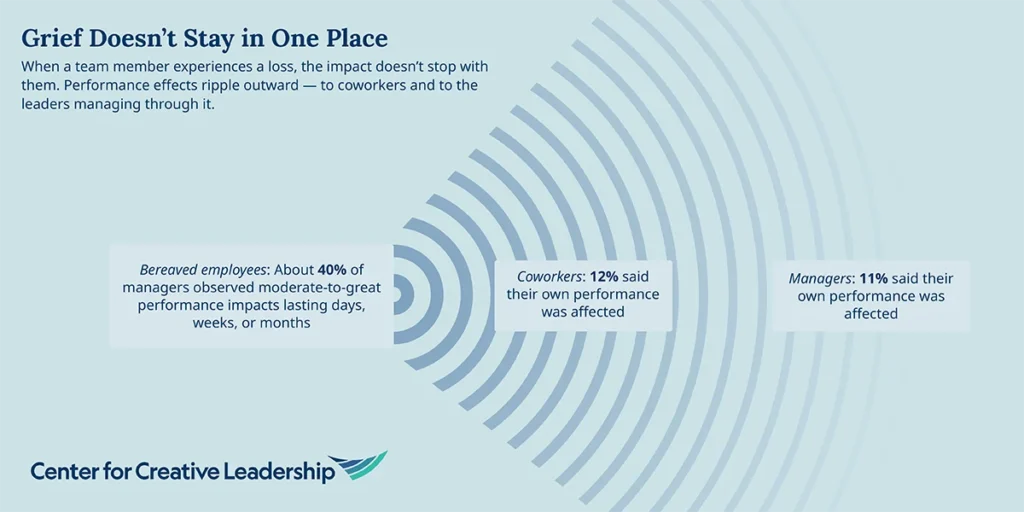
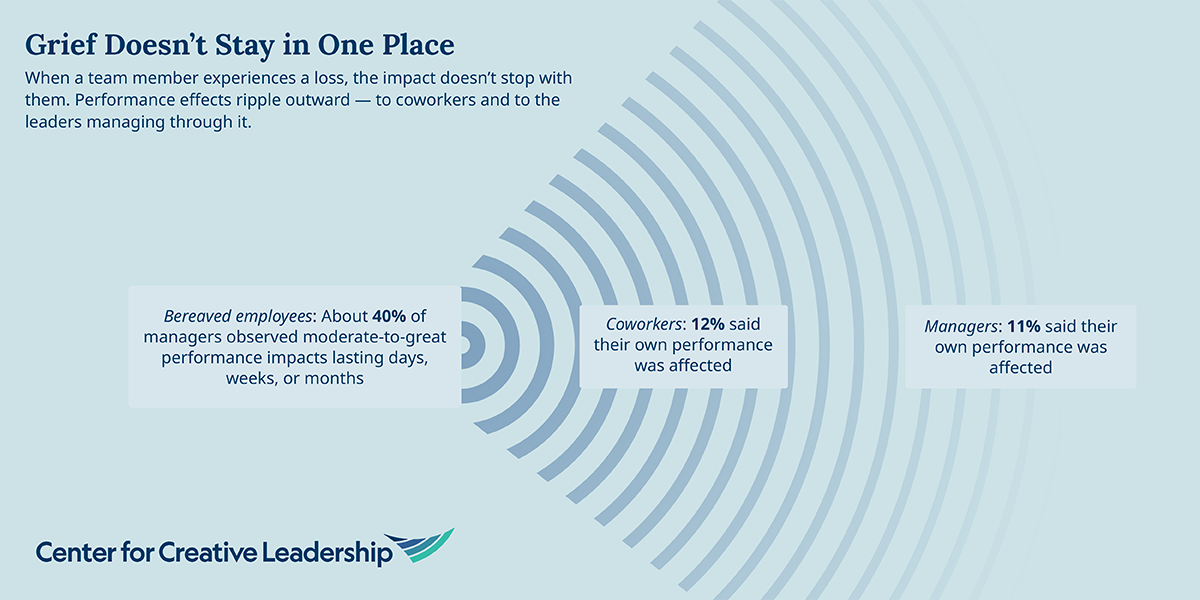
To illuminate this complex dynamic, a comprehensive study surveyed managers, coworkers, and bereaved employees, employing a three-perspective approach that often eludes traditional bereavement research. This methodology reveals that the impact of loss extends far beyond the individual directly experiencing it. The findings are stark: 90% of managers reported noticing some degree of performance impact in a bereaved employee, with approximately 40% observing moderate to significant impacts that could persist for days, weeks, or even months.
However, the data reveals a broader contagion of distress. A notable 11% of managers acknowledged their own performance was affected, a figure mirrored by 12% of coworkers. This indicates that bereavement ripples outward, disrupting not only the individual at the center of the loss but also the interpersonal and operational fabric of the teams and organizations around them.
The existing framework for bereavement leave further exacerbates these challenges. A significant majority of bereaved employees, precisely 73%, reported insufficient time off work to adequately grieve. This statistic becomes even more concerning when considering that 28% of employees had no bereavement leave available to them at all. Consequently, many employees are compelled to return to their professional duties before they are emotionally or psychologically ready. They are tasked with navigating the profound emotional labor of grief while simultaneously attempting to maintain professional efficacy. This emotional burden is compounded by practical realities, such as arranging funerals, managing estate matters, and supporting other grieving family members. These figures are not merely abstract productivity metrics; they are poignant indicators of the silent burdens employees are expected to carry, often without adequate organizational support.
Bridging the Gap: Effective Support Amidst Good Intentions
The inherent desire of most leaders to offer solace and support during a team member’s bereavement is undeniable. However, the crucial distinction lies between the will to help and the knowledge of how to do so effectively. Our research highlights a concerning disparity: while 60% of bereaved employees reported their managers demonstrated compassion to a great extent, a significant 20% felt they received little to no support. This means one in five individuals enduring one of life’s most challenging experiences felt their leader was absent or unsupportive.

It is imperative to clarify what is not expected of leaders in these situations. They are not tasked with finding the perfect words, an often impossible and anxiety-inducing pursuit. They are not expected to "fix" grief, an inherently unfixable human process, nor are they meant to accelerate an individual’s healing, an unreasonable demand on a deeply personal journey. Leaders are not therapists, and attempting to assume that role can be detrimental.
The core of effective support, as illuminated by our research on workplace bereavement, is far simpler. Leaders are called upon to demonstrate presence, attentive observation, offer choices, and crucially, follow the lead of the grieving employee.
The Power of Subtle Observation and Timely Intervention
A critical insight from our findings is the necessity for leaders to be attuned to subtle signals. Many leaders tend to wait for overt displays of distress—a public breakdown, a missed deadline, or a clearly visible struggle—before intervening. However, grief in the workplace rarely announces itself with such dramatic clarity. More often, it manifests in quieter, less conspicuous shifts that managers themselves identified in our research. These can include changes in communication patterns, such as increased withdrawal or uncharacteristic chattiness; alterations in work habits, like heightened meticulousness or a decline in attention to detail; or shifts in emotional presentation, such as increased irritability, tearfulness, or uncharacteristic silence.
These are not immediate red flags that demand urgent intervention. Instead, they are subtle indicators, and overlooking them means missing a crucial window of opportunity to offer support. Conversely, certain leader behaviors can inadvertently exacerbate the situation. These might include minimizing the loss, offering platitudes that dismiss the employee’s feelings, making assumptions about their needs, or pushing for a swift return to "normalcy" without acknowledging the ongoing impact of grief. Checking in does not necessitate having all the answers; it requires the simple act of noticing and acknowledging.
Small Gestures, Profound Impact: The Value of Consistent Presence
In the realm of supporting grieving employees, grand, performative gestures often hold less weight than consistent, understated presence. Simple acts, such as a signed card conveying genuine sentiment, a quietly offered cup of coffee, or a brief, non-intrusive check-in that does not require the employee to feign normalcy, can leave lasting impressions. These gestures signal recognition and care, fostering a sense of being seen and valued as a person, not merely as a functional unit within the organization.
In contrast, employees often recall unhelpful interactions as those that involved avoidance, insensitive remarks, an overemphasis on productivity, or an attempt to rush the grieving process. The essence of a supportive gesture lies not in its magnitude, but in the message it conveys: "I see you as a human being, not just in your professional role."
Embracing Individuality: Tailoring Support to Unique Needs
One of the most significant findings from our research is the inherent individuality of grief. There is no universal response or a single type of support that fits all. Some employees may require solitude and space, while others may find solace in open conversation. Some may wish to immerse themselves in work as a coping mechanism, while others need their professional expectations temporarily lowered. Despite this diversity, a common pitfall for many leaders is the tendency to apply a one-size-fits-all approach to workplace bereavement. This often manifests as either outright avoidance or excessive, perhaps well-intentioned but ultimately intrusive, check-ins.
The solution is remarkably straightforward and hinges on a fundamental leadership skill: asking. Simple questions like, "How can I support you right now?" or "Would you prefer to ease back in, or jump back into tasks?" signal that the employee’s experience is valued and remove the guesswork that can lead to mismatched or ineffective support. It is important to acknowledge that grieving individuals may not always articulate their needs clearly. Providing options, allowing them time to adjust, and revisiting these conversations periodically can be highly effective.
Exemplary Leadership in Times of Loss
Bereaved employees vividly remember leaders who demonstrated genuine support. The most impactful responses identified in our research often involved straightforward actions such as offering flexibility, maintaining a consistent presence, and acting as an advocate or protector. Leaders who excelled in these situations demonstrated keen observational skills, acted upon what they noticed, and championed requests for extended time off. They maintained regular, yet not overbearing, contact and allowed employees to dictate their own pace of return. Crucially, they practiced active listening and, perhaps most importantly, they acknowledged the loss. Our research unequivocally underscores that the acknowledgment of grief carries far more weight than many leaders realize.
Bereavement at Work: A Catalyst for Leadership Development
Even the most sophisticated leadership development programs can fall short when confronted with the unscripted, deeply human moments that bereavement represents. Most leaders encounter these situations unprepared. Our research indicates that a substantial 73% of managers feel they require training on how to support a bereaved employee. This statistic reveals a widespread desire among leaders—nearly three-quarters of them—to acquire the fundamental human skills necessary to be present and supportive for their teams.
These essential capabilities are not novel concepts in leadership development; they are, in fact, its very foundation. The skills required to effectively respond to a grieving employee—emotional intelligence, self-awareness, empathy, the capacity for difficult conversations, and coaching presence—are intrinsically linked to broader definitions of exceptional leadership. Workplace bereavement, therefore, serves as a high-stakes test of these competencies, a scenario for which many leaders have historically received inadequate preparation.
The solution lies not in the creation of standalone bereavement programs, but in the seamless integration of these human-centric skills into existing leadership frameworks. Every module on emotional intelligence implicitly addresses how a leader might navigate the complexities of workplace grief and offer solace. Similarly, coaching skills training prepares leaders for the vital practice of asking, without undue haste, "How are you really doing?" and "What else do you need to feel supported?" This is not about adding an ancillary layer to leadership development; it is about adopting a more holistic lens that illuminates the existing core competencies.
The Future of Leadership: Embracing Human-First Principles
Bereavement is an inevitable aspect of human experience that will touch every workplace and team. The critical question is whether leaders will be equipped to respond with empathy and efficacy when confronted with it. This readiness is not about possessing a repertoire of perfect phrases, but about cultivating the skills to observe, inquire, and follow the lead of those in distress. It is, as one of our research participants eloquently put it, about being "human first."
Therefore, a crucial question for organizational leaders to consider is: Where in your existing leadership curriculum is the practice of sitting with another’s pain explicitly taught? Where do your leaders hone the ability to say, "I don’t know what to say, but I am here"? Engaging with these questions and actively developing leaders who can show up for their people in meaningful and necessary ways is a worthwhile and essential endeavor.
The ongoing research into bereavement at work continues to yield vital insights. Organizations and individuals interested in staying abreast of the latest findings and best practices are encouraged to subscribe to relevant newsletters and publications. The ultimate goal is to foster work environments where leaders are not only proficient in managing tasks and projects but are also deeply capable of navigating the human spectrum of experience, offering genuine support during life’s most challenging moments.








