
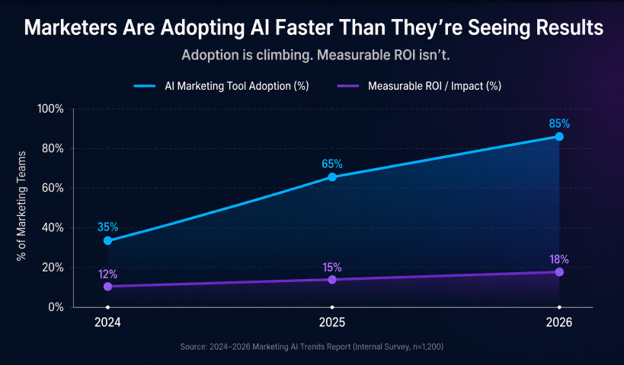
The marketing landscape is experiencing a seismic shift, characterized by an unprecedented surge in the adoption of generative artificial intelligence (AI) tools. Nearly nine in ten marketers now integrate these technologies into their workflows, a dramatic increase from approximately half just two years ago. This rapid adoption rate positions generative AI as one of the fastest-spreading marketing technologies in history. However, beneath this surface-level success lies a significant chasm: while the tools are ubiquitous, their impact remains largely confined to isolated pilot projects. McKinsey’s ongoing research into marketing’s use of AI reveals that most organizations have struggled to scale AI beyond initial experimentation, with a notable majority of European marketing teams, in particular, reporting no advancement in their generative AI maturity. This stark contrast between widespread adoption and shallow impact is the defining narrative of marketing technology in the current era. The challenge is not in acquiring the tools, but in building a cohesive system that leverages them for meaningful business outcomes. This article delves into the bottlenecks hindering AI’s transformative potential in marketing and identifies the strategies employed by leading teams to transcend mere content generation and achieve tangible gains.
The Widening Chasm: Adoption Outpacing Impact
The current scenario presents an uncomfortable paradox: metrics for AI tool usage are soaring, while the corresponding improvements in business results have plateaued. Marketers report significant time savings, with many dedicating upwards of six hours per week to AI-assisted tasks. Consequently, marketing teams are publishing a substantially higher volume of content compared to two years prior, indicating a clear increase in overall output.
However, when revenue attribution is examined, a different picture emerges. The majority of organizations find it difficult to establish a direct correlation between AI implementation and revenue generation. This disconnect arises from the fact that AI tools became readily accessible and user-friendly at a pace that outstripped the development of strategic understanding and application within marketing teams. As a result, adoption outpaced strategy, leading to a substantial portion of the saved time being diverted into producing more of the same generic content, albeit at an accelerated rate. This phenomenon creates a "content treadmill," where increased output doesn’t necessarily translate into increased effectiveness or business value.
Identifying the Drivers of Real ROI
The key differentiator between teams that are merely increasing output and those achieving substantial returns lies in their strategic approach to AI deployment. Three core elements consistently distinguish high-impact AI users:

-
Strategic Alignment with Business Objectives: Leading teams do not adopt AI for its own sake. Instead, they meticulously align AI initiatives with overarching business goals, whether it be increasing customer acquisition, enhancing customer retention, or improving campaign ROI. This strategic foresight ensures that AI applications are targeted towards areas with the greatest potential for measurable impact. For instance, a company aiming to boost customer loyalty might deploy AI for hyper-personalized customer service interactions or proactive engagement based on predictive analytics, rather than simply for faster ad copy generation.
-
Data Foundation and Integration: The most successful AI implementations are built upon a robust and unified data infrastructure. Organizations that have prioritized data cleansing, standardization, and integration are better positioned to leverage AI effectively. This involves consolidating customer data from disparate sources into a single, coherent view, enabling AI models to operate with a comprehensive understanding of the customer journey. Without this foundational element, AI tools, however sophisticated, will operate on incomplete or fragmented information, leading to suboptimal outcomes.
-
Focus on High-Value Use Cases: Not all AI applications yield equal returns. Leading marketers are identifying and prioritizing use cases that demonstrably drive business value. Personalization and content drafting consistently emerge as areas with the strongest ROI. This is largely due to their compounding effects: personalized content resonates better with audiences, leading to improved engagement and conversion rates. This enhanced performance, in turn, generates more first-party data, which further refines the accuracy and effectiveness of subsequent personalization efforts, creating a virtuous cycle of improvement.
The Unseen Hurdle: The Data Foundation Problem
When marketing leaders are pressed to identify the primary obstacles hindering AI’s progress, the answer frequently points not to the technology itself, but to the underlying data infrastructure. The pervasive issue of fragmented customer records, inconsistent data tagging, and siloed systems that fail to communicate effectively means that AI tools are often fed a partial, and sometimes contradictory, picture of the customer. This lack of a unified, reliable data source is a critical bottleneck.
Organizations that are successfully navigating the AI landscape did not commence their journey with the latest generative AI platforms. Instead, they first focused on unifying their customer data. This involved establishing a single, coherent record for each customer, rather than relying on multiple, inconsistently updated profiles scattered across various platforms. Only after this foundational work was completed did they layer AI capabilities on top. While this approach might appear less glamorous and more time-consuming than launching a new AI initiative, it represents the crucial difference between building a system that compounds value and one that merely automates the production of mediocre output.

This data deficiency also explains why a significant number of AI rollouts stall at the pilot stage. An AI model’s ability to perform tasks such as personalization is directly contingent on the data it can access. If this data is inconsistent, outdated, or incomplete, the AI’s output will invariably reflect these limitations. While the AI may operate with confidence, the suboptimal performance often goes unnoticed until the actual business metrics fail to meet expectations.
The State of Marketing Teams in 2026: A Call for Deliberate Deployment
As we look towards the current landscape in 2026, it’s clear that the primary constraint on AI’s effectiveness in marketing is no longer the availability of advanced tools. The generative AI technologies currently on the market are, for the most part, highly capable. The real bottleneck lies in the deliberate and strategic deployment of these tools by marketing teams. Before integrating another platform into an already complex martech stack, organizations must ask themselves a more fundamental question: do we possess clean, unified data to effectively fuel these AI capabilities, and do we have clearly defined metrics to measure the expected impact?
Teams that can confidently answer both these questions are the ones that witness their productivity gains translate directly into tangible revenue growth. Conversely, those unable to provide affirmative answers often find themselves with an abundance of generated content, a plethora of new dashboards, but ultimately, the same conversion rates they had eighteen months prior.
Therefore, the pivotal question for marketing teams to consider is whether they are using AI to execute existing marketing strategies more efficiently, or to fundamentally reimagine and improve their marketing efforts. These are not synonymous objectives. Achieving the latter requires significant foundational work in data management and strategic planning, aspects that are often overlooked in the pursuit of immediate, superficial gains. The true potential of AI in marketing lies not in the speed of content creation, but in the intelligence and efficacy of the marketing it enables.
The Evolution of AI in Marketing: A Timeline of Adoption and Maturation
The rapid integration of generative AI into marketing workflows can be traced through several key phases, each marked by evolving capabilities and challenges.
Early 2020s: The Dawn of Accessibility (Pre-2022)
Prior to the widespread availability of user-friendly generative AI tools, AI in marketing was largely the domain of sophisticated predictive analytics, customer segmentation, and programmatic advertising. Adoption was significant but focused on specialized, data-intensive applications. The idea of AI generating creative content or engaging in conversational marketing was nascent, primarily confined to academic research and niche enterprise solutions.
Mid-2022 to Early 2023: The Generative AI Explosion
The public release and rapid improvement of models like GPT-3 and DALL-E marked a pivotal moment. These tools democratized AI’s creative and generative capabilities, making them accessible to a much broader audience, including individual marketers. This period saw an explosion of interest and initial adoption, driven by the novelty and perceived efficiency gains. Marketers began experimenting with AI for tasks such as drafting email subject lines, generating social media posts, and brainstorming content ideas. This is the period where usage numbers began to climb dramatically.
Late 2023 to Early 2024: The Pilot Project Plateau
As the initial novelty wore off, a critical challenge emerged: scaling AI beyond isolated experiments. While many teams had successfully implemented AI for specific tasks, translating these pilot successes into organization-wide, impactful strategies proved difficult. This phase is characterized by the "adoption-impact gap" highlighted in the research. Companies found that while they were using AI tools more, the direct link to increased revenue or significant business transformation remained elusive. The focus was on output, not necessarily on outcome.
Mid-2024 Onwards: The Strategic Imperative
The current phase, extending into 2026 and beyond, is defined by a growing recognition that AI’s true value lies in strategic integration, not just tool adoption. This period emphasizes the need for robust data foundations, clear objective setting, and a focus on high-ROI use cases. Leading organizations are shifting from simply "using AI" to "doing marketing better with AI." This involves significant investment in data infrastructure, upskilling teams, and developing a mature understanding of how AI can drive genuine business outcomes. The trend is moving from broad adoption of tools to a more discerning and strategic application of AI as a core component of marketing strategy.
Broader Implications for the Marketing Industry
The current AI adoption paradox has significant implications for the future of the marketing industry.

- Shifting Skill Requirements: The demand for marketers who can strategically deploy AI, manage data infrastructure, and interpret AI-generated insights will continue to grow. Traditional roles may evolve, with a greater emphasis on analytical and strategic thinking over purely creative or execution-focused tasks.
- Competitive Differentiation: Companies that successfully bridge the adoption-impact gap will gain a significant competitive advantage. Their ability to leverage AI for hyper-personalization, predictive insights, and optimized campaign performance will translate into superior customer experiences and greater market share.
- The Future of Martech Stacks: The focus is shifting from accumulating a vast array of AI tools to integrating them seamlessly within a unified, data-driven ecosystem. The success of a martech stack will be measured by its ability to leverage AI to deliver cohesive and impactful customer journeys.
- Ethical Considerations and Governance: As AI becomes more deeply embedded in marketing, the ethical implications surrounding data privacy, algorithmic bias, and transparent communication will become increasingly critical. Robust governance frameworks will be essential to ensure responsible AI deployment.
Ultimately, the current phase of AI adoption in marketing is a critical juncture. The widespread availability of powerful tools presents an unprecedented opportunity for transformation. However, realizing this potential hinges on a fundamental shift from simply embracing technology to strategically integrating it into a data-centric, goal-oriented framework. The marketers and organizations that master this transition will define the future of the industry.