A recent groundbreaking finding by the prominent IT consultancy firm Tenth Revolution has unequivocally revealed that Artificial Intelligence (AI) remains a cornerstone in modern hiring strategies. However, the path to AI success in talent acquisition (TA) is no longer a straightforward pursuit of the most advanced technological solutions. Instead, TA teams are now confronting a more profound, human-centric challenge that compels a fundamental re-evaluation of the workforce concept itself. This shift marks a pivotal moment, moving beyond mere technological adoption to a strategic integration that prioritizes human oversight, ethical considerations, and a redefined understanding of roles and responsibilities in an increasingly automated landscape.
From Hype to Harmony: The Evolution of AI in Talent Acquisition
The journey of AI in hiring has been characterized by rapid advancements and shifting paradigms. In its nascent stages, the allure of AI lay in its promise of efficiency and automation, with early adopters often seeking the most complex and feature-rich tools available. The prevailing sentiment was that superior technology inherently guaranteed a competitive edge, with each new breakthrough pushing the boundaries of what was thought possible. Indeed, AI has demonstrated capabilities that frequently surpass human performance in specific tasks, as exemplified by significant milestones such as Claude’s Fable 5 recently solving the 87-year-old Jacobian conjecture, a problem that had eluded even the most brilliant human mathematicians. Such achievements have naturally fueled a surge of interest and substantial investments in AI technologies across all sectors, including human resources.
However, the landscape has matured. The initial "experimental phase," where the sheer sophistication of an AI tool might dictate hiring outcomes, has given way to a more nuanced reality. The market is now saturated with innovative options, rendering the simple acquisition of "the best tech" an insufficient strategy for sustained success. As the Tenth Revolution report implicitly suggests, technology now accounts for only a fraction of the overall talent acquisition challenge. The focus has decisively shifted from what AI can do to how it should be strategically integrated, managed, and understood by human teams. This involves selecting specialized partners, equipping TA professionals with the necessary AI literacy, and fundamentally reimagining job roles and descriptions (JDs) to align with data-driven tools and qualified talent.
The Human Element: Bridging the Gap in Automated Processes
Despite the undeniable march towards automated hiring solutions, a critical understanding has emerged: AI’s ultimate purpose is to empower, not replace, human expertise. Decision-making, particularly in the nuanced realm of talent selection, must remain firmly human-driven. Relying solely on AI without human oversight carries significant risks, such as overlooking exceptional talent due to rigid keyword parsing or perpetuating biases embedded within training data. Such "accidental false negatives" can be costly, depriving companies of valuable hires and undermining diversity initiatives.
AI excels at streamlining repetitive, high-volume tasks. Platforms like Ongig’s Text Analyzer effectively optimize job descriptions by identifying and rectifying biases, improving readability, and ensuring completeness. Similarly, AI can efficiently manage interview scheduling, candidate screening logistics, and initial communication. However, human recruiters and TA experts remain indispensable for critical aspects of candidate engagement, building rapport, and assessing soft skills that algorithms currently struggle to evaluate accurately. Even if a candidate isn’t suitable for a current opening, a human touch ensures they are respectfully managed and potentially added to a talent network for future consideration, fostering long-term relationships crucial for sustained talent pipelines.
Crucially, TA teams must develop a deep understanding of the rationale and evidence underpinning AI’s decisions. Blindly accepting automated workflow recommendations risks technological over-reliance, potentially leading to a resurgence of issues seen in pre-AI hiring days, or worse, generating compliance and legal challenges. "Transparency in AI is not just a buzzword; it’s a foundational requirement for ethical and effective talent acquisition," states Dr. Anya Sharma, a leading AI ethicist specializing in HR tech. "Organizations must demand explainable AI solutions and ensure their teams are trained to interpret and validate AI outputs." Fostering enduring partnerships with trusted AI experts can demystify complex recruitment technology, build accountability, and ensure a comprehensive understanding of both the benefits and limitations of AI software.
Strategic Collaboration: Essential Specialist Roles in AI-Driven TA
The complexity of integrating AI effectively necessitates a multi-disciplinary approach, as highlighted by Tenth Revolution. Recruitment teams can no longer operate in silos; instead, they must collaborate with a diverse group of specialists possessing varied AI knowledge. A cohesive, AI-supported TA team might include:
- AI Ethicists and Bias Auditors: These specialists are crucial for identifying and mitigating inherent biases in AI algorithms and training data, ensuring fairness, inclusivity, and compliance with anti-discrimination laws. They conduct regular audits of AI systems to maintain ethical standards.
- Data Scientists and Machine Learning Engineers: Responsible for developing, deploying, and maintaining the AI models used in hiring. They ensure data integrity, optimize algorithms for accuracy, and provide the technical backbone for AI operations.
- AI Product Managers: Bridging the gap between technical teams and TA professionals, these individuals ensure that AI tools are user-friendly, meet business needs, and align with strategic hiring objectives.
- Legal and Compliance Experts: Essential for navigating the complex and ever-evolving landscape of data privacy regulations (e.g., GDPR, CCPA, PIPL) and employment laws, especially for global enterprises. They ensure AI implementation adheres to all legal frameworks.
- Change Management Specialists: Facilitate the adoption of AI technologies within the organization, managing resistance, training staff, and ensuring a smooth transition to new workflows.
- UX/UI Designers (for internal tools): While often overlooked, ensuring internal AI tools are intuitive and efficient for recruiters is vital for user adoption and maximizing productivity.
"The future of TA is inherently collaborative," noted a spokesperson for Tenth Revolution, emphasizing the need for a ‘symphony of skills’ to harness AI’s full potential responsibly. "Recruiters bring the human insight into talent, while specialists ensure the technology is robust, ethical, and strategically aligned."
Quantifying Success: Beyond Experimentation to Tangible ROI
The era of merely experimenting with AI in hiring is over; its positive impact is now unequivocally proven. Companies are moving from pilot programs to full-scale strategic integration, driven by compelling statistics that demonstrate significant return on investment (ROI). PwC reports that companies with the most extensive AI adoption experienced a 40% higher productivity increase compared to their less AI-exposed competitors. This is not just about doing more with less; it’s about doing things better and faster.
Leading global organizations provide clear examples of this success:
- Unilever achieved a remarkable 75% reduction in hiring time through AI-streamlined applicant management, concurrently boasting an impressive 96% application completion rate. This indicates not only efficiency but also an enhanced candidate experience.
- Siemens leveraged AI solutions to accelerate the average time-to-fill for executive roles by 40%, a critical improvement for high-impact positions where delays can be exceptionally costly.
These figures underscore that the pertinent question for TA teams is no longer whether to use AI, but how to implement it effectively to maximize these benefits. Experts, including those at PwC, strongly advocate for acquiring the necessary human expertise to manage AI-supported hiring. This includes a strategic reframing of specialized onboarding, mentorship, and continuous training programs designed to foster improved decision-making skills. The acceleration of AI adoption also means that junior and entry-level TA staff are increasingly expected to develop senior-level competencies, such as critical judgment and leadership, at a much quicker pace, as they are entrusted with overseeing more complex AI-driven decisions earlier in their careers.
The Rise of Agentic AI: Autonomous Partners in Recruitment
A particularly exciting development in the AI landscape is the emergence of agentic AI. Unlike conventional AI solutions that typically require manual prompting or oversight for each task, agentic solutions operate autonomously, functioning as proactive, 24/7 hiring partners working seamlessly behind the scenes. These intelligent agents can execute complex, multi-step tasks independently, learning and adapting as they go.
The operational benefits are substantial. McKinsey & Company’s research indicates that human resource teams leveraging agentic AI have witnessed a remarkable 51% decrease in functional and operational costs. This dramatic reduction frees recruiters from the burden of repetitive technicalities, allowing them to redirect their focus towards higher-value activities such as refining engagement strategies, building deeper candidate relationships, and improving overall talent acquisition outcomes through enhanced human communication.
Agentic AI also holds immense potential for optimizing internal recruitment initiatives. A robust agentic system can autonomously scan internal employee databases, analyze skill sets, project experiences, and career aspirations, then proactively identify and prioritize current employees as top choices for vacant roles. This capability significantly slashes the costs associated with external hiring, onboarding, and extensive training for new recruits. By fostering internal mobility, agentic AI not only boosts efficiency but also enhances employee satisfaction and retention, creating a more agile and resilient workforce.
Navigating the Global Landscape: Data Privacy and Ethical AI
The proliferation of AI in hiring brings with it significant responsibilities concerning data protection and ethical compliance, especially for global enterprises operating with distributed teams. TA teams are entrusted with managing vast quantities of sensitive information, including personally identifiable information (PII) during candidate assessments. Ensuring this data remains safeguarded, accessible only to authorized parties, and processed with utmost care is paramount. A single data breach can lead to severe financial penalties, reputational damage, and erosion of candidate trust.
Equally critical is the oversight of ethical considerations and bias mitigation within AI training data. Responsible AI aims to ensure that job descriptions and open positions are accessible and fairly presented to every qualified candidate, regardless of demographic. This necessitates reinforcing robust regulatory frameworks and conducting frequent, independent audits of AI systems.
The challenge is amplified for global organizations, as AI data requirements are constantly evolving and vary significantly across regions. Compliance demands a meticulous approach to overlapping legislation. Key examples include:
- General Data Protection Regulation (GDPR) in the EU: Strict rules on data processing, consent, and data subject rights.
- California Consumer Privacy Act (CCPA) and California Privacy Rights Act (CPRA) in the US: Grant consumers extensive rights over their personal information.
- Personal Information Protection Law (PIPL) in China: Comprehensive framework for personal information protection.
- Health Insurance Portability and Accountability Act (HIPAA) in the US: Though primarily healthcare-focused, its principles of data security can inform broader PII handling.
Given this complex regulatory patchwork, it is imperative for in-house TA experts to collaborate closely with legal and policy specialists. This interdisciplinary approach strengthens the AI workforce strategy, enabling skill-based hiring while meticulously navigating the myriad of data compliance requirements globally.
Unlocking Insights: The Power of Talent Intelligence Platforms
While Applicant Tracking Systems (ATS) have long been the gold standard for streamlining hiring processes, a new generation of tools is now transforming how companies source and understand talent. Enter talent intelligence platforms, exemplified by innovators like Metaview, Eightfold, and SeekOut. These sophisticated data giants leverage advanced machine learning and precision analytics to provide companies with a real-time, dynamic assessment of the global workforce, moving beyond static databases.
Metaview, for instance, focuses on optimizing interview quality. It offers built-in talent intelligence capture, measuring candidate responses against predetermined rubrics and detecting hiring patterns among teams. Its off-list candidate search function allows employers to connect with talent based on deep hiring context, including past applications and nuanced JD analysis, offering a proactive approach to talent sourcing.
Integrating talent intelligence platforms into the existing hiring stack offers a multitude of advantages:
- Proactive Talent Sourcing: Moving beyond reactive job postings to actively identify and engage potential candidates before a role even opens.
- Data-Driven Decision Making: Providing actionable insights into market trends, competitor hiring, and internal skill gaps.
- Enhanced Candidate Experience: Tailoring outreach and communication based on deep understanding of candidate profiles and preferences.
- Streamlined Operations: Automating the identification of best-fit candidates, reducing manual screening efforts.
- Improved Retention: Identifying candidates whose skills and aspirations align with long-term career paths within the organization.
- Reduced Bias: Leveraging data to make objective hiring decisions, minimizing human subjectivity.
- Faster Insights: Providing real-time analytics to adapt recruitment strategies quickly.
By including talent intelligence platforms in their hiring toolkit, TA teams gain critical information to hone in on the most qualified candidates. The days of relying on outdated snapshots of professional profiles are rapidly fading. With AI-powered talent intelligence, TA teams can anticipate and fill talent gaps effectively through broad, dynamic total talent networks.
Reframing Roles: Modernizing Job Descriptions for the AI Era
The timeless adage, "Your JD is the precious gateway to your organization," remains profoundly true. It is often the initial and most critical touchpoint between a prospective candidate and a hiring team. In an AI-driven workforce, modernizing JD content is no longer optional; it’s essential for making the most positive impact.
Optimizing JDs, however, presents a significant challenge for enterprise hiring teams managing thousands of applications. Factors such as ensuring inclusive hiring standards, incorporating key JD sections, and integrating trending job seeker terms for maximum visibility can lead to countless under-optimized JDs that inadvertently deter qualified talent.
The AI Curveball: Impact on Entry-Level Roles
A recent finding by Gartner has introduced another critical "AI curveball": AI automation has reduced a quarter of entry-level hiring across organizations. This trend poses a substantial risk for future workforce stability. Kaelyn Lowmaster, a director analyst in Gartner’s HR practice, warns, "Organizations that respond by cutting their early career talent pipelines altogether risk creating significant workforce challenges down the road." This highlights a pivotal moment where companies must redefine roles and adapt their talent strategies. This means evaluating job scopes, preparing earlier stages of career development for more complex tasks, and fostering the ability to navigate higher levels of ambiguity. The future workforce will require adaptable individuals capable of working alongside AI, not merely being replaced by it.
Text Analyzer as a Solution
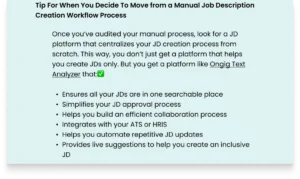
Ongig’s Text Analyzer solution directly addresses these challenges by simplifying JD management through the power of AI and Natural Language Processing (NLP). It seamlessly integrates with existing HRMS and ATS, preventing disruptive downtime and enabling enterprises to launch hiring campaigns at scale. The platform provides a cloud-based JD library, allowing teams to manage all JD changes with unmatched convenience. This efficiency saves valuable time, enabling recruiters to focus on engaging star candidates and improving the overall candidate experience.
Text Analyzer also offers smart templating features, where users can upload JDs and make quick edits for updates across similar roles via a structured format. This ensures JDs for all levels are consistently touched up based on the latest hiring practices, brand consistency, and posting compliance, mitigating the risks of bias and ensuring clarity in a rapidly evolving job market.
Further Clarify Your Roles
In an era marked by AI’s widespread influence and inherent market uncertainty, it is more critical than ever for employers to articulate job roles and responsibilities with extreme clarity. Eliminating unnecessary terms, jargon, or ambiguous requirements is crucial to avoid breeding doubt or insecurity, which can compromise the candidate experience. JDs, career sites, and job postings must cohesively assure potential hires that their roles are secure for the long haul and that they will receive the necessary support and resources to thrive in a resilient, human-AI collaborative workforce.
Companies can achieve greater transparency and attractiveness in their role positioning with AI automation by:
- Streamlining communication: Using AI to ensure JDs are clear, concise, and free of unnecessary complexity.
- Highlighting growth opportunities: Emphasizing how AI tools will augment human capabilities and open new avenues for skill development and career progression.
Looking Ahead: The Future of Human-AI Synergy in the Workforce
The evolving landscape of AI in hiring is not merely a technological shift; it’s a profound organizational transformation. The insights from Tenth Revolution and other industry leaders underscore a future where AI and human intelligence are inextricably linked, forming a synergistic partnership. This future demands continuous learning, adaptability, and a proactive approach to skill development for TA professionals. Organizations that embrace this human-centric AI strategy will not only attract and retain top talent but also cultivate a resilient, innovative, and ethically sound workforce ready to navigate the complexities of the 21st century.
This new imperative signifies a move beyond simply automating tasks to strategically enhancing human decision-making, fostering inclusive environments, and building enduring relationships within the talent ecosystem. The ultimate success of AI in hiring will be measured not just by efficiency gains, but by its ability to create a fairer, more equitable, and ultimately more human-centered future of work.