A classroom without a teacher isn’t just an open requisition; it’s a student potentially falling behind. A hospital ward short two nurses isn’t merely a staffing gap; it’s a patient facing extended wait times for critical care. For the human resources leaders and recruiters tasked with staffing schools, universities, hospitals, and public health departments, the challenge of filling these vital roles transcends operational function. It represents a direct conduit to the individuals these organizations are fundamentally designed to serve. This profound responsibility carries immense pressure, especially as hiring seasons approach. School principals urgently need classrooms filled before the first bell rings, and nursing directors must ensure shifts are covered before the peak of flu season. Their efforts are further complicated by fierce competition with private-sector employers who often possess greater agility and more lucrative compensation packages.
In this demanding landscape, artificial intelligence (AI) interviewing has emerged as a practical and increasingly vital tool to bridge this critical gap. It empowers public-serving organizations to hire with the necessary speed without compromising the essential quality of their candidates. This technology is not about replacing human judgment but about augmenting it, allowing skilled professionals to focus on the nuanced aspects of candidate evaluation while AI handles the initial, often time-consuming, screening processes.
The Parallel Struggles: Education and Public Health Hiring Challenges
At first glance, a school district and a public hospital system might seem to operate in vastly different spheres. However, a closer examination of their hiring calendars and the pressures they face reveals striking similarities. Both sectors are characterized by intense, predictable hiring waves. Educational institutions must staff up extensively before the commencement of each academic year and again mid-year as turnover inevitably occurs. Similarly, health systems and departments experience significant hiring surges tied to seasonal demands like flu season, annual budget cycles, and unpredictable public health emergencies that cannot be conveniently scheduled around.
In both these critical sectors, the window for effective hiring is notoriously short, and the volume of applicants can be overwhelming. This confluence of factors transforms the screening process – not just candidate sourcing – into a significant bottleneck. Furthermore, both education and public health contend with a competitive talent market where private sector entities often possess an inherent advantage. Private clinics or corporate training companies, for instance, are typically unburdened by the extensive procurement timelines, complex union processes, or rigid budget cycles that can slow down hiring in public institutions. This often leaves public-serving organizations in a position where they are vying for the same talent pool with fewer inherent speed advantages.

The repercussions of a delayed or suboptimal hire in these fields are not confined to internal organizational metrics. They manifest directly in the quality of service delivered to students and patients. An unfilled teaching position can mean a larger class size or a longer reliance on substitute teachers, impacting the learning environment. A vacant nursing role can translate into longer wait times for patients, increased workload for existing staff, and potential compromises in care delivery. This shared reality underscores the importance of examining AI interviewing as a cohesive solution applicable across both education and public health, rather than as two entirely separate use cases.
Public Education: Navigating the Seasonal Demand in K-12 and Higher Education
The hiring cycle in public education is dictated by a relentless seasonal clock. School districts and universities are under immense pressure to fill positions before the academic semester begins, with very little flexibility to postpone these critical deadlines. Adding to this complexity, the very individuals responsible for conducting interviews – principals, department chairs, and deans – are often the busiest people within their institutions during the exact weeks when hiring volume peaks. Expecting them to personally screen every applicant on top of their already demanding workloads in August or January is both unrealistic and unfair to them and to the candidates.
Compounding these challenges, the applicant pool for many teaching and instructional roles has been shrinking in various regions. This means that the candidates who do apply need to be processed efficiently through the hiring pipeline before they accept positions elsewhere. This is precisely where an AI interviewer proves its value. Instead of supplanting the crucial human judgment that is paramount in educational hiring – assessing a candidate’s ability to connect with students or their cultural fit within a school – AI interviewing effectively manages the volume that precedes this vital human evaluation. It can meticulously screen a large cohort of applicants during the peak hiring weeks, posing the same set of role-specific questions to every candidate. This process then surfaces only the most promising matches for the subsequent human-led interview rounds, where teaching aptitude and cultural alignment are genuinely assessed.
This capability significantly alleviates the burden on principals and department heads during their most demanding periods. It also ensures that candidates receive timely feedback, rather than enduring prolonged silence while a backlog of applications makes its way through an overburdened system. An AI Interviewer can be precisely configured to screen for the specific qualifications, certifications, and criteria essential for a given role. This might include a valid teaching license, a specialized subject-matter background, or demonstrated experience with a particular student demographic. Consequently, the screening stage becomes a robust and meaningful filter, moving beyond simple keyword-based resume triage to identify truly suitable candidates.
Furthermore, data from organizations implementing AI interviewing solutions indicate the significant scale that can be achieved. A single posting can attract hundreds of applicants, and an AI Interviewer can efficiently process and summarize each invited candidate. This allows hiring managers to engage with candidates armed with relevant context, rather than facing an overwhelming backlog of applications. The ability to streamline this initial phase is crucial for public education, where the impact of timely hiring directly affects student learning and educational outcomes.

Public Health and Healthcare Systems: Accelerating the Pace in Critical Services
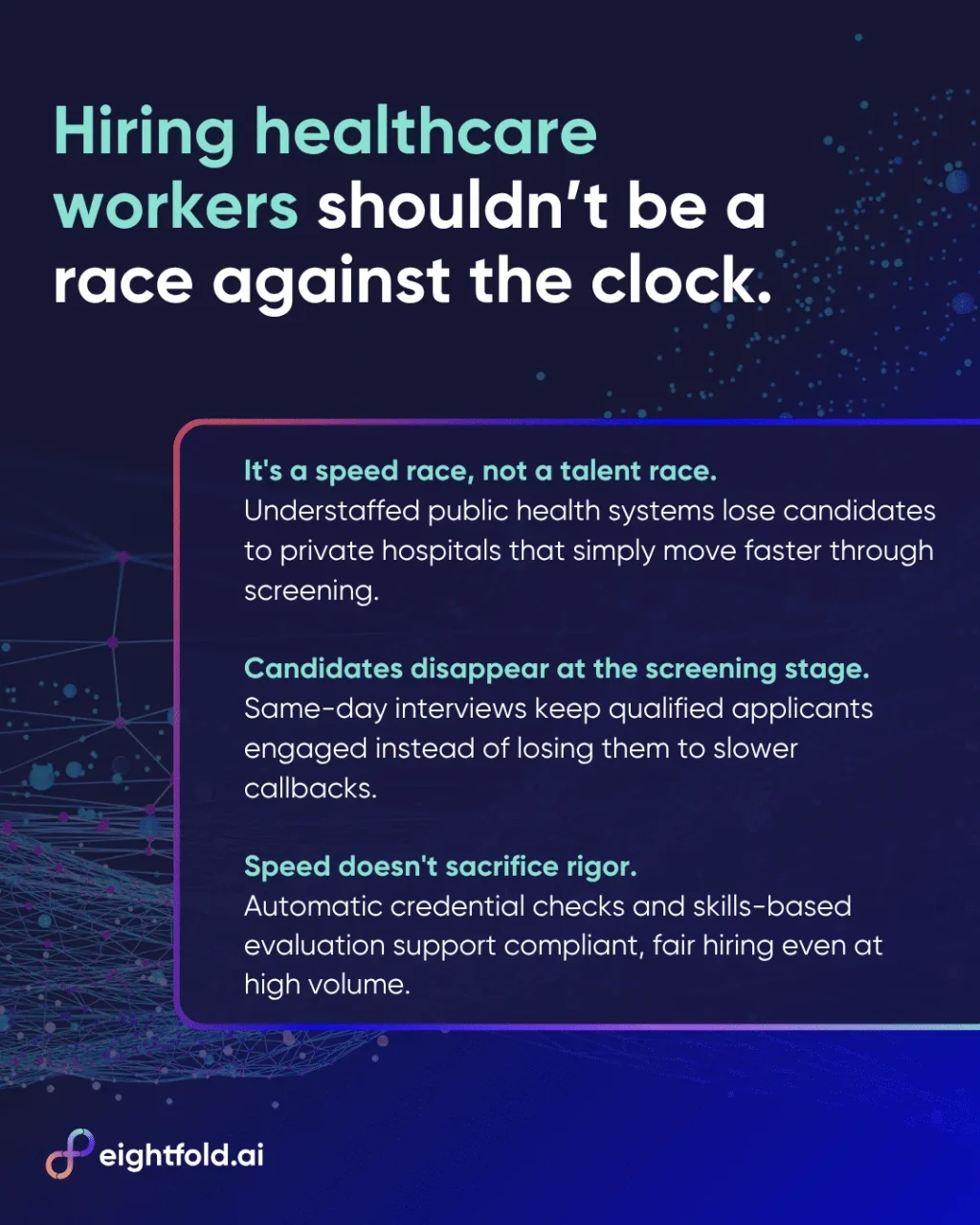
Public hospitals and health departments frequently operate from a disadvantaged starting position compared to many private healthcare systems. They often grapple with chronic understaffing, stringent budget constraints, and the imperative to fill clinical and support roles with remarkable speed. Every vacant shift represents a direct impediment to the organization’s capacity to serve the community. Moreover, these public institutions often lose valuable candidates to private hospitals and health systems that navigate their hiring pipelines far more rapidly. In some instances, an offer is extended by a private entity before the public-sector hiring process has even completed its initial screening phase.
The screening stage is frequently where these vital public health systems lose promising candidates. A qualified applicant may apply, only to wait several days for a callback while simultaneously managing other job offers. By the time a recruiter reaches out, the candidate may have already accepted a position elsewhere. An AI interviewer effectively eliminates this detrimental delay by engaging candidates immediately. In practice, this can mean a candidate completes an interview on the very same day they apply, thereby maintaining their engagement and keeping them within the pipeline during the critical window when they are most likely to be exploring other opportunities.
For roles where specific credentials are non-negotiable – such as a nursing license, a particular certification, or a required background check – an AI interviewing platform can be configured to screen for these qualifications directly within the interview process. This ensures that no critical requirement is overlooked at a stage where a missed credential could otherwise surface much later, potentially derailing the hiring process. This is particularly significant in regulated environments. AI Interviewer is designed to evaluate only what a candidate says, meticulously avoiding any assessment of facial expressions, tone of voice, or emotional cues. This approach is engineered to promote fairness and ensure compliance with stringent regulations, such as New York City’s Local Law 144, Illinois’s Biometric Information Privacy Act, and Maryland’s HB 1202. This evaluation methodology, coupled with built-in fraud detection safeguards, assists public health employers in documenting a consistent and defensible hiring process.
The scale of impact for AI interviewing in public health is particularly relevant, given that a substantial portion of this hiring is high-volume and shift-based. Early adopters of AI Interviewer have reported dramatic acceleration in hiring cycles, compressing them from an average of six weeks down to under a week. The time taken to advance a candidate to their initial interview has been reduced by as much as 90%. In the context of chronically understaffed public health systems, this reduction translates directly into more shifts being covered and fewer critical roles remaining vacant.
Closing the Gap Without Compromising Standards
In both public education and public health, a protracted hiring process is never merely an internal operational metric. It translates into tangible consequences for the individuals these organizations serve. It can mean a classroom relying on a substitute teacher for an extended period, impacting the consistency and quality of instruction. It can mean a hospital unit operating short-staffed through the most challenging weeks of an epidemic, potentially straining resources and affecting patient care. The individuals affected by these delays are not within the HR department; they are the students and patients whose well-being and development are entrusted to these vital public institutions.
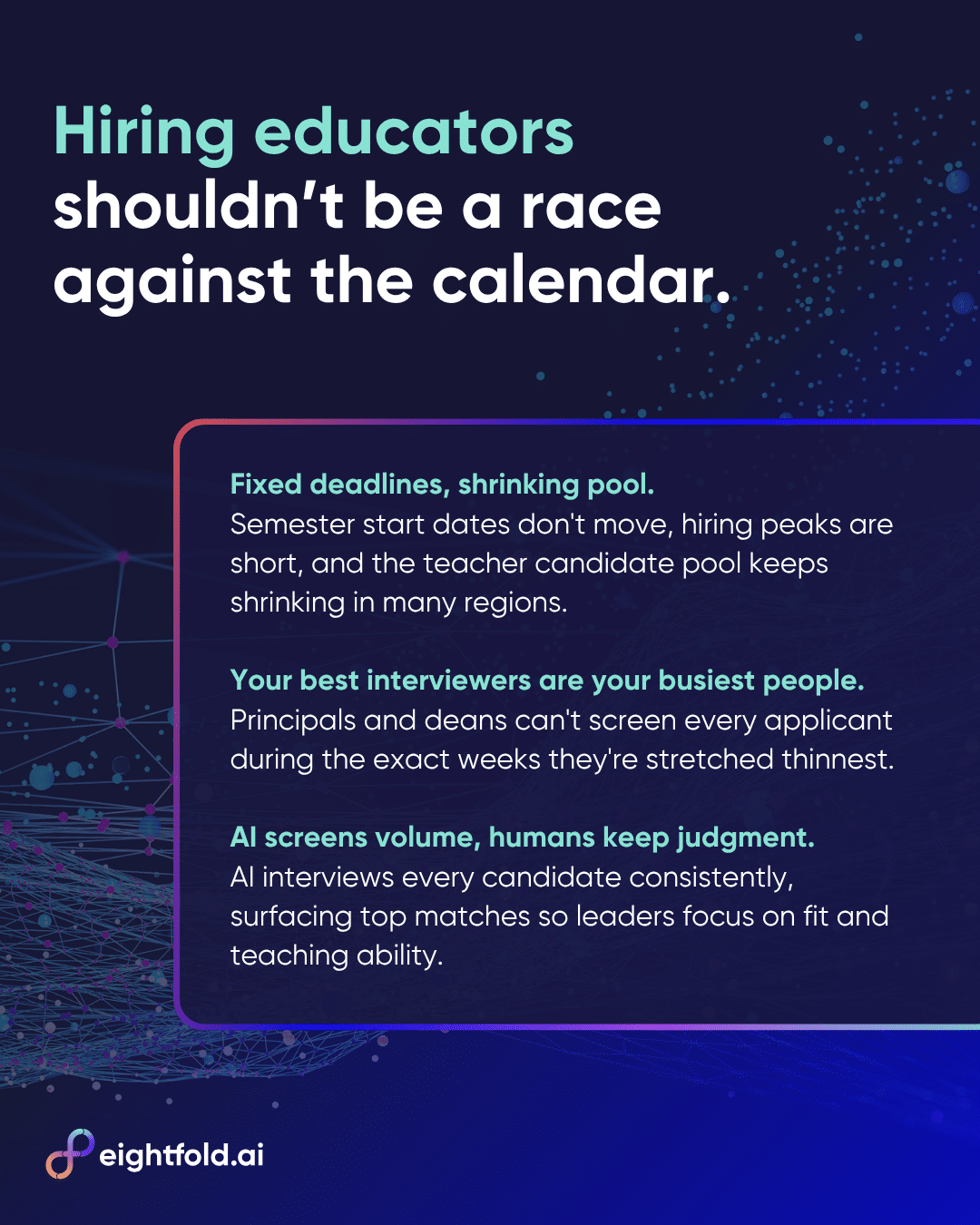
AI interviewing offers a solution that does not force HR leaders in education and public health to choose between speed and quality. It strategically offloads the high-volume, initial screening tasks – processes that traditionally consume weeks and divert the attention of the busiest personnel – to an automated layer. This layer can operate around the clock, evaluate every applicant against the same objective criteria, and deliver a curated list of genuinely qualified candidates to the hiring team, rather than an unsorted deluge of applications.
Crucially, the ultimate decision-making power remains with human professionals. They are empowered to make faster, more informed hiring decisions without the risk of losing promising candidates to more agile private-sector competitors. As these organizations face impending hiring surges – whether for the start of a new academic year, the staffing demands of flu season, or the hiring waves associated with budget cycles – it is increasingly imperative to explore the capabilities of AI-powered screening solutions. Evaluating how such a system can be configured to meet the specific credential, certification, and criteria requirements for their open roles offers a proactive approach to addressing persistent talent acquisition challenges and ensuring the continued delivery of essential public services.