In an era defined by global volatility and rapid technological shifts, the failure of institutional leadership is rarely the result of total stagnation; rather, it is increasingly driven by the tendency of leaders to respond to one extreme with another. As organizations navigate the complexities of the 21st century, the "Leadership Pendulum" has emerged as a critical diagnostic framework for understanding why visible action often fails to translate into disciplined progress. Leadership experts and organizational psychologists argue that institutions drift not when their leaders hesitate, but when they overcorrect, substituting raw force for nuanced judgment and confusing the appearance of activity with the substance of endurance. The central challenge for modern executives is to maintain a strict proportion between purpose, power, and performance, ensuring that the organization moves forward with legitimacy and clarity rather than succumbing to the destructive swings of reactive governance.
The Crisis of Proportionality and the Paradox of Choice
The modern leadership landscape is increasingly defined by what psychologists call the "paradox of choice." While leaders in previous decades may have struggled with a lack of information, today’s executives are often overwhelmed by an abundance of it. Surrounded by relentless data streams, competing stakeholder demands, and an infinite array of strategic alternatives, leaders face a environment where everything appears both possible and urgent. This saturation creates a dangerous illusion of control; as leaders attempt to manage every variable, they often weaken the very discipline required to decide what is institutionally necessary.
In the context of the Leadership Pendulum, this excessive optionality serves to widen the arc of the swing. By increasing internal tension and weakening the "pivot"—the stable point of mission and governance—the paradox of choice makes decisive, sustained movement nearly impossible. When a leader fails to distinguish between what is merely feasible and what is strategically essential, the organization begins to drift. This drift is not a personality flaw but a systemic misalignment where the leader’s behavior no longer fits the requirements of the moment.

The Integrated Model: Purpose, Power, and Performance
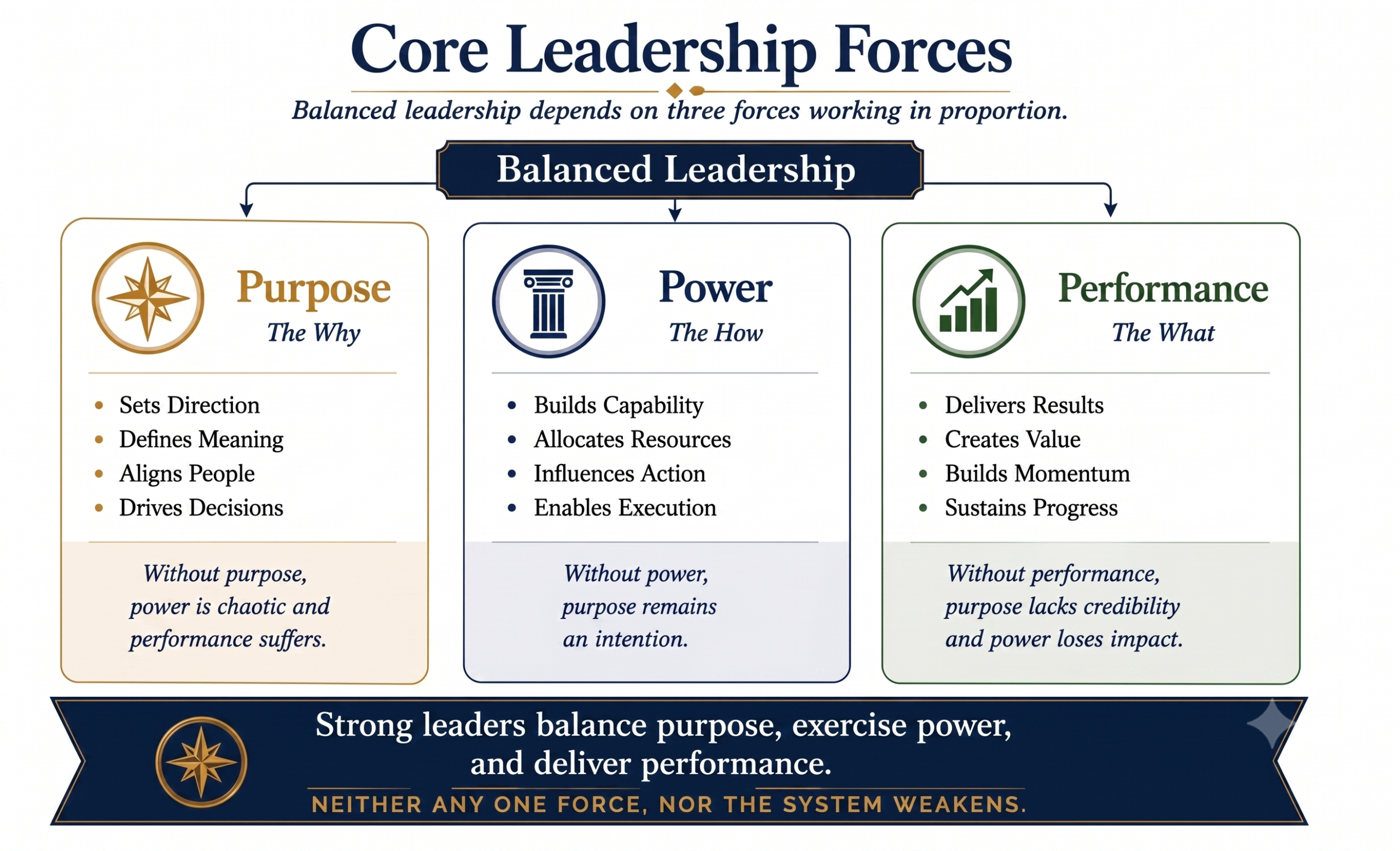
To move beyond metaphorical descriptions of leadership, the Leadership Pendulum Integrated Model offers a tangible diagnostic for assessing institutional health. At the heart of this model are three core forces that must remain in equilibrium:
- Purpose: The moral rationale and strategic reason for action. Purpose serves as the guide for executive judgment.
- Power: The capacity to decide, direct, allocate resources, and influence stakeholders. Power is the engine of leadership behavior.
- Performance: The disciplined execution that transforms intention into measurable results. Performance determines the ultimate institutional impact.
When these three forces are in proportion, leadership gains traction and legitimacy. However, when one force dominates—such as power being exercised without the grounding of purpose—the pendulum begins to swing toward overreach. Conversely, when performance is demanded without the necessary allocation of power, the system experiences strain that leads to retrenchment or symbolic action.
The Leadership Balance Index (LBI) and Quantitative Assessment
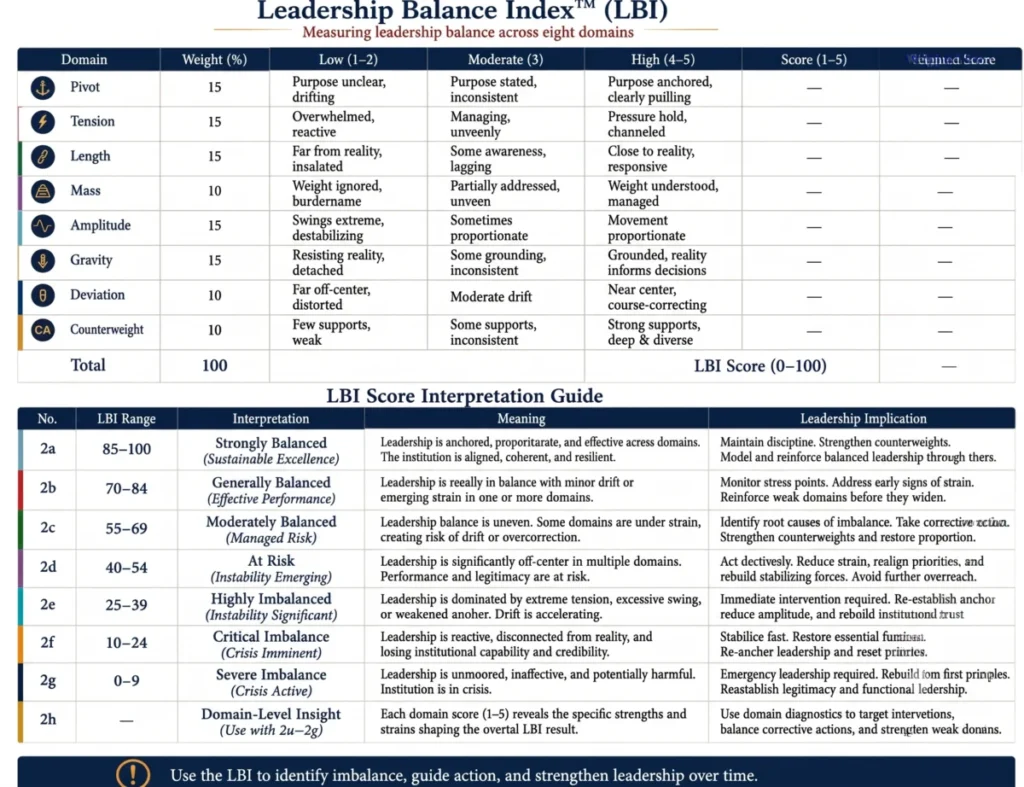
In a significant departure from traditional "soft skill" assessments, the pendulum framework introduces the Leadership Balance Index (LBI). This analytic tool moves leadership evaluation away from subjective impressions of charisma or "executive presence" and toward a more rigorous, evidence-based assessment of proportionality. The LBI is designed to show which forces are stabilizing an institution and which are pushing it away from its center.
Mathematically, the Leadership Pendulum can be expressed through a regression model that identifies the interaction of stabilizing and destabilizing forces:
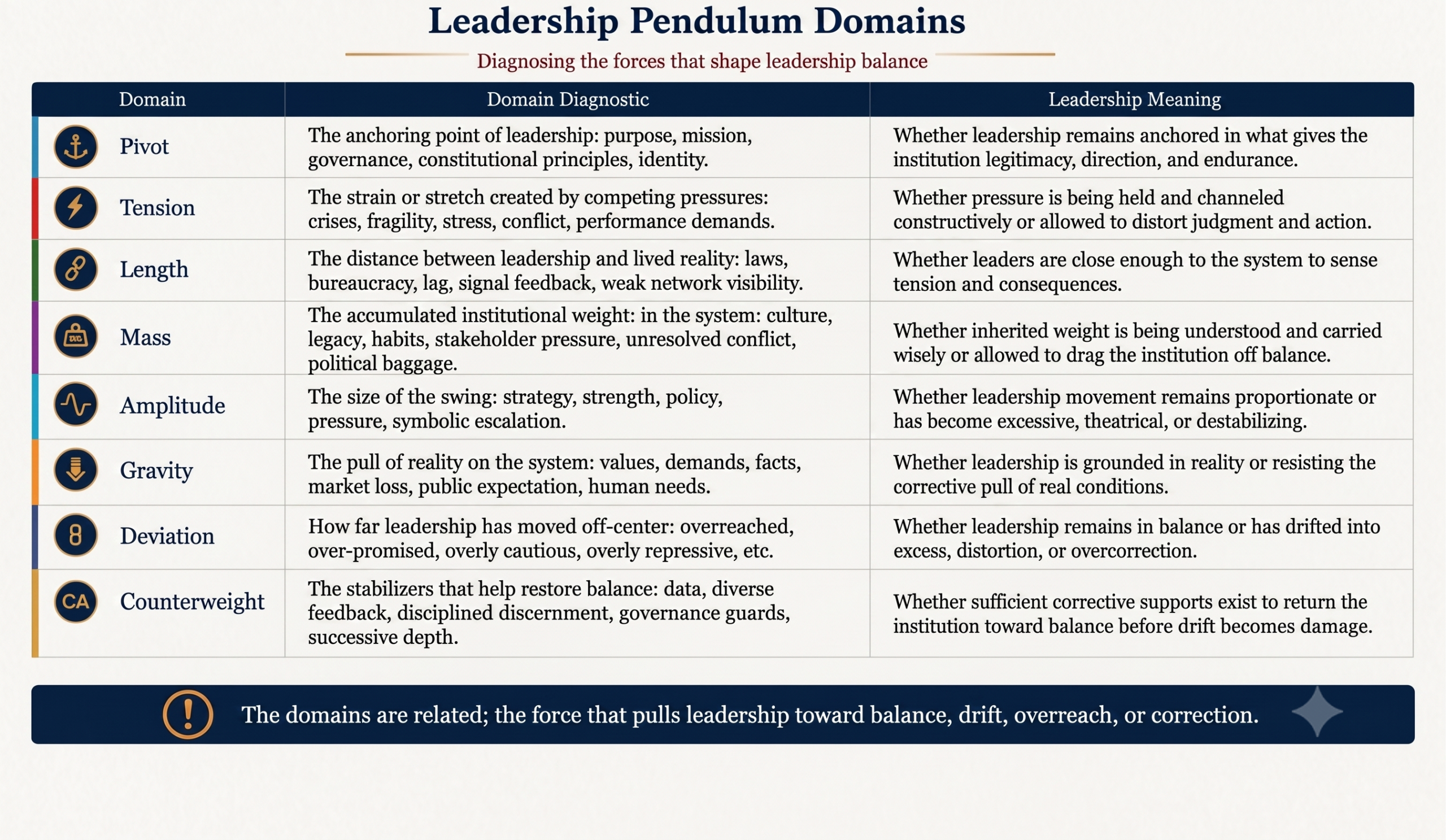
Leadership Balance Index = β0 + β1(Pivot) − β2(Tension) − β3(Length) − β4(Mass) − β5(Amplitude) − β6(Gravity) − β7(Deviation) + β8(Counterweights) + ε.
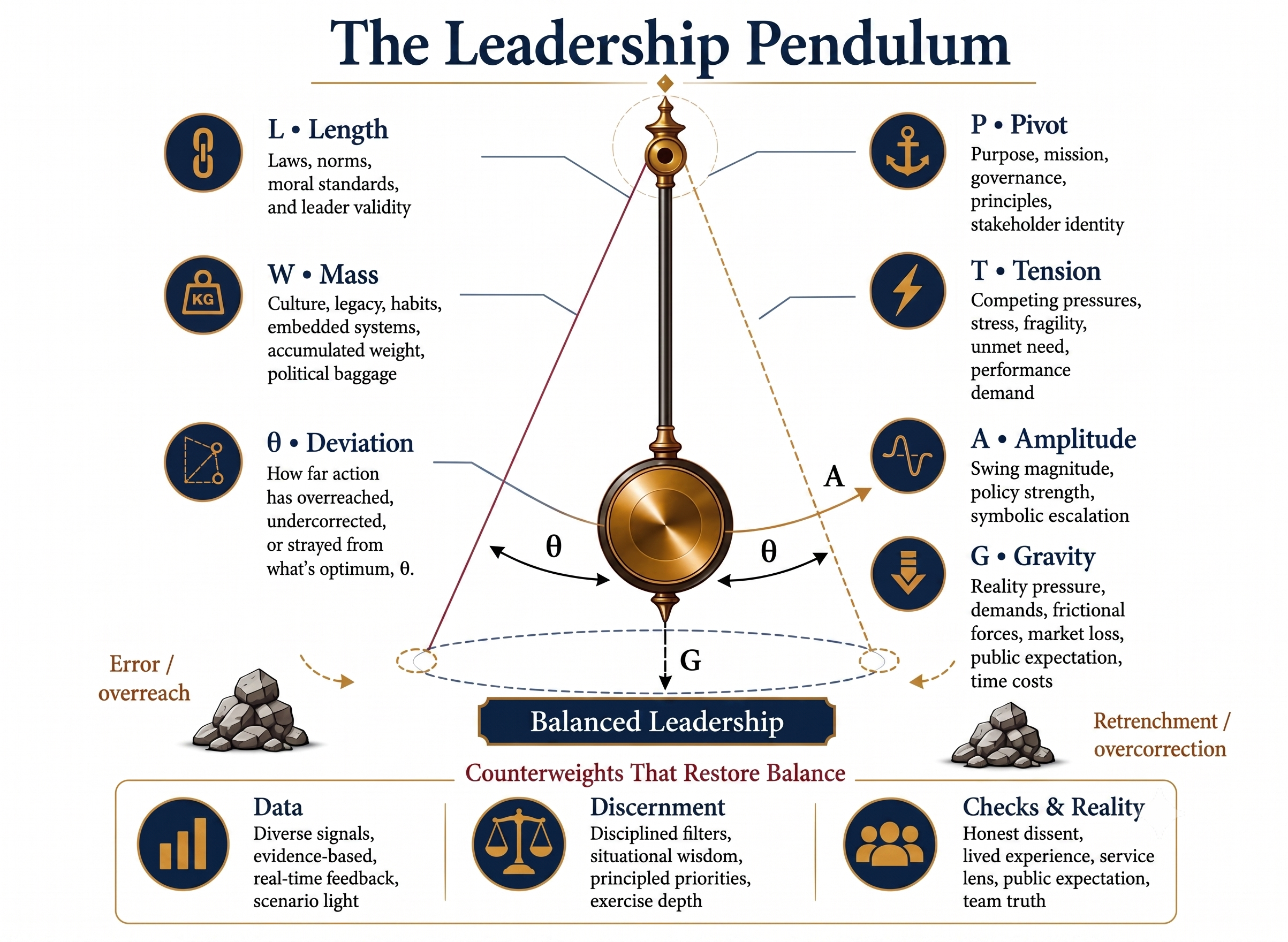
This equation highlights seven critical domains that shape leadership impact:
- Pivot: The strength of the organization’s mission and governance structures.
- Tension: The accumulation of internal and external pressures.
- Length: The "distance" or disconnect between decision-makers and the lived reality of the organization.
- Mass: The inherited weight of past decisions, culture, and institutional inertia.
- Amplitude: The degree of oscillation between strategic extremes.
- Gravity: The real-world constraints and market forces that pull aspirations back to reality.
- Deviation: The visible misalignment between a leader’s intentions and the institution’s actual needs.
A Chronology of Leadership Theory Evolution
The development of the Leadership Pendulum model represents a significant stage in the evolution of management theory.
- The Early 20th Century (The Heroic Era): Leadership was viewed through the "Great Man" theory, focusing on innate traits and the exercise of absolute command.
- The Mid-20th Century (The Bureaucratic Era): Focus shifted toward systems, hierarchy, and "Scientific Management," where the goal was to eliminate the "swing" entirely through rigid standardization.
- The Late 20th Century (The Transformational Era): Leadership became synonymous with vision and charisma, often encouraging wide swings in pursuit of "disruption," sometimes at the expense of stability.
- The 21st Century (The Proportional Era): In the wake of global financial crises and the collapse of major institutions due to executive overreach, the focus has shifted toward balance, sustainability, and "disciplined motion."
The Leadership Pendulum reflects this current era, acknowledging that while movement is necessary for growth, that movement must be anchored by robust counterweights to prevent systemic failure.
Institutional Responses and Market Data
The demand for such diagnostic tools is supported by recent corporate performance data. Studies by global management consultancies suggest that approximately 50% to 70% of new executives fail within their first 18 months, not because they lack competence, but because they fail to align their leadership style with the specific "moment" or context of the organization. Furthermore, companies that demonstrate high levels of "leadership consistency"—a key component of the LBI—tend to outperform their peers in long-term shareholder value and employee retention.
Industry experts have noted that "leadership drift" often precedes financial decline. For example, when an organization moves from a period of intense innovation (wide amplitude) to one of extreme cost-cutting (reactive correction) without a stabilizing pivot, it loses the trust of both its workforce and its investors. The LBI provides a way for boards of directors to intervene before these swings become destructive.
Implementing Rebalance: Muscle Memory and Counterweights
The practical application of the pendulum model requires more than just self-reflection; it demands the development of "leadership muscle memory." This is the learned capacity of a team to think and act under pressure through patterns strengthened by repetition. In healthy institutions, leaders do not wait for a crisis to rebalance; they build habits that serve as natural counterweights.
Key strategies for rebalancing include:
- Seeking Disconfirming Evidence: Actively looking for data that challenges the current strategic direction to prevent overcorrection.
- Testing Against Mission: Ensuring that every major power move is anchored in the organization’s core purpose.
- Closing the Distance: Reducing the "length" of the pendulum by ensuring leaders remain close to the operational realities of their front-line employees.
- Strengthening Governance Guardrails: Using board oversight and ethical frameworks as stabilizers that prevent the pendulum from swinging into the territory of overreach.
The Broader Impact on Global Governance
The implications of the Leadership Pendulum extend beyond the boardroom and into the broader realm of institutional and civic governance. In an age of polarization, the tendency to respond to one political or social extreme with an opposite extreme is a form of societal "drift." The principles of proportionality, the avoidance of the paradox of choice, and the reliance on counterweights are as applicable to public policy as they are to corporate strategy.
Ultimately, the work of a balanced leader is not to freeze the organization in a state of stillness. Institutions require motion to survive and thrive; they need energy, risk-taking, and the courage to adapt. However, the discipline of leadership lies in ensuring that this motion does not become unmoored from reality. Leadership endures when it is viewed not as a series of grand gestures, but as "discipline in motion"—a continuous, calibrated effort to keep purpose, power, and performance in a state of productive tension. By mastering the mechanics of the pendulum, leaders can ensure that their organizations recover their balance long before the swing becomes a fall.