What truly motivates individuals to commit their best work and remain loyal to an organization extends far beyond the confines of a regular paycheck. While competitive compensation undeniably forms a foundational pillar, it represents only one facet of a much broader, intricate ecosystem of employee value. The profound impact on retention, engagement, and overall organizational performance stems from the strategic implementation of a comprehensive total rewards experience—a holistic approach designed to address the multifaceted needs and aspirations of the entire employee, encompassing everything from meaningful recognition and robust growth opportunities to a deep commitment to their overall well-being.
This integrated strategy demonstrably yields tangible returns. Organizations that cultivate strong, consistent recognition programs, for instance, report a significant 31% reduction in voluntary employee turnover. This substantial decrease translates directly into measurable Return on Investment (ROI), mitigating the considerable costs associated with recruitment, onboarding, and lost productivity. However, constructing a rewards framework that genuinely inspires and retains talent demands meticulous thought, deliberate intention, and often, the leverage of sophisticated technological platforms capable of executing such a complex vision effectively.
The Genesis and Evolution of Total Rewards
The concept of compensating employees has evolved dramatically over the centuries. Historically, remuneration was a straightforward exchange of labor for wages, often subsistence-level. The industrial revolution introduced more structured pay scales, but it was primarily transactional. The mid-20th century saw the rise of employee benefits, largely driven by post-war economic conditions and the growing influence of labor unions, leading to the establishment of healthcare, retirement plans, and paid time off as standard offerings. These additions marked a shift from mere compensation to a broader understanding of employee welfare.
However, as global competition intensified and the nature of work transformed in the late 20th and early 21st centuries, a more strategic approach became necessary. The "war for talent," driven by demographic shifts, technological advancements, and changing employee expectations, highlighted the limitations of fragmented compensation and benefits packages. This backdrop gave rise to the "total rewards" philosophy—a recognition that employees consider a wide array of factors when evaluating their employment experience. It’s no longer just about what’s in their bank account, but also how they feel, how they grow, and how their life outside of work is supported. This holistic view acknowledges that intrinsic motivators often rival, and sometimes surpass, purely extrinsic financial incentives in driving long-term commitment and performance.
The Foundational Pillars of a Modern Total Rewards Program
A truly effective total rewards program is meticulously designed around the complete employee experience. It strategically integrates various components to create an environment where individuals feel supported, genuinely valued, and intrinsically motivated to remain with the organization and contribute their optimal efforts.
1. Financial Compensation: The Non-Negotiable Baseline
At its core, financial compensation remains the indispensable foundation of any robust rewards strategy. This category encompasses direct monetary payments, including base salary, hourly wages, bonuses, commissions, profit-sharing schemes, and equity options such as stock grants or employee stock ownership plans (ESOPs). While the adage "money isn’t everything" holds true, the absence of competitive pay renders any other offering precarious, regardless of its perceived value.
In today’s dynamic labor market, competitive financial packages are not merely about attracting talent; they are critical for maintaining a sense of fairness and equity, preventing top performers from seeking opportunities elsewhere. Organizations must regularly benchmark their compensation structures against industry standards and regional cost-of-living indices to ensure they remain attractive and equitable. A well-structured compensation plan signals to employees that their skills and contributions are appropriately valued, thereby building a crucial layer of trust and professional respect.
2. Benefits and Incentives: The Differentiators of Choice
Beyond direct pay, benefits and incentives are the strategic "extras" that significantly influence an individual’s decision to join and remain with an organization long-term. While essential offerings like comprehensive health insurance, ample paid time off (PTO), and robust retirement plans (e.g., 401k matching) have become standard "table stakes," forward-thinking organizations distinguish themselves through more expansive and flexible provisions.
Modern benefits packages increasingly include:
- Flexible Work Arrangements: Options for remote work, hybrid models, compressed workweeks, and flexible hours are paramount for work-life integration. A 2023 survey by Statista indicated that 77% of employees consider flexible work arrangements an important factor when considering a job.
- Health and Wellness Programs: Beyond traditional insurance, this includes mental health support (e.g., EAPs, therapy access), physical wellness challenges, gym memberships, and nutritional counseling.
- Learning and Development (L&D): Tuition reimbursement, professional certification support, access to online learning platforms, mentorship programs, and opportunities for internal mobility signal an investment in an employee’s long-term career trajectory. Research from LinkedIn’s 2023 Workplace Learning Report highlights that 94% of employees would stay at a company longer if it invested in their learning and development.
- Family Support: Enhanced parental leave, childcare subsidies, and eldercare resources address critical life stages for many employees.
- Financial Wellness: Programs that offer financial planning advice, student loan repayment assistance, or emergency savings accounts acknowledge the broader financial pressures employees face.
These benefits demonstrate that an organization values its employees not just as contributors to the bottom line, but as whole individuals with diverse lives and needs. Such an approach fosters a deeper sense of loyalty and commitment.
3. Recognition: The Performance Multiplier and Culture Catalyst
When employees feel genuinely seen, appreciated, and acknowledged for their contributions, their engagement and performance naturally soar. Employee recognition, particularly when it is timely, specific, and frequent, serves as a powerful performance multiplier and a cornerstone of any effective total rewards strategy. The "2026 State of Recognition Report," which surveyed 3,000 employees globally, underscored a crucial insight: 44% of respondents reported that the most meaningful recognitions were specific and often did not involve a monetary reward. This highlights the profound psychological impact of sincere appreciation.
Recognition can take many forms:

- Formal Programs: Annual awards, milestone celebrations, peer-nominated accolades.
- Informal Recognition: Public shout-outs, private thank-you notes, team lunches, small celebratory gestures.
- Monetary Recognition: Gift cards, spot bonuses, experiential rewards (e.g., tickets to an event).
- Non-Monetary Recognition: Public praise in meetings, opportunities for high-profile projects, increased autonomy, professional development opportunities.
The power of recognition lies in its ability to reinforce desired behaviors, boost morale, and cultivate a positive organizational culture where contributions are valued and celebrated. It fosters a sense of belonging and purpose, transforming the workplace into a community where individuals feel respected and motivated to excel.
The Strategic Imperative: Why Total Rewards Justify the Investment
Developing a truly standout total rewards program is a complex, ongoing strategic endeavor, not a superficial initiative. It demands significant time, resources, and a deep understanding of organizational values and employee needs. However, the multifaceted returns on this investment are substantial and critical for long-term organizational health and competitiveness.
- Enhanced Talent Attraction and Retention: In a fiercely competitive global talent market, a compelling total rewards package serves as a powerful differentiator. It helps organizations attract top-tier candidates who are not just seeking a job, but a comprehensive career and life experience. Once hired, a well-executed program significantly boosts retention, reducing the costly churn of voluntary turnover and preserving institutional knowledge.
- Boosted Employee Engagement and Productivity: Employees who feel valued, supported, and recognized are inherently more engaged. High engagement correlates directly with increased productivity, innovation, and higher quality of work. When individuals see a clear path for growth and feel their well-being is prioritized, they are more likely to go above and beyond their basic job requirements.
- Strengthened Organizational Culture and Employer Brand: A robust total rewards strategy is a tangible expression of an organization’s values. It cultivates a positive, supportive, and appreciative culture, which in turn enhances the employer brand. A strong employer brand attracts future talent and fosters a positive reputation within the industry and the broader community.
- Improved Diversity, Equity, and Inclusion (DEI): Thoughtfully designed total rewards programs can advance DEI initiatives by ensuring equitable access to benefits, fair compensation practices, and inclusive recognition opportunities. For instance, comprehensive parental leave policies support gender equity, while flexible work options can accommodate diverse needs.
- Sustainable Financial Performance: Beyond the warm, fuzzy feeling of doing right by employees, the financial benefits are clear. Reduced turnover saves significant recruitment and training costs. Higher engagement leads to improved customer satisfaction and sales. A healthier, more productive workforce directly impacts the bottom line, making total rewards a strategic investment rather than merely an expense.
Developing a Comprehensive and Dynamic Total Rewards Plan
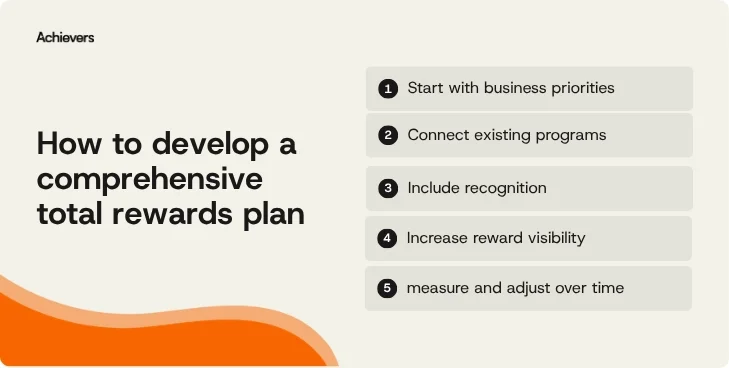
Crafting an effective total rewards strategy requires a methodical, data-driven approach that aligns with overarching business objectives and remains adaptable to evolving workforce needs.
1. Align with Business Outcomes and Strategic Goals:
The initial step involves clearly identifying the overarching business and workforce objectives that the total rewards strategy is intended to support. Whether the primary goal is to drastically improve employee retention, elevate overall performance metrics, enhance engagement scores, or reinforce specific cultural initiatives, every component of the plan must demonstrably contribute to these measurable outcomes. This alignment ensures that resources are allocated strategically and that the program delivers tangible value back to the organization. For example, if innovation is a key business goal, rewards might be structured to celebrate collaborative problem-solving and creative breakthroughs.
2. Integrate and Unify Existing Programs:
A common pitfall is to manage compensation, benefits, recognition, and employee incentives as siloed, independent programs. A truly comprehensive strategy seamlessly connects and unifies these disparate elements under a single, cohesive framework. From the employee’s perspective, these are all part of a single "total rewards package." Therefore, they should be designed to work in concert, reinforcing consistent behaviors, priorities, and organizational goals. An integrated approach ensures that employees receive a clear, consistent message about what the organization values and how their contributions are rewarded across all dimensions.
3. Embed Recognition as a Core Component:
Recognition should not be treated as a standalone, "nice-to-have" initiative but rather as an integral, foundational element woven directly into the fabric of the total rewards plan. As highlighted by the "2026 State of Recognition Report," the how rewards are delivered is often as impactful as the rewards themselves. This means fostering a culture of frequent, specific, and meaningful appreciation, both peer-to-peer and from leadership. Platforms that facilitate easy and regular recognition can transform occasional gestures into daily habits, significantly enhancing employee morale and engagement.
4. Enhance Visibility and Communication:
Even the most meticulously designed total rewards program will fail if its full value is not clearly communicated and understood by employees. Many employees underestimate the true monetary and non-monetary value of their benefits and perks. Organizations must proactively make the complete value of compensation, benefits, rewards, incentives, and recognition transparent and easily accessible. This can be achieved through personalized total compensation statements, regular informational campaigns, interactive portals, and clear policy documentation. When employees clearly perceive and appreciate the comprehensive package they receive, their appreciation, engagement, and program participation naturally improve.
5. Ensure Measurability and Adaptability:
A total rewards plan is not a static document; it is a living strategy that must evolve with the organization and its workforce. Regular review and analysis of key metrics such as employee participation rates, engagement scores, performance data, and retention statistics are crucial. This data-driven approach allows organizations to identify areas of success, pinpoint shortcomings, and make informed adjustments. The strongest plans are those that adapt over time, utilizing employee feedback, market trends, and program insights to guide future investments and continuous improvements, ensuring relevance and effectiveness.
Beyond "Fine" to Unforgettable: The Future of Total Rewards
While competitive salaries and solid benefits remain essential table stakes, organizations aspiring to truly move the needle in talent attraction, engagement, and retention must look beyond these fundamental components. The future of total rewards lies in creating an experience that resonates deeply with employees’ desire for recognition, purpose, growth, and overall well-being. It necessitates a people-first mindset, transcending a mere perks-only approach.
This is where specialized platforms and strategic thinking become invaluable. Solutions like Achievers, for instance, are designed to seamlessly embed robust recognition programs directly into an organization’s broader total rewards strategy. Such platforms provide intuitive tools that encourage frequent, specific, and meaningful appreciation, transforming good intentions into ingrained daily habits that foster a culture of gratitude and respect.
The ultimate outcome is a dynamic company culture where employees feel genuinely supported, celebrated for their contributions, and intrinsically motivated to bring their best selves to work—not merely because it’s their job, but because they genuinely want to. Investing in the right tools and strategies that shape positive behaviors, build strong connections, and articulate the full spectrum of employee value is no longer optional. With a truly integrated and thoughtful approach, recognition doesn’t just complement a total rewards program; it elevates it, creating a powerful competitive advantage in the modern talent landscape.