The modern business arena is characterized by an unrelenting torrent of complexity, constant flux, and, all too frequently, unforeseen crises. These prevailing conditions have not only amplified an already arduous operating environment but have also underscored the critical imperative for organizations and their leaders to respond with remarkable agility. While the capacity to react swiftly can undoubtedly help businesses weather immediate storms, it is, by itself, insufficient for achieving sustained growth and true competitive differentiation. In an era where simply keeping pace is no longer a viable strategy for long-term success, organizations face a stark urgency to identify and cultivate what truly sets them apart. This necessitates a profound focus on the specific behaviors and mindsets that leaders must embody. The path forward is often obscured by ambiguity, making it challenging to delineate a clear connection between the leadership practices that guide decisions and actions, and the overarching strategic objectives of the organization.
The Crucial Nexus: Organizational Capabilities and Leadership Strategy
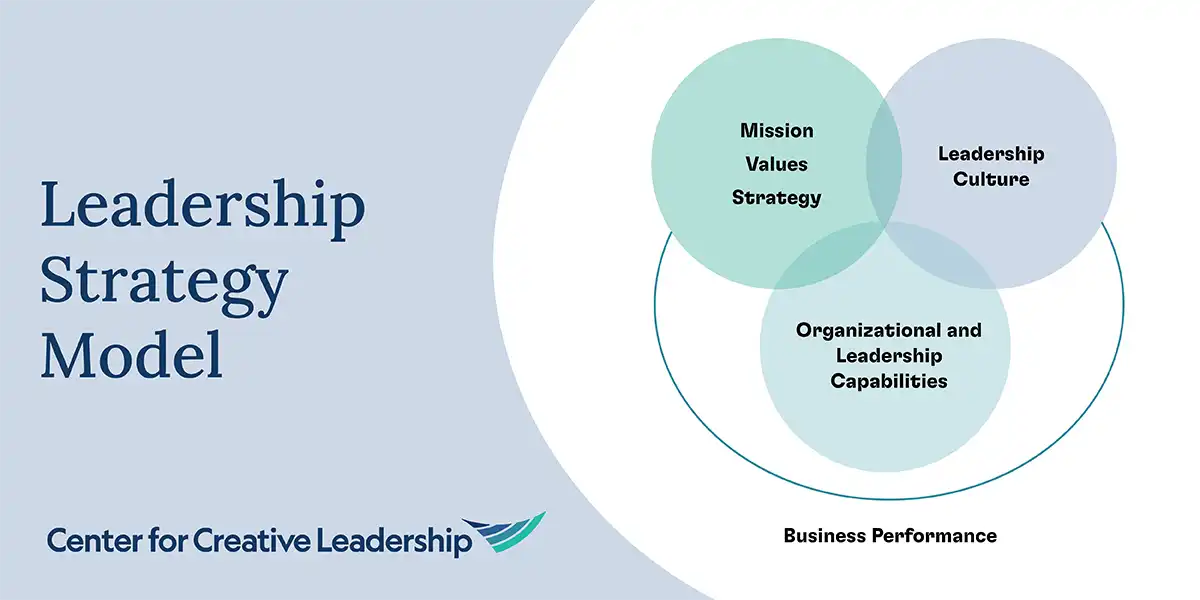
To bridge this gap and forge a clearer link between day-to-day leadership practices and enduring organizational success, a robust framework is essential. Building on decades of research and practical experience, the Leadership Strategy Model offers a comprehensive approach, emphasizing five interconnected elements. At the heart of this model lies the concept of organizational capabilities, which serve as the vital conduit connecting strategic intent to the development of critical leadership behaviors.
The foundational elements of this model are the organization’s mission, values, and overarching strategy, forming its strategic core. Equally vital is the leadership culture – the shared beliefs, norms, and unwritten rules that dictate how leadership is enacted and recognized on a daily basis. From this bedrock, organizational capabilities emerge, imbuing the business with its unique competitive identity. These capabilities are then nurtured and sustained through the development of leadership capabilities. In essence, organizational capabilities translate strategic ambition into tangible action, and leadership capabilities ensure that this translation is effective and resilient.
A common pitfall observed in many organizations is the direct leap from business strategy to individual leader behaviors, bypassing the crucial step of defining what the organization needs to be collectively exceptional at. Organizational capabilities act as this indispensable bridge. Clarifying these collective strengths and competencies first lends a far greater sense of purpose and precision to subsequent efforts, including the prioritization of specific leadership behaviors. Without this foundational clarity, leadership development can become a disconnected exercise, failing to align with the organization’s true differentiating potential.
Defining Organizational Capabilities: The Cornerstone of Competitive Identity
Organizational capabilities are not merely abstract concepts; they represent the sum total of what an organization collectively knows and does. They encompass both its established strengths and areas requiring development. These capabilities serve as a powerful indicator of the customer segments a business is best positioned to serve and the strategies it is most likely to execute successfully. They manifest through observable leadership behaviors that can be tracked and measured. Crucially, organizational capabilities are inherently tied to the people within the organization; they exist only when individuals bring the requisite combination of skills, knowledge, and attributes to their work. This inextricable link makes it impossible to isolate collective organizational capabilities from the actions and competencies of individual leaders.
The consequence of expecting strategic execution solely through individual behaviors, without first identifying the necessary collective capabilities, is a significant operational void. Leaders are deprived of the necessary context to prioritize the most impactful behaviors, and the organization lacks the cohesive force required for effective execution. When organizational capabilities are clearly defined, they orchestrate the alignment of both business and human systems, enabling the creation of value in ways that competitors find exceptionally difficult to emulate.

The concept of organizational capabilities is not a recent innovation. Business strategists in the 1990s began shifting the focus from an outward-looking perspective on markets to an inward examination of an organization’s core competencies. This necessitated deliberate trade-offs regarding investment priorities. This thinking has continued to evolve, particularly in response to the relentless pace of disruption, requiring organizations to adapt their capabilities to remain relevant and competitive.
For decades, the Organizational Leadership practice has leveraged a research-based framework of organizational capabilities to assist clients navigating large-scale change and transformation initiatives. This work has been underpinned by a profound understanding of leadership as a social process and the significant influence of leadership culture in demonstrating these capabilities. Extensive studies, spanning over 20 years and involving numerous executive teams, have informed the identification of a core set of capabilities crucial for successful organizational transformations.
More recently, this research has been revisited and updated to reflect the evolving landscape shaped by technological advancements, globalization, and other influential factors. The behavioral components of these capabilities have also been refined to enhance understanding and facilitate a more precise connection to leadership capabilities.
A Research-Based Framework of Organizational Capabilities
Through extensive research and practical application, a set of 11 core organizational capabilities has been identified. Each capability is intrinsically linked to an organization’s strategic and cultural identity and is defined by its tangible manifestation in action. These capabilities include:
- Strategic Agility: The capacity to sense and respond effectively to market shifts and emerging opportunities.
- Customer Centricity: Deeply understanding and prioritizing customer needs and experiences.
- Innovation and Creativity: Fostering an environment that generates novel ideas and solutions.
- Operational Excellence: Driving efficiency, quality, and continuous improvement in processes.
- Talent Development and Engagement: Attracting, nurturing, and retaining a high-performing workforce.
- Digital Transformation: Effectively leveraging technology to reimagine business models and operations.
- Collaboration and Teamwork: Promoting seamless interaction and shared goals across teams and departments.
- Data-Driven Decision Making: Utilizing analytics and insights to inform strategic choices.
- Change Leadership: Guiding and motivating individuals and the organization through transitions.
- Ethical Governance and Compliance: Upholding the highest standards of integrity and regulatory adherence.
- Brand Stewardship: Building and protecting a strong and resonant brand reputation.
While all these capabilities contribute to a high-performing organization, the strategic imperative lies in identifying a focused subset, typically three to four, that will serve as the primary drivers of excellence for a specific organization. This curated selection of capabilities tells a compelling story about how the organization positions itself to address strategic challenges and what it uniquely does to achieve success.
Consider, for example, a services company aiming to become an AI-driven entity, embedding artificial intelligence at the core of its operations and client offerings. If the organization already possesses strong capabilities in "Innovation and Creativity" and "Operational Excellence," its executive team might decide to further cultivate these areas. This could involve emphasizing behaviors such as rapidly developing and launching new products and services, and continuously optimizing organizational structures and workflows. Simultaneously, given the transformative nature of integrating AI, the company might identify a need to build a "Digital Transformation" capability. This might also involve reframing the focus on "Data-Driven Decision Making" to specifically address AI-powered insights.
The process of narrowing down to the most critical three to four organizational capabilities is not a simple exercise in consensus-building. It demands careful consideration of multiple factors, including which capabilities warrant significant investment and what constitutes acceptable performance levels for the remaining ones. The more aligned an executive team and its stakeholders are regarding these essential capabilities, the clearer and more streamlined the path to establishing and sustaining them becomes. Decades of guiding executive teams through this process have yielded a well-established approach that fosters direction, alignment, and commitment, paving the way for the translation of organizational capabilities into the individual and collective leadership behaviors that bring them to life.
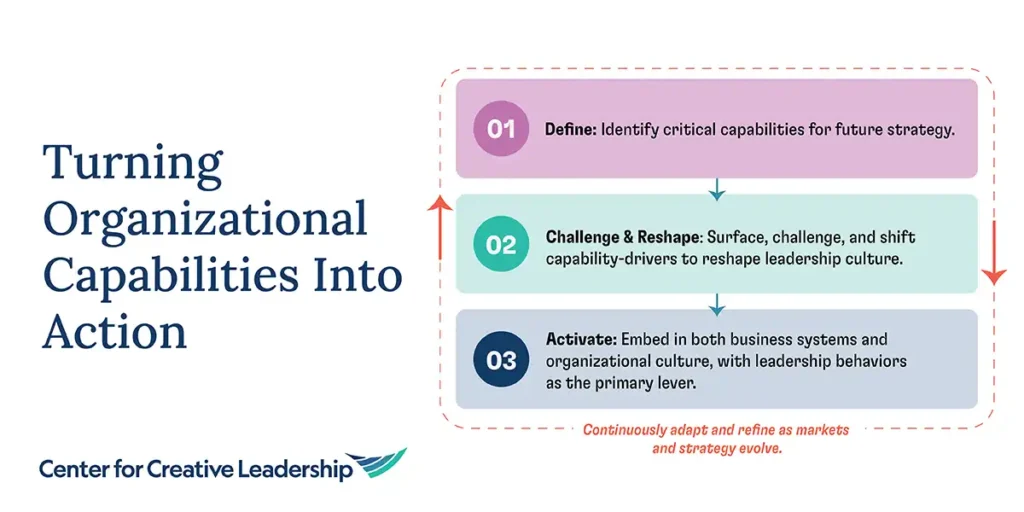
A Three-Phase Approach to Transforming Capabilities into Action
Translating organizational capabilities into tangible action requires a dual focus: looking both outward towards future strategic goals and inward towards internal organizational dynamics. This dual perspective forms the bedrock of a structured, three-phase approach designed for executive teams:
Phase 1: Strategic Capability Assessment and Alignment
This initial phase involves a thorough evaluation of the current organizational capabilities against the backdrop of the future strategic vision. It includes identifying existing strengths, pinpointing critical gaps, and understanding the competitive landscape. A key outcome of this phase is achieving executive team alignment on the core organizational capabilities that will define the company’s future competitive identity. This often involves rigorous analysis, facilitated workshops, and candid discussions to ensure a shared understanding and commitment.
Phase 2: Leadership Capability Development and Culture Shaping
Once the strategic organizational capabilities are defined, the focus shifts to developing the corresponding leadership capabilities and fostering a supportive leadership culture. This phase involves designing and implementing targeted leadership development programs, coaching initiatives, and talent management strategies. It also entails actively shaping the leadership culture to reinforce the desired behaviors and mindsets. This might include revamping performance management systems, recognition programs, and communication strategies to embed the chosen capabilities into the daily fabric of the organization.
Phase 3: Sustained Execution and Capability Evolution
The final phase focuses on embedding the new capabilities into the organization’s operational DNA and establishing mechanisms for continuous improvement and adaptation. This involves monitoring progress against defined metrics, celebrating successes, and addressing any emerging challenges. Crucially, it also involves creating a feedback loop that allows for the ongoing evolution of organizational capabilities in response to changing market dynamics and strategic imperatives. This ensures that the organization remains agile and resilient in the face of future disruptions.
Translating Strategy into Tangible Leadership Practice
As organizations envision their future trajectory and the role of their leaders, organizational capabilities emerge as a pivotal bridging mechanism. By channeling energy into defining and cultivating the organization’s differentiating strengths, these capabilities position the enterprise for strategic success and provide invaluable clarity on the specific behaviors leaders must embody to excel.
The future is inherently dynamic; strategies will evolve, and so too will the demands placed upon leaders to execute them. However, when an organization meticulously aligns its mission, values, strategy, and leadership culture around a focused set of capabilities, it not only strengthens its execution capabilities in the present but also enhances its capacity to adapt and thrive in the future. This holistic approach ensures that every component of the Leadership Strategy Model, and indeed every individual within the organization, remains aligned and on the optimal path toward sustained success.
Ready to Elevate Your Organization’s Strategic Edge?
Identifying the organizational capabilities that transform a company’s strategy into a distinct competitive identity, and cultivating the leadership culture necessary to sustain them, represents consequential work for any executive team. Expert guidance through this complex process can be instrumental in achieving profound and lasting results. Partnering with experienced consultants can illuminate the path forward, assisting executive teams in defining, aligning, and activating the most critical capabilities for sustained business performance. Exploring specialized Organizational Leadership consulting services can provide the framework, tools, and expertise needed to navigate this transformative journey and unlock the full potential of your organization.