In an era where global regulatory environments are becoming increasingly complex, large-scale organizations are facing a critical crossroads in how they deliver essential compliance training to a distributed workforce. The traditional model of synchronous, webinar-based instruction—once the gold standard for remote learning—is rapidly revealing its limitations in the face of shifting time zones, varying regional regulations, and the need for immediate, on-demand knowledge. A recent large-scale digital transformation project led by CommLab India highlights a significant shift in corporate Learning and Development (L&D) strategy: the conversion of legacy, deep-knowledge sanitation curricula into modular, asynchronous eLearning paths designed for longevity and global scalability.
This initiative addressed a common paradox in corporate training: possessing high-quality, expert-driven content that is rendered ineffective by an outdated delivery format. For many multinational corporations, the "Sanitation Curriculum" represents years of accumulated institutional wisdom. However, as this project demonstrates, even the most robust subject matter can become a logistical burden if it remains trapped in a format that does not support modern operational demands.
The Infrastructure of Inefficiency: The Limitations of Webinar-Based Training
For years, the organization at the center of this transition relied on live webinars to train its staff on complex sanitation protocols. While these sessions were rich in detail and benefited from the real-time presence of subject matter experts (SMEs), they were fundamentally unsuited for a global enterprise. The primary friction point was scalability. A live session conducted in one time zone inevitably inconveniences employees in another, leading to fragmented training schedules and inconsistent knowledge levels across different regions.
Furthermore, the "shelf-life" of a webinar is notoriously short. In the highly regulated world of industrial sanitation and manufacturing compliance, a single update to federal or international safety standards can render an entire recorded session obsolete. Under the legacy model, such updates required the organization to re-schedule, re-record, and re-distribute entire webinars—a process that is both time-consuming and cost-prohibitive.
The "forgetting curve," a psychological phenomenon suggesting that humans lose roughly 70% of new information within 24 hours if it is not reinforced, also played a role in the decision to modernize. Webinars, which often last 60 to 90 minutes, provide a massive influx of data that is difficult for learners to retain without the ability to quickly revisit specific segments during their actual work shifts.

Strategic Re-Engineering: The Four Pillars of the Digital Overhaul
To solve these systemic issues, the development team established a framework of four guiding principles. These principles were designed to ensure that the transition to eLearning would not result in a "watered-down" version of the original expertise, but rather a more accessible and resilient iteration of it.
1. Preservation of Subject Matter Depth
A common pitfall in eLearning conversion is the tendency to over-simplify content to fit a digital interface. The project stakeholders mandated that no depth be sacrificed. The goal was to maintain the "experience-based" nuances that had been built over decades, ensuring that the technical rigor required for high-level sanitation compliance remained the core of the program.
2. Microlearning and Self-Paced Delivery
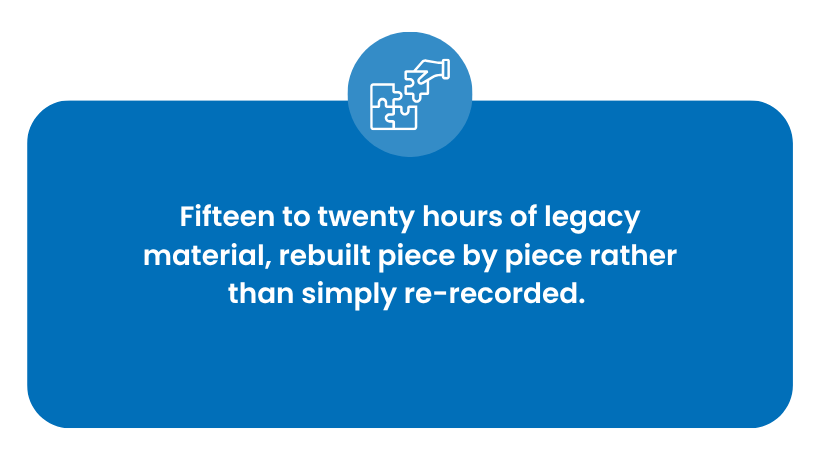
The second principle focused on the "chunking" of information. By breaking down 15 to 20 hours of legacy material into short, self-paced lessons, the training became digestible. Each module was designed to address a single, specific concept that a learner could master in a matter of minutes. This approach aligns with modern cognitive load theory, which suggests that learning is more effective when delivered in small, focused bursts.
3. Modular Learning Paths
The curriculum was reorganized into independent learning paths. This structural change was perhaps the most significant for the organization’s long-term maintenance. By categorizing lessons into discrete paths—such as chemical safety, equipment handling, or regulatory reporting—the organization gained the ability to update a single module in response to a regulatory change without having to touch the rest of the curriculum.
4. Just-in-Time Performance Support
Finally, the team integrated "takeaway" resources. These are digital job aids, checklists, and infographics that employees can access on mobile devices directly on the factory floor or in the field. This shifted the training from a one-time event to a continuous support system.
From Theory to Prototype: Proving the Modular Model
A project of this magnitude—transforming nearly 20 hours of technical content—carries significant financial and operational risks. To mitigate these, the development team utilized an "Agile" prototyping approach. Rather than building the entire curriculum at once, they focused on a single, high-stakes path: Clean-in-Place (CIP).
CIP is a critical process in manufacturing where the interior surfaces of pipes, vessels, and filters are cleaned without disassembly. It is scientifically complex and carries high stakes; an error in CIP can lead to product contamination and massive financial losses. The CIP module was built as a 50-minute path divided into four distinct lessons:
- The Business Case: Understanding the "why" and the cost of failure.
- The Science of Sanitation: The chemical and thermal dynamics of the process.
- The Animated Sequence: A visual, step-by-step walkthrough of the cleaning cycle.
- System Integration: How the CIP hardware fits into the broader plant architecture.
By delivering a fully branded, interactive prototype of the CIP path, the team was able to demonstrate to stakeholders exactly how the new format would function. They also developed a second prototype featuring an on-screen avatar guide to test different instructional tones. This "proof of concept" phase ensured that the pacing, tone, and technical functionality met the organization’s standards before full-scale production commenced.
Technical Execution and Global Integration Standards
The backend development of the program required rigorous technical standards to ensure compatibility with the organization’s existing Learning Management System (LMS). The team utilized industry-leading authoring tools, specifically Articulate Storyline and Rise, to create a responsive design that functions seamlessly across desktops, tablets, and smartphones.
Crucially, every course was built to SCORM (Shareable Content Object Reference Model) standards. This ensures that the data—such as completion rates, quiz scores, and time spent on modules—is accurately tracked and reported within the LMS. For a global compliance program, this data is not just a metric of engagement; it is a legal requirement. In the event of a regulatory audit, the organization must be able to provide documented proof that every employee has successfully completed the required training.
The transition also involved "layering" interactivity. Unlike the passive experience of watching a webinar, the new eLearning modules include scenario-based practice and knowledge checks. These interactive elements force the learner to apply what they have learned in a simulated environment, which significantly increases knowledge retention and reduces the likelihood of on-the-job errors.
Analysis of Broader Implications for Global L&D
The success of this sanitation training overhaul provides a roadmap for other sectors—such as finance, healthcare, and aerospace—where compliance is non-negotiable and the workforce is geographically dispersed.
Market data suggests that the corporate eLearning market is expected to grow by over $160 billion between 2022 and 2026. This growth is driven by the realization that VILT (Virtual Instructor-Led Training) is often a "band-aid" solution for global training needs. True scalability requires asynchronous models that empower the learner to engage with content at the point of need.
Industry analysts note that the "modularization" of training is also a response to the "Great Reshuffle" and high turnover rates in manufacturing and logistics. When new employees are hired, they need to be onboarded quickly. A modular system allows them to jump directly into the training relevant to their specific role, rather than waiting for the next scheduled webinar or sitting through hours of irrelevant content.
Conclusion: A Future-Proofed Compliance Ecosystem
The transformation of this global sanitation program from a series of aging webinars into a dynamic, 10+ path eLearning curriculum represents more than just a technical upgrade. It is a strategic realignment that treats institutional knowledge as a living asset rather than a static record.
By focusing on delivery rather than content overhaul, the organization was able to preserve its hard-won expertise while eliminating the logistical bottlenecks that hindered its growth. The result is a compliance program that is built to last—one where a regulatory change no longer necessitates a complete rebuild, but rather a simple update to a single, modular piece of a much larger, more efficient puzzle. For compliance leaders worldwide, the lesson is clear: the value of your training lies in its depth, but its impact is determined by its accessibility.