Employee recognition is evolving from a peripheral perk to a core business performance system by 2026, directly influencing the employee behaviors that drive organizational success. A recent study conducted by Harvard Business Review Analytic Services, surveying 566 respondents, revealed that 66% consider recognition highly important for business performance. However, a mere 33% of these organizations report their recognition programs as highly effective, presenting a significant opportunity for Chief Human Resource Officers (CHROs) to strategically align recognition with organizational values, priorities, and rewards.
Elevating Recognition to a Strategic Business Pillar
CHROs are increasingly recognizing the need to treat employee recognition not as an optional add-on, but as a fundamental business strategy. This strategic shift is driven by the power of recognition to communicate unequivocally which behaviors, priorities, and values are paramount to the organization’s success. New research highlighted in HBR’s report, "Improving Business Performance Through Appreciation," indicates that a substantial 88% of leading organizations in recognition design their programs to actively cultivate specific employee behaviors. This contrasts sharply with the 28% of organizations that are slower to adopt such programs. The efficacy of recognition is maximized when it is deliberately engineered around the precise behaviors and efforts the business requires, moving beyond generic and infrequent expressions of appreciation.
Recognition as a Catalyst for Business Strategy and Outcomes
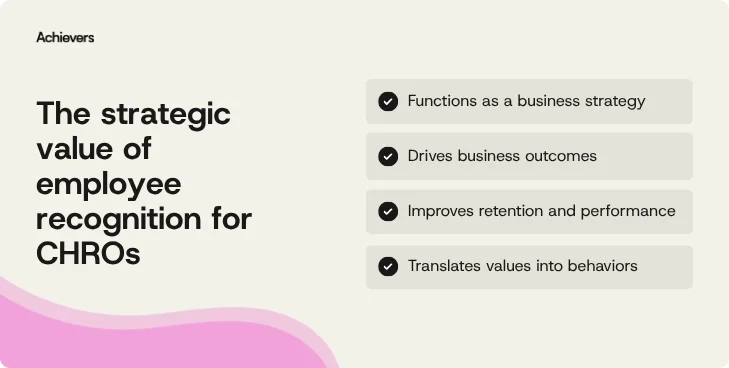
For CHROs, employee recognition functions as a potent business strategy. It serves as a sophisticated mechanism to guide behavior, reinforce organizational priorities, and clarify expectations without introducing additional bureaucratic processes. When integrated strategically, recognition actively supports and amplifies the broader people agenda rather than creating friction.
Crucially, recognition directly drives the key organizational outcomes that HR departments are most pressured to achieve: employee engagement, retention, and overall performance. Organizations that consistently implement effective recognition practices witness demonstrably lower rates of voluntary employee turnover within reported benchmarks, cultivate stronger employee engagement, and achieve superior levels of productivity and performance. Moreover, recognition plays a vital role in helping employees understand what constitutes "hard work" and encourages the replication of these valuable efforts.
The financial implications of effective recognition are also significant. Replacing disengaged or departing employees is an inherently costly, time-consuming, and disruptive undertaking. Strategic recognition proactively mitigates this risk by fostering stronger employee connections from the outset. For CHROs tasked with balancing stringent budgets and high expectations, recognition emerges as one of the few organizational levers that delivers meaningful impact without demanding constant reinvention or substantial structural change.
Furthermore, recognition serves as a powerful tool for translating abstract organizational values into tangible, daily behaviors. By highlighting and celebrating specific actions, recognition effectively communicates to employees which behaviors are deemed worthy of repetition and emulation. As Robert Dur, Professor of Economics at Erasmus University Rotterdam, aptly describes in the latest HBR report, recognition acts as "a compass that directs people’s attention, time, and energy." This makes recognition an exceptionally clear and actionable tool for CHROs seeking to imbue organizational policies with practical application in the everyday work environment.
The Evolution of Employee Recognition in 2026
The landscape of employee recognition is undergoing a significant transformation. By 2026, modern approaches are diverging sharply from traditional models that are increasingly proving inadequate for the dynamic and evolving nature of the contemporary workplace.
The Shortcomings of Legacy Recognition Models
Traditional recognition models were conceived and implemented in a vastly different organizational context. Today, these outdated frameworks struggle to keep pace with the realities of how work is actually conducted. For CHROs, these legacy models often result in limited reach, diminished relevance, and a failure to acknowledge and celebrate the moments that truly matter most to employees. This can manifest as infrequent, top-down awards that fail to resonate with the day-to-day contributions of the broader workforce.

The Shift from Episodic to Frequent, Embedded Recognition
In contrast, modern recognition strategies are built on the principles of consistency and proximity to the actual work being performed. This paradigm shift emphasizes frequent, ongoing appreciation that is seamlessly integrated into the daily workflow and team interactions. This approach fosters a more credible and inclusive recognition culture, proving far more effective in shaping day-to-day behaviors and reinforcing desired actions. The move is away from annual awards ceremonies towards real-time acknowledgments that occur during project milestones, team huddles, and everyday collaborations.
Recognition’s Role in Building Resilient and Connected Organizations
In an era characterized by constant change and uncertainty, employee recognition transcends mere motivation; it acts as a stabilizing force. By consistently acknowledging contributions and reinforcing alignment with organizational goals, recognition helps to anchor employees amidst shifting priorities and evolving business landscapes. This is the fundamental building block of a truly connected company—one where recognition serves as the steadying influence that keeps individuals aligned, engaged, and prepared for future challenges.
The significance of this stability cannot be overstated, as the ultimate success or failure of any major business transformation hinges on whether employees adapt their work behaviors accordingly. In a recent edition of The Recognition Effect, David Bator, Managing Director of the Achievers Workforce Institute, elaborates on the findings from Harvard Business Review Analytic Services research. He posits that recognition plays a critical role in enabling organizations to translate fleeting change initiatives into enduring behavioral shifts. This proactive integration of recognition ensures that change efforts are not merely top-down directives but are actively embraced and internalized by the workforce.
Harnessing Recognition for Engagement, Retention, and Culture
CHROs have a critical opportunity to leverage employee recognition as a powerful lever for driving engagement, improving retention, and cultivating a thriving organizational culture.
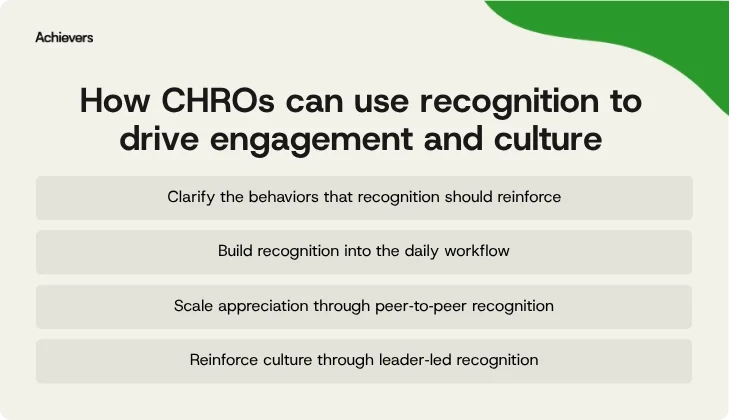
Clarifying Behaviors for Reinforcement
Effective recognition is intrinsically linked to clear expectations. CHROs must meticulously define the specific behaviors that most directly contribute to enhanced engagement, improved morale, stronger retention, and superior performance. It is imperative to ensure that recognition consistently reinforces these targeted behaviors. Vague or generalized recognition dilutes its impact. Conversely, specific and clearly tied recognition to organizational priorities and values becomes a practical and actionable signal that employees can readily understand and act upon daily. For instance, if collaboration is a key value, recognition should be given to individuals or teams who demonstrably share knowledge, support colleagues, or work effectively across departmental lines.
Embedding Recognition into the Daily Workflow
The most impactful recognition occurs organically within the flow of work, not as an isolated event separate from daily operations. Instead of being confined to annual programs or one-off initiatives, recognition should be a natural occurrence during moments that matter: team check-ins, project completion, client successes, and routine collaborative efforts. This embedded approach makes recognition feel authentic and consistently present, rather than a sporadic bonus. This could involve a quick shout-out in a team meeting for overcoming a technical hurdle or a digital acknowledgment for a client win shared across a relevant channel.
Scaling Appreciation Through Peer-to-Peer Recognition
While manager-led recognition holds significant weight, it cannot solely shoulder the burden of fostering a recognition-rich environment. Peer-to-peer recognition plays a crucial role in expanding the visibility of contributions, strengthening a sense of belonging, and capturing valuable efforts that leaders might otherwise overlook. When recognition becomes a shared responsibility across the organization, the overall culture scales in parallel. CHROs are instrumental in setting the expectation that recognition is a collective endeavor—an active practice employees engage in, rather than solely a top-down directive from leadership. This democratizes appreciation and fosters a more inclusive environment where all contributions are acknowledged.
Reinforcing Culture Through Leader-Led Recognition
Recognition from senior leaders carries a distinct and often amplified impact, as it powerfully signals what truly matters to the organization at any given moment. A CEO publicly commending a team for successfully navigating a challenging period of change, or an executive acknowledging exceptional collaboration during a difficult quarter, communicates priorities more effectively than any formal announcement or email. CHROs can ensure this impact is sustained by empowering leaders to recognize visibly, consistently, and in ways that serve as learning opportunities for all employees. This involves training leaders on how to deliver meaningful and specific recognition that resonates with their teams and the broader organization.
Designing Inclusive Recognition Across Diverse Roles and Work Models
Effective recognition must extend to all employees, irrespective of their roles, work locations, or working models. This necessitates designing recognition opportunities that accommodate diverse realities, from frontline employees to remote teams and those in different time zones. The goal is to acknowledge contributions based on genuine impact, not proximity to leadership. This might involve developing digital platforms for remote teams to share praise, implementing quick recognition systems for on-site staff, or ensuring that all recognition efforts are culturally sensitive and universally accessible. When recognition focuses on the substance of an employee’s contribution, individuals feel genuinely seen and valued for the impact they make.
Positioning Recognition as a Culture-Shaping System
Recognition achieves its greatest value when it evolves into a consistent leadership habit, rather than a one-time rollout or a superficial program. When utilized consistently, recognition helps employees understand the organization’s core values and their individual place within the broader mission. This transforms recognition into a robust system—one that CHROs can meticulously track, continuously improve, and strategically deploy to strengthen organizational culture over time. This systemic approach ensures that recognition is not a fleeting initiative but a foundational element of the employee experience.
Measuring Recognition ROI and Addressing Program Deficiencies
Quantifying the return on investment (ROI) of employee recognition programs is critical for demonstrating their business impact and identifying areas for improvement. This measurement process begins with a thorough understanding of program usage, consistency of application, and the tangible impact on key performance indicators. These metrics provide invaluable insights into what is functioning effectively and where adjustments are needed.
Key Metrics for Proving Business Impact
CHROs should focus on measuring several key areas to effectively demonstrate the business impact of recognition programs:
- Usage and Participation Rates: Tracking how frequently employees and managers engage with recognition platforms, the percentage of the workforce participating, and the frequency of recognition given and received. High usage indicates a program is accessible and relevant.
- Recognition Consistency and Timeliness: Monitoring whether recognition is distributed equitably across departments and levels, and whether it is delivered in a timely manner close to the observed behavior. Inconsistent or delayed recognition diminishes its effectiveness.
- Alignment with Strategic Goals: Assessing whether recognition is explicitly tied to and reinforcing specific company objectives, values, and desired behaviors. This ensures recognition is strategically focused rather than arbitrary.
- Impact on Employee Engagement Scores: Correlating recognition data with employee engagement survey results, looking for improvements in areas such as feeling valued, motivated, and connected to the organization.
- Correlation with Retention Rates: Analyzing whether departments or teams with higher recognition engagement exhibit lower voluntary turnover. This directly links recognition to a critical business outcome.
- Productivity and Performance Metrics: Investigating potential links between recognition and improvements in team or individual productivity, quality of work, or achievement of performance targets.
- Employee Feedback and Satisfaction: Gathering qualitative data through surveys, focus groups, or direct feedback to understand employees’ perceptions of the recognition program’s fairness, impact, and meaningfulness.
Linking Recognition Data to People and Business Outcomes
The true power of recognition data lies in its ability to be linked directly to broader people and business outcomes. This involves establishing clear causal pathways:
- Engagement to Retention: Demonstrating that higher levels of recognition correlate with higher engagement scores, which in turn correlate with lower attrition rates.
- Performance to Recognition: Showing that teams or individuals who receive consistent, targeted recognition for specific performance-related behaviors exhibit improved productivity or achieve key performance indicators at higher rates.
- Culture to Recognition: Measuring how recognition practices contribute to the perception and reality of desired cultural attributes, such as collaboration, innovation, or customer-centricity, as reported in employee surveys.
- Absenteeism to Recognition: Investigating potential reductions in absenteeism among highly recognized employees, suggesting increased job satisfaction and commitment.
Common Recognition Challenges and Solutions
CHROs frequently encounter a range of challenges in implementing and optimizing recognition programs:
- Lack of Strategic Alignment: Recognition efforts are often disconnected from overarching business goals. Solution: Clearly define the specific behaviors and outcomes the recognition program is intended to drive, and ensure these are directly linked to strategic objectives.
- Inconsistent or Inequitable Distribution: Recognition is often concentrated among a few high-performers or specific departments, leading to perceptions of unfairness. Solution: Implement transparent guidelines, provide training on equitable recognition practices, and leverage technology to monitor distribution across the organization.
- Infrequent or Generic Recognition: Recognition is often delivered sporadically or lacks specificity, diminishing its impact. Solution: Encourage frequent, timely, and specific recognition. Train managers and employees on how to deliver meaningful acknowledgments that highlight the exact behavior and its impact.
- Limited Reach: Recognition programs fail to reach all employees, particularly those in frontline or remote roles. Solution: Design recognition programs that are accessible across all work models and locations, utilizing digital platforms and diverse communication channels.
- Lack of Measurement and ROI: Inability to demonstrate the tangible business value of recognition efforts. Solution: Establish clear metrics from the outset and consistently track usage, impact, and correlations with key business outcomes.
The Path Forward: Turning Recognition into Tangible Results
For CHROs, the pertinent question is not whether recognition matters, but whether it is effectively deployed in the moments that are most critical. In times of employee disconnection, uncertainty, or heightened pressure, recognition often serves as the primary signal for employees to gauge whether their work is still valued and acknowledged. When executed effectively, recognition becomes the vital thread that connects individuals to their purpose, to their colleagues, and to the core values of the organization.
Progressive CHROs are not pursuing flashy programs or fleeting victories. Instead, they are meticulously observing where and how recognition is being applied, who it is reaching, and how it is actively reinforcing the specific type of culture that demonstrably drives results. They are willing to conduct honest assessments of what is working effectively and what requires evolution. This commitment to continuous improvement ensures that recognition remains a dynamic and impactful component of the organizational strategy.
Achievers offers comprehensive solutions designed to empower CHROs to unlock the full potential of recognition, transforming it into a powerful driver of engagement, retention, and ultimately, business success. By embracing recognition as a strategic imperative, organizations can foster a more motivated, productive, and resilient workforce poised for sustained achievement.