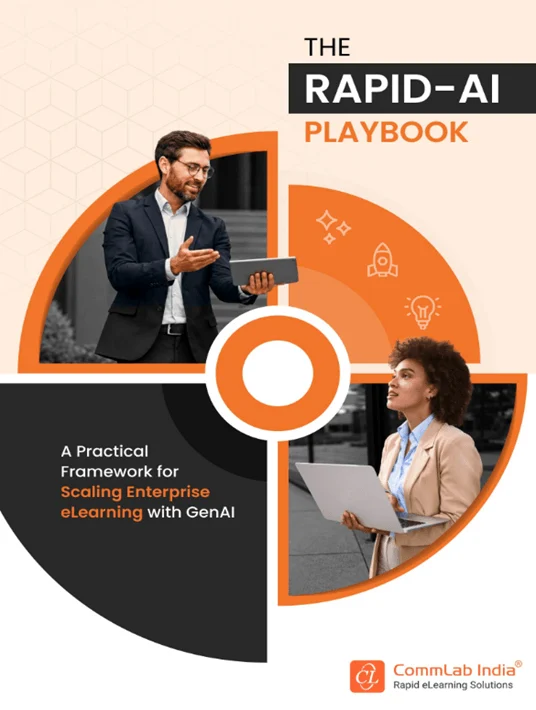
The global corporate training landscape is currently undergoing a fundamental shift as Learning and Development (L&D) departments transition from experimental use of Generative Artificial Intelligence (GenAI) to systematic, enterprise-wide integration. CommLab India, a prominent leader in the corporate training solutions sector, has officially released a comprehensive operating framework titled RAPID-AI, designed to bridge the gap between isolated AI successes and scalable, high-volume production. This new playbook addresses a critical paradox in modern corporate education: while the majority of L&D teams report using AI tools for individual tasks, very few have successfully translated these tools into a consistent, repeatable development cycle that maintains quality at scale.
The Challenge of Scalability in AI-Driven Training
The emergence of GenAI in late 2022 and throughout 2023 provided L&D professionals with immediate efficiency gains in content drafting, image generation, and initial brainstorming. However, as organizations move into the mid-2020s, the limitations of an ad-hoc approach have become apparent. Individual instructional designers may use AI to speed up their personal workflows, but without a unified framework, these "isolated wins" do not contribute to organizational maturity.
The RAPID-AI framework is positioned as a solution to this fragmentation. It is built upon real-world experience gathered from high-volume learning projects for global enterprises, where the primary challenge is not merely speed, but the orchestration of people, processes, and technology. The framework aims to move the conversation beyond the "potential" of AI and toward a standardized operating model that ensures every piece of content meets rigorous corporate standards and pedagogical requirements.
Historical Context: The Evolution of eLearning Development
To understand the necessity of the RAPID-AI framework, one must look at the chronology of eLearning development over the past two decades. In the early 2000s, the industry relied on the ADDIE model (Analysis, Design, Development, Implementation, and Evaluation), a linear process that was often slow and resource-heavy. The 2010s saw the rise of Agile and SAM (Successive Approximation Model) methodologies, which introduced iterative development to keep pace with rapid business changes.
The introduction of GenAI represents the third major evolution in this timeline. While previous shifts focused on project management styles, the AI revolution alters the very nature of content creation. The "RAPID-AI" approach represents a synthesis of these historical methodologies, updated for an era where the speed of content generation can easily outpace the speed of human review. The framework serves as a necessary governor to ensure that the acceleration of development does not lead to a decline in educational efficacy or factual accuracy.
The Five Pillars of the RAPID-AI Framework
The playbook outlines a holistic strategy that connects five essential domains of enterprise operations. By addressing these pillars, L&D teams can move away from "prompt-and-hope" tactics toward a professionalized production line.
1. People: Upskilling and Cultural Alignment
The framework emphasizes that AI integration is as much a human challenge as a technical one. Organizations must identify the "AI-ready" competencies required for instructional designers, such as prompt engineering, AI-assisted storyboarding, and the ability to act as "AI Editors" rather than just content creators. The RAPID-AI model suggests a structured approach to upskilling, ensuring that the workforce is comfortable collaborating with machine intelligence.
2. Processes: The New Instructional Design Workflow
Standard instructional design workflows are often ill-equipped for the speed of GenAI. The framework proposes a restructured workflow that identifies specific "AI-intervention points." This includes using AI for rapid prototyping during the analysis phase and employing automated tools for initial drafting, while preserving human-centric design for the final creative and pedagogical polish.
3. Technology: The Enterprise AI Stack
Scaling requires more than just a subscription to a single Large Language Model (LLM). The playbook discusses the necessity of a curated "AI stack" that includes secure, enterprise-grade AI platforms, specialized authoring tools with AI integrations, and asset management systems that can handle the influx of AI-generated media.
4. Quality: Maintaining Pedagogical Integrity
One of the primary risks of GenAI is the production of "hallucinations" or factually incorrect content. The RAPID-AI framework introduces rigorous quality assurance (QA) protocols specifically designed for AI-generated outputs. This involves multi-stage verification processes where human experts validate the pedagogical soundness and technical accuracy of the content before it reaches the learner.
![The RAPID-AI Playbook: A Practical Framework For Scaling Enterprise eLearning With GenAI [eBook Launch]](https://cdn.elearningindustry.com/wp-content/uploads/2026/09/shutterstock_2761905765.jpg)
5. Governance: Ethics and Compliance
As enterprises deploy AI, they face significant concerns regarding data privacy, intellectual property, and ethical bias. The framework provides a roadmap for establishing governance committees that oversee how AI is used, ensuring that proprietary company data is protected and that the training content remains compliant with global regulations and internal brand guidelines.
Supporting Data: The State of AI in Corporate Learning
Industry data underscores the urgency of adopting a structured framework like RAPID-AI. According to recent industry surveys, approximately 83% of L&D leaders believe that GenAI will significantly change how they develop training content over the next three years. However, a 2024 report on digital learning maturity found that only 15% of organizations have a formal strategy for AI implementation.
Furthermore, data from early adopters of AI-augmented development shows a potential reduction in development time of 30% to 50% for certain types of content. Yet, without a framework to manage this speed, teams often report a "content bottleneck" at the review and approval stages. The RAPID-AI playbook addresses this by optimizing the review cycle alongside the creation cycle, preventing the gains in speed from being lost in administrative delays.
Industry Perspectives and Organizational Reactions
While CommLab India has spearheaded this specific framework, the broader industry reaction reflects a desperate need for such standardization. Analysts in the EdTech space have noted that "AI fatigue" is setting in for teams that have experimented with various tools but haven’t seen a measurable return on investment (ROI).
"The problem isn’t the AI; it’s the lack of a blueprint," suggests one industry analyst following the release of the playbook. "Most L&D teams are currently in a ‘pilot’ phase that never ends. A framework like RAPID-AI provides the structural integrity needed to turn those pilots into a permanent part of the business infrastructure."
Organizational leaders are increasingly looking for ways to justify the costs of AI subscriptions and specialized talent. By adopting a proven operating framework, L&D departments can present a clearer ROI to C-suite executives, demonstrating how AI contributes to faster employee onboarding, more frequent upskilling, and reduced overall training costs.
Analysis of Implications: The Future of Training
The release of the RAPID-AI framework signals a maturing of the GenAI market in the corporate sector. We are moving past the "novelty" phase of AI where the goal was simply to see what the technology could do. We are now entering the "industrialization" phase, where the focus is on reliability, consistency, and scale.
The implications of this shift are profound. For instructional designers, it means a shift in their professional identity toward high-level strategy and quality control. For corporations, it means the ability to update training materials in near real-time as market conditions or internal policies change. For learners, it promises more personalized and timely content, provided the framework’s quality controls are strictly followed.
However, the transition is not without risks. The framework highlights that "governance" is perhaps the most difficult pillar to implement. As AI tools become more democratized, maintaining a "single source of truth" within an organization becomes harder. The RAPID-AI playbook argues that without a centralized framework, organizations risk creating a "Wild West" of training content that could lead to misinformation or brand dilution.
Conclusion and Practical Application
The RAPID-AI Playbook is currently available as a free resource, positioned as a guide for L&D leaders who are ready to move beyond experimentation. By focusing on the intersection of people, process, and technology, CommLab India aims to provide a repeatable roadmap for the modern enterprise.
As the corporate world continues to grapple with the rapid pace of technological change, the focus will inevitably shift from the tools themselves to the systems that manage them. The RAPID-AI framework represents a significant step toward that systemic maturity, offering a practical way to harness the power of GenAI without sacrificing the quality and governance that enterprise learning demands. In the coming months, the success of such frameworks will likely be measured by their ability to help L&D teams handle increasing volumes of work while maintaining—or even improving—the impact of corporate training on business performance.