
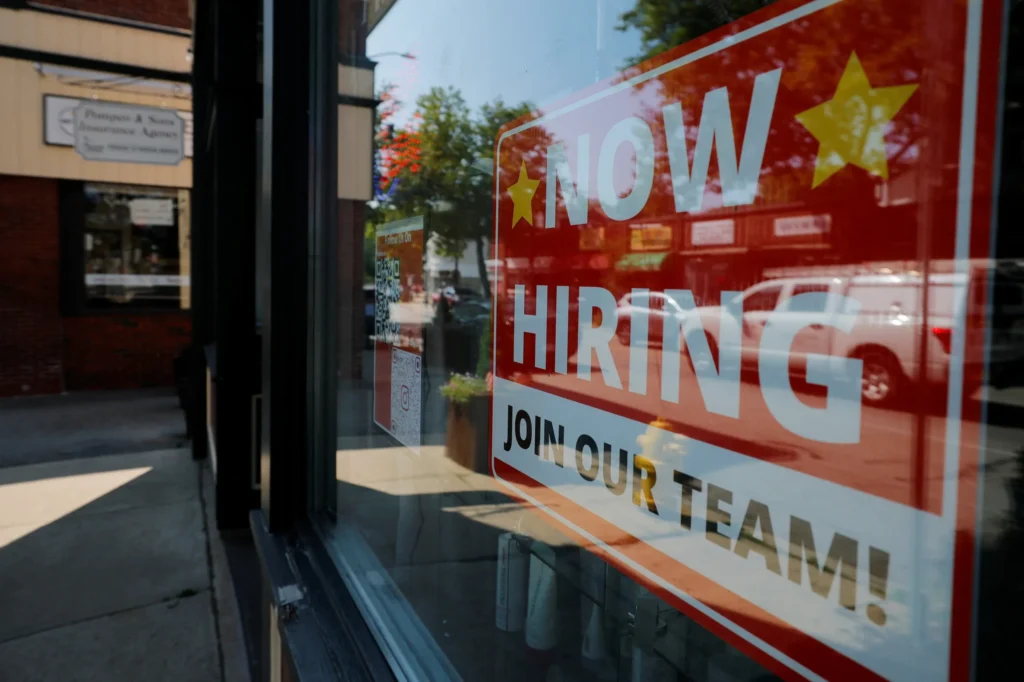
The American labor market demonstrated robust resilience in August, with job growth accelerating significantly beyond expectations and the unemployment rate holding steady at 4.1%. This stronger-than-anticipated performance, detailed in the Labor Department’s closely watched employment report released on Friday, suggests a notable rebound after a period of softer gains. The data has promptly re-energized discussions about the Federal Reserve’s potential to implement another interest rate increase at its upcoming September meeting.
The Bureau of Labor Statistics revealed that nonfarm payrolls increased by a substantial 162,000 jobs in August, marking the largest monthly gain in five months. This figure significantly surpassed the 56,000 jobs economists had forecast and represented a dramatic improvement from the upwardly revised gain of 21,000 jobs in July. The report also indicated that June payrolls were revised higher by 11,000 to 20,000. The range of August payroll estimates from economists polled by Reuters had been wide, from a loss of 25,000 jobs to a gain of 121,000, highlighting the degree to which the actual number defied more conservative predictions.
This surge in job creation was largely attributed to a significant rebound in the leisure and hospitality sector, which added 62,000 jobs. Within this sector, restaurants and bars alone contributed 59,000 new positions. This marked a crucial reversal after two consecutive months of declines in leisure and hospitality employment. Additionally, the education sector, specifically local government education, saw a reversal of recent negative trends, adding 42,000 jobs and erasing a previous month’s decrease. Overall government payrolls rebounded by 35,000 positions. Together, the leisure and hospitality sector and government employment accounted for more than 60% of the total employment gains in August, underscoring their pivotal role in the month’s robust job market performance.
The labor market’s strength was further underscored by the fact that the unemployment rate remained unchanged at 4.1%, despite a significant increase in the labor force. The labor force expanded by 683,000 individuals in August, a substantial jump that suggests more people are actively seeking employment. This expansion, coupled with the steady unemployment rate, indicates a healthy absorption of new workers into the economy. The labor force participation rate, a key indicator of the proportion of working-age Americans who are either employed or actively looking for work, rebounded by 0.2 percentage points to 61.6% in August. While this represents a positive development, it still remains below the 62.1% recorded at the beginning of the year, suggesting there is still room for further participation to recover.
The robust employment figures have directly influenced financial markets’ expectations regarding the Federal Reserve’s next move. Prior to the release of the jobs report, market sentiment had shifted towards a pause in interest rate hikes, influenced by comments from Fed Governor Christopher Waller. Waller had indicated on Thursday at a Reuters NEXT Newsmaker event that he would be inclined to support keeping rates steady if incoming data confirmed a cooling of inflation pressures. However, the stronger-than-expected jobs report has led to a reassessment, with financial markets now pricing in a higher probability of a rate hike. CME’s FedWatch tool showed that the odds of a quarter-percentage-point rate increase at the Fed’s September 15-16 meeting rose to approximately 62%, up from around 49% on Wednesday. The Federal Reserve’s benchmark overnight interest rate is currently set within a range of 3.50% to 3.75%.
Economists and market analysts have offered varying perspectives on the implications of these August jobs numbers. "The American labor market is in good condition heading into the end of the year," commented Joe Brusuelas, chief economist at RSM. "The data does lend support to the hawks at the Fed who are growing impatient with inflation." This sentiment reflects the ongoing tension between the Fed’s dual mandate of maximizing employment and maintaining price stability.
Factors Contributing to August’s Job Surge
Several specific factors contributed to the significant uptick in August payrolls. The rebound in leisure and hospitality employment is particularly noteworthy. This sector, which was heavily impacted by pandemic-related restrictions and subsequent recovery phases, has shown resilience. The 59,000 jobs added in restaurants and bars signal a strong consumer demand for services. The reversal of the drag from local government education also played a crucial role. Some economists suggest that difficulties in adjusting the data for seasonal fluctuations might have boosted August payrolls, after having potentially restrained job growth in July.
Beyond these key sectors, other industries also saw gains. Manufacturing payrolls increased by 16,000, and the construction sector added 22,000 jobs, indicating continued activity in these vital areas of the economy. Healthcare employment rose by 13,000, though this was slower than the average monthly gain of 32,000 over the past year. This moderation in healthcare job growth could potentially be linked to the revocation of Temporary Protected Status (TPS) for hundreds of thousands of Haitian immigrants, which may have impacted their work permits and availability in the labor force.
However, not all sectors experienced growth. Professional and business services payrolls saw a modest increase of 10,000 jobs. More notably, the information sector shed 23,000 jobs, and the financial activities industry lost 11,000 positions, primarily in finance and insurance. Economists have attributed these declines to the increasing adoption of artificial intelligence for certain work roles, suggesting a structural shift in some industries.

Broader Economic Context and Federal Reserve Policy
The August jobs report arrives at a critical juncture for the Federal Reserve, which has been engaged in an aggressive campaign to combat inflation through interest rate hikes. The central bank has been closely monitoring incoming economic data for signs of cooling inflation and a moderating labor market, which would provide a rationale for pausing its tightening cycle.
The average workweek also lengthened in August, reaching 34.4 hours, the longest duration since March 2024, up from 34.3 hours in July. This increase in hours worked can also be seen as a sign of labor market strength, as employers may be increasing hours for existing staff before resorting to new hires, or as demand for labor intensifies.
Despite the surge in payrolls and the low unemployment rate, wage growth has shown signs of moderation. Wages increased by 3.1% in the 12 months through August, a slight deceleration from the 3.2% rise recorded in July. This moderation in wage growth is a key factor for the Federal Reserve, as persistently high wage increases can contribute to inflationary pressures.
The upcoming Consumer Price Index (CPI) report for August, due next week, will be a critical determinant for the Federal Reserve’s decision on interest rates. If the CPI data confirms that inflation is continuing to cool, it could strengthen the case for the Fed to hold rates steady. Conversely, any indication of renewed inflationary pressures might tip the balance towards another rate hike.
Market Reactions and Implications
The release of the August jobs report triggered immediate reactions in financial markets. Stocks on Wall Street traded lower following the news, reflecting investor concerns about a potential rate hike potentially dampening economic activity and corporate earnings. The U.S. dollar gained ground against a basket of currencies, as higher interest rates typically make a currency more attractive to investors. U.S. Treasury yields also rose, driven by expectations of further monetary tightening and ongoing concerns about inflation.

The rise in Treasury yields has had a direct impact on borrowing costs for consumers and businesses. This week, the 30-year fixed mortgage rate climbed to a more than one-year high of 6.71%, according to data from mortgage finance agency Freddie Mac. This increase in mortgage rates could further strain the already struggling housing market, potentially impacting sales and construction activity.
Jeffrey Roach, chief economist at LPL Financial, offered a nuanced perspective on the potential market volatility. "Ironically, a rate hike may generate less market volatility than another meeting in which policymakers choose to stand pat," Roach stated. This suggests that a decisive action from the Fed, even if it involves a rate hike, might provide greater clarity and reduce uncertainty compared to a prolonged period of indecision.
Underlying Labor Market Dynamics and Challenges
While the headline numbers paint a picture of a strengthening labor market, some underlying data points reveal ongoing challenges. The number of people experiencing long bouts of unemployment—those out of work for 27 weeks or more—rose by 159,000 in August. The median duration of unemployment also increased to 11.4 weeks, nearing a 4-1/2-year high touched in May and up from 10.5 weeks in July. This suggests that while new jobs are being created, it is taking longer for some individuals to find employment, indicating potential mismatches in skills or regional economic disparities.
Tom Porcelli, chief economist at Wells Fargo, cautioned about the potential for future increases in the unemployment rate. "Even if the household survey’s measure of employment continues to improve, further scope for participation to at least partially rebound leaves room for a modest rise in the unemployment rate by year-end," Porcelli noted. This outlook considers the possibility that as more people re-enter the labor force, the unemployment rate could tick up even if job creation remains steady.
Furthermore, the current labor market dynamics are being shaped by broader demographic and policy trends. The Trump administration’s policies aimed at curbing immigration, including increased deportations and the revocation of TPS, have been identified as a significant factor in shrinking the labor pool. Economists estimate that the economy needs to create between zero and 50,000 jobs per month to simply keep pace with the growth in the working-age population, a threshold that the August numbers comfortably surpassed. However, the reduced labor supply, combined with factors like retirements and slower population growth due to immigration policies, is contributing to the persistently low unemployment rate.

The household employment survey, which measures employment from the perspective of households rather than establishments, showed an increase of 569,000 jobs in August, recovering after two consecutive months of declines. The number of people working part-time for economic reasons also decreased by 414,000, suggesting that some individuals who were previously underemployed have found full-time positions or that demand for full-time work has increased.
Conclusion
The August employment report presents a complex and dynamic picture of the U.S. labor market. The sharp acceleration in job growth and the steady unemployment rate offer clear evidence of underlying strength and resilience. However, these positive indicators are juxtaposed with concerns about persistent inflation, the potential for further interest rate hikes, and underlying structural challenges within the labor force. As the Federal Reserve weighs its next monetary policy decision, the August jobs data provides significant ammunition for those advocating for a hawkish stance, while the broader economic context and evolving labor market trends will continue to be closely scrutinized by policymakers and market participants alike. The coming weeks, particularly the release of the August CPI report, will be crucial in determining the trajectory of interest rates and the broader economic outlook.








