The United States labor market is undergoing a significant transformation as 2026 unfolds, marked by a noticeable uptick in the national unemployment rate and a growing divergence in opportunities between recent college graduates and more experienced professionals. While broader economic headwinds such as inflation, elevated interest rates, and the lingering effects of global trade policies have contributed to a general slowdown, emerging data suggests that Artificial Intelligence (AI) is beginning to play a more direct and impactful role, particularly in shaping the career trajectories of younger workers.
For much of the past year, analyses of employment data and discussions with industry press indicated a relatively muted impact of AI on job displacement. The prevailing narrative attributed the slowdown in job growth primarily to cost-cutting measures and pervasive economic uncertainty, rather than widespread AI-driven automation. However, the landscape appears to be shifting. The U.S. unemployment rate, which stood at 3.7% in November 2023, has climbed to 4.6% by early 2026. This represents a substantial increase of approximately 24.7% over two years and a 9.5% rise in just the last year, escalating from 4.2% a year prior. This trend signals a cooling economy, a stark contrast to the post-pandemic "revenge spending" boom of 2021 and 2022. Factors such as persistent inflation, a relatively high interest rate environment maintained by the Federal Reserve to combat price pressures, and the imposition of tariffs on goods have all played a role in this economic recalibration.
The Emerging AI Divide: Graduates Face New Headwinds
A deeper examination of unemployment data reveals a striking disparity when segmented by age and experience. Analysis of U.S. Bureau of Labor Statistics (BLS) data, when broken down into two key demographics – new college graduates (aged 24 and younger) and more seasoned professionals (aged 25-35) – highlights a growing divergence.
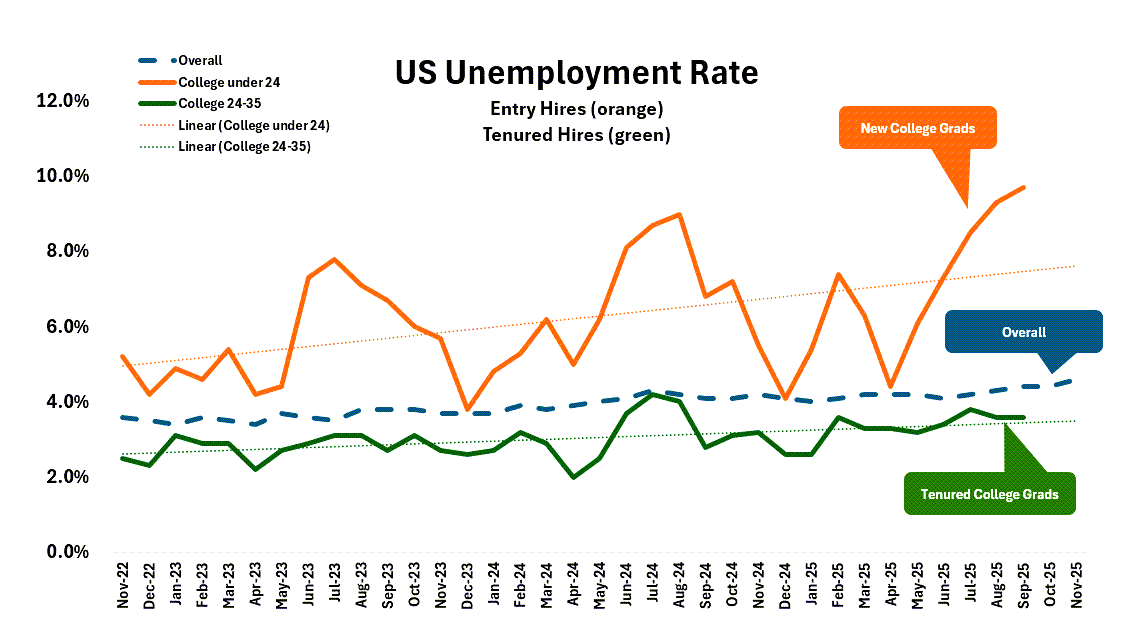
The unemployment rate for tenured college graduates, those with established careers and years of experience, has remained relatively stable and below the overall national average. This segment of the workforce, characterized by accumulated skills, developed judgment, and professional maturity, appears to be weathering the economic slowdown more effectively. Their experience and proven track record provide a degree of resilience in a tightening job market.
In contrast, the unemployment rate for recent college graduates is trending sharply upward. Data indicates that this rate is approaching 10%, a level not seen since the peak of the pandemic recovery in July 2021. This situation echoes historical economic downturns, with a similar surge in young college graduate unemployment occurring in 2011, a period of recovery following the 2008 Great Recession. Research from institutions like the St. Louis Federal Reserve has corroborated this trend, noting that recent college graduates are bearing the brunt of current labor market shifts.
Furthermore, data from Hiring Lab suggests that jobs not requiring a college degree constitute a significant and growing portion of the workforce, accounting for approximately 82% of all jobs, an increase from 79% five years ago. This trend, coupled with the rising unemployment among college graduates, implies a dual impact of AI: not only is it potentially slowing the hiring of new graduates, but it may also be contributing to a reduction in the overall number of jobs that traditionally require a four-year degree.
AI as a Socio-Technological Force: Trust and Anxiety
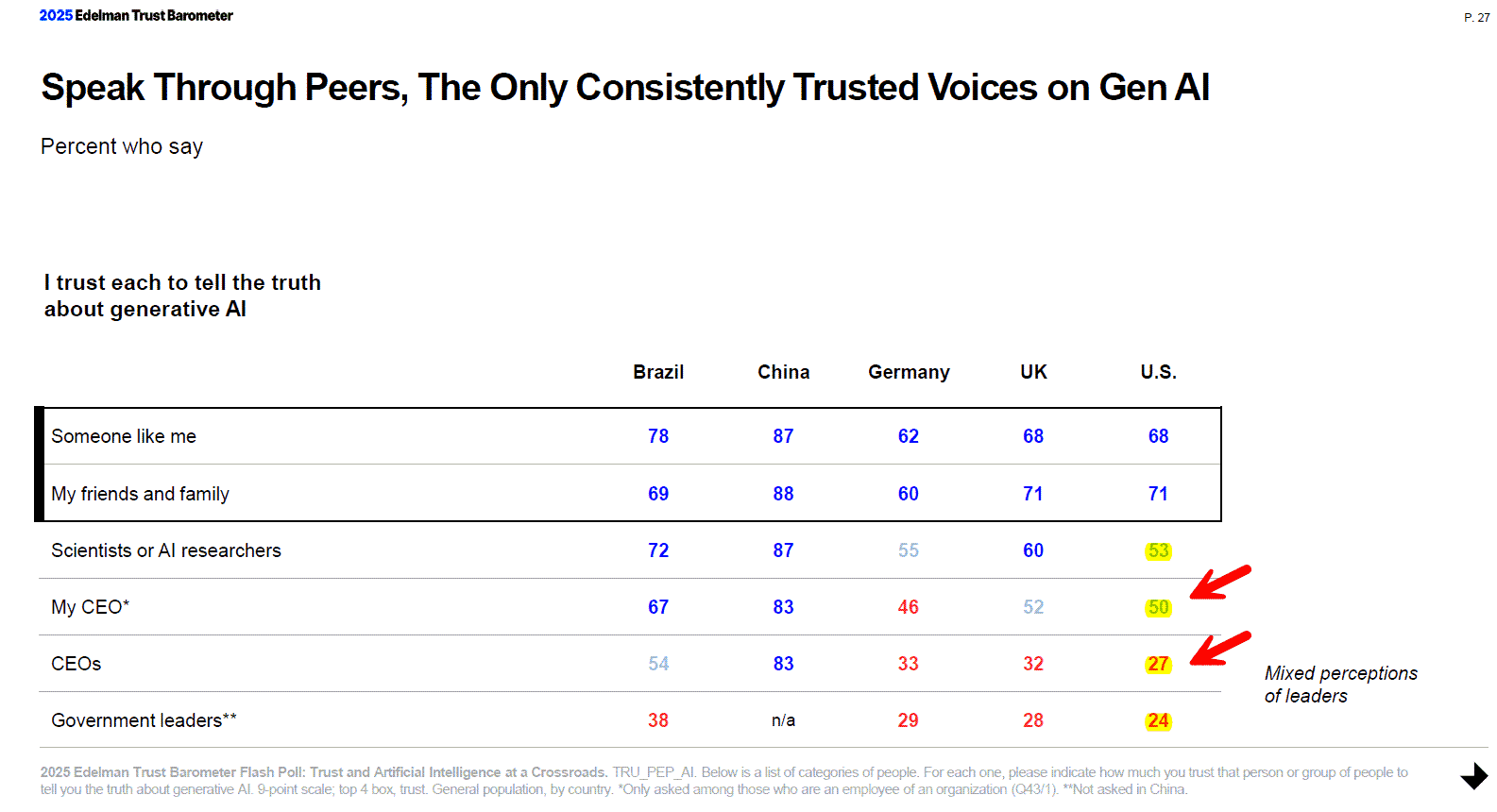
The evolving employment landscape is intrinsically linked to societal perceptions and trust in Artificial Intelligence. Recent polling, such as the Edelman Trust Barometer flash poll on Trust in Artificial Intelligence, reveals a nuanced picture. While a significant portion of the public expresses concerns about AI’s impact, the data suggests a distinction between trust in AI platforms themselves and trust in the value AI can deliver. This "trust in AI’s value" versus "trust in the AI platform" dichotomy is crucial for understanding employee adoption and organizational integration.

As articulated in discussions surrounding the Human Capital Agenda, AI is increasingly recognized as a "socio-technological innovation." This designation underscores its profound societal and sociological implications, extending far beyond mere technological advancement. When employees perceive a lack of transparency or feel that leadership is not candid about AI’s role and potential impact, trust erodes. This can lead to widespread apprehension, employee resistance to change, and a general sense of economic insecurity. Such anxieties, rooted in concerns about job security, career progression, and future earnings, can paradoxically stifle economic productivity as individuals become more risk-averse and less engaged.
The path forward, therefore, necessitates open and honest dialogue about AI. The full extent of its impact on the job market remains a subject of ongoing study and debate. Many current AI platforms are perceived to overstate their capabilities, contributing to both hype and apprehension. Navigating this transition requires individuals and organizations to become more comfortable with AI’s evolving presence in the workplace. This includes adapting to AI-powered communication tools, personalized marketing, AI-assisted recruitment processes like avatar-based interviews, AI-driven career guidance, and AI-informed performance evaluations. Projections for 2026 indicate an acceleration of these trends, with the emergence of "digital twins," advanced robotics, and increasingly sophisticated AI-driven animations of human work processes. Tools like Galileo Learn, which employs an "AI Agent" for coaching and skill development, exemplify this shift.
Strategic Implications for Hiring and Workforce Development
The current economic climate and the evolving role of AI present critical strategic considerations for employers. A cautious approach to entry-level hiring, particularly for roles that might be perceived as susceptible to automation, could prove to be a miscalculation. Younger workers, having grown up with advanced digital technologies, are often more adept at integrating and innovating with AI tools. Their fresh perspectives can lead to novel applications and reinventions of existing processes, moving beyond simply optimizing current workflows.
The Rise of the "Superworker": AI as an Equalizer
AI is not inherently a job destroyer but rather a powerful "job leveler." It democratizes access to information and expertise, empowering individuals to rapidly acquire new skills and advance their careers. For aspiring professionals, AI tools can bridge the gap between apprentice and expert, offering unprecedented opportunities for self-directed learning and skill development. This extends to job seekers, who can leverage AI to thoroughly research companies and roles, presenting themselves as highly informed candidates.
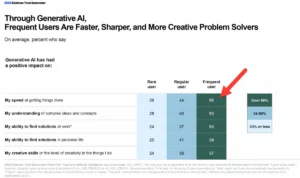
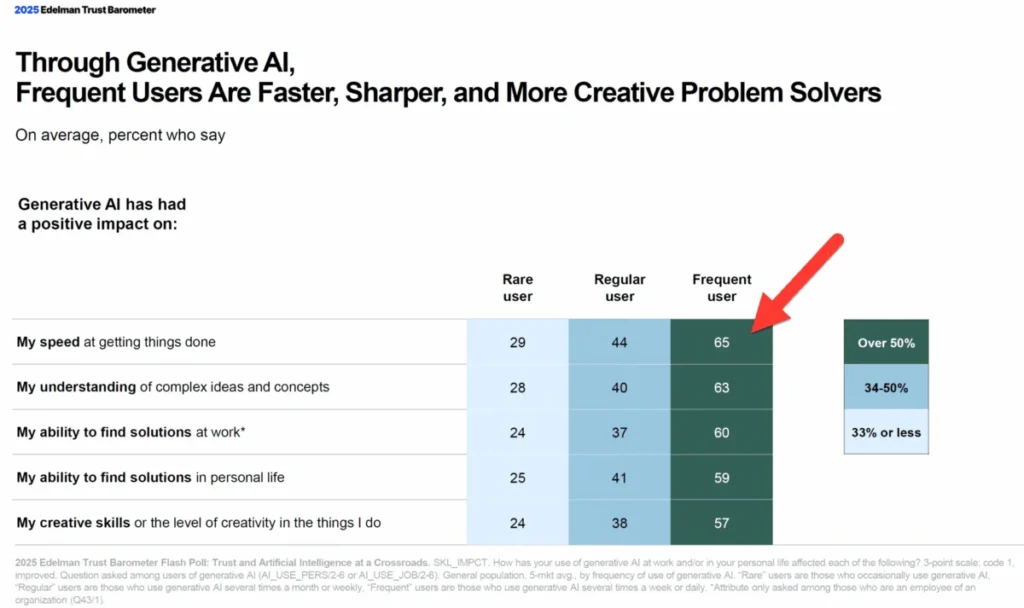
Similarly, for experienced professionals, AI necessitates a commitment to continuous learning. Relying solely on past experience is no longer sufficient. A proactive engagement with new technologies, tools, and advancements within one’s domain is essential for remaining competitive. Research consistently indicates that frequent users of AI tools report higher levels of problem-solving efficacy and greater efficiency in completing work tasks. This suggests that embracing AI is not just about adaptation, but about unlocking enhanced productivity and capability.
Guidance for Employers and Leaders
For hiring managers and executives, a critical challenge lies in overcoming the "tenure trap." While senior employees bring invaluable institutional knowledge, their perspective on AI might be to leverage it as a means to accelerate existing, familiar processes. Conversely, younger, AI-savvy hires may be more inclined to fundamentally rethink workflows and adopt entirely new methodologies. Employers must foster an environment that encourages this innovative thinking.
Human Resources leaders and recruiters face the imperative of identifying and nurturing "Superworkers." These individuals, often younger and more agile in their adoption of AI, possess the potential to drive faster learning curves and significantly boost organizational productivity. Their adaptability and willingness to embrace new technological paradigms can be a key differentiator for companies seeking to stay ahead.
CEOs and senior executives are tasked with establishing clear, honest, and supportive strategies for AI integration. Evidence points to AI as a "scaling technology," designed to augment rather than eliminate human roles. Transparency regarding AI’s intended purpose and its potential impact on the workforce is paramount. Companies that foster an open and supportive environment for AI adoption are more likely to see their employees adapt effectively, ultimately strengthening the organization’s competitive position. The journey into the age of AI requires a thoughtful, human-centered approach, recognizing that technological advancement is most impactful when it is aligned with the growth and well-being of the workforce.