In today’s rapidly evolving professional landscape, leaders are inundated with an unprecedented volume of information and potential solutions. While technology, particularly artificial intelligence, has dramatically amplified the speed at which answers can be generated, a more significant challenge has emerged: discerning which answers truly warrant action, understanding their ripple effects across an organization, and establishing clear lines of accountability once a decision is enacted. The proliferation of data does not inherently translate into enhanced knowledge or more effective leadership.
Organizations are increasingly confronting scenarios where technical expertise alone is insufficient. Leaders are compelled to simultaneously navigate profound ambiguity, balance competing priorities, and foster collaboration across diverse teams and organizational silos. In such complex environments, leadership wisdom transcends a mere aspirational virtue; it solidifies as a learnable and indispensable capability. Without this crucial element, leaders often default to the seductive, yet ultimately inadequate, substitutes of sheer speed or an unwavering, often false, sense of certainty. These responses, while appearing decisive, crumble under genuine pressure and the inherent uncertainties of complex decision-making.
The cultivation of wisdom not only fortifies individual leaders but also fundamentally shapes the efficacy with which teams and entire organizations respond to situations characterized by uncertainty and urgency. This growing understanding of leadership wisdom begins with a foundational premise: it is not an innate gift bestowed upon a select few, nor is it an abstract concept divorced from the daily practice of leadership. Instead, wisdom is an actionable leadership capability that can be comprehended, developed, and actively deployed, starting with its most commonly associated facets: sound judgment and effective decision-making.
The Interplay of Decision-Making, Judgment, and Wisdom for Modern Leaders
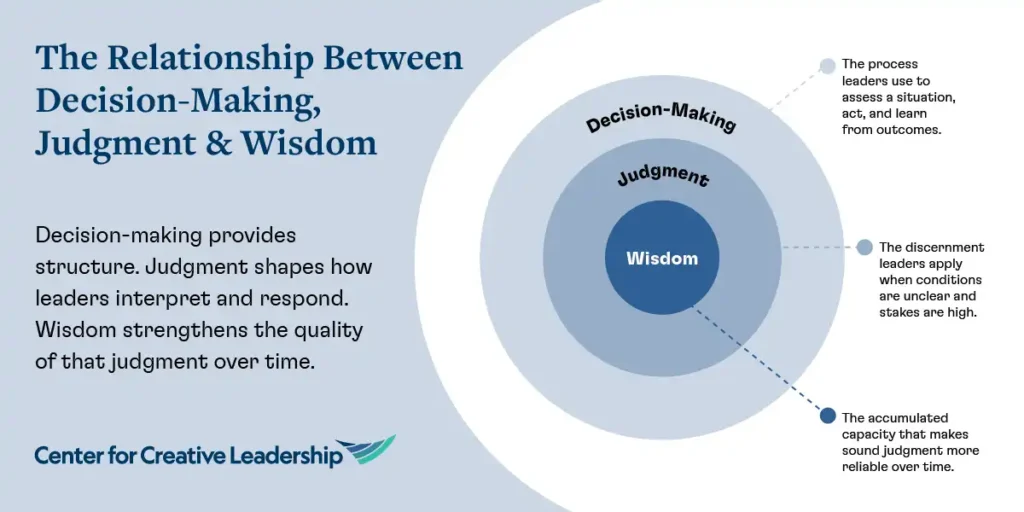
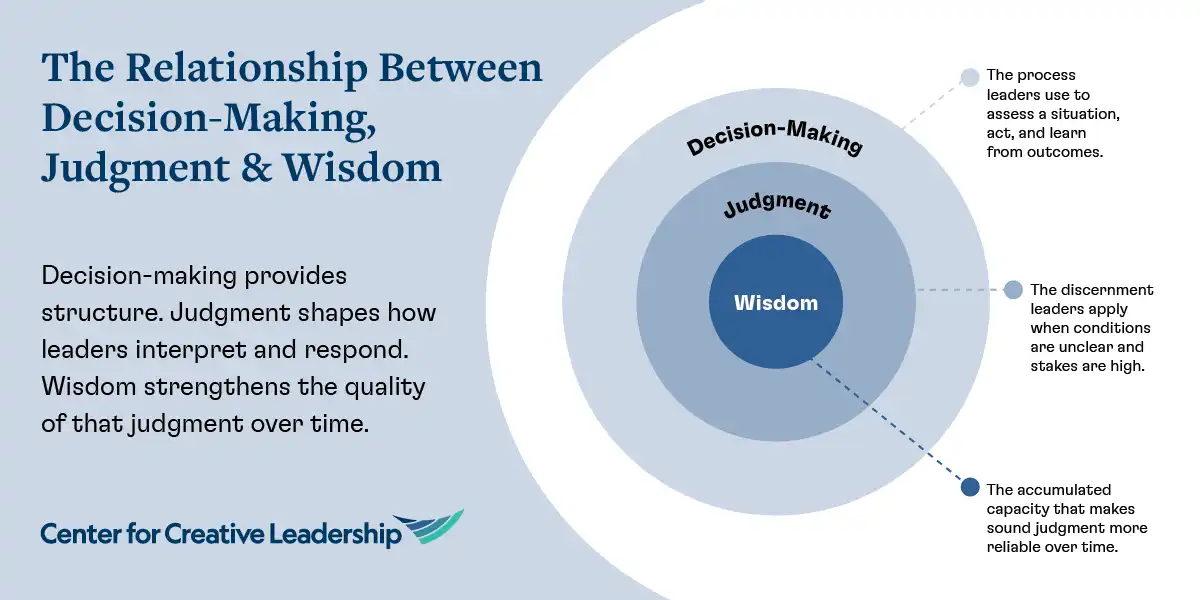
Navigating complexity in leadership requires a nuanced understanding of three interconnected concepts: decision-making, judgment, and wisdom. Each plays a distinct and vital role in a leader’s ability to chart a course through challenging circumstances.
Decision-making represents the structured process through which leaders work to analyze a challenge and arrive at a definitive conclusion or course of action. It is the procedural framework for problem-solving. Judgment, on the other hand, is the critical faculty leaders employ within that process, particularly when faced with ambiguity, incomplete information, or high stakes. It is the discerning ability to weigh options and make informed choices. Wisdom, however, is the overarching quality that elevates and refines judgment, making it more sound, reliable, and effective over time. It is the accumulation of experience, insight, and ethical consideration that informs better decision-making.
The advent of artificial intelligence is already profoundly reshaping the landscape of decision-making. AI algorithms can process vast datasets, identify patterns, and present potential solutions at a speed and scale previously unimaginable. For instance, financial institutions are leveraging AI for fraud detection, identifying anomalies in transactions far faster than human analysts. Similarly, in healthcare, AI assists in analyzing medical images for early disease detection, augmenting the diagnostic capabilities of physicians. These applications showcase AI’s power in accelerating the "answer generation" phase.
However, AI cannot replicate or replace core leadership functions like judgment and wisdom. An AI system, by its very nature, lacks the capacity for self-reflection on past decisions, the ability to internalize lessons learned from experience, or the empathy required to understand the human impact of a decision on individuals or communities. It cannot factor in the nuanced ethical considerations or the long-term societal consequences that are integral to wise leadership. Furthermore, AI cannot engage in the crucial process of collective sensemaking, where raw data is imbued with deeper meaning through shared dialogue and diverse perspectives.

While AI can significantly enhance analytical capabilities and surface a wider array of possibilities, it is leadership wisdom that ultimately dictates how these possibilities are interpreted, evaluated, and applied within a specific context. As AI democratizes access to answers, leadership wisdom emerges as the scarce and indispensable resource for identifying which answers are truly relevant, actionable, and aligned with organizational values and long-term goals. Wise leaders and their teams demonstrate a profound capacity to dissect intricate challenges, draw upon a rich reservoir of knowledge and insights gleaned from past experiences, and engage in collaborative sensemaking. This process culminates in sound judgments that pave the way for progress and contribute to the greater good.
The Accelerating Urgency for Wisdom in Leadership
Several converging forces are intensifying the need for leadership wisdom. The transformative impact of AI on decision-making processes is undeniable. Simultaneously, the nature of the decisions themselves is becoming more complex: they involve a greater number of interacting variables, present less clear-cut trade-offs, carry higher stakes, and demand timely responses within compressed timelines. Leaders are increasingly expected to operate at high speed in environments where rapid action and thoughtful deliberation are not naturally aligned.
This complexity is further amplified by the evolving demographics of the modern workforce. With multiple generations coexisting in the workplace, each possesses distinct perspectives on experience, technology adoption, and risk tolerance. This generational diversity, while a source of strength, also adds layers of complexity to communication, motivation, and strategic alignment, making the need for wise, inclusive leadership more critical than ever.
While individual leaders may excel at exercising sound judgment in their specific domains, achieving consistent, high-quality decision-making across an entire organization, beyond a select group at the top, presents a far greater challenge. This is particularly evident in areas like succession planning. Extensive research indicates that the effective transfer of wisdom from outgoing leaders to their successors is one of the most critically overlooked, yet profoundly impactful, levers for ensuring successful leadership transitions. The loss of an experienced leader’s accumulated wisdom can have a far more detrimental effect on an organization’s trajectory than the mere vacancy of their formal role.
Deconstructing Leadership Wisdom: Key Components
Contrary to a common misconception, leadership wisdom is not an exclusive attribute of the most senior executives, nor is it a fixed trait that individuals either possess or lack. Based on extensive research and practical experience with global organizations, leadership wisdom can be understood as encompassing several critical characteristics:
- Contextual Understanding: Wise leaders possess a deep appreciation for the intricate web of relationships, historical precedents, and cultural nuances that shape their operating environment. They understand that decisions do not exist in a vacuum and that past events profoundly influence present realities.
- Ethical Compass: A strong moral framework guides wise leaders. They consistently weigh decisions against ethical principles, considering fairness, integrity, and the long-term impact on all stakeholders. This ethical grounding ensures that decisions, even when difficult, are rooted in sound moral reasoning.
- Self-Awareness and Humility: Wise leaders understand their own strengths and limitations. They are open to feedback, acknowledge their fallibility, and are willing to admit when they don’t have all the answers. This humility fosters trust and encourages collaborative problem-solving.
- Long-Term Perspective: Beyond immediate pressures, wise leaders maintain a focus on the future. They anticipate potential consequences, consider sustainability, and strive to make decisions that will yield enduring positive outcomes, rather than short-term gains.
- Empathy and Compassion: Understanding and valuing the perspectives and feelings of others is a hallmark of wisdom. Empathetic leaders can better anticipate the human impact of their decisions, fostering stronger relationships and more cohesive teams.
- Resilience and Adaptability: Facing setbacks is inevitable. Wise leaders demonstrate the ability to learn from failures, adapt to changing circumstances, and maintain composure under pressure, guiding their teams through periods of disruption with steadfastness.
- Holistic Thinking: They move beyond siloed thinking, recognizing the interconnectedness of various organizational functions and external factors. This holistic approach allows for more comprehensive problem-solving and strategic planning.
- Purpose-Driven Orientation: Wise leaders are often guided by a clear sense of purpose. This underlying drive helps them to prioritize effectively, inspire others, and make decisions that align with a larger mission or vision.
Cultivating Wisdom: A Developmental Journey
The development of leadership wisdom is more akin to nurturing a plant than teaching a fixed curriculum. It is a process that thrives within specific conditions, supported by guidance and consistent reinforcement. Organizations play a crucial role in creating environments that foster this growth, supporting the emergence of both individual and collective wisdom.
A robust approach to developing leadership wisdom typically involves a three-pronged strategy:
- Experiential Learning: This is the bedrock of wisdom development. Leaders must be exposed to a diverse range of challenges, responsibilities, and opportunities for growth. This includes assignments that push them beyond their comfort zones, requiring them to navigate complex problems with incomplete information and to manage diverse stakeholders. The insights gained from these experiences, particularly those involving overcoming obstacles or learning from mistakes, are foundational.
- Reflective Practice: Simply accumulating experience is not enough. Leaders need dedicated time and structured opportunities to reflect on their experiences. This can involve journaling, peer coaching, mentorship, or formal debriefing sessions. Reflection allows leaders to critically analyze their actions, understand the causality of outcomes, and extract meaningful lessons. It is the crucible where raw experience is transformed into actionable insight.
- Developmental Support: This encompasses a range of formal and informal mechanisms designed to guide and accelerate the wisdom development process. It includes feedback mechanisms (360-degree reviews, performance evaluations focused on behavioral competencies), coaching, mentoring programs that pair emerging leaders with experienced, wise individuals, and access to learning resources that explore topics related to ethics, decision-making frameworks, and organizational dynamics. Developmental challenges, such as leading cross-functional initiatives or managing change, are also critical components.
These three dimensions are mutually reinforcing. Experience alone does not guarantee wisdom. Leaders require structured reflection, constructive feedback, the practice of perspective-taking (understanding situations from multiple viewpoints), and deliberate developmental challenges to effectively translate their experiences into sound discernment and robust judgment.
The Transformative Impact of Leadership Wisdom
The presence of leadership wisdom creates a profound and lasting impact, resonating from the individual leader to the broader societal landscape.
For Individuals: Wisdom acts as a compounding force. As leaders engage in a continuous cycle of experience, reflection, and learning, their insights deepen, their judgment strengthens, and their sense of purpose becomes clearer and more robust with each successive decision. This accumulation of wisdom enhances their personal effectiveness and their capacity to lead with greater confidence and foresight.
For Teams: When wisdom is shared and cultivated within teams, it fosters collective judgment that transcends the capabilities of any single individual. This enhanced collective intelligence enables teams to navigate highly complex challenges more effectively. This is particularly crucial for global and cross-functional teams, where the synergistic leveraging of diverse perspectives is essential for arriving at optimal, long-term outcomes. Shared wisdom builds trust, encourages open dialogue, and promotes a unified approach to problem-solving.
For Organizations: At an organizational level, wisdom scaled across the enterprise supports the creation of cultures characterized by psychological safety, open dialogue, and continuous renewal. These are precisely the conditions that underpin sustained high performance. Wise organizations elevate collective wisdom to the status of institutional wisdom, embedding it into their operational frameworks and decision-making processes. This institutional wisdom empowers them to navigate periods of crisis and disruption with a greater degree of confidence, agility, and competence. For example, during the COVID-19 pandemic, organizations led by wise individuals and exhibiting institutional wisdom were often more adept at pivoting their operations, supporting their workforce, and communicating transparently with stakeholders.
For the Greater Good: While leadership wisdom may not be a universal panacea for all the persistent challenges facing societies, it undeniably equips leaders with the maturity, insight, and forward momentum required for genuine, sustainable progress. It fosters a more considered approach to complex global issues, from climate change to economic inequality, encouraging collaborative solutions that prioritize long-term well-being over short-term expediency.
The future of leadership will not be defined by those who possess the most data or can generate answers the fastest. Instead, it will be shaped by leaders who can effectively discern what truly matters, who can collaboratively make sense of overwhelming complexity, and who can consistently exercise sound judgment when the stakes are highest. This is the enduring power and the critical imperative of leadership wisdom.
Ready to Elevate Your Leadership?
The evolving demands on leaders necessitate a proactive approach to developing critical capabilities. For those seeking to understand the nuanced impact of emerging technologies on leadership, the webinar "How AI Is Changing Decision-Making" offers a deep dive into why leaders are increasingly relying on AI before engaging in crucial human-to-human discourse, and the potential costs to collective judgment. To stay abreast of emerging research on AI, wisdom, and the future of leadership, we invite you to sign up for our newsletters.