The concept of "capitalist realism," famously articulated by cultural critic Mark Fisher in 2009, described a pervasive societal mindset where the dominance of capitalism was so absolute that imagining alternatives became nearly impossible. Fisher, who passed away in 2017, could scarcely have foreseen a future where not one, but two distinct forms of capitalism would vie for economic and psychological dominance, particularly in the wake of rapid technological advancement. This is precisely the dynamic now playing out, with profound implications for the labor market, job security, and the career trajectories of younger generations.
At the heart of this evolving economic landscape lie two competing theses regarding the impact of Artificial Intelligence (AI) on employment. The first, often termed the "ghost GDP" thesis, championed by researchers like Citrini Research, posits AI as a direct substitute for human labor. This perspective suggests that codifiable, routine, and formalizable tasks are increasingly being automated, leading to a significant reduction in demand for human workers in these roles. Firms that embrace this automation swiftly are predicted to gain a competitive edge.
Conversely, the "relational work" thesis, as explored by economists like Alex Imas, presents a more nuanced view. This argument posits AI not as a replacement, but as a complement to human capabilities. In this framework, AI enhances the value of uniquely human skills such as tacit knowledge, contextual understanding, and complex judgment – attributes that are difficult to codify and automate. Companies that leverage AI to augment their human workforce, rather than simply replace it, are seen as better positioned for long-term success, as they recognize the enduring value of human ingenuity.
A Divergent Labor Market Revealed
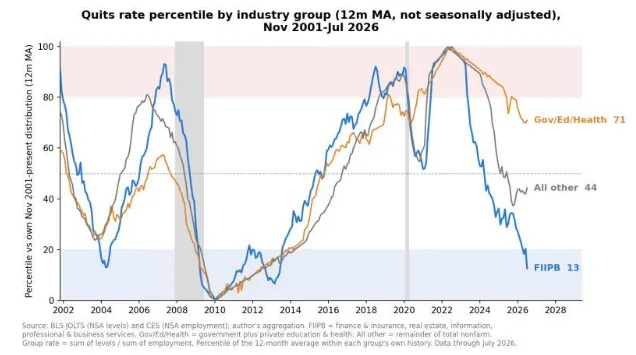
Empirical data is beginning to illuminate this bifurcation. Gad Levanon, chief economist at the Burning Glass Institute, conducted a revealing experiment by analyzing industry quits rates against their own 25-year historical averages, rather than simply comparing raw rates across different sectors. This methodology effectively segmented the labor market into three distinct tiers whose movements had diverged significantly since 2022, underscoring the emergence of these "two capitalisms."
Levanon’s analysis revealed a striking pattern. In the Finance, Insurance, Information, and Professional and Business Services (FIIPB) sector, the quits rate has plummeted to the 13th percentile of its 25-year historical range. Currently standing at 1.8%, this represents a substantial 28% drop from the 2.5% recorded in 2019, and marks the lowest reading since 2013. In stark contrast, the rest of the private economy exhibits a quits rate at the 44th percentile, indicating it remains close to its historical norm. The government, education, and healthcare sectors show a quits rate at the 71st percentile, essentially unchanged from 2019 levels.

"Job hugging is real, but it’s mostly happening in one part of the economy," Levanon stated in a LinkedIn post. "Only FIIPB has collapsed… because that’s where the jobs stopped." His research indicates that employment in the FIIPB sector peaked in early 2023 and has been on a downward trajectory since. The logic is straightforward: employees are most likely to leave their jobs when they have promising alternative opportunities. In a sector experiencing job contraction, such alternatives become scarce. Data from the Bureau of Labor Statistics, released on September 1, corroborated this, showing a significant drop of 188,000 hires in professional and business services in July alone, even as national job openings saw a slight increase.
Unpacking the Decline: AI’s Role and Generational Shifts
When questioned about the underlying causes of this sector-specific decline, and whether it signaled a reversal of the decades-long "financialization" of the American economy, Levanon offered a more pragmatic explanation. He suggested it was primarily "a decline in the labor intensity of white-collar work." While FIIPB output continued to grow, the labor required to achieve that growth did not keep pace. Levanon attributed this shift to the impact of technology, including evolving expectations about its future capabilities, which has suppressed hiring in roles involving codifiable tasks. He noted that the initial impetus might have been a "post-ZIRP correction" – a reference to the era of zero-interest rate policy – but this alone doesn’t explain the widening gap observed in the fourth year of this trend.
Further insights into this phenomenon come from a working paper by economists Erik Brynjolfsson, Bharat Chandar, and Ruyu Chen from Stanford’s Digital Economy Lab. Utilizing high-frequency ADP payroll data covering millions of U.S. workers, their research found no evidence of widespread, economy-wide job displacement. However, they did observe a notable disparity in employment trends for younger workers. Specifically, employment for individuals aged 22 to 25 in AI-exposed occupations was found to be 19% lower than it would have been had it kept pace with their peers in less AI-exposed roles. Crucially, experienced workers in the same occupations did not exhibit a similar decline. This divergence manifests not as mass layoffs, but as a significant absence of new hiring.

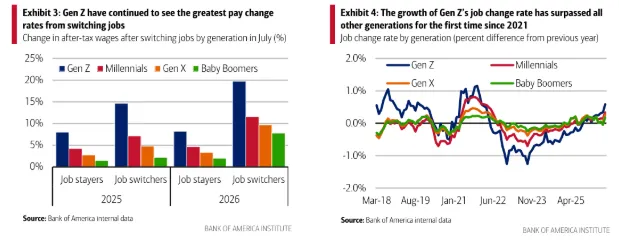
A concurrent report from the Bank of America Institute, published on September 9, highlighted a related trend: Generation Z’s job-switching rate has surpassed that of all other generations for the first time since 2021, even amidst broader hiring slowdowns. Furthermore, Gen Z is securing the largest pay increases when they do switch jobs. When viewed alongside Stanford’s findings, this suggests that younger workers may be finding themselves priced out of AI-exposed roles, leading them to seek opportunities in other sectors more rapidly than their predecessors.
The Complement vs. Substitute Dichotomy
Both Levanon’s analysis of quits rates and the Stanford team’s payroll data point to a concentration of employment decline in occupations where AI can substitute for human tasks. Conversely, occupations where AI acts as a complement to human workers are showing stable or increasing employment, particularly for experienced professionals. This stark contrast between substitutable work contracting and complementary work holding or growing, within the same economy and during the same period, defines the "two capitalisms" now in play.
Economist Tyler Cowen has been a vocal proponent of this distinction on his blog, Marginal Revolution. He differentiates between raw "intelligence," which can be automated, and "Polanyi knowledge" – the tacit, contextual expertise that is difficult to articulate or codify, named after the Hungarian-British polymath Michael Polanyi. Cowen’s framework suggests that workers possessing this tacit knowledge are more resilient to automation.

The Stanford data offers a critical layer to this discussion: the substitutable work is vanishing most acutely among workers with the least experience, those who have not yet had the opportunity to accumulate significant tacit knowledge. These are the individuals most vulnerable in the current economic transition.
Chandar from the Stanford Digital Economy Lab clarified that the paper’s designations of occupations as "substitute-heavy" or "complement-heavy" are based on the nature of the tasks involved, irrespective of worker tenure. However, he noted that the differing employment trajectories for junior and senior workers align with the hypothesis that generative AI substitutes for codified knowledge and complements tacit knowledge. Occupations characterized by higher levels of codified knowledge exhibit slower entry-level employment growth, while those with greater reliance on tacit knowledge demonstrate faster employment growth for mid-career and senior professionals.
The Pipeline Problem and the Future of Expertise
This dynamic raises a critical concern about the "pipeline problem": where will the next generation acquire essential tacit knowledge if the traditional entry points and apprenticeship opportunities are the first casualties in this technological "proxy war"? The increasing bans on AI tools in high schools, while ostensibly aimed at preventing academic dishonesty, may inadvertently exacerbate this issue by limiting exposure to nascent technologies.
A recent working paper by David Autor and colleagues, known for their work on the "China shock," further illustrates this point. A randomized controlled trial involving 133 practicing patent lawyers revealed that the long-term benefits of AI assistance were concentrated entirely among senior lawyers. Junior lawyers showed no average gains, leading the authors to conclude, "The largest gains from AI thus accrued to the lawyers who retained the least. Foundational expertise may be a prerequisite for extracting durable skill from AI-assisted practice." This suggests that AI tools may amplify existing expertise rather than create it from scratch, posing a challenge for those entering the workforce without a strong foundational understanding.
Ironically, the FIIPB sector, which is at the forefront of these technological shifts and the resulting employment contractions, is also disproportionately responsible for generating commentary on its own evolving landscape. This includes sell-side research from investment banks and financial news articles, like this one. The individuals narrating these economic shifts are often geographically and professionally closer to the epicenter of the changes than the broader population.
Media’s AI Narrative and the Unseen Gains
The media sector itself is experiencing a form of moral panic surrounding AI. Discussions oscillate between the ethics of AI-generated content and more existential "doomsday scenarios." However, as Semafor’s Reed Albergotti observed, the narrative of AI safety escaping containment makes for "an incredibly fun story." This suggests a potential for self-interest within the media’s framing of AI, as sensational narratives can drive engagement.

Tyler Cowen has offered a reflective perspective on these developments. In response to warnings from mathematicians, including UCLA’s Terry Tao, about AI encroaching on their field, Cowen invoked Claude Frédéric Bastiat’s distinction between the seen and the unseen. He acknowledged the visible, personal cost to his own status as an economist, admitting it’s "not altogether pleasant for me personally, given how much personal status I have wrapped up in particular modes of economic thought." However, he posited that the unseen future gains to the field from AI will likely be "enormous, even if current practitioners cannot foresee most of those benefits today."
Cowen went further, conceding, "I realize AIs someday will end up as better column and blog writers than I am." When pressed on whether the media’s backlash against AI writing might stem from more than just sincerity – perhaps a degree of self-interest given the quits data in the FIIPB sector – Cowen suggested a blend of motives. "I think the backlash is both sincere and self-interested, the two motives are working together," he told Fortune. He drew a parallel to "corporate protectionists" who may genuinely believe in the benefits of tariffs, even if their motivations are also tied to profit.
Ultimately, Cowen’s observation encapsulates the deep-seated human resistance to profound change: "People just do not want the world to change so much." This sentiment, coupled with the emerging economic realities of AI’s dual role as both substitute and complement, paints a complex picture of the future of work, one where adaptation, lifelong learning, and a nuanced understanding of technological impact will be paramount for navigating the evolving economic landscape. The "war" for the future of work is not a singular battle, but an ongoing evolution, with younger generations like Gen Z likely to bear the brunt of its immediate consequences and shape its long-term outcomes.