Recent research sponsored by the Association for Talent Development (ATD) has unveiled a critical shift in how executive leadership perceives the value of employee training. According to the study, 96 percent of CEOs from Fortune 500 companies identified "business impact" as their primary metric for evaluating the success of talent development programs. Return on Investment (ROI) followed closely as the second most important measure. This data underscores a growing demand for learning and development (L&D) initiatives to move beyond simple participation metrics and demonstrate a direct, quantifiable connection to organizational performance.
The alignment between educational initiatives and business objectives is no longer a luxury but a strategic necessity. Whether in a multinational corporation or a specialized nonprofit, every organization operates on fundamental business measures: output, quality, cost, and time. For L&D professionals, the challenge lies in bridging the gap between classroom learning and the bottom line. The solution, increasingly adopted by over 10,000 organizations worldwide, is the ROI Methodology—a rigorous, 12-step process designed to provide credible evidence of value to the highest levels of management.
The Evolution of Performance Measurement
To understand the current landscape of talent development evaluation, one must look at the historical progression of organizational logic models. While modern discourse often focuses on recent innovations, the roots of these systems date back to the 19th century. The structured approach to evaluating social and educational programs evolved significantly in 1952 when Raymond Katzell published a framework for assessing training outcomes. This model was later popularized by Donald Kirkpatrick, whose four-level model—Reaction, Learning, Behavior, and Results—became the industry standard for decades.

However, as global markets became more competitive and financial scrutiny intensified, the Kirkpatrick model was found to be incomplete for the needs of the modern C-suite. It lacked a mechanism for isolating the specific effects of a program from external variables and failed to provide a financial ratio (ROI) that Chief Financial Officers (CFOs) could compare against other capital investments. This led to the development of the ROI Methodology, which adds a fifth level—Return on Investment—and a comprehensive process for data isolation and financial conversion.
The Value Chain: From Input to ROI
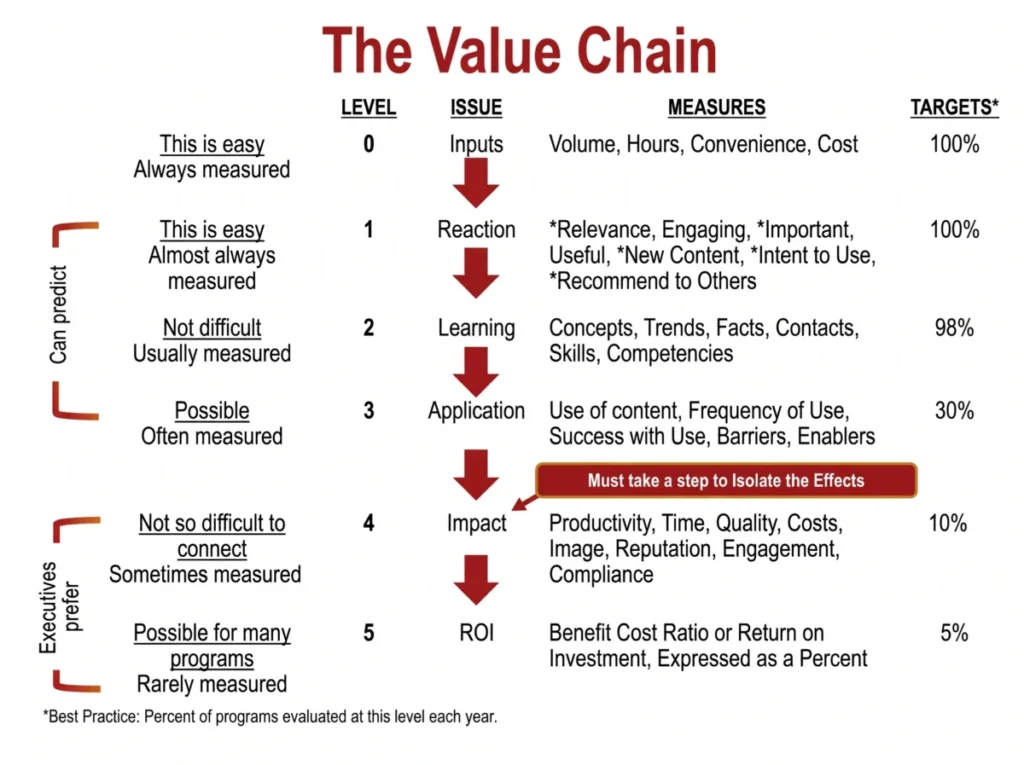
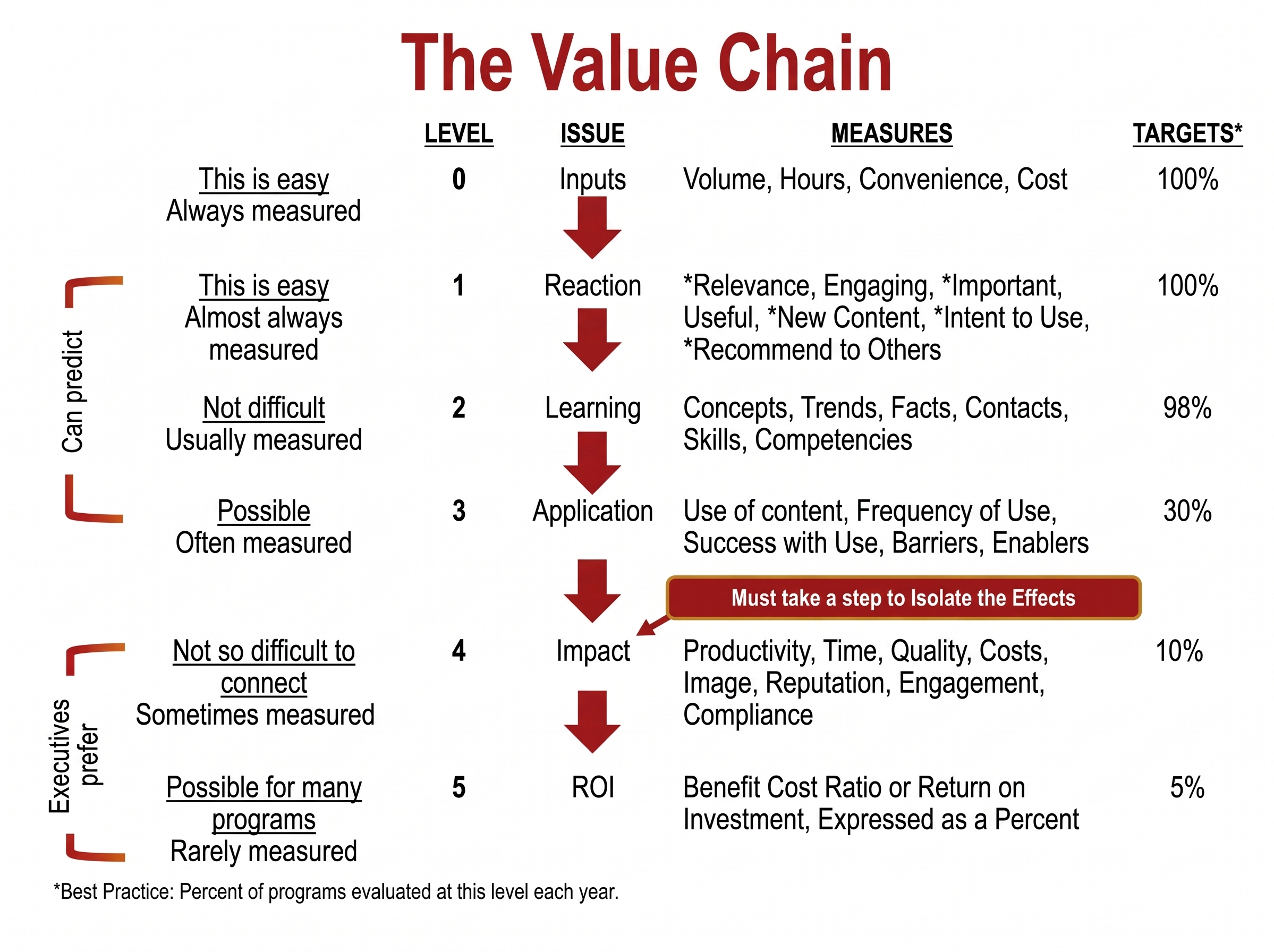
The ROI Methodology operates on a value chain consisting of six distinct datasets. Understanding how these levels build upon one another is essential for any professional seeking to prove the worth of their programs.
Level 0: Input. This measures the basics of program delivery, including the number of participants, the duration of the sessions, and the direct costs involved. While necessary for logistics, Level 0 provides no information regarding the program’s effectiveness.
Level 1: Reaction. This assesses how participants perceived the training. Effective evaluation at this level asks whether the content was relevant, important, and if the participants would recommend it. A negative reaction at this stage is often a leading indicator that the program will fail to achieve higher-level results.

Level 2: Learning. This level confirms that a transfer of knowledge or skills has occurred. Through testing, simulations, or demonstrations, organizations ensure that the "input" resulted in an actual increase in capability.
Level 3: Application. Often the most overlooked stage, application measures whether participants are actually using their new skills in the workplace. It identifies barriers to success—such as a lack of managerial support—and enablers that facilitate performance.
Level 4: Impact. This is the "why" of the program. Impact measures are the business KPIs: increased sales, reduced error rates, improved patient outcomes, or faster production times. To maintain credibility, the methodology requires that the effects of the training be isolated from other factors, such as market shifts or new technology.
Level 5: ROI. The final level converts the impact data into monetary value and compares it to the total cost of the program. The resulting ROI percentage answers the ultimate executive question: "Was this investment worth it?"
The 12-Step ROI Methodology: A Strategic Roadmap
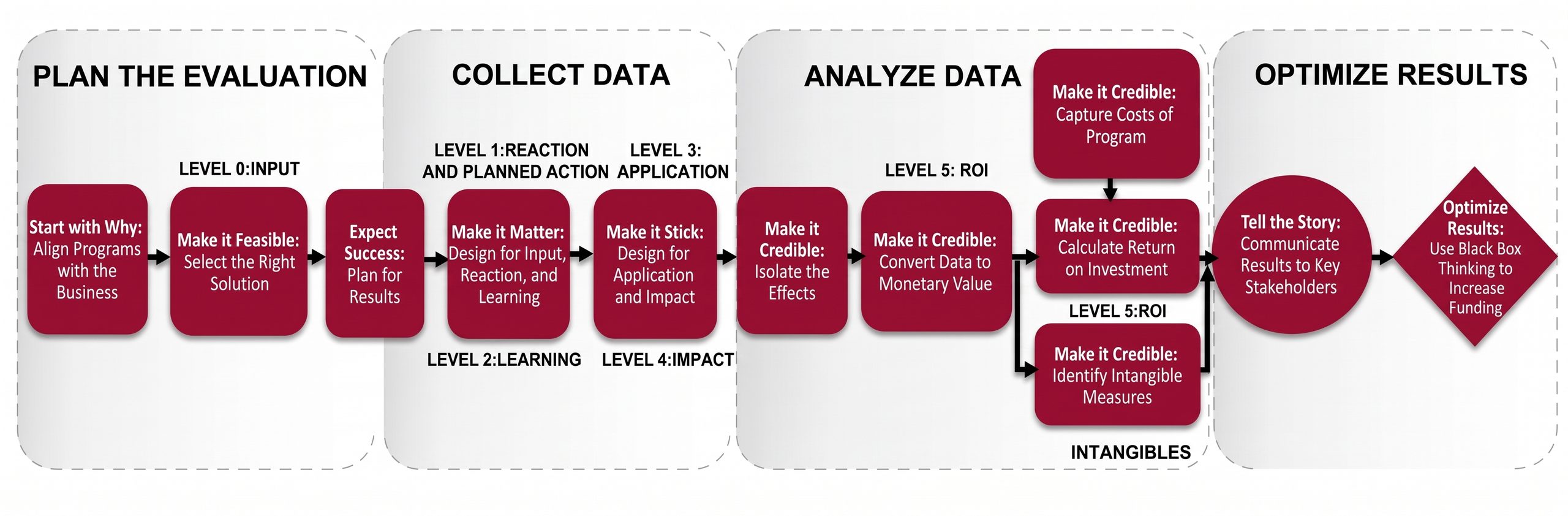
The ROI Methodology is more than an evaluation tool; it is a design system that ensures programs are built for success from the outset. The process is divided into four main phases: Planning, Data Collection, Data Analysis, and Optimization.
Phase 1: Planning the Evaluation
The first three steps are foundational. Practitioners must "start with why" by aligning the program to a specific business measure. If an organization is facing a high turnover rate or declining quality, the program must be designed specifically to address those metrics. Step two involves ensuring the proposed solution is actually the right one for the problem. Finally, step three involves "expecting success" by setting clear objectives for all five levels of evaluation. This phase culminates in a data collection plan and an ROI analysis plan, which serve as the blueprint for the entire project.
Phase 2: Collecting Data
Data collection occurs at multiple points during and after the program. Level 1 (Reaction) and Level 2 (Learning) data are typically gathered during the implementation phase. Level 3 (Application) and Level 4 (Impact) data are collected after a sufficient period has passed for the training to influence behavior and business results. Common methods include surveys, action plans, performance records, and direct observations.
Phase 3: Analyzing the Data
This is the most technical phase of the methodology and is where credibility is established.
- Isolating the Effects: This step is mandatory. Practitioners use techniques such as experimental vs. control groups, trend line analysis, or expert estimates to determine exactly how much of the improvement was caused by the training versus other factors.
- Converting Data to Money: Impact measures (like time saved or units produced) are converted into a monetary value using standard values or expert input.
- Identifying Intangibles: Not every benefit can be converted to cash. Factors like "brand reputation" or "employee morale" are recorded as intangible assets.
- Capturing Costs: Every cost, including participant time, travel, materials, and overhead, must be included.
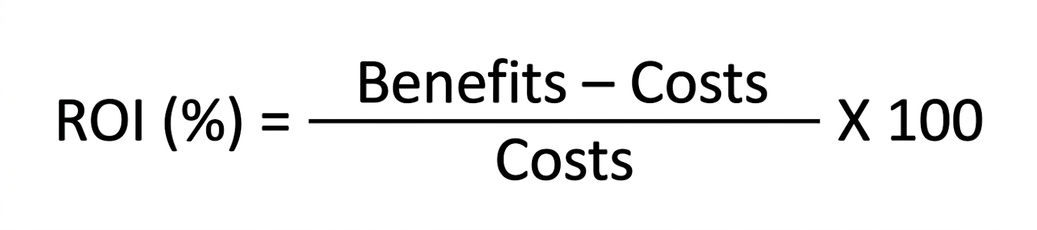
- Calculating ROI: The final calculation uses the formula: [(Total Benefits – Total Costs) / Total Costs] x 100.
Phase 4: Optimizing Results
The final steps involve reporting the results to stakeholders and using the data to improve the program. By presenting a "data-rich story" that includes both hard numbers and intangible benefits, L&D leaders can secure future funding and gain the respect of the executive suite.
The Credibility Factor: Conservative Principles
A primary reason the ROI Methodology has gained such widespread adoption—with over 11,000 certified professionals globally—is its reliance on conservative standards. To satisfy a CFO’s scrutiny, the process follows 12 guiding principles. These include the "when in doubt, leave it out" rule for benefits and the "when in doubt, leave it in" rule for costs. By understating benefits and overstating costs, the resulting ROI becomes a "defensible" number that executives can trust.
Furthermore, the methodology insists on using the most credible source for data and ensuring that at least one method is used to isolate the effects of the program. This rigor transforms L&D from a "cost center" into a "value creator."
Implications for the Future of Talent Development
The shift toward business-impact-driven evaluation comes at a time when organizations are facing unprecedented pressure to optimize every dollar. As artificial intelligence and automation reshape the workforce, the need for rapid upskilling and reskilling is at an all-time high. However, without a clear way to measure the efficacy of these massive investments, L&D departments risk budget cuts during economic downturns.
Industry analysts suggest that the adoption of the ROI Methodology represents a professionalization of the talent development field. By speaking the language of the business—money, impact, and ROI—L&D leaders are moving from the periphery of organizational strategy to the center.
"The question is no longer whether we should train our people," noted one industry expert during a recent ATD conference. "The question is how we can prove that the training moved the needle on the things the CEO cares about. If you can’t measure it, you can’t manage it, and you certainly can’t defend it."
Conclusion: A Mandate for Measurement
As the ATD research suggests, the appetite for business impact and ROI is nearly universal among top-tier executives. The ROI Methodology provides a standardized, reliable, and transparent way to meet this demand. By following the 12 steps—starting with a clear "why" and ending with optimized results—organizations can ensure that their talent development programs are not just educational exercises, but powerful drivers of organizational success. For the modern Chief Learning Officer, mastering this value chain is the key to securing a seat at the table and ensuring the long-term viability of the human capital function.