The modern talent acquisition landscape, characterized by fierce competition and evolving candidate expectations, has brought to the forefront a persistent challenge for organizations: candidate reneges. Historically, many recruitment programs operated without a formalized process to pre-empt such occurrences, often learning of a candidate’s withdrawal only after the decision had been firmly made. This reactive posture leaves teams scrambling to backfill critical roles, incurring significant costs and operational disruptions. However, a paradigm shift is underway, championed by methodologies that treat engagement signals as crucial leading indicators, allowing organizations to intervene effectively before a commitment unravels.
The Pervasive Problem of Post-Offer Disengagement
The period between a candidate accepting an offer and their official start date is often a vulnerable one. During this crucial window, candidates may be courted by competing offers, experience personal circumstances that shift their priorities, or simply grapple with uncertainty about their decision. Without a structured engagement strategy, these early signs of wavering commitment frequently go unnoticed until it is too late. The ramifications extend beyond merely losing a hire; they encompass direct financial costs associated with repeating the recruitment process, opportunity costs from delayed project starts, and potential damage to an employer’s brand reputation. Industry reports indicate that renege rates can vary significantly by sector, with high-demand fields like technology and specialized engineering sometimes seeing rates upwards of 15-20% for certain roles. Even a conservative estimate places the cost of replacing a reneged candidate at 1.5 to 2 times their annual salary, factoring in recruitment fees, lost productivity, and administrative overhead. This financial burden, coupled with the drain on recruiter and hiring manager time, underscores the urgent need for a more robust, preventative approach.
Introducing the Engagement Health Scorecard: A Proactive Framework
To counteract this pervasive issue, innovative talent acquisition strategies are advocating for the implementation of an "Engagement Health Scorecard." This data-driven framework categorizes candidates into distinct groups based on their behavior during the pre-start period, enabling tailored interventions designed to sustain commitment. The scorecard transforms passive observation into active monitoring, providing actionable insights that allow teams to maintain a strong connection with their future employees. By systematically tracking various engagement touchpoints, organizations can move from a reactive "firefighting" stance to a proactive "relationship-building" model.
Deconstructing the Scorecard: Three Tiers of Engagement
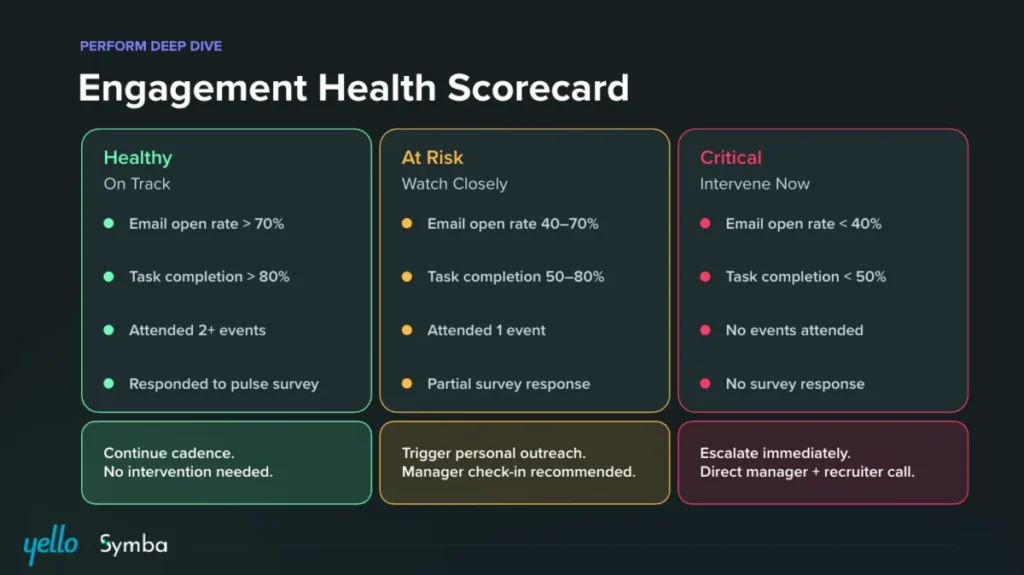
The Engagement Health Scorecard typically delineates candidates into three primary tiers: Healthy, At-Risk, and Critical. Each tier is defined by specific behavioral metrics and necessitates a distinct set of responsive actions. This structured approach ensures that resources are allocated efficiently, with higher-risk candidates receiving more immediate and personalized attention.
-
Healthy Candidates: Sustaining Momentum
Candidates categorized as ‘Healthy’ demonstrate consistent and robust engagement with pre-start communications and activities. Their behavior typically includes email open rates exceeding 70%, diligent completion of onboarding tasks, active participation in multiple pre-start events (e.g., virtual meet-and-greets, informational webinars), and prompt, comprehensive responses to surveys. For these candidates, the prescribed action is to "continue the cadence and stay the course." This involves maintaining the established communication schedule, ensuring a steady flow of relevant information, and reinforcing the positive aspects of their upcoming role and the company culture. The goal is to nurture this positive momentum, ensuring they feel valued, informed, and excited about their impending start. This consistent engagement reinforces their decision and mitigates the chances of external factors swaying their commitment. -
At-Risk Candidates: Prompt Personal Intervention
The ‘At-Risk’ category signals a noticeable decline in engagement. Metrics for this group typically include email open rates falling between 40% and 70%, limited attendance at scheduled events, and incomplete or delayed survey responses. These subtle shifts are critical red flags that demand immediate attention. The recommended intervention is "personal outreach within 48 hours." This is not a mass communication but a targeted, individualized effort. Examples include a direct message from the program manager, a personalized invitation to an upcoming event that highlights its specific relevance to the candidate, or a brief, informal check-in call from the hiring manager. The intent is to re-establish a personal connection, understand any nascent concerns, and provide tailored reassurance or information. Often, a quick, genuine touchpoint at this stage can re-engage the candidate and prevent further disengagement. The speed of response is paramount, as delays can allow minor uncertainties to escalate into significant doubts. -
Critical Candidates: Immediate Escalation and Direct Dialogue
‘Critical’ candidates exhibit severe disengagement, indicating a high probability of reneging. Their behavioral patterns include email open rates plummeting below 40%, complete absence from pre-start events, no survey responses, and a prolonged period of inactivity, often spanning three or more weeks. This level of disengagement necessitates "immediate escalation." The recommended actions are direct and impactful: a personal call from the hiring manager, a dedicated touchpoint from the recruiter, and, crucially, a genuine conversation to uncover the underlying issues. The aim here is not just to re-engage but to understand "what’s going on." Common root causes include competing job offers, unforeseen personal circumstances, or profound uncertainty about the role or company. Catching these issues in time allows the organization to potentially address concerns, negotiate, or provide support, thereby salvaging the candidate relationship. A direct, empathetic conversation can often uncover concerns that mass communications fail to address, offering a final opportunity to reinforce the value proposition.
The Economic Imperative: Quantifying the Cost of Inaction
The decision to invest in proactive engagement strategies is not merely a matter of good HR practice; it is a sound economic imperative. According to a 2023 report by the Society for Human Resource Management (SHRM), the average cost-per-hire in the U.S. can range from $4,000 to $5,000 for standard roles, escalating significantly for specialized or executive positions. When a candidate reneges, this entire investment is lost, and the process must restart. This leads to additional expenditure on job postings, recruiter time, interview panel hours, and background checks. Beyond direct costs, there are the intangible but equally impactful costs of lost productivity due to an open position, increased workload on existing team members, and the potential delay of critical projects. A study by the Corporate Executive Board (CEB) estimated that a single open position can cost an organization up to $500 per day in lost productivity. By preventing even a fraction of potential reneges, an Engagement Health Scorecard can deliver substantial returns on investment, safeguarding recruitment budgets and operational efficiency.
Industry Context: The Evolving Talent Landscape
The necessity for such proactive measures is amplified by the current state of the global job market. The "Great Resignation" and the subsequent "talent war" have shifted power dynamics, placing candidates in a stronger negotiating position. Companies are not only competing for talent but also fighting to retain accepted offers. Furthermore, the rise of remote and hybrid work models has inadvertently made it easier for candidates to disengage without physical presence, making digital engagement signals even more vital. In this environment, a company’s ability to maintain strong candidate relationships post-offer is a significant competitive advantage. Organizations that demonstrate genuine care and consistent communication during the pre-start phase are not only more likely to retain candidates but also to enhance their employer brand, making them more attractive to future talent pools.
Expert Perspectives and Strategic Implications
"The era of ‘set it and forget it’ after an offer acceptance is long over," states Dr. Evelyn Reed, a leading HR strategist specializing in talent retention. "Companies that succeed in today’s market are those that embrace continuous data-driven engagement. The Engagement Health Scorecard isn’t just a tool; it’s a fundamental shift in how we view the candidate journey – from a transactional process to an ongoing relationship." This sentiment is echoed by recruitment technology providers, who are increasingly integrating advanced analytics and CRM functionalities into their platforms to facilitate such proactive strategies. The emphasis is on predictive analytics, using historical data and real-time engagement metrics to identify potential issues before they manifest as a renege.
The strategic implications of adopting an Engagement Health Scorecard extend beyond immediate candidate retention. It contributes significantly to a stronger employer brand, as candidates who feel valued and supported are more likely to share positive experiences, both online and offline. This word-of-mouth endorsement is invaluable in a competitive market. Moreover, a robust pre-start engagement process contributes to higher initial employee satisfaction and faster time-to-productivity once new hires join, as they arrive feeling better prepared and integrated into the company culture.
Beyond Backfilling: A Strategic Advantage
The fundamental difference between organizations that successfully retain candidates and those that are perpetually caught in a cycle of backfilling is almost invariably their approach to data. The former group actively monitors and analyzes engagement data continuously, rather than waiting for the dreaded renege email. This continuous data feedback loop allows for incremental improvements with every recruitment cycle. Tools like ‘The KEEP Playbook,’ which includes comprehensive engagement health scorecards, intervention playbooks, and post-cycle review templates, provide organizations with the structured resources needed to refine their processes and enhance their talent acquisition capabilities program after program.
The future of talent acquisition is undeniably rooted in proactive, data-informed engagement. As the global economy continues to evolve and the competition for skilled professionals intensifies, the ability to effectively nurture candidate relationships from offer acceptance to start date will no longer be a luxury but a strategic imperative. Organizations that embrace methodologies like the Engagement Health Scorecard will not only mitigate the significant costs and disruptions associated with candidate reneges but will also build stronger, more resilient talent pipelines, ultimately securing a distinct advantage in the ongoing battle for top talent.