In an era defined by relentless acceleration, a fundamental challenge confronts organizational leaders: discerning precisely what requires transformation, what merits preservation, and, critically, where to strategically allocate scarce resources. This dilemma is amplified by a pervasive tendency for established entities to invest in historical successes rather than future potential, a phenomenon the "Wheel of Change" model aims to address. This framework, developed by management strategists and drawing from insights in influential business literature, offers a structured approach to navigating the complexities of organizational evolution.
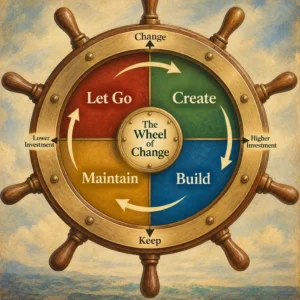
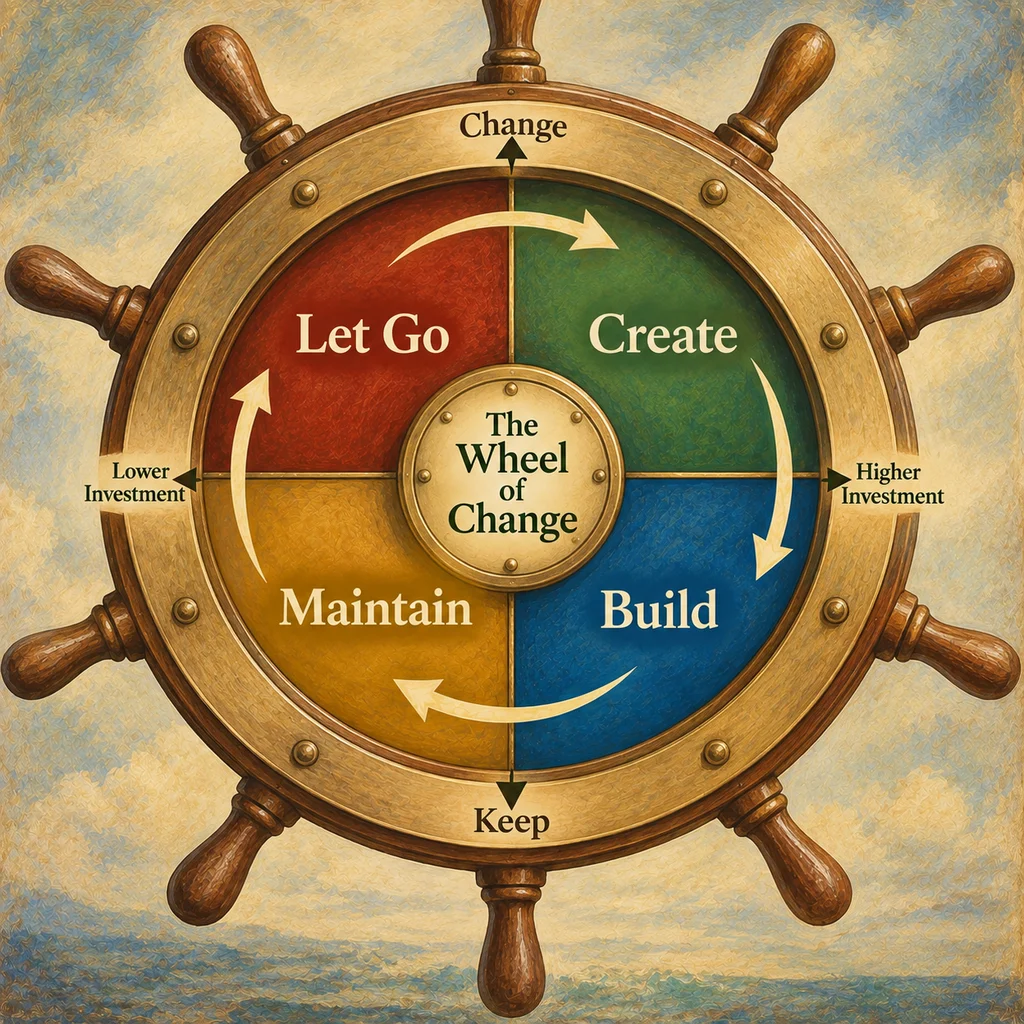
The core of this challenge lies in understanding that a company is rarely static; it exists simultaneously at multiple points on a spectrum of change and investment. The "Wheel of Change" visualizes this by positing four distinct quadrants, each representing a different strategic imperative: Create, Build, Maintain, and Let Go. These quadrants are defined by two key dimensions: the level of investment required (from low to high) and the degree of change involved (from preserving the status quo to initiating radical shifts).
Deconstructing the Wheel of Change
At its most fundamental level, the Wheel of Change is a diagnostic tool designed to help leaders categorize and prioritize their organizational activities and resource allocations. The model, which has evolved over years of observation and refinement, most recently building upon concepts presented in best-selling business works, provides a clear visual and conceptual framework.
1. Create: High Change, High Investment
This quadrant represents the frontier of innovation and future-building. "Creating" involves embarking on entirely new ventures, whether it’s launching a novel product, adopting groundbreaking technology, entering uncharted markets, developing new capabilities, or fundamentally altering business processes. This domain is characterized by inherent uncertainty and risk. It demands significant upfront investment in research, development, experimentation, and bold leadership. Unlike activities focused on immediate returns, "creation" is inherently about planting seeds for future growth, acknowledging that success is not guaranteed and that immediate financial metrics may not reflect its true value. This is the realm of visionaries and early adopters, where courage and resourcefulness are paramount.
2. Build: High Investment, Emphasis on Expansion
Once an innovative concept has moved beyond the experimental phase and demonstrated its viability, the focus shifts to "building." This quadrant involves scaling successful initiatives, requiring substantial investment in infrastructure, talent, distribution networks, and robust systems. The question evolves from "Can this work?" to "How significant can this become?" "Building" is about solidifying a proven model, optimizing its reach, and maximizing its impact. It requires strategic planning, operational excellence, and a deep understanding of market dynamics to capitalize on initial successes and transform them into sustainable, large-scale operations.
3. Maintain: Low to Moderate Change, Stewardship of Value
The "Maintain" quadrant addresses the essential need to preserve and nurture existing valuable assets. This doesn’t imply stagnation or neglect; rather, it signifies the careful stewardship of elements that underpin an organization’s enduring success. This includes vital brand equity, strong corporate culture, deep customer relationships, and established profitable business lines. Maintaining requires ongoing, often incremental, investment to ensure these elements remain robust and relevant. The critical challenge here is to distinguish between necessary preservation and the avoidance of progress, ensuring that maintaining what works does not preclude adapting to future needs. It’s about safeguarding the foundation while being mindful of the evolving landscape.
4. Let Go: High Change, Low Investment
This final quadrant signifies the strategic imperative to divest from or discontinue elements that have lost their relevance or future viability. This could encompass outdated products, underperforming business units, inefficient processes, obsolete technologies, underutilized office spaces, or even ingrained traditions that no longer serve the organization’s strategic goals. "Letting go" involves a conscious decision to change by reducing investment in areas that are no longer aligned with future objectives. Many initiatives that were once critical to success may become liabilities in a changing environment, and recognizing this is a sign of astute leadership.
The Resource Allocation Conundrum
The true power of the Wheel of Change model emerges when leaders recognize that any given organization is a complex ecosystem, simultaneously operating within all four quadrants. A dynamic company will invariably have initiatives that are in the "Create" phase, others being "Built," some needing to be "Maintained," and, crucially, others that should be "Let Go." This inherent multiplicity of strategic needs underscores the criticality of effective resource allocation.
A common pitfall observed across industries is the tendency to allocate resources based on historical precedent rather than future potential. Mature, established business units often continue to receive substantial funding simply because they have always been recipients of such investment. Legacy activities, sometimes sustained by emotional attachment or inertia, can persist long after their strategic value has diminished. Conversely, nascent but promising new ideas, particularly those in the "Create" phase, may be starved of necessary resources because their eventual impact and return on investment are not yet quantifiable or proven. This "funding the past" mentality can stifle innovation and prevent organizations from adapting to emerging opportunities and threats.
The CEO’s Imperative: Four Guiding Questions
The Wheel of Change offers a powerful antidote to this inertia. By providing a simple yet profound framework, it empowers leaders to challenge conventional wisdom and make more informed strategic decisions. The model prompts leaders to systematically evaluate their entire portfolio of activities, products, technologies, processes, and even organizational practices.

The process begins with a direct engagement with the four core questions derived from the model:
- What should we create? This question compels leaders to identify unmet needs, emerging trends, and potential disruptive innovations that could shape the future. It’s about proactive exploration and the commitment to pioneering new territories.
- What should we build? This probes the existing successes and asks how they can be amplified, scaled, and optimized for maximum impact and market dominance. It’s about strategic growth and capitalizing on proven value.
- What should we maintain? This focuses on identifying and safeguarding the core strengths, essential assets, and foundational elements that provide stability and long-term competitive advantage. It’s about disciplined stewardship and preserving what is truly valuable.
- What should we let go? This is often the most difficult but arguably the most critical question. It requires an honest assessment of activities, products, or business lines that are no longer strategically relevant, are draining resources, or are hindering progress. It’s about courageous divestment and strategic pruning.
Following this diagnostic phase, the more challenging yet essential step is to ask: "Does our investment match our answer?" This critical follow-up question forces a direct confrontation between strategic intent and financial reality. It demands a rigorous examination of current budget allocations, capital expenditures, and operational spending to ensure they align with the answers derived from the Wheel of Change. For instance, if the assessment reveals a strong need to "Create" new markets, but the budget heavily favors "Maintaining" legacy operations, a strategic rebalancing is clearly required.
The Unfolding Cycle of Evolution
The Wheel of Change is not a static diagram but a dynamic representation of an ongoing cycle. What is "created" today with significant investment and risk may mature into a successful venture that tomorrow warrants "building" for scale. Similarly, a business that is meticulously "maintained" for years may eventually reach a point where it needs to be strategically "let go" to make way for new opportunities. This cyclical nature emphasizes that organizational leadership is a continuous process of adaptation and renewal.
The ultimate outcome of effectively applying the Wheel of Change is not about achieving universal transformation or absolute preservation. Instead, it is about cultivating the wisdom and courage to accurately assess an organization’s current position on the wheel and to make decisive choices that are appropriate for the prevailing moment. This involves understanding when to invest boldly in the unknown, when to scale proven successes, when to diligently protect core strengths, and when to bravely relinquish what no longer serves the future.
Data-Driven Insights and Broader Implications
The challenge of funding the past over the future is not merely theoretical; it is demonstrably reflected in corporate financial performance and market dynamics. Studies have consistently shown a correlation between companies that invest heavily in R&D and innovation (akin to "Create" and "Build" activities) and their long-term market capitalization and profitability. For example, analyses by organizations like McKinsey & Company have highlighted that companies prioritizing innovation consistently outperform their peers in revenue growth and shareholder returns over extended periods. Conversely, a reliance on legacy revenue streams without reinvestment in future growth can lead to a gradual decline in market share and competitive relevance, a phenomenon often observed in industries undergoing rapid technological disruption.
Consider the technology sector, where the rapid obsolescence of hardware and software necessitates constant "creation" and "building." Companies that fail to allocate sufficient resources to developing next-generation products and platforms, opting instead to "maintain" existing, less profitable lines, often find themselves supplanted by more agile competitors. A historical example could be the shift from feature phones to smartphones, where companies that were slow to invest in the "creation" of new operating systems and user experiences, and instead focused on "maintaining" their established mobile phone businesses, rapidly lost market dominance.
Furthermore, the implications extend beyond financial metrics. A culture that prioritizes "maintaining" over "creating" or "letting go" can foster organizational inertia and employee disengagement. When employees see valuable but outdated initiatives persisting while promising new ideas are starved, it can lead to frustration and a diminished sense of purpose. Conversely, a leadership team that demonstrates clarity in its strategic direction, coupled with the courage to reallocate resources and make difficult decisions about what to "let go," can inspire confidence and foster a more dynamic and adaptive organizational culture.
Strategic Narratives and Stakeholder Reactions
While the original article does not specify a particular event or set of reactions, the principles of the Wheel of Change are universally applicable. Imagine a hypothetical scenario: a publicly traded manufacturing company, facing declining demand for its traditional product lines, announces a strategic pivot. This announcement, if framed effectively using the Wheel of Change principles, would likely elicit varied reactions.
Shareholders focused on short-term returns might express concern over increased investment in R&D ("Create") or the upfront costs associated with scaling a new product line ("Build"). They might question why resources are being diverted from established, profitable (though perhaps stagnant) operations. However, if the company’s leadership articulates a clear vision of how these investments are essential for future growth and sustainability, and importantly, demonstrates a plan for what will be "let go" to fund these new ventures, investor confidence can be bolstered.
Employees, particularly those in departments associated with the initiatives slated for divestment ("Let Go"), might experience anxiety. Transparent communication about the rationale behind these decisions, emphasizing the long-term health of the organization and the potential for redeployment or new opportunities in growth areas, is crucial for managing these reactions. The goal is to frame these changes not as failures, but as necessary evolutionary steps for long-term survival and success.
The Enduring Significance of Adaptability
In conclusion, the Wheel of Change model offers a vital framework for leaders grappling with the fundamental challenge of resource allocation in a rapidly evolving world. By moving beyond the comfort of historical funding patterns and embracing a proactive, forward-looking approach, organizations can unlock their true potential. The simple yet profound questions – What should we create? What should we build? What should we maintain? What should we let go? – coupled with the critical follow-up on investment alignment, provide a roadmap for navigating the complexities of change. Ultimately, the ability to effectively manage the cyclical nature of organizational evolution, understanding where one is on the wheel and what the moment truly requires, is the hallmark of great leadership and the key to enduring success.