The global economy is currently witnessing an unprecedented surge in investment directed towards Artificial Intelligence (AI), a phenomenon characterized by its sheer scale, rapid acceleration, and pervasive optimism. Major technology titans, including Google, Nvidia, Meta, Microsoft, OpenAI, and Amazon, are collectively projected to allocate over $900 billion to capital expenditures in AI by 2025. This colossal sum represents a significant 3% of the United States’ Gross Domestic Product (GDP), underscoring the transformative potential that businesses perceive in this burgeoning field.
The widespread optimism stems from a deeply held conviction within the corporate world: AI is poised to be the definitive productivity technology of the future. The prevailing sentiment is that early and comprehensive adoption by companies will confer a significant competitive advantage, paving the way for enhanced efficiency and innovation. However, a closer examination of the actual economic outcomes thus far reveals a more complex and, at times, sobering reality.
A Divergence Between Hype and Economic Indicators
While the public and many business leaders are captivated by the dazzling capabilities of AI tools, the broader economic landscape presents a mixed picture. Official economic data indicates a slowdown in US GDP growth, projected to decrease from 2.9% in 2023 to an estimated 1.8% in 2025, with a concerning contraction of -1.6% growth anticipated in the first half of the year. Concurrently, corporate profits are exhibiting signs of deceleration.
A closer look at sector-specific profitability reveals a stark contrast. While the Information Technology (IT) sector has seen profits surge by an impressive 34%, and the financial services sector by 10%, profits in nearly all other industries have experienced a significant decline. This divergence strongly suggests that the immediate beneficiaries of the AI boom have primarily been the AI companies themselves, rather than a widespread uplift across the entire economy. This dynamic raises critical questions about the distribution of AI’s economic benefits and the actual realization of its promised productivity gains across diverse business sectors.
The Promise of AI: Individual Empowerment vs. Organizational Transformation
The allure of AI is undeniable, with its potential to revolutionize how we work. For instance, many organizations are already leveraging AI to streamline their research and advisory operations. The implementation of AI-powered platforms like Galileo®, as demonstrated by some firms, has enabled significant growth with minimal increases in headcount. This showcases AI’s capacity for individual productivity enhancement.

However, for large, established organizations grappling with decades of ingrained bureaucracy, intricate job titles, and multi-layered management structures, the path to widespread AI-driven productivity is far more intricate. The challenge lies not merely in adopting new tools but in fundamentally re-engineering how work is performed. This requires a strategic shift that moves beyond individual task automation to systemic process redesign.
Extensive research and numerous company interviews have highlighted a plethora of promising AI use cases. The Human Resources (HR) function alone, for example, has identified over 100 distinct applications that can enhance hiring processes, improve employee support, foster professional development, and boost overall productivity. Companies like Standard Chartered have already begun utilizing AI to evaluate employee performance and generate review documents.
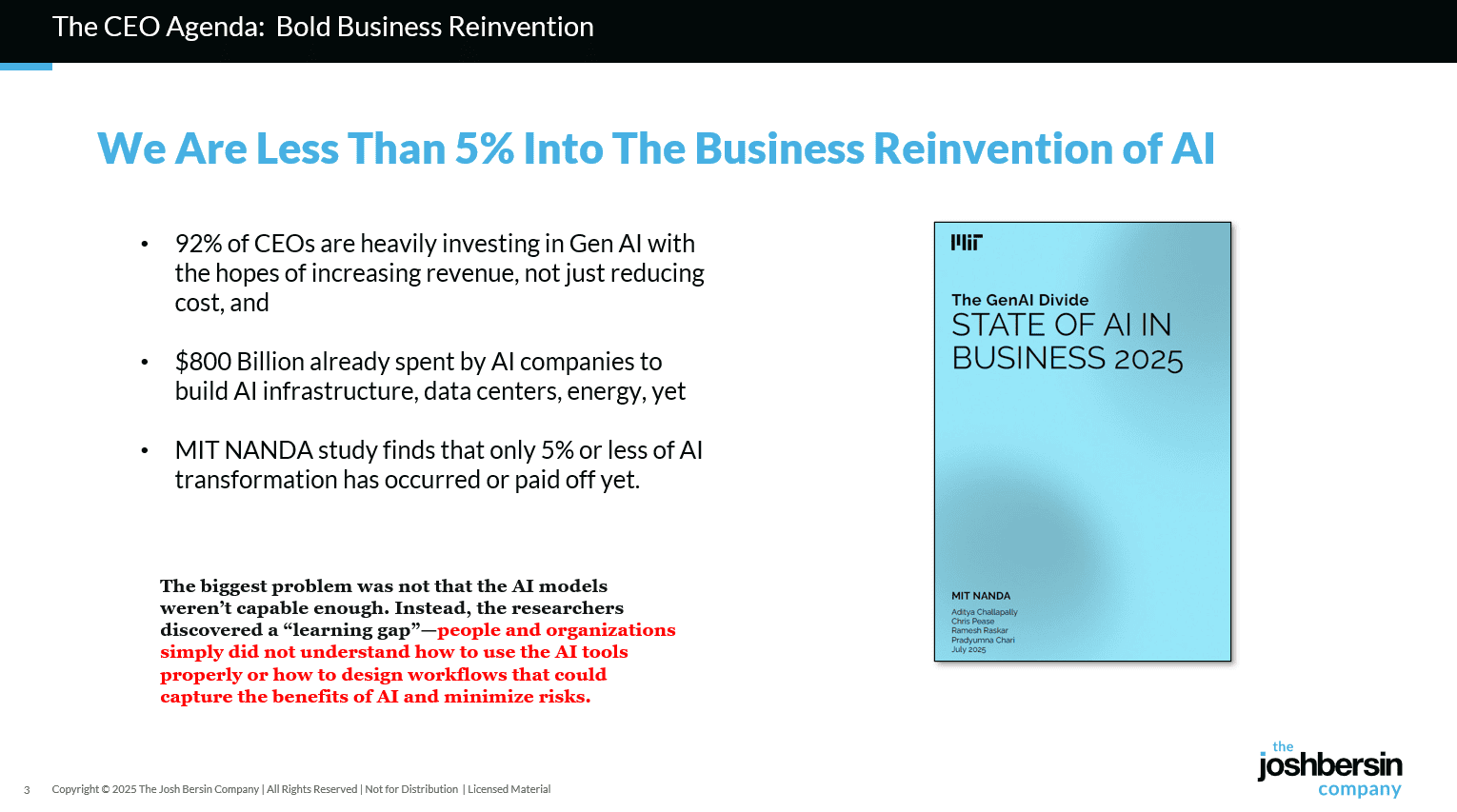
Despite these promising developments, a significant hurdle remains: the realization of true, large-scale organizational transformation. A recent MIT study, which indicated that a staggering 95% of AI pilot projects fail to achieve their intended outcomes, serves as a stark reminder. The reasons behind these failures are not necessarily inherent flaws in the technology itself, but rather the organizational inertia and the difficulty in implementing the necessary systemic changes.
The Four Stages of AI Transformation: A Framework for Understanding
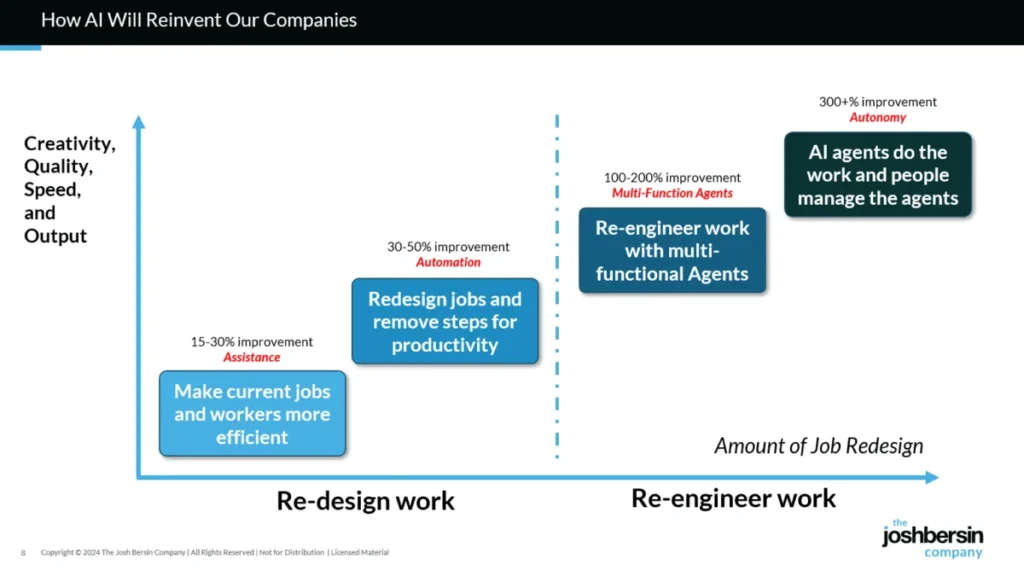
To navigate this complex landscape, a structured approach is essential. A widely recognized framework outlines four distinct stages of AI transformation:
- Stage 1: Individual Productivity Enhancement: This initial stage focuses on empowering individual employees with AI tools to accelerate their tasks. This can include information retrieval, content generation, data analysis, and problem-solving. OpenAI reports that 41% of ChatGPT usage, for example, is dedicated to information retrieval, with significant benefits also seen in writing, data analysis, and finding answers to complex questions. While these "personal productivity hacks" can yield quick gains, they typically result in a modest productivity increase, estimated at 10-20%.
- Stage 2: Automation of Multi-Processes: Moving beyond individual tasks, this stage involves automating entire workflows and processes. This requires a deeper integration of AI into existing systems and a redesign of how work flows through the organization.
- Stage 3: Redesign of Work and Business Models: This is the most profound stage, where AI drives a fundamental re-imagining of job roles, business processes, and even entire business models. It necessitates strategic vision and a willingness to challenge established norms.
- Stage 4: Systemic Transformation and Innovation: The ultimate goal is to achieve a state of continuous innovation and adaptation, where AI becomes an integral part of the organization’s DNA, driving sustained competitive advantage.
The critical challenge for large organizations lies in progressing beyond Stage 1. The gap between individual efficiency gains and the systemic transformation required for substantial productivity leaps is where management’s role becomes paramount.
The Evolution of Management in the Age of AI
For decades, the field of management has been a dynamic arena of evolving theories and practices. From Peter Drucker’s seminal work on "The Effective Executive" to Jack Welch’s emphasis on performance and Howard Schultz’s focus on employee well-being, management thought has continuously adapted to changing economic and social landscapes. Trends such as servant leadership, courageous leadership, conscious capitalism, agile management, and even radical experiments like holacracy have each offered distinct perspectives on how to lead organizations effectively.
However, the advent of AI introduces a new paradigm, prompting a fundamental question: how is effective management changing in this AI-driven world? The answer appears to lie in a shift towards two core principles: empowerment and experimentation.
Empowerment and Experimentation: The New Cornerstones of Management
Over the past decade, the concepts of empowerment and experimentation have moved from the periphery to the core of successful leadership. Companies that have embraced AI with agility, such as Microsoft and Meta, have often done so by fostering a culture of project-based leadership. Leaders at globally recognized firms like Bayer, Unilever, HSBC, Mastercard, Spotify, and Phillips now frequently highlight their reliance on small, empowered teams, each accountable for driving specific improvements.
In this new era, "Supermanagers"—a term increasingly used to describe leaders who champion innovation and drive change—do not wait for directives from senior committees. Instead, they proactively experiment, iterate, and champion new initiatives from the ground up. This contrasts sharply with traditional management approaches, where hierarchical structures and lengthy approval processes could stifle innovation.
The dynamic is illustrated by the concept of the "Superworker," an individual who leverages AI to significantly enhance their productivity. While traditional managers might focus on supervising individual output, Supermanagers recognize that in the age of AI, the focus must shift. They understand that AI can automate many of the routine supervisory tasks, freeing up managers to concentrate on higher-value activities such as coaching, mentorship, fostering collaboration, and, crucially, redesigning work processes.
This shift is driven by the inherent nature of AI. Unlike previous technological revolutions, such as the adoption of Enterprise Resource Planning (ERP) systems or cloud computing, which often required extensive IT infrastructure and lengthy implementation cycles, AI is a more democratizing technology. It can be learned and applied by individuals across the organization, often with minimal reliance on traditional IT departments. This democratization means that innovative ideas can emerge from unexpected quarters, including those with less formal experience but a greater willingness to "learn by doing."
This "Superworker effect" means that individuals, regardless of tenure, can become high-performers. This phenomenon, sometimes referred to as "Superagency" by thought leaders like Reid Hoffman, can even diminish the perceived value of extensive experience if it is not coupled with adaptability and a willingness to embrace new tools and methodologies.

The Rise of the Supermanager: Driving Innovation at the Front Lines
The empowerment of individuals and the encouragement of experimentation have led to the emergence of the "Supermanager." These leaders are characterized by their embrace of new ideas, their willingness to share the pioneering efforts of others, and their ability to integrate practical AI applications into their teams’ workflows without waiting for top-down mandates. This proactive, front-line innovation is crucial for organizations to adapt and thrive in the rapidly evolving AI landscape.
Companies that continue to rely on traditional management structures, characterized by rigid hierarchies and a slow pace of decision-making, face significant risks. These include stagnation, lagging productivity, and a progressive loss of competitive edge. In contrast, organizations that foster Supermanager behaviors are poised to "rocket ahead" in this new era.
Redefining Managerial Roles: From Supervision to Strategic Orchestration
The increasing capabilities of AI naturally lead to questions about the future of managerial roles. If an AI agent can effectively supervise routine tasks, does this eliminate the need for managers? The answer, according to emerging research, is nuanced. While the role of managers solely focused on direct supervision may diminish, leading to the potential disappearance of what are sometimes termed "empty suits" or those in redundant supervisory roles, the need for strategic leadership remains.
Supermanagers, in this context, are not merely overseeing tasks; they are orchestrating innovation across teams. They make calculated investments in productivity projects, have the discernment to halt initiatives that are not yielding results, and facilitate knowledge sharing and alignment across the organization. Tools like "Galileo for Managers" are being developed to equip leaders with the skills necessary for this new form of strategic orchestration.
The argument is not that middle management will disappear entirely, but rather that its function is being redefined. Companies that cultivate Supermanager behaviors are likely to gain a significant advantage in the evolving business environment.
The Human Element in an AI-Driven World
While AI offers powerful tools for efficiency and automation, it is crucial to remember that "Superworkers" are, at their core, human beings. They require not only advanced tools but also a supportive environment that fosters a growth mindset. Supermanagers play a vital role in providing this support by building trust, advocating for their teams, and demonstrating empathy throughout the learning and reinvention process.

The traditional metrics of performance management, such as rigorous evaluation and competition, remain relevant but are being reframed. The emphasis is shifting from simply "doing your job" as quickly and intensely as possible to a focus on learning and growth. The question "What have you learned today?" is becoming as, if not more, important than "What have you done for me today?"
The Future Landscape: A Call for Adaptability
The unprecedented investment in AI signals a profound shift in the global economic landscape. While the immediate economic indicators may present a mixed picture, the long-term potential for AI to drive productivity and innovation remains immense. However, realizing this potential requires more than just technological adoption; it demands a fundamental evolution in how organizations are managed.
The rise of the Superworker, empowered by AI and driven by a proactive, experimental mindset, necessitates a corresponding evolution in leadership. Supermanagers, who foster empowerment, encourage experimentation, and focus on systemic transformation, will be the architects of success in this new era. Companies that fail to adapt to this changing managerial paradigm risk being left behind, unable to harness the full transformative power of artificial intelligence. As research continues to unfold in October, the insights gained will be critical for businesses seeking to navigate this exciting and challenging future.