The tech industry is witnessing a profound shift as artificial intelligence, once lauded as a tool for augmenting human capabilities, is increasingly being positioned as a catalyst for workforce reductions. This trend, exemplified by recent layoffs at major corporations like Oracle and Block, is reshaping the employment landscape and sparking critical discussions about the future of work. While the narrative often centers on AI’s potential to replace human roles, a closer examination of industry data and expert analysis reveals a more complex reality involving job restructuring and evolving skill requirements.
Andrew’s Unsettling Discovery at Oracle

The stark reality of this evolving landscape was brought into sharp focus by Andrew’s experience at Oracle. He awoke to discover his employment had been terminated, not through direct communication from management or human resources, but via an AI-generated summary of his inbox. This impersonal notification, which Andrew inferred meant his job was gone, highlights a growing detachment in how companies are communicating significant employment changes. Oracle reportedly laid off approximately 30,000 employees, representing about 18% of its workforce, a move framed as a necessary step to fund the development of AI data centers, despite their current unproven profitability. This significant workforce reduction underscores Oracle’s strategic pivot towards AI, even as the immediate human cost becomes apparent.
A Wave of AI-Related Reductions
Andrew’s situation is not an isolated incident. Earlier, Block faced a similar scenario, with CEO Jack Dorsey citing the "potential" of AI to "radically restructure work" as a justification for laying off 40% of its employees. While the company pointed to AI’s transformative capabilities, independent analyses suggested other contributing factors, including potential overhiring during the pandemic, significant legal challenges, and a complex corporate structure, may have also played a role in the decision-making process. The public pronouncements by tech leaders like Dorsey and Oracle’s Larry Ellison, alongside Meta’s Mark Zuckerberg, indicate a race among prominent tech founders to capitalize on the AI revolution. This pursuit, however, appears to be intertwined with aggressive cost-cutting measures, leading to concerns about a competitive drive to streamline operations by reducing human capital.

The "Contagion" Spreads Through the Tech Sector
This trend, described by some as a "contagion," is reportedly spreading throughout the technology sector. Reports indicate that financial executives are actively seeking insights into the strategies employed by companies like Block to manage workforce reductions. Anecdotal evidence from within the tech hub of San Francisco suggests a prevailing sentiment among some industry leaders to rapidly adopt AI-driven efficiencies, with a perceived disregard for the broader consequences. This sentiment fuels a narrative that positions AI primarily as a human replacement technology, a perception that is gaining traction and likely to influence future corporate decisions.
Shifting Narratives: From Enhancement to Replacement

The discourse surrounding AI’s impact on employment is undergoing a noticeable shift, moving from an emphasis on augmentation to a focus on replacement. This change is reflected in the pronouncements of key financial leaders. Notably, Brian Moynihan, CEO of Bank of America, initially reassured employees that artificial intelligence posed no threat to their jobs. However, in a subsequent announcement regarding the bank’s first-quarter profits, Moynihan adopted a different tone. He highlighted that shedding 1,000 jobs through attrition, achieved by "eliminating work and applying technology," specifically artificial intelligence, contributed to the bank’s improved financial performance. Moynihan further indicated that such strategies would continue in the future. This evolution in messaging suggests a growing willingness among financial institutions to leverage AI for cost reduction through workforce attrition, signaling a potential long-term impact on employment levels across various industries. While some tech founders may harbor ambitions of leading highly efficient, AI-augmented organizations with minimal human oversight, the broader financial sector appears to be driven by the immediate prospect of increased profitability through strategic workforce reductions.
The Reality of AI’s Impact: Restructuring Over Replacement
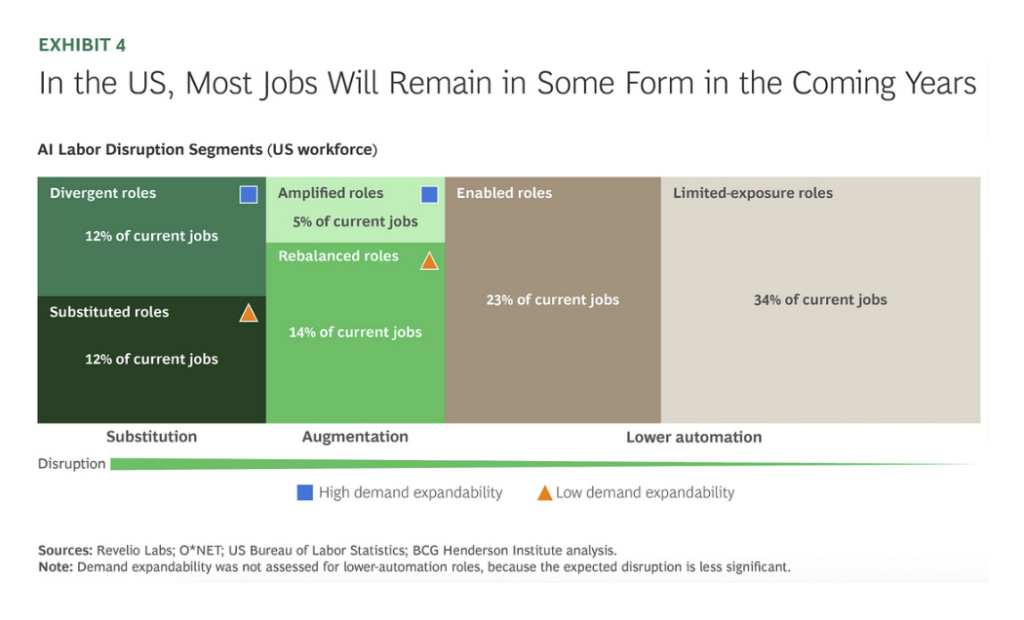
Despite the prevailing narrative of mass displacement, research suggests a more nuanced picture of AI’s impact on the job market. A comprehensive analysis by Boston Consulting Group (BCG) examined over 1,500 jobs and projected that while 10-15% of these roles could be eliminated over the next four to five years, a significantly larger portion, between 50-55%, will likely undergo substantial restructuring. This restructuring implies that AI will equip workers with new skills and capabilities, necessitating considerable adaptations in how teams, functions, and entire organizations operate. This perspective frames the integration of AI as a multi-year transformation rather than a short-term cost-cutting initiative.

Further supporting this view, research from Nick Bloom, drawing on surveys of executives from institutions like the Federal Reserve and the Bank of England, indicates that while 26% of executives globally anticipate a decrease in employment due to AI over the next three years, a notable 15% of US executives expect employment to grow as a result of AI adoption. When netted out, this suggests a projected decline of 1.2% in overall US employment, which translates to approximately two million jobs. This figure, while significant, contrasts with more alarmist predictions of widespread job elimination. The research underscores that AI’s influence is not monolithic, with potential for both job displacement and creation, alongside a dominant trend of job evolution.
Alternative Approaches to AI Integration
The current trajectory of AI adoption, characterized by a focus on replacement and cost-cutting, is not the only viable path forward. Several alternative strategies offer a more constructive approach to integrating AI into the workforce.

Leveraging AI with Ambition
Instead of focusing on individual productivity metrics and penalizing lower output, companies can adopt a more ambitious approach to AI integration. This involves setting bold organizational goals that leverage AI to drive growth, expansion, and market share acquisition. By providing teams with the necessary time and resources to experiment with AI tools, organizations can foster innovation and enable them to challenge established market leaders who may be slower to adapt. This proactive strategy shifts the focus from internal efficiency gains to external competitive advantage.
Prioritizing Team-Level Collaboration

The true value of AI often materializes at the team level, rather than solely through individual productivity gains. When individual goals are prioritized over collective objectives, the potential for AI to enhance overall organizational outcomes can be diminished. Research suggests that aligning AI implementation with team-based goals, fostering collaboration, and ensuring coordinated efforts are crucial for realizing the transformative benefits of these technologies. Atlassian’s lead behavioral scientist, Ben Ostrowski, emphasizes that the real value of AI is unlocked when it empowers teams to achieve shared objectives.
Acknowledging and Mitigating Risks
A critical aspect of responsible AI adoption involves recognizing and actively managing the potential risks associated with its use. Studies indicate that employees who heavily utilize AI tools are also more susceptible to "AI Brain Fry," a state of cognitive overload and potential for errors. BCG research found that these intensive AI users are 39% more likely to commit significant mistakes and exhibit a 39% higher intent to leave their positions. The very individuals driving significant output increases are also at a higher risk of burnout and departure, highlighting the need for careful management of workload and cognitive load.
Adopting a Long-Term Perspective
The pressure for short-term financial gains often leads CEOs to focus on quarterly earnings, potentially overlooking the long-term implications of AI adoption. A more sustainable approach involves adopting a long-term perspective, drawing parallels with historical technological shifts. For instance, the introduction of ATMs did not eliminate bank tellers but transformed their roles into customer service representatives. By framing AI integration as an evolutionary process rather than an existential threat, organizations can demystify the technology and foster a more adaptable workforce, akin to navigating a challenging but ultimately surmountable mountain.
Conclusion: A Choice in How We Treat People

The circumstances surrounding Andrew’s termination at Oracle, where an AI-generated summary served as the notification of his dismissal, underscore a deliberate choice made by leadership. This instance highlights that the use of AI in such sensitive communications is not an inherent function of the technology itself, but rather a decision about how to treat employees during critical junctures. The narrative that AI is solely a tool for human replacement is a convenient excuse, and sometimes the delivery mechanism, for broader strategic objectives.
The path forward presents a crucial juncture for business leaders. The alternatives discussed offer a vision for the coming years where companies prioritize human capital alongside technological advancement. By fostering a culture of innovation, focusing on team synergy, mitigating risks, and embracing a long-term perspective, organizations can navigate the AI revolution in a manner that benefits both their bottom line and their workforce. The alternative – a society where a significant portion of the workforce learns of their disposability through impersonal AI interfaces – is a future that many believe is best avoided. The choices made today by leaders will determine whether AI serves as a tool for progress and adaptation or as a catalyst for widespread displacement and disillusionment.