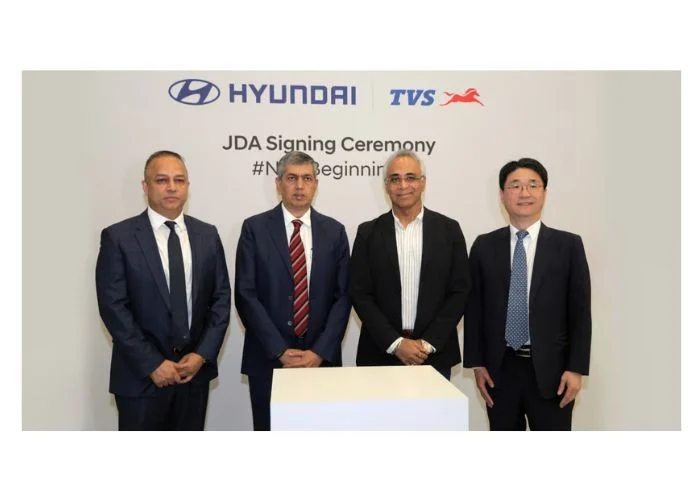
Hyundai Motor Company and TVS Motor Company have formally announced a strategic joint development agreement aimed at designing and launching electric three-wheelers (E3Ws) specifically tailored for India’s burgeoning last-mile mobility market. This landmark collaboration, which follows a successful showcase at the Bharat Mobility Global Expo 2025, positions the two automotive giants at the forefront of India’s electric vehicle (EV) transformation, leveraging global technological prowess with deep-rooted local market understanding. The partnership delineates clear roles: Hyundai Motor will spearhead the design and technology development, drawing upon its extensive global research and development (R&D) capabilities, while TVS Motor will contribute its established electric platform, profound insights into local customer needs, and robust manufacturing, sales, and distribution networks.
The Strategic Partnership Unveiled: A Blueprint for Sustainable Mobility
The core objective of this alliance is to create purpose-built E3Ws that are not only technologically advanced but also economically viable and perfectly suited to the diverse operational demands of both urban and rural India. The structure of the partnership emphasizes local manufacturing, a critical component for achieving cost competitiveness, ensuring scalability, and fostering opportunities for exports to other developing markets. By prioritizing the localization of components, the collaboration is poised to significantly strengthen India’s nascent electric vehicle supply chain, creating a ripple effect of employment generation across manufacturing, engineering, and the extensive distribution networks that TVS Motor already commands. This strategic alignment reflects a shared vision for cleaner, more efficient transport solutions that address environmental concerns while simultaneously boosting economic growth and employment.
Deep Dive into India’s Last-Mile Mobility Sector
India’s last-mile mobility sector is characterized by its sheer volume and its indispensable role in the country’s economic fabric. Three-wheelers, commonly known as auto-rickshaws for passenger transport and cargo carriers for goods delivery, are the backbone of urban and semi-urban transportation, providing affordable and accessible services to millions daily. The market for three-wheelers in India is one of the largest globally, with annual sales often exceeding half a million units. This segment is particularly ripe for electrification due to several factors: the vehicles operate primarily within defined geographical areas, making range anxiety less of a concern; their high daily utilization makes the lower running costs of EVs highly attractive; and their contribution to urban air pollution and noise levels is significant, making their electrification a priority for city planners.
The electric three-wheeler (E3W) segment, while still a fraction of the overall market, has been witnessing explosive growth. Government incentives, coupled with rising fuel prices and increasing environmental awareness, have accelerated this transition. Projections indicate that E3Ws could capture a substantial share of the new three-wheeler sales within the next five to seven years, potentially reaching 30-40% or even higher in key urban centers. This growth is further fueled by the burgeoning e-commerce and logistics sectors, which rely heavily on efficient and cost-effective last-mile delivery solutions, where E3Ws offer a compelling value proposition.
A Precursor: The Bharat Mobility Global Expo 2025 Connection
The Bharat Mobility Global Expo 2025 served as a significant platform for showcasing India’s capabilities and ambitions in the automotive sector, particularly in the realm of future mobility. The fact that this partnership "builds on the successful showcase" at the expo suggests that the event was instrumental in bringing these two entities together, or at least in publicizing their shared vision and preliminary discussions. Such expos are crucial for fostering collaborations, attracting investments, and demonstrating technological advancements. For India, the expo underscored its commitment to becoming a global manufacturing and R&D hub for electric vehicles, aligning with national initiatives like "Make in India" and the broader push for sustainable development. The alliance between Hyundai and TVS, therefore, can be seen as a direct outcome or a significant validation of the strategic direction championed at such global forums.
Technological Synergy and Manufacturing Prowess
The collaboration harnesses the distinct strengths of both companies. Hyundai Motor Company, a global automotive powerhouse, has made substantial investments in electric vehicle technology worldwide. Its dedication to R&D has yielded advanced EV platforms like the E-GMP (Electric Global Modular Platform), innovative battery technologies, and sophisticated design philosophies. While E3Ws will likely not utilize the E-GMP directly, Hyundai’s expertise in electric powertrain integration, battery management systems, thermal management, and robust vehicle architecture will be invaluable in developing a highly reliable and efficient electric three-wheeler. Their global design language and engineering excellence are expected to bring a fresh perspective to a segment often characterized by utilitarian designs.
TVS Motor Company, on the other hand, brings an unparalleled understanding of the Indian market and a proven track record in electric mobility within the two-wheeler segment, exemplified by the success of its iQube electric scooter. More importantly, TVS possesses extensive experience in designing, manufacturing, and distributing two- and three-wheelers specifically for Indian road conditions and customer preferences. Their established electric platform for two-wheelers provides a strong foundation, which can be adapted and scaled for three-wheelers. TVS’s deep knowledge of local operating conditions, customer expectations regarding cost of ownership, durability, and serviceability, combined with its vast dealer and service network across India, are critical for the successful market penetration and long-term viability of the E3Ws. The focus on local component sourcing, driven by TVS’s manufacturing capabilities, will not only keep costs competitive but also foster a robust domestic supply chain, reducing reliance on imports and bolstering India’s industrial ecosystem.
Governmental Impetus and Policy Landscape
The timing of this collaboration aligns perfectly with the Indian government’s aggressive push for electric mobility. The FAME (Faster Adoption and Manufacturing of Electric Vehicles) II scheme has been a cornerstone of this policy, offering significant subsidies and incentives for EV manufacturers and buyers, particularly for two- and three-wheelers. These incentives make E3Ws more affordable, bridging the initial cost gap with their internal combustion engine (ICE) counterparts. Beyond FAME II, various state governments have introduced their own EV policies, offering additional subsidies, road tax exemptions, and registration fee waivers, creating a favorable ecosystem for EV adoption.
The development of charging infrastructure, though still nascent in many areas, is also gaining momentum. Fleet operators and commercial vehicle users, including E3W drivers, often benefit from dedicated charging points and battery swapping stations, which mitigate range anxiety and reduce downtime. India’s commitment to achieving net-zero emissions by 2070, coupled with its ambitious targets for EV penetration, provides a strong regulatory and strategic tailwind for partnerships like that between Hyundai and TVS.
Voices from the Industry: Inferred Reactions and Perspectives
The announcement has likely generated significant interest across the automotive sector and beyond. An inferred statement from Mr. Jaehoon Chang, President and CEO of Hyundai Motor Company, might emphasize, "This partnership with TVS Motor is a testament to Hyundai’s unwavering commitment to sustainable mobility solutions globally, and particularly in India, a market of immense strategic importance. By combining our advanced design and technology capabilities with TVS’s profound local expertise and manufacturing prowess, we are poised to introduce a new generation of electric three-wheelers that will redefine last-mile transport, offering superior performance, efficiency, and environmental benefits."
Similarly, Mr. K.N. Radhakrishnan, Director & CEO of TVS Motor Company, could be inferred to have stated, "TVS Motor has always been at the forefront of innovation and customer-centric solutions. Our collaboration with Hyundai Motor Company is a pivotal step in our journey towards electrifying India’s mobility landscape. This alliance allows us to leverage Hyundai’s global R&D strength while capitalizing on our deep understanding of Indian customers and our proven electric platform. Together, we aim to deliver purpose-built E3Ws that are not just vehicles, but catalysts for economic empowerment and environmental sustainability across the nation."
From an analytical perspective, Ms. Priya Sharma, a leading automotive industry analyst, might comment, "This Hyundai-TVS alliance is a game-changer for the Indian E3W market. It brings together a global OEM with cutting-edge technology and a domestic leader with unparalleled market reach and understanding. The synergy promises robust, reliable, and cost-effective E3Ws that could significantly accelerate the transition from ICE. The focus on local manufacturing and a strong distribution network gives them a formidable competitive edge against both incumbent players and emerging startups. It also highlights the increasing trend of global-local partnerships to tap into specific market opportunities in emerging economies."
A government official, perhaps from the Ministry of Road Transport and Highways, could be inferred to have remarked, "Initiatives like the Hyundai-TVS partnership are crucial for achieving India’s ambitious electric mobility targets. Beyond reducing our carbon footprint, this collaboration will spur significant job creation in manufacturing, R&D, and the entire EV ecosystem. It exemplifies the ‘Make in India’ vision, attracting global technology while strengthening our domestic industrial base and empowering countless drivers with sustainable livelihood opportunities."
Economic and Social Implications: A Transformative Shift
The initiative carries wide-ranging economic and social benefits that extend far beyond the immediate mobility sector. The commitment to local sourcing and production will stimulate job creation across the value chain – from R&D and engineering to factory floor assembly, logistics, sales, and after-sales service. This will also necessitate skill development programs, enhancing the capabilities of the Indian workforce in advanced manufacturing and EV technologies.
For drivers and fleet operators, the rollout of electric three-wheelers promises substantial operational savings due to lower fuel (electricity) costs and reduced maintenance requirements compared to their ICE counterparts. This translates into higher take-home incomes, supporting sustainable livelihoods and improving the economic well-being of a significant segment of the population.
Environmentally, the widespread adoption of E3Ws will lead to a tangible reduction in air pollution and noise levels, particularly in congested urban areas. This directly contributes to improved public health outcomes and a better quality of life for urban residents. Furthermore, by reducing dependence on fossil fuels, India strengthens its energy security and makes significant strides towards its climate change mitigation goals. The partnership thus embodies a holistic approach to development, linking technological innovation with economic empowerment and environmental stewardship.
The Competitive Landscape: Who Else is in the Race?
The Indian electric three-wheeler market is already dynamic and competitive, with several established players and agile startups vying for market share. Companies like Mahindra Electric Mobility, with its Treo range, have been early movers. Bajaj Auto, a dominant player in the ICE three-wheeler segment, has also introduced electric variants. Piaggio Vehicles India, another veteran in the segment, offers electric versions of its Ape series. Newer entrants and startups are also innovating, particularly in battery swapping technologies and modular vehicle designs.
The entry of a formidable alliance like Hyundai-TVS, however, is set to significantly reshape this landscape. Hyundai’s global R&D capabilities and TVS’s manufacturing prowess and market penetration could set new benchmarks for product quality, performance, and reliability. Their combined might could put pressure on smaller players and compel existing competitors to accelerate their own technological advancements and market strategies. This heightened competition is ultimately beneficial for the consumer, leading to better products and more competitive pricing.
Looking Ahead: Export Potential and Future Horizons
Beyond the domestic market, the strategic focus on cost-competitive local manufacturing opens significant opportunities for exports. India is strategically positioned to become a global hub for electric three-wheeler manufacturing, catering to the last-mile mobility needs of other developing countries in Africa, Southeast Asia, and Latin America. The E3Ws designed and manufactured under this partnership could well become a global benchmark for affordable, robust, and sustainable last-mile transport.
Furthermore, the successful collaboration on E3Ws could pave the way for future partnerships between Hyundai and TVS in other electric vehicle segments, such as electric two-wheelers, small electric commercial vehicles, or even exploring advanced battery technologies and charging solutions. This alliance is not just about a single product category; it represents a synergistic model for innovation and growth in the broader electric mobility ecosystem, promising a future of accessible, clean, and efficient transportation for India and potentially the world.
In conclusion, the joint development agreement between Hyundai Motor Company and TVS Motor Company represents a pivotal moment in India’s electric mobility journey. By combining global technological leadership with local market expertise, the alliance is poised to deliver purpose-built electric three-wheelers that will not only transform last-mile transport but also generate substantial economic benefits, create employment, and significantly contribute to India’s environmental sustainability goals. This collaboration stands as a powerful example of how strategic partnerships can drive innovation and accelerate the transition to a cleaner, more prosperous future.