
For much of the past year, prevailing economic discourse has largely attributed shifts in the US job market to factors such as cost-cutting measures and pervasive economic uncertainty, rather than widespread job displacement by artificial intelligence. This perspective, informed by extensive analysis of employment data and numerous press engagements, suggested that AI’s direct impact on job roles remained relatively contained. However, as the United States enters 2026, a discernible recalibration of this landscape is underway, marked by a notable uptick in the unemployment rate and a widening divergence in job prospects between new college graduates and more experienced professionals.
Unemployment Rate on an Upward Trajectory
The Bureau of Labor Statistics (BLS) reported a US unemployment rate of 4.6% as of the most recent data, a significant increase from 4.2% recorded a year prior – representing a 9.5% rise. This upward trend is even more pronounced when viewed over a two-year span, with the November 2023 unemployment rate standing at 3.7%. The increase from November 2022, when the rate was a mere 3.6%, highlights a substantial 24.7% surge in unemployment within this timeframe. This trajectory suggests a cooling of the US economy, following a post-pandemic surge in consumer spending, often termed "revenge buying," which characterized 2021 and 2022. Contributing factors to this economic deceleration include ongoing US tariffs, persistent inflation, and relatively high interest rates.
A Tale of Two Labor Markets: Graduates Versus Tenured Professionals
A deeper examination of the unemployment data reveals a critical divergence when the labor force is segmented into two distinct groups: new college graduates (aged 24 and younger) and more seasoned workers (aged 25-35). This segmentation exposes a growing disparity in their employment experiences.
Unemployment Trends for Different Age Groups
The accompanying visual data, which tracks unemployment rates for college graduates by age, illustrates this trend. The line representing tenured college graduates (typically those aged 25 and older with established careers) consistently remains below the overall average unemployment rate. This stability is logically attributed to their accumulated skills, seasoned judgment, and a maturity in decision-making that often makes them more resilient in the face of economic fluctuations.
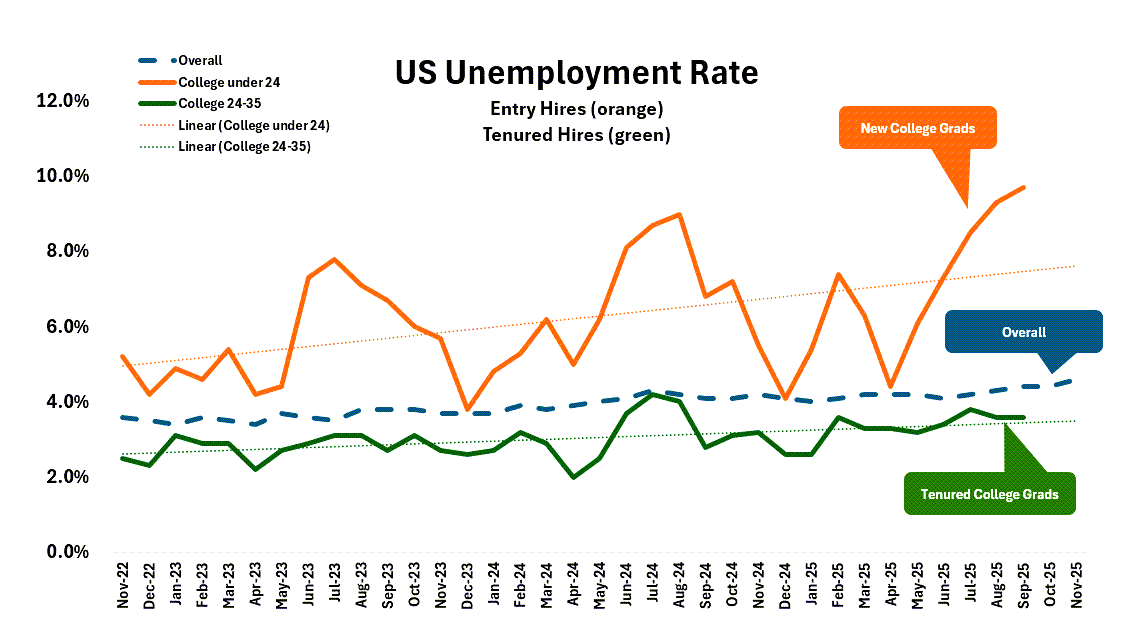
Conversely, the unemployment rate for new college graduates, depicted by a separate line, shows a concerning upward trend. As of the latest reports, this rate hovers near 10%, marking the highest point since July 2021, the peak of the post-pandemic economic recovery. Historical analysis of this metric reveals a striking parallel: the last time young college graduate unemployment reached such elevated levels was in 2011, a period of recovery from the 2008 Great Recession. This observation is corroborated by research from institutions like the St. Louis Fed, which has also highlighted the disproportionate impact of recent labor market shifts on recent college graduates.
The Shrinking Landscape for College-Educated Roles
Compounding this challenge, data indicates a robust demand for jobs that do not necessitate a college degree. These roles constitute approximately 82% of the total workforce, an increase from 79% five years ago. This suggests a dual impact of evolving economic forces: not only is AI contributing to a slowdown in the hiring of new college graduates, but it is also, in effect, reducing the overall number of job openings that require a four-year degree. This trend has significant implications for educational investment and career planning for a generation entering the workforce.
The Socio-Technological Integration of AI
The escalating concern surrounding AI’s role in the job market is intrinsically linked to its nature as a "socio-technological" innovation. This means AI’s impact extends beyond mere technological advancement to encompass profound societal and sociological ramifications. As articulated in recent discussions on the human capital agenda, the integration of AI into the workplace is not solely a matter of software and algorithms; it profoundly affects human behavior, trust, and organizational dynamics.
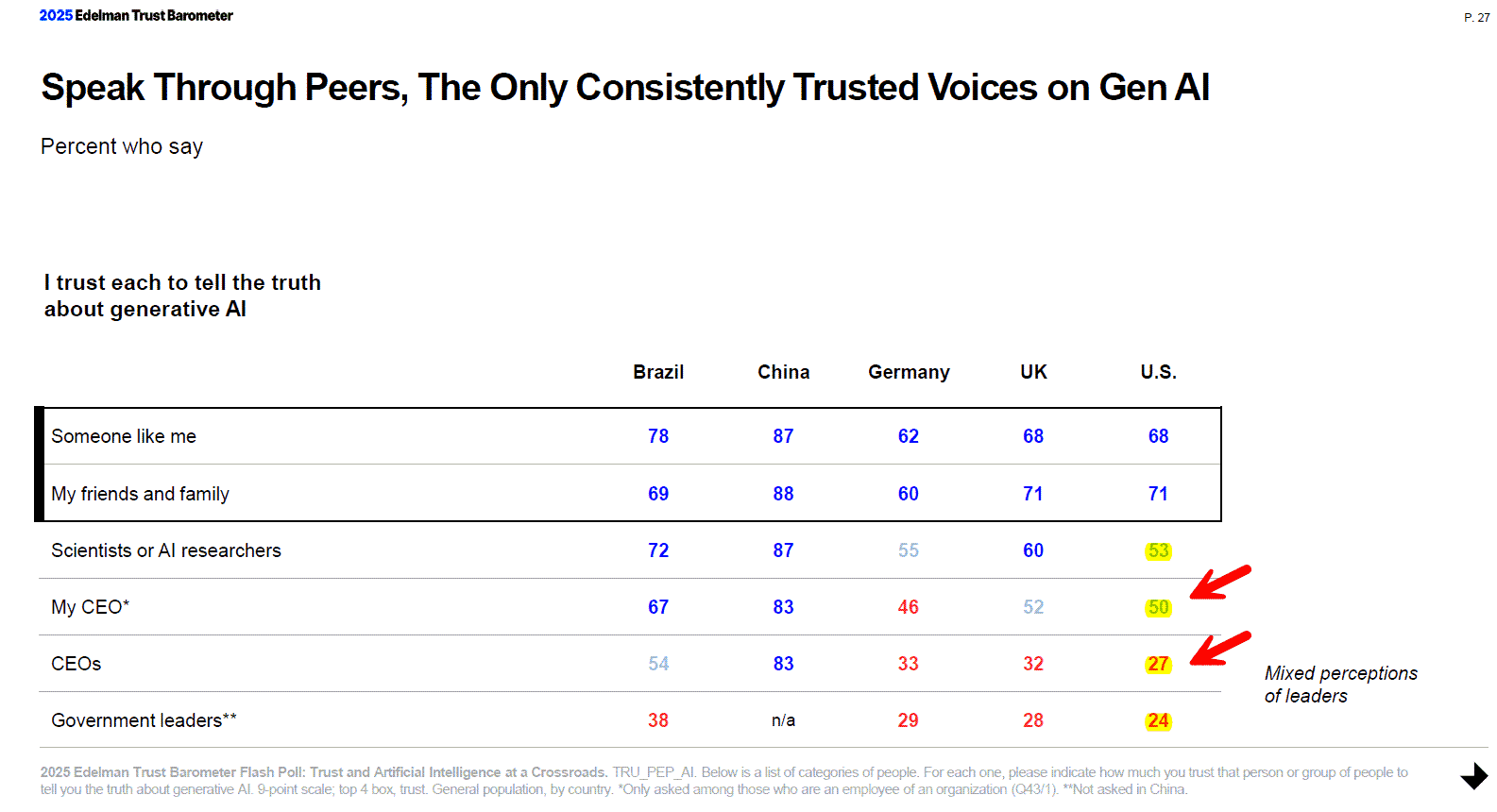
A critical aspect of this integration is employee trust in AI. Research, such as the Edelman Trust Barometer flash poll on Artificial Intelligence, indicates that while there might be a growing acceptance of AI’s potential value, there remains a significant gap in trust regarding the specific AI platforms and their implementation. This sentiment is further underscored by data showing low trust in CEOs regarding their handling of AI initiatives. When only a portion of the workforce trusts the narrative surrounding AI’s integration, it breeds hesitancy, skepticism, and resistance to change. This erosion of trust can directly contribute to economic insecurity, as employees grapple with concerns about their job security, career progression, and future earning potential.
The Paradox of AI Anxiety: Productivity and Innovation
The pervasive anxiety surrounding AI could paradoxically lead to a decrease in economic productivity. When employees are preoccupied with job displacement or feel their concerns are not adequately addressed, their engagement and efficiency can suffer. This underscores the necessity for open and transparent communication regarding AI’s role in the workplace.
The rapid evolution of AI technologies presents a landscape of unfamiliar and sometimes unsettling innovations. From conversational AI interfaces and personalized email communications to avatar-based interviews, AI-driven career guidance, and AI-informed performance reviews, these advancements are becoming increasingly integrated into daily professional life. Projections for 2026 indicate a further acceleration of these trends, with the emergence of "digital twins," advanced robotics, and more sophisticated human-like animations in professional settings. Platforms like Galileo Learn are already employing AI agents to provide personalized coaching and developmental support.

Strategic Imperatives for Employers and Employees
The current economic climate necessitates a strategic reevaluation of hiring practices, particularly concerning entry-level positions. Companies that are hesitant to hire new graduates might be overlooking a crucial talent pool. Younger professionals, having grown up with digital technologies, are often more adept at embracing and innovating with AI applications. Their perspective, untethered by established methodologies, can lead to novel approaches and reinvention within organizations.
The Rise of the "Superworker"
AI is increasingly being framed not as a job eliminator, but as a "job leveler." This signifies a paradigm shift where access to information and expertise is democratized. Younger workers, in particular, can leverage AI tools to rapidly acquire knowledge and skills, potentially transitioning from an "apprentice" role to that of a nascent expert at an accelerated pace. Job seekers can utilize AI to thoroughly research companies and roles, presenting themselves as well-informed candidates.
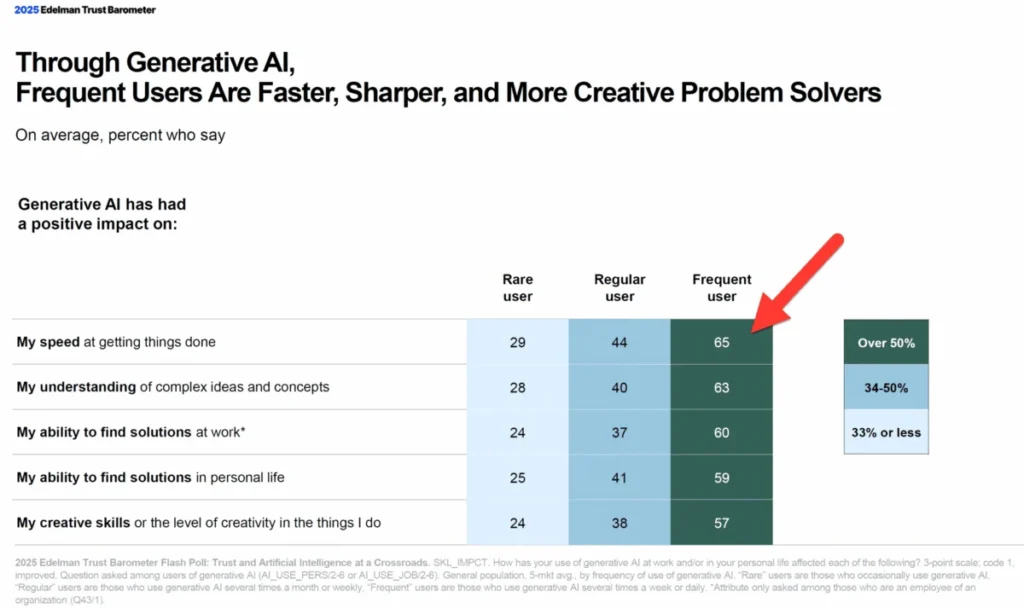
For seasoned professionals, the principle remains the same: experience alone is no longer a sufficient safeguard. Continuous learning and adaptation to new technologies and advancements within their respective fields are imperative. Research consistently shows that frequent users of AI report a greater ability to find solutions at work and complete tasks more efficiently, highlighting the tangible benefits of AI adoption.
Navigating the AI Transition: A Call for Transparency and Adaptability
Guidance for Employers:
Hiring managers and executives must exercise caution to avoid falling into the "tenure trap." While experienced employees possess invaluable institutional knowledge, younger individuals proficient in AI may rapidly acquire the skills to match or even surpass their productivity, particularly in innovative applications of the technology. Tenured employees may be inclined to use AI to optimize existing processes, whereas newer entrants might leverage it to fundamentally rethink and re-engineer workflows.
For HR leaders and recruiters, the focus should be on identifying individuals who demonstrate rapid learning capabilities and a propensity for adopting AI. These individuals are poised to become the "Superworkers" of the future, driving enhanced productivity and innovation. Furthermore, the often lower cost associated with hiring and training early-career professionals who are quick to adapt to AI can present a significant advantage.
CEOs and senior executives are urged to adopt a transparent and thoughtful approach to AI integration. Evidence suggests that AI is a "scaling technology" that augments human capabilities rather than a wholesale job replacement tool. Honest communication and a supportive environment will foster employee adaptation and ensure the organization remains competitive.
The Broader Implications of AI Integration:
The successful integration of AI into the workforce hinges on a delicate balance between technological advancement and human adaptation. As AI continues its rapid evolution, organizations that proactively address employee concerns, foster a culture of continuous learning, and strategically leverage AI for augmentation rather than mere automation will be best positioned to thrive in the evolving economic landscape. The coming years will likely witness a significant recalibration of skill demands and organizational structures as businesses navigate this transformative era.
The discourse surrounding AI’s impact on employment is evolving from a hypothetical discussion to an observable reality. While the initial phase saw economic headwinds driven by broader factors, the current data points towards a more direct and nuanced influence of AI, particularly on emerging career trajectories. The ability of both individuals and organizations to adapt to these shifts will be a defining factor in future economic success.







