The rapid integration of artificial intelligence into the recruitment process over the past year has outpaced even the most forward-thinking organizational leaders, ushering in an era of unprecedented efficiency and, simultaneously, escalating risks. While AI has undeniably streamlined candidate screening, broadened recruitment reach, and improved candidate-to-role matching, it has also inadvertently lowered the barriers for sophisticated candidate fraud. This surge in AI-generated resumes and inflated credentials has transformed hiring into a complex risk management challenge with profound legal, reputational, and operational implications for businesses globally.
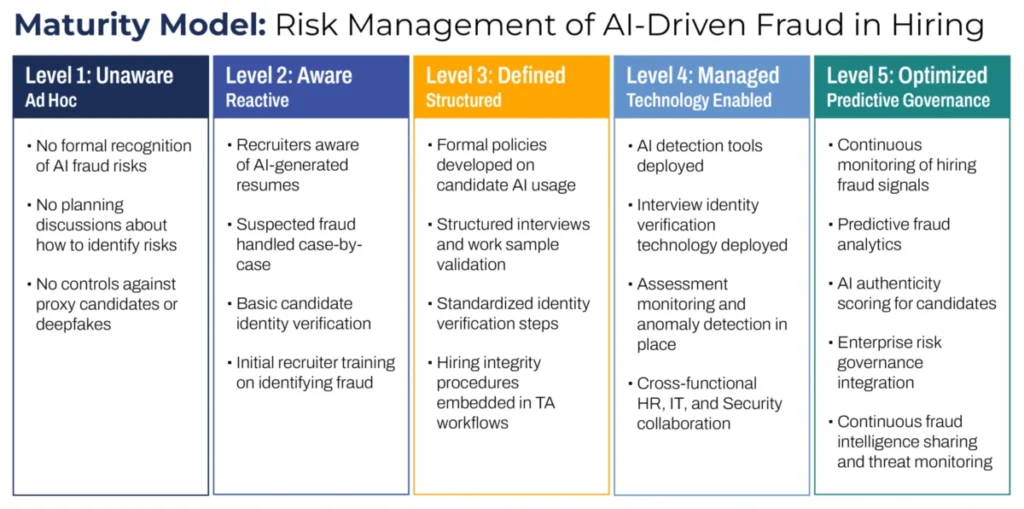
As organizations increasingly turn to AI-powered tools to manage the overwhelming volume of applications, a sobering reality is emerging: the very automation designed to enhance efficiency has also empowered individuals intent on perpetrating elaborate deceptions. A recent survey conducted by the Institute for Corporate Productivity (i4cp) among senior talent acquisition executives highlighted this growing concern, revealing that a significant majority (56%) of organizations are still in the rudimentary "awareness/ad hoc" phase of AI risk management maturity. This indicates a widespread lack of structured governance and strategic planning around the adoption of AI in hiring.
The current hiring environment is characterized by a trifecta of challenges: overwhelming volume, breakneck velocity, and profound vulnerability. Recruiters are inundated with resumes, many of which are churned out by AI, making it increasingly difficult for genuine, qualified candidates to stand out. In response, companies are leaning more heavily on AI-driven screening and assessment tools, often without a comprehensive understanding of the inherent risks. This reliance on automated systems, coupled with a lack of robust oversight, creates significant exposure, not only to hiring unsuitable individuals but also to legal liabilities and cybersecurity threats.
Candidate Fraud: An Enterprise-Wide Risk, Not Just an HR Issue
The ramifications of fraudulent candidates extend far beyond a simple misplacement in the hiring process. Negligent hiring claims remain a persistent and significant legal vulnerability for employers. Courts have consistently held organizations liable when it can be demonstrated that they "knew or should have known" an employee posed a risk at the time of hire. In an era where AI facilitates sophisticated deception, proving such foresight has become a more achievable standard for plaintiffs.

The stakes are amplified when fraudulent hires gain access to sensitive company systems or data. Law enforcement agencies have issued stark warnings about the infiltration of U.S. companies by fake IT workers, some of whom are allegedly linked to foreign criminal organizations or state-sponsored actors. These infiltrators aim to steal intellectual property, exfiltrate customer data, or deploy ransomware. In highly regulated sectors, the compromise of customer or patient data due to a fraudulent hire can lead to extended liability, even involving third parties.
Ultimately, AI-enabled fraud blurs the traditional departmental lines, collapsing the boundaries between Human Resources, Legal, IT, Privacy, and Security. Senior HR leaders can no longer afford to view hiring controls as mere operational details; they are integral components of an organization’s overall risk architecture.
The Evolving Legal Landscape: A Patchwork of Regulations
Adding to the complexity is a fragmented and rapidly evolving regulatory environment. At the federal level in the United States, there has been a discernible pullback in enforcement related to disparate impact claims, and previous guidance concerning AI in employment has been rescinded. Recent judicial decisions have shifted the evidentiary burden, demanding higher thresholds for proving discrimination based solely on statistical disparities.
However, this federal retrenchment should not be interpreted as a permissive environment for employers. Instead, it has created a vacuum that states are aggressively filling with new and stringent laws governing AI in hiring and employment decisions. For instance, New York now mandates annual bias audits and public disclosures for automated employment decision tools. California has finalized comprehensive regulations for automated decision systems, imposing strict data retention requirements and prohibitions on discriminatory outcomes. Colorado, through its "Artificial Intelligence Act," requires employers to exercise "reasonable care" to prevent algorithmic discrimination, with substantial civil penalties for violations.
For multinational corporations and even companies operating across multiple U.S. states, compliance is no longer about adhering to a single federal standard. It necessitates the design of AI governance frameworks that can satisfy the diverse and often conflicting requirements of various jurisdictions. To mitigate liability, employers are increasingly compelled to meet the standards of the most restrictive jurisdiction in which they operate, often before regulators or courts have fully clarified the interpretation and application of these novel laws. The proliferation of new, untested state laws creates significant potential for liability, especially those with predefined penalties for minor infractions, which can serve as a potent catalyst for class-action lawsuits. The recent wave of job posting disclosure laws, for example, has already resulted in hundreds of lawsuits, with many yielding substantial settlements in the six or even seven figures.

The EU’s Proactive Stance: High-Risk AI and Mandatory Safeguards
The global regulatory landscape presents a stark contrast, particularly when comparing the United States to the European Union. Under the EU’s Artificial Intelligence Act, AI systems deployed in recruitment, candidate screening, interviewing, performance evaluation, or termination decisions are explicitly classified as "high-risk." This designation triggers a rigorous set of mandatory requirements that significantly exceed current U.S. norms. These include the implementation of formal risk management programs, the completion of documented impact assessments, extensive bias testing, mandated human oversight, the maintenance of audit-ready technical documentation, and continuous monitoring of AI system performance.
The Peril of "Black Box" AI: Board-Level Liability
A critical message for senior HR leaders is the imperative to avoid "black box" hiring tools. If an organization cannot transparently explain how an AI system evaluates candidates—detailing the data it utilizes, its training methodologies, and the decision-making processes—it will face immense challenges defending its practices to regulators, courts, or even its own board of directors.
Executives should expect AI vendors to furnish comprehensive documentation regarding training data, bias testing, auditability, and adherence to relevant regulatory frameworks. Contracts with AI tool providers must incorporate robust audit rights, clearly defined limitations on data usage, and meaningful indemnification clauses. A vendor’s reluctance to provide such transparency should be viewed as a significant risk indicator.
Furthermore, HR leaders must prioritize the protection of applicant data. Privacy liabilities are expanding, especially in jurisdictions like California, where applicant and employee data receive comprehensive privacy protections. Mishandling resumes, video interview recordings, IP addresses, or inferred data can lead to substantial fines, costly litigation, and severe reputational damage.
Reinforcing Foundational Hiring Practices in an AI-Driven World
Despite the sophisticated nature of AI-related risks, many of the most effective defenses remain rooted in fundamental, time-tested hiring practices. The strategic deployment of camera-on interviews, in-person meetings where feasible, rigorous reference checks, consistent background screening protocols, and a zero-tolerance policy for intentional misrepresentation are more crucial now than ever before.

While AI detection tools can be a part of the solution, they must be employed with caution. Poorly trained detection systems can inadvertently introduce bias or trigger their own legal obligations. Simpler procedural safeguards, such as requiring candidates to perform basic actions during video interviews, can be surprisingly effective in deterring fraud without introducing new regulatory risks.
Most importantly, HR leaders must act swiftly and decisively when suspected fraud is identified. This includes immediate suspension of access, preservation of all relevant data, prompt involvement of IT and Legal departments, and a thorough, impartial investigation. Delays in addressing suspected fraud invariably amplify an organization’s exposure.
The Executive Mandate: Balancing Innovation with Accountability
The path forward for senior HR executives lies in achieving a delicate balance: harnessing the legitimate benefits of AI while simultaneously building governance structures commensurate with its inherent risks. This is not about stifling innovation; rather, it is about ensuring that technological advancement does not outpace accountability and legal compliance. As AI continues its inexorable integration into the recruitment lifecycle, a proactive, risk-aware, and legally compliant approach is no longer optional—it is essential for organizational resilience and long-term success.