NACE26: A Confluence for Early Talent Leaders
NACE26 served as a critical forum for practitioners, educators, and technology providers dedicated to college career services and university recruiting. The National Association of Colleges and Employers, established over six decades ago, is the leading professional organization for college career services and HR/staffing professionals who recruit college students. Its annual conference is renowned for bringing together thousands of professionals to share best practices, discuss emerging trends, and explore innovative solutions for connecting students and recent graduates with meaningful employment opportunities. This year’s event in Denver, following a period of unprecedented volatility in the labor market and rapid technological advancement, was particularly focused on adaptability and strategic innovation. Themes such as leveraging technology for efficiency, fostering genuine candidate relationships, and navigating a competitive talent landscape dominated the discourse, setting the stage for Yello’s key announcements. The conference underscored a collective industry push towards more data-driven, personalized, and efficient recruiting methodologies, moving away from traditional, volume-based approaches.
The AI Imperative: Redefining the Recruiter’s Role
A central theme permeating NACE26 discussions was the undeniable impact of artificial intelligence on recruiting. While AI’s integration into talent acquisition is not new, the conference highlighted a crucial distinction: how AI is used profoundly matters. According to Yello’s latest State of Campus Recruiting report, current AI adoption among campus teams primarily concentrates on top-of-funnel activities, with 26% of usage in sourcing and 25% in candidate communications. This data points to a significant gap in leveraging AI for more strategic functions, such as data analysis and proving return on investment (ROI) – areas where its potential for transformative impact remains largely untapped.
The consensus among recruiters in Denver was clear: they are not seeking AI to make hiring decisions autonomously. Instead, the demand is for AI to shoulder the administrative burdens and repetitive tasks that consume valuable time, thereby freeing recruiters to engage in higher-value interactions with candidates. This sentiment was robustly explored during Yello’s session, "Can Campus Recruiting Be Autonomous? The Answer Is Complicated." Moderated by Yello’s Dan Bartfield, the panel featured Tamara Welch from LPL Financial and Matthew Brink from NACE, who collectively delved into whether the ultimate goal should be fully autonomous recruiting or simply empowering recruiters to focus on strategic candidate engagement. The audience overwhelmingly favored the latter, emphasizing that effective AI must be purpose-built to address the unique complexities and challenges inherent in campus recruiting. By automating manual workflows, AI can significantly enhance recruiters’ capacity for meaningful candidate interaction, which is critical in a competitive market.
Furthermore, the discussion touched upon the candidate perspective, with Matthew Brink noting a growing wariness among students regarding employers who excessively rely on undisclosed AI in their hiring processes. An impersonal or opaque AI-driven experience risks alienating qualified candidates and subtly eroding employer brand reputation. This insight underscores the importance of transparency and human touchpoints, even as technology streamlines the process. The implication is that while AI offers immense potential for efficiency and precision, its implementation must be balanced with ethical considerations and a continued focus on human connection to maintain candidate trust and attraction.
Transforming Event Strategies: From Presence to Purpose
Another pivotal discussion point at NACE26 revolved around a fundamental shift in how employers approach recruitment events. The session titled "Purpose Over Presence: Rethinking Your Event Strategy for Better ROI" brought together industry leaders Vincent Bond from Synchrony, Kristin Leek from Boeing, and Christopher Cantu from Marathon Petroleum. They articulated a shared challenge: despite escalating application volumes, identifying genuinely qualified candidates has become increasingly difficult. This paradox is partly attributed to the proliferation of AI-assisted resume tools, which, as Vince Bond succinctly put it, means "every resume looks the same now. AI is fighting AI." Candidates utilize AI to craft resumes, and employers, in turn, use AI to screen them, creating an arms race in the early stages of the hiring funnel.
In response to this dynamic, these leaders advocated for a more intentional and outcomes-based approach to events, emphasizing early and sustained investment in relationship building. The traditional model of attending numerous career fairs to meet a high volume of candidates, hoping to unearth a few suitable fits, is giving way to a strategy focused on quality over quantity. Employers are now scrutinizing which events yield the highest return on investment, measured by actual quality hires rather than mere activity metrics. Christopher Cantu likened career fairs to the "end zone" – the stage where offers are closed, not where initial connections are forged. The foundational work, he argued, occurs months, or even years, prior through targeted engagement and consistent touchpoints. This concept of "relationship equity" is emerging as a critical competitive differentiator in campus recruiting, providing a strategic defense against both overwhelming application volumes and the rising specter of candidate fraud. The implications are far-reaching, suggesting a reallocation of resources from broad, general outreach to more focused, high-touch engagement strategies, fostering deeper connections that lead to better long-term talent acquisition outcomes.
Combating Reneges: The Post-Offer Engagement Imperative
The challenge of offer reneges — when a candidate accepts an offer but later withdraws — continued to be a significant concern among NACE26 attendees. This issue underscores that an offer acceptance no longer guarantees a hire, necessitating a proactive and sustained engagement strategy during the post-offer period. Recruiting teams demonstrating the lowest renege rates are those that treat the time between offer acceptance and the start date as an active recruiting phase, characterized by consistent, personalized communication. The panelists highlighted that robust relationship-building efforts initiated during events significantly contribute to lower renege rates, reinforcing the value of early engagement.
In a virtual session titled "Designing the Complete Journey: From Pre-Boarding to Off-Boarding," Yello’s Ahva Sadeghi introduced the KEEP framework, a structured approach designed to maintain candidate engagement throughout the entire journey. KEEP, an acronym for Kick Off, Engage, Enable, and Perform, outlines four pillars guiding employers from offer acceptance through Day One. Sadeghi also presented compelling insights into the underlying reasons why candidates renege, the substantial financial and operational costs employers incur as a result, and demonstrated how Symba customers have successfully reduced their renege rates by over 55% through strategic interventions. The true cost of a renege extends beyond the immediate loss of a candidate, encompassing sunk recruitment costs, delayed project timelines, reduced team morale, and the additional expense of restarting the hiring process. These discussions at NACE26 emphasized that a comprehensive, empathetic, and continuous engagement strategy post-offer is not merely a best practice but a business imperative for talent retention.
Yello’s Dual Announcements: Pioneering the Future of Campus Recruiting
NACE26 served as the official launchpad for two significant developments from Yello, poised to redefine efficiency and reach in early talent acquisition.
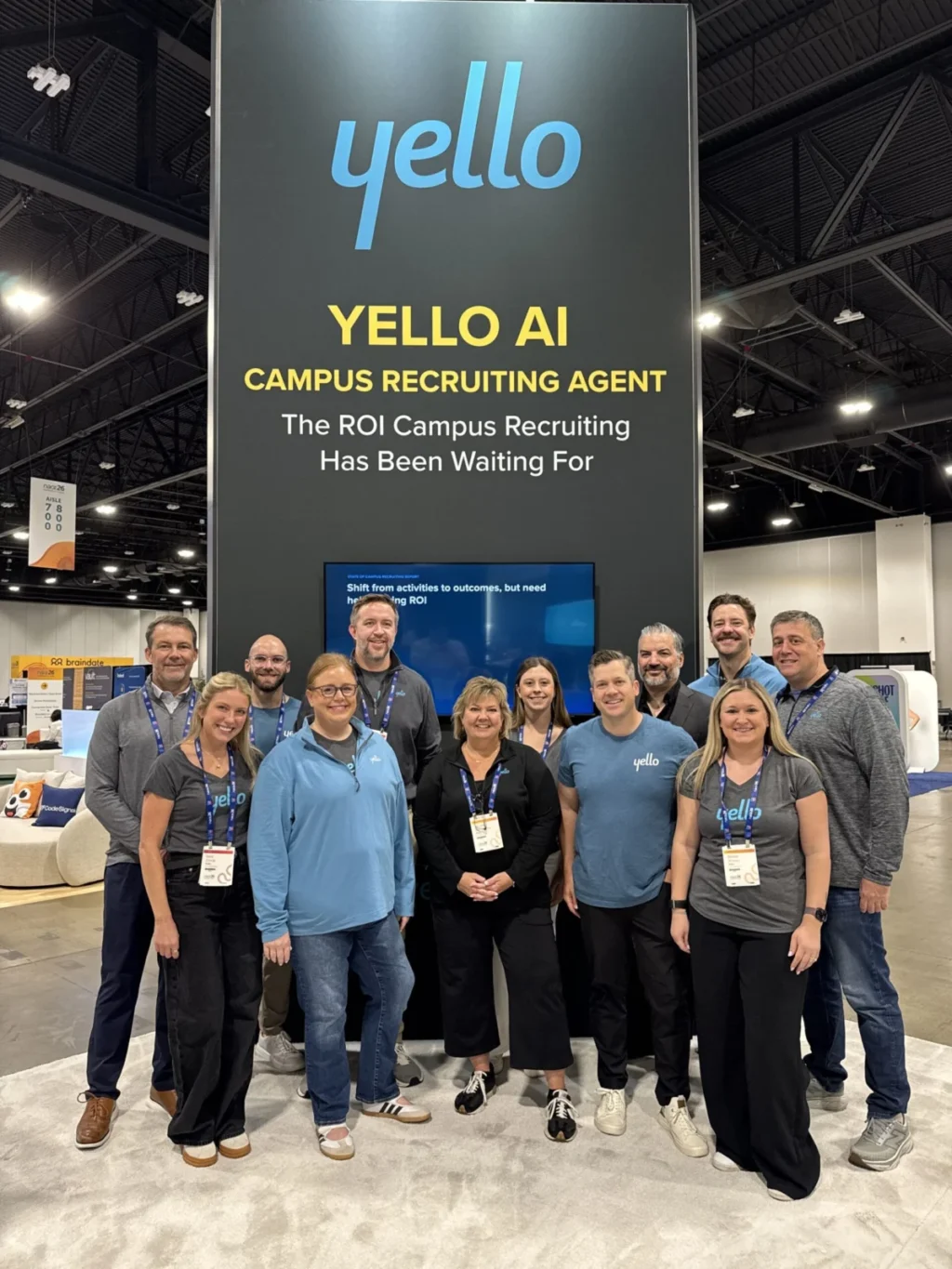
1. The Yello Campus Recruiting Agent: Yello unveiled its AI Campus Recruiting Agent, a solution specifically engineered to automate manual tasks and streamline critical recruiting functions. This AI-powered agent simplifies event creation, candidate sourcing, campaign management, and interview scheduling, effectively shifting the recruiter’s focus from administrative overhead to meaningful candidate engagement. Historically, campus recruiting has been a reactive process, relying on recruiters showing up to events and hoping the right candidates would visit their booth. Yello’s new agent fundamentally flips this model.
The AI Campus Recruiting Agent proactively identifies best-fit candidates and pre-schedules interviews before an event even commences. It takes on the heavy lifting of event planning and management, intelligent candidate matching and prioritization, targeted outreach, and precise interview scheduling. This means recruiters arrive at events with a pre-populated interview schedule, filled with candidates who have already been identified as strong matches for their open roles. This capability promises to dramatically enhance efficiency, improve the quality of interactions, and ultimately, drive a higher ROI from recruiting events. Early adopters have reported significant reductions in administrative time, allowing them to expand their reach and deepen engagement with a more relevant pool of candidates. This marks a paradigm shift towards proactive, data-driven event recruitment, promising a significant competitive advantage for employers.
2. Strategic Partnership with Symplicity: Complementing the AI agent’s launch, Yello announced a strategic partnership with Symplicity, a move set to expand candidate access for Yello customers dramatically. This collaboration grants Yello customers unparalleled access to Symplicity’s extensive network of over 600,000 early talent candidates. Symplicity, a long-standing leader in student success and engagement technology, connects millions of students with career opportunities through its widespread university partnerships.
Through this integration, employers utilizing the Yello Campus Recruiting Agent can now match candidates not only from their existing Applicant Tracking Systems (ATS), their proprietary Yello database, and platforms like WayUp, but also against active candidates directly from the Symplicity database. This broadens the candidate pool significantly, offering a more diverse and readily available talent pipeline. The partnership addresses the persistent challenge of sourcing qualified candidates by bringing together Yello’s advanced AI matching capabilities with Symplicity’s vast network. This symbiotic relationship promises to shorten time-to-hire, enhance candidate quality, and provide recruiters with a more comprehensive view of available early talent, solidifying Yello’s position at the forefront of campus recruiting innovation.
Broader Impact and Future Implications
The announcements from Yello at NACE26, coupled with the prevailing themes of the conference, signal a transformative era for early talent acquisition. The industry is moving beyond rudimentary automation towards intelligent, predictive, and candidate-centric systems. The emphasis on leveraging AI for administrative efficiency, rather than decision-making, reflects a mature understanding of technology’s role: to augment human capabilities, not replace them.
The shift towards outcomes-based event strategies and sustained post-offer engagement highlights a broader recognition of the long-term value of relationship building in talent acquisition. In an increasingly competitive landscape where employer branding and candidate experience are paramount, personalized interactions and continuous support are crucial for attracting and retaining top early talent. The integration of Yello’s AI Campus Recruiting Agent with Symplicity’s extensive network offers a powerful solution to the challenges of sourcing, engagement, and conversion. This synergy promises to empower recruiters with the tools needed to navigate the complexities of modern campus recruiting, fostering more efficient processes, deeper candidate relationships, and ultimately, more successful hiring outcomes. These innovations are not just about new features; they represent a fundamental reimagining of how organizations connect with the next generation of professionals, setting a new standard for strategic early talent acquisition.