
U.S. employers largely met their compensation commitments for 2026, a new report from Mercer reveals, indicating a stable yet strategically nuanced approach to remuneration. The data effectively challenges recent narratives suggesting a widespread adoption of undifferentiated, "peanut butter" pay increases, instead highlighting a continued reliance on performance-based and market-driven compensation strategies. This comprehensive analysis, derived from Mercer’s QuickPulse US Compensation Planning Survey, offers critical insights into the evolving landscape of workforce compensation, impacting both employee expectations and organizational talent strategies.
The Nuance of Compensation: Beyond the Averages
According to Mercer’s findings, which gathered responses from 756 organizations across the United States, the mean merit increase paid out this spring registered at 3.1%. This figure stood just shy of the 3.2% employers had projected in their October 2025 forecasts, demonstrating a remarkable degree of accuracy in planning. When considering average total increases, which encompass all forms of pay adjustments beyond standard merit raises—such as promotional increases, equity adjustments, and market-based adjustments—the average came in at 3.4%. This also narrowly missed the fall projection by merely one-tenth of a percentage point, signaling a consistent, albeit slightly conservative, execution of compensation budgets.
These figures underscore a period of measured stability in U.S. compensation practices, following several years of volatility influenced by the pandemic, unprecedented inflation, and intense competition for talent. The ability of employers to adhere closely to their financial forecasts suggests a maturing understanding of economic pressures and a more refined approach to salary budgeting in the current climate.
Setting the Stage: Economic Context and 2025 Projections
The compensation landscape for 2026 was largely shaped by the economic conditions and projections prevalent in late 2025. At that time, the U.S. economy was navigating a complex environment characterized by persistent, albeit moderating, inflation, a relatively tight labor market, and ongoing discussions about potential recession risks. The Federal Reserve had been aggressively raising interest rates through 2023 and 2024 to curb inflation, leading to a cautious optimism regarding a "soft landing" scenario.
Employers, still grappling with the lingering effects of the "Great Resignation" and an elevated demand for skilled workers, faced pressure to offer competitive compensation packages to attract and retain talent. However, there was also an increased focus on cost management and productivity as economic growth showed signs of cooling. The projections made in October 2025 by organizations participating in Mercer’s survey reflected this delicate balancing act: a commitment to meaningful pay increases to maintain competitiveness and address cost-of-living concerns, tempered by a realistic assessment of economic headwinds. These projections were also influenced by the observed trends from 2024, where salary budgets had seen some of their highest increases in years, prompting employers to carefully consider the sustainability of such aggressive increments. The slight miss in actual payouts compared to projections, therefore, can be interpreted as a prudent adjustment in response to evolving market dynamics or perhaps a slightly less severe inflationary environment than initially feared.
Debunking the "Peanut Butter" Myth
A notable aspect of the 2026 compensation cycle was the emergence of headlines suggesting a trend towards "peanut butter" pay raises—a strategy where salary increase budgets are distributed equally across all employees, regardless of individual performance or contribution. This approach, while seemingly equitable on the surface, often raises concerns about its potential to demotivate high-performers and fail to adequately reward critical skills or market demand.
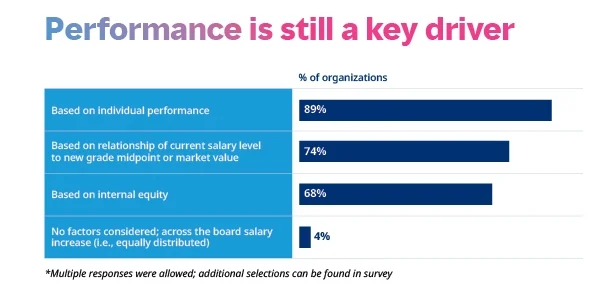
Despite the attention-grabbing nature of these headlines, Mercer’s QuickPulse survey definitively debunks this myth. The data revealed that a mere 4% of participating organizations reported giving equal raises to everyone. This stark contrast between media narrative and actual practice underscores the importance of data-driven insights in understanding complex HR trends.
The vast majority of employers, Mercer found, continue to employ more sophisticated and differentiated compensation strategies. These typically involve a combination of factors:
- Individual Performance: The most common differentiator, linking pay increases directly to an employee’s achievement of goals, quality of work, and contribution to organizational success.
- Market Positioning: Adjusting salaries to ensure they remain competitive with external market rates for similar roles, crucial for attracting new talent and retaining existing employees.
- Peer Comparisons: Ensuring internal equity by comparing salaries among employees in similar roles or with comparable experience and responsibilities within the organization.
This finding aligns with observations made by WTW’s Rewards Data Intelligence practice in the summer of 2025. Their extensive survey, encompassing over 29,000 organizations across 157 countries, similarly found a departure from across-the-board increases. Brittany Innes, director of Rewards Data Intelligence at WTW, articulated this shift, stating, "Instead of across-the-board increases, companies are raising starting salaries, bringing in talent higher in the respective pay range and enhancing retention incentives." This strategic allocation of compensation funds highlights a deliberate effort by organizations to invest in specific talent segments and critical roles, rather than a blanket approach that risks diluting the impact of pay increases.
For HR leaders who have been fielding questions from managers and employees regarding the potential for flat pay increases, Mercer’s 4% figure serves as a powerful rebuttal. It reinforces that highly differentiated, performance-based compensation remains the prevailing standard, emphasizing the continued value placed on individual contribution and market competitiveness in the U.S. workforce. This also means that employees seeking significant pay bumps must continue to focus on demonstrating high performance, acquiring in-demand skills, and understanding their market value.
Industry-Specific Compensation Dynamics
While the overall U.S. compensation trends revealed consistency, a closer look at industry-specific data provides a more nuanced picture of how different sectors are navigating their unique challenges and opportunities. Across industries, merit increases exhibited remarkable uniformity, with no sector reporting an average above 3.2%. This suggests a collective prudence in base salary adjustments, perhaps influenced by a shared economic outlook or a desire to manage fixed costs.
However, total pay increases, which account for all forms of adjustments, tell a more varied and strategic story:
-
Technology Sector’s Recalibration: The tech industry, long a leader in compensation growth, projected a 3.4% merit increase but delivered 3.2%. However, its total pay increase led all sectors at 3.6%. This "recalibration" is particularly significant for a sector that has experienced a complex period of mass layoffs in some areas while simultaneously seeing massive investment and demand in others, particularly around artificial intelligence. The slight dip in merit increases could reflect a tighter rein on general salary budgets amid restructuring and workforce optimization. Yet, the higher total increase suggests a targeted investment in critical roles, specialized AI talent, and retention incentives for key employees essential to innovation and strategic growth, even as other roles are shed. This dual approach indicates a strategic shift from broad-based hiring and pay growth to a more focused investment in high-value, high-demand skill sets.
-
Healthcare’s Resurgence: Healthcare services, an industry that has historically lagged in compensation and struggled to compete on pay, showed a meaningful uptick. Organizations in this sector delivered 3.0% in merit increases and 3.3% in total increases. This positive shift is a direct response to the immense pressures faced by the healthcare sector, including chronic labor shortages, increased demand for services post-pandemic, and widespread burnout among medical professionals. The industry has been actively working to enhance its value proposition, and competitive pay is a critical component of attracting and retaining nurses, doctors, technicians, and support staff. This improvement hints at a sector strategically investing in its workforce to address critical staffing needs and ensure the continuity and quality of patient care, as evidenced by healthcare jobs accounting for a significant portion of U.S. job gains in recent months, as reported by HR Executive.
-
Other Key Sectors: At the lower end of total pay increases, chemicals and other manufacturing sectors came in at 2.9%, while retail and wholesale saw 3.1%. These sectors often operate with tighter margins or face different talent acquisition challenges compared to tech or healthcare. Their compensation strategies may reflect a greater emphasis on operational efficiency, a less acute talent shortage for certain roles, or a higher proportion of entry-level positions. The consistency in merit increases across all sectors, however, suggests a foundational commitment to employee compensation across the board, even if the total investment varies based on industry-specific dynamics and strategic priorities.
The Silent Threat: Salary Structure Compression
Beyond individual pay raises, Mercer’s data sheds light on another critical, often overlooked, aspect of compensation management: salary structure adjustments. The survey indicates that just under 60% of responding organizations plan to adjust their salary structure in 2026, by an average of 2.6%.
A salary structure defines the pay ranges, grades, and steps for different job levels within an organization. It provides a framework for internal equity and career progression. The concern arises when the average adjustment to these structures (2.6%) is lower than the average merit increase paid to employees (3.1%). This dynamic means that employees are, on average, moving through their pay grades and potentially reaching the midpoint or top of their salary ranges faster than the entire structure is expanding.
Over time, this disparity creates a phenomenon known as "pay compression." Pay compression occurs when there is a relatively small difference in pay between employees with different levels of experience, skills, or responsibility, particularly between long-tenured employees and newer hires. For example, a new hire might be brought in at a salary very close to, or even exceeding, that of an existing employee who has been in the role for several years.
The implications of pay compression are significant and detrimental:
- Demotivation and Turnover: Experienced, high-performing employees may feel undervalued if their salaries are too close to those of less experienced colleagues or new hires, leading to dissatisfaction and a higher likelihood of seeking opportunities elsewhere.
- Difficulty Attracting Senior Talent: If internal pay scales are compressed, it becomes challenging to offer competitive salaries to experienced external candidates without creating further internal equity issues.
- Erosion of Internal Equity: The perceived fairness of the compensation system can be severely undermined, leading to morale problems and potentially legal challenges related to pay equity.
- Limited Career Progression: If pay ranges are not expanding sufficiently, it limits the financial growth potential for employees within their current roles, potentially forcing them to seek promotions or move companies to achieve significant salary increases.
HR leaders who are not actively tracking and addressing salary structure compression now will likely face significant fallout later. Proactive measures, such as conducting regular pay equity audits, strategically adjusting salary ranges, and implementing robust performance management systems that clearly differentiate rewards, will be crucial to mitigate this silent threat and maintain a healthy, equitable, and motivating compensation environment.
Expert Perspectives and Broader Implications
The detailed insights from Mercer and WTW underscore a fundamental shift in compensation philosophy: from broad-based, reactive adjustments to a more strategic, differentiated approach. Compensation experts generally agree that this targeted investment is a more sustainable and effective way to manage talent in a competitive market.
"The data clearly shows that employers are making strategic choices about where to allocate their compensation budgets," notes a leading compensation consultant, who preferred to remain anonymous to speak freely on industry trends. "It’s no longer about simply keeping up with inflation for everyone. It’s about identifying critical skills, rewarding top performers, and ensuring market competitiveness for roles that truly drive the business forward." This emphasis on performance and market value aligns with a long-term trend towards a meritocracy in compensation, where pay is directly linked to an individual’s contribution and market demand for their specific capabilities.
For employees, this means that merely staying with a company or performing adequately may not be sufficient for substantial pay increases. The onus is increasingly on demonstrating exceptional performance, acquiring new and in-demand skills, and understanding one’s market value through research and networking. It also highlights the importance of total rewards—considering not just base pay, but also bonuses, benefits, development opportunities, and work-life balance—as key factors in overall job satisfaction and career progression.
For employers, the implications are profound. They must refine their talent management strategies to clearly define performance expectations, conduct robust performance evaluations, and communicate compensation decisions transparently. The challenge lies in balancing budget constraints with the need to attract and retain high-value talent, particularly in niche or rapidly evolving fields. Moreover, the increasing focus on pay equity and transparency regulations means that compensation decisions must be justifiable and defensible, demanding sophisticated data analytics and a clear rationale for differentiated pay.
Looking Ahead: The Evolving Compensation Landscape
As the U.S. economy continues to evolve through late 2026 and into 2027, several factors will continue to shape compensation strategies. The ongoing impact of artificial intelligence and automation is poised to redefine job roles and skill requirements across industries, potentially leading to increased pay for highly specialized AI-related roles and a re-evaluation of compensation for roles susceptible to automation. The future of remote and hybrid work also remains a critical variable, influencing geographic pay differentials and the scope of talent pools.
Employers will continue to face the delicate balancing act of managing inflationary pressures, maintaining profitability, and fostering a motivated and productive workforce. The Mercer data suggests a steady hand in compensation planning, moving away from reactive, broad-stroke adjustments towards a more analytical and strategic allocation of resources. The message is clear: the era of blanket pay raises is largely over, replaced by a nuanced approach that rewards performance, addresses market realities, and strategically invests in the talent essential for future success. Organizations that proactively adapt to these trends, focusing on differentiated rewards and transparent communication, will be best positioned to attract, retain, and motivate the workforce of tomorrow.








