
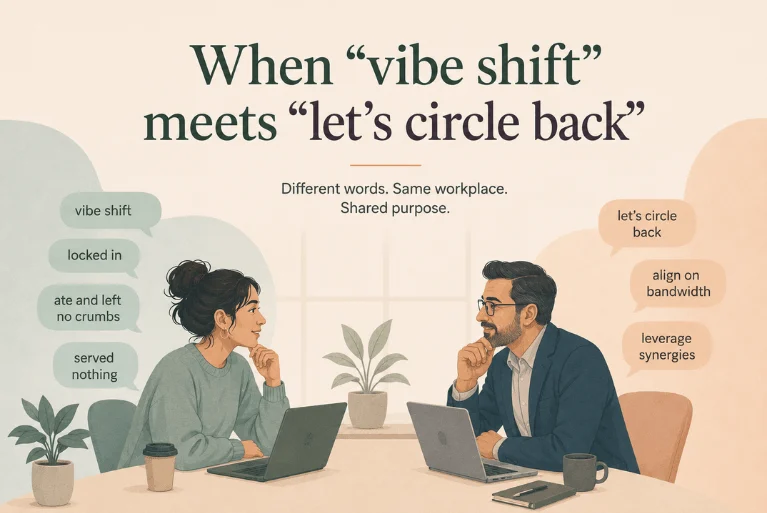
The contemporary corporate landscape is experiencing a profound linguistic shift, marked by the integration of a distinct vocabulary from the younger generation into traditional professional discourse. Historically, office environments have cultivated their own brand of jargon, with phrases like "aligning on bandwidth" or "leveraging synergies" becoming ubiquitous, often eliciting a weary, if unspoken, recognition of their abstract nature. However, the arrival of Generation Z into the workforce has introduced a fresh lexicon, challenging established communication norms and prompting organizations to reconsider their approach to workplace language. Projects are now "locked in," signifying complete focus; ineffective ideas "serve nothing," conveying direct dismissal; and exceptional work "ate and left no crumbs," a vibrant expression of outstanding achievement. This infusion of new terms often leaves senior leaders questioning the quiet, unauthorized evolution of English within their professional domains.
The initial, predictable response within many organizations has been to encourage younger employees to adopt a more "professional" tone, often interpreted as adhering to the existing corporate lexicon. Yet, a more insightful inquiry emerges: should organizations invest as much effort in understanding and learning this evolving workplace dialect as they do in policing it? This question underscores a broader challenge of generational integration and effective communication in increasingly diverse teams. The dynamic interplay between established corporate language and the emergent Gen Z vocabulary necessitates a deeper exploration into its origins, implications, and potential for fostering a more inclusive and productive work environment.
The Rise of Gen Z Lexicon and its Digital Roots
Generation Z, broadly defined as individuals born between the mid-1990s and early 2010s, are digital natives who have grown up with social media, instant communication, and a rapidly evolving online culture. This environment has profoundly shaped their communication styles, favoring directness, authenticity, and often, a playful, expressive quality. Terms such as "vibe shift," which denotes a significant change in direction or atmosphere, or "locked in," signifying intense commitment and focus, reflect a desire for clarity and immediacy that often contrasts with the more verbose or euphemistic corporate speak of previous eras.
Consider the stark difference between "leveraging synergies" – a phrase often criticized for its vagueness and corporate-speak feel – and "locked in." The latter is concise, actionable, and leaves little room for ambiguity regarding the speaker’s intent and dedication. Similarly, "ate and left no crumbs" is a vivid, albeit informal, way to convey exceptional performance, far more evocative than a generic "excellent work." This generational preference for directness can be seen as a corrective to the perceived obfuscation common in older corporate language, where complex phrases sometimes mask simple ideas or even a lack of concrete progress. The pervasive influence of short-form content, memes, and rapid online discourse has trained Gen Z to communicate efficiently and impactfully, even if that impact comes with a dose of informality.
Historical Precedent: Every Generation Shapes Its Language
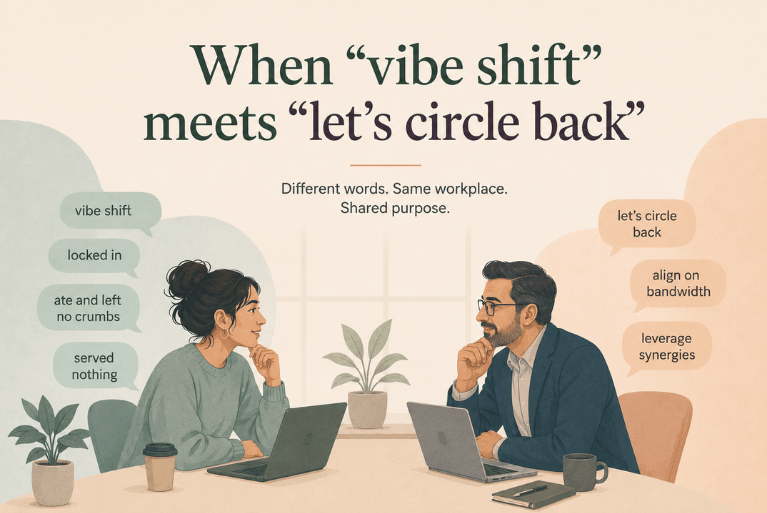
The notion that each generation introduces its unique linguistic footprint into the workplace is not new. Tanushree Gupta, VP of Learning and Development at NAB, eloquently articulates this historical pattern. She reminds us that the corporate world has consistently absorbed and normalized terms that were once considered novel or informal. The Baby Boomer generation, for instance, popularized phrases like "touch base" for checking in or "paradigm shift" for a fundamental change. Generation X introduced concepts such as "thinking outside the box" and "synergy" itself, which, ironically, is now seen as a hallmark of older corporate jargon. Millennials, in turn, brought "adulting" to denote taking on adult responsibilities and "deep dive" for thorough analysis. None of these expressions sounded timeless upon their initial appearance; many were met with similar skepticism about their "professionalism" before becoming integrated into the common corporate lexicon.
This historical context is crucial. It suggests that the current linguistic dynamic with Gen Z is not an anomaly but rather a continuation of a natural, ongoing process of language evolution. Workplaces, like societies, are living entities whose communication patterns adapt to the demographic and cultural shifts of their participants. To resist this evolution is to resist a fundamental aspect of language itself, which is inherently dynamic and responsive to its users. The challenge, therefore, lies not in preventing linguistic change, but in understanding and managing its integration into diverse professional settings.
Leadership Perspectives: Embracing the Shift for Connection and Retention
Some forward-thinking leaders are recognizing the strategic value in understanding and even adopting elements of Gen Z’s vocabulary. Ajay Sharma, VP HR at The Oberoi Group, has made a deliberate choice to treat Gen Z vocabulary not as a problem to be managed, but as a language worth learning. His reasoning is rooted in the directness that Gen Z brings, often lacking in traditional corporate language. He highlights that a "vibe shift" is simply a change in direction, and "being locked in" means complete focus, both conveying meaning more directly than phrases like "leveraging synergies" or "taking this offline," which often sound more sophisticated than their actual substance.
Sharma’s approach is exemplified by a memorable interaction with a younger colleague: "You’re locked in? Good. Just don’t lock the rest of us out." This remark, met with laughter and a palpable relaxation in the room, signaled something far more valuable than humor. It demonstrated active listening, curiosity, and a willingness to engage on the younger employee’s terms. This gesture fosters psychological safety and builds rapport, showing that leaders are paying attention and value diverse forms of expression. As Sharma emphasizes, good communicators are "linguistic opportunists," utilizing whatever language facilitates the travel of ideas. For him, learning how younger colleagues express themselves is not an abandonment of professionalism, but a crucial strategy for staying connected to a demographic that organizations are increasingly striving to attract and retain.
Navigating Nuances: Clarity, Inclusion, and Mutual Responsibility
While embracing new language is vital, the conversation also requires nuance, particularly regarding clarity and inclusion. Manika Awasthi, Chief People Officer at Compass Group, shares an anecdote from a demanding project review where a younger team member, facing a difficult update, responded with quiet confidence: "We’re locked in." While the phrase was initially unfamiliar to Awasthi, its intent was unmistakably clear: unwavering commitment despite challenges. This moment profoundly shaped her perspective on generational language. She contends that professionalism has never been solely about vocabulary; it fundamentally revolves around clarity, respect, and mutual understanding. If communication effectively improves collaboration and achieves desired outcomes, then the words, regardless of their origin, are serving their purpose.

Awasthi introduces a critical element of inclusion: not everyone, across generations, understands every piece of Gen Z slang, just as not everyone comprehends every corporate acronym. She argues that the responsibility for effective cross-generational communication is bidirectional. Leaders must cultivate the curiosity to understand unfamiliar language, demonstrating a willingness to learn and adapt. Simultaneously, employees, including Gen Z, need the awareness to adapt their communication to different audiences and contexts. This might involve code-switching – adjusting one’s language style to suit a particular situation or group – or offering brief explanations when introducing new terms. The most effective communicators are not necessarily those with the largest vocabularies, but rather those skilled in translating between linguistic styles without losing the core meaning, thereby ensuring that ideas flow freely across generational divides. This collaborative approach fosters an environment where diverse communication styles are respected and leveraged, rather than suppressed.
The Strategic Imperative: Why Organizations Must Adapt
The implications of effectively managing generational language extend far beyond mere etiquette; they touch upon critical aspects of talent management, organizational culture, and business performance. Gen Z is rapidly becoming a dominant force in the global workforce. By 2025, Gen Z is projected to account for 27% of the total workforce in OECD countries. Their presence demands that organizations evolve their engagement strategies. A rigid stance on language can inadvertently create barriers, leading to feelings of alienation, reduced psychological safety, and ultimately, higher turnover rates among younger employees who value authenticity and connection.
Research consistently shows that an inclusive culture, where employees feel understood and valued for their unique contributions, significantly correlates with higher engagement, productivity, and retention. When leaders demonstrate an openness to learning and adapting to Gen Z’s communication style, it signals respect and a commitment to their integration. This, in turn, can enhance morale, foster innovation (as diverse perspectives are more likely to be shared openly), and strengthen employer branding, making the organization more attractive to future talent. Conversely, a dismissive attitude towards Gen Z’s language can build quiet distance, creating a perception of an inflexible, out-of-touch workplace.
Moreover, the directness often found in Gen Z’s communication can streamline processes. If "serve nothing" directly conveys a lack of utility, it might be more efficient than a lengthy, polite circumlocution that still needs interpretation. This efficiency, coupled with an environment that encourages open and honest feedback, can lead to quicker decision-making and problem-solving.
Practical Strategies for Bridging the Gap
For organizations serious about fostering effective cross-generational communication, several practical strategies can be implemented:

- Reverse Mentoring Programs: Pair senior leaders with junior employees. This allows younger staff to share insights into their communication styles, digital fluency, and cultural references, while senior leaders can impart institutional knowledge and traditional professional norms.
- Cross-Generational Communication Workshops: Develop training sessions that focus on understanding different communication styles, active listening, and the nuances of generational slang. These workshops can include role-playing exercises to practice navigating unfamiliar terms.
- Internal Glossaries: Create an internal, evolving glossary of terms – both corporate jargon and emerging Gen Z slang – with clear, concise definitions. This can be a collaborative, wiki-style document that encourages participation and demystifies language.
- Promote Curiosity and Open Dialogue: Leaders should explicitly encourage questions when unfamiliar terms arise. Instead of assuming "unfamiliar" equals "unprofessional," the default response should be "What does that mean?" This builds understanding rather than distance.
- Contextual Communication Guidelines: Establish clear guidelines for communication in different settings. A board presentation might require more formal language, while an internal team huddle could accommodate more informal expressions. The key is to define these contexts clearly, empowering employees to code-switch effectively.
- Lead by Example: When senior leaders occasionally use or acknowledge Gen Z terms appropriately, it normalizes the integration and signals acceptance. Ajay Sharma’s example of a lighthearted comment shows how humor and recognition can disarm tension.
The Role of HR and Learning & Development
Human Resources (HR) and Learning & Development (L&D) departments play pivotal roles in navigating this linguistic evolution. HR, as exemplified by Ajay Sharma, can champion inclusive communication policies, facilitate cross-generational understanding through cultural initiatives, and integrate these considerations into onboarding and employee development programs. L&D, under the guidance of professionals like Tanushree Gupta, can design and deliver targeted training that helps employees at all levels become more linguistically agile. This includes modules on cultural intelligence, active listening, and effective feedback mechanisms that bridge communication gaps. By proactively addressing these linguistic differences, HR and L&D can transform potential friction points into opportunities for enhanced collaboration and a more vibrant organizational culture.
Conclusion: Beyond the Words – Fostering Connection
The debate over Gen Z slang, like similar linguistic debates before it, is rarely just about the vocabulary itself. Fundamentally, it concerns who is expected to adapt and whose communication style is deemed "professional." For decades, the onus has been on younger employees to assimilate into the established language of organizations. The current moment calls for organizations to demonstrate a reciprocal curiosity and willingness to adapt. Language is an organic entity, evolving faster than the rigid structures of many workplaces. Each generation brings with it expressions that initially puzzle the one before it, only for many of these terms to eventually become commonplace.
The real question confronting organizations is not whether Gen Z should cease using terms like "locked in" or "vibe shift." Instead, it is whether organizations possess the curiosity and foresight to understand what these terms mean before prematurely dismissing them as unprofessional or inappropriate. Workplaces that successfully integrate diverse communication styles – where individuals can fluidly understand both "the vibe shift is real" and "let’s circle back next week" – are not lowering their standards. On the contrary, they are demonstrating a heightened capacity for empathy, inclusivity, and, most importantly, effective listening. This adaptability is not merely a courtesy; it is a strategic imperative for fostering deeper connections, retaining talent, and ensuring that communication remains a bridge, not a barrier, in the dynamic modern workplace.








