
The U.S. Equal Employment Opportunity Commission (EEOC) concluded its 2025 fiscal year on September 30, revealing a litigation landscape that has undergone a dramatic contraction. According to an analysis of filing data, the Commission initiated only 93 merit lawsuits over the past twelve months, marking a ten-year low for the agency and one of its least active periods in the last three decades. This decline follows a year of unprecedented structural changes within the Commission’s leadership, significant budgetary constraints, and a fundamental realignment of enforcement priorities under the Trump administration. While the agency began the fiscal year with a robust pipeline of charges and a Democratic majority, the swift transition of power in January 2025 fundamentally altered the EEOC’s trajectory, resulting in a "sluggish" performance that has significant implications for employers and legal practitioners nationwide.
A Year of Unprecedented Leadership Transition
The 2025 fiscal year was defined by a volatile political and administrative climate. At the outset of the year in October 2024, the EEOC was operating under a Democratic majority led by Chair Charlotte Burrows. However, following the presidential election and the subsequent inauguration in January 2025, the executive branch moved with unusual speed to reshape the agency’s leadership. President Trump took the anticipated step of elevating Andrea Lucas to Acting Chair and terminated General Counsel Karla Gilbride, an appointee of the previous administration.
In a move described by legal analysts as without precedent, the administration also fired Commissioners Charlotte Burrows and Jocelyn Samuels, despite both having several years remaining on their appointed terms. This action effectively stripped the Commission of its quorum, leaving only Acting Chair Lucas and Commissioner Kalpana Kotagal to oversee the agency’s operations. The lack of a quorum has had profound legal consequences, as the Commission’s ability to authorize systemic litigation and "pattern or practice" lawsuits is heavily restricted when a full board is not seated. Under current delegations of authority, the General Counsel may file routine cases, but high-stakes litigation involving major expenditures or novel legal theories typically requires Commission approval—a hurdle that became nearly insurmountable in the latter half of the fiscal year.
Chronology of Filings: The Pre-Election Surge and Post-Transition Lull
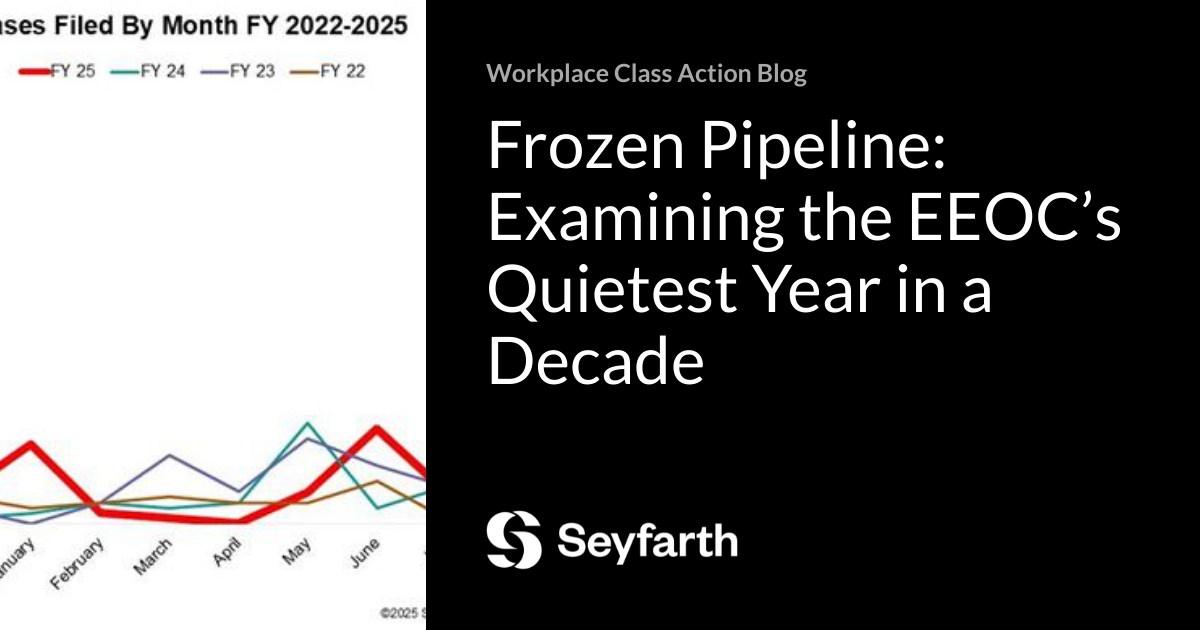
The timing of the EEOC’s 93 filings in FY 2025 suggests a strategic response to the shifting political winds. The Commission launched 24 lawsuits in the first four months of the fiscal year, with 15 filings occurring in January alone. Legal experts interpret this early activity as an effort by outgoing enforcement personnel to move cases into the judicial system before the change in administration.
Following the January transition, litigation activity fluctuated. The agency saw a brief spike in June 2025 with 18 filings, reaching a five-year high for that specific month. However, the traditional "September Surge"—a period where the EEOC typically files a massive volume of cases to meet end-of-year quotas—was remarkably muted. In September 2025, the Commission filed 35 lawsuits. While this was the busiest month of the year, it paled in comparison to previous years: 56 filings in September 2024, 71 in September 2023, and 46 in September 2022. The contrast is even more stark when compared to the 144 total merit lawsuits filed in FY 2023, illustrating a nearly 35% decrease in overall litigation volume in just two years.
Geographic Trends: The Rise of the Midwest and the Silence of the West
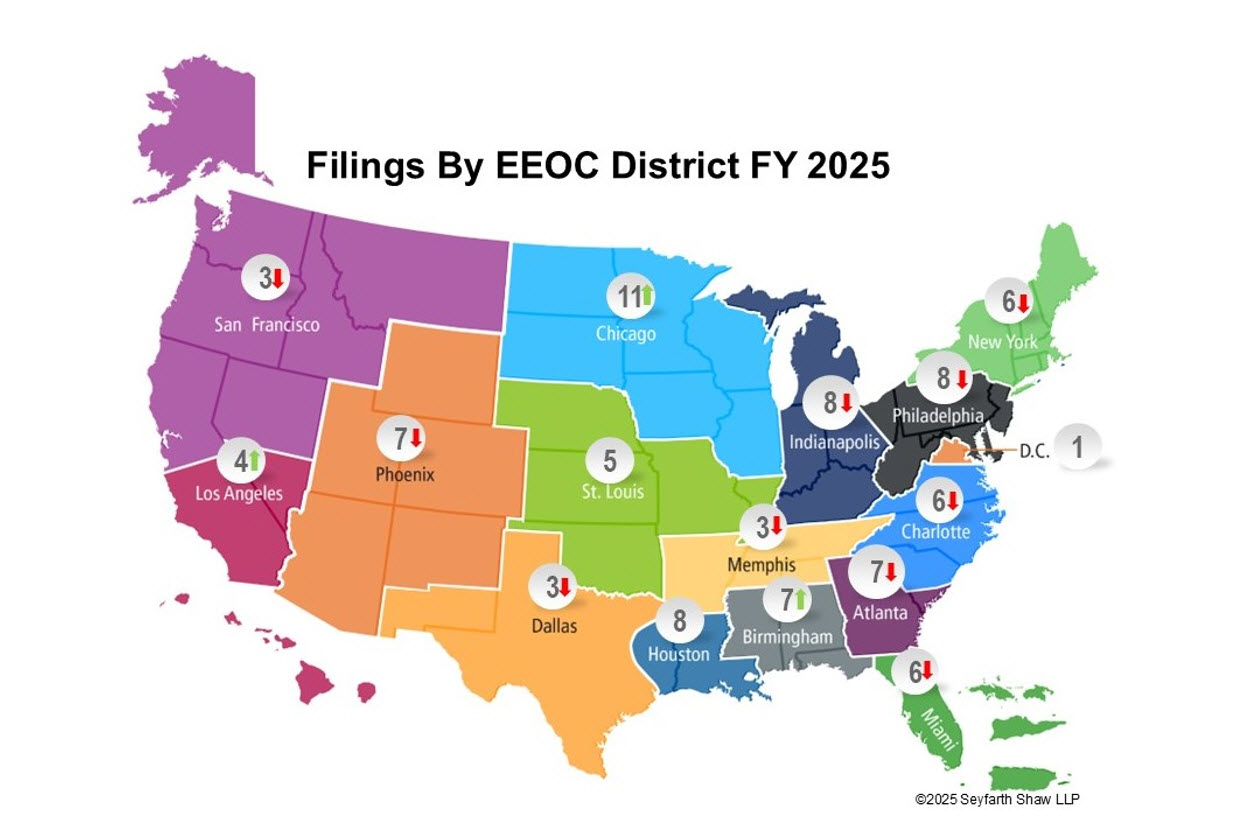
The distribution of lawsuits across the EEOC’s 15 District Offices highlights a significant shift in regional enforcement activity. For the first time in several years, the Chicago District Office reclaimed its position as the most litigious, leading the nation with 11 merit filings. This was followed closely by Philadelphia, Indianapolis, and Houston, each recording 8 filings. These offices have remained consistent in their pursuit of enforcement actions, even as national numbers plummeted.
Conversely, the EEOC’s West Coast presence has effectively gone dormant. The Los Angeles, San Francisco, and New York District Offices—historically the most aggressive enforcement hubs during the Obama administration—filed only 4, 3, and 6 lawsuits, respectively. This trend of "West Coast quietude" has persisted for several years but reached a new nadir in FY 2025. During the peak of the Obama-era EEOC, these three offices combined often filed dozens of lawsuits annually; their current output suggests a redistribution of resources or a more conservative approach to case selection in those jurisdictions.

Substantive Shifts: ADA Dominance and the Pregnancy Pivot
Despite the overall drop in litigation, the EEOC maintained a steady focus on certain protected categories while abandoning others. The Americans with Disabilities Act (ADA) remained the primary vehicle for EEOC litigation, accounting for 34 of the 93 filings. Notably, the Commission continued to target cases involving hearing and vision impairments, as well as "invisible" disabilities such as post-traumatic stress disorder (PTSD), anxiety, and depression. This indicates that disability accommodation remains a non-partisan enforcement priority that transcends administration changes.
Title VII of the Civil Rights Act also featured prominently, but with a specific focus on pregnancy and sex discrimination. In FY 2025, the EEOC filed 10 lawsuits under the Pregnancy Discrimination Act and the newly enacted Pregnant Workers Fairness Act (PWFA). When combined with other sex-based claims, these accounted for 37 cases. Acting Chair Andrea Lucas has publicly emphasized the protection of biological women and pregnant workers as a cornerstone of her leadership, a policy shift that is reflected in these filing statistics.
The Reversal on LGBTQ+ and Gender Identity Issues
One of the most significant policy reversals in FY 2025 concerned LGBTQ+ rights and gender identity. In October 2024, under the Biden administration, the EEOC filed two lawsuits concerning transgender workers: EEOC v. Starboard Group, Inc. and EEOC v. Brik Enterprises, Inc. However, following an executive order in January 2025 titled "Defending Women From Gender Ideology Extremism and Restoring Biological Truth to the Federal Government," the EEOC under Acting Chair Lucas moved to dismiss both actions.
This pivot was formalized in a January 28, 2025, statement from the Acting Chair, which asserted that biological sex is "binary and immutable" and that the use of pronouns corresponding to biological sex does not constitute harassment. Consequently, the EEOC did not file a single new lawsuit related to gender identity or sexual orientation for the remainder of the fiscal year, signaling a total withdrawal from this area of workplace law.

Religious Freedom and "Anti-American Bias"
In a parallel shift, the EEOC significantly ramped up its enforcement of religious protections. After a period where religious discrimination charges surged by 600% due to COVID-19 vaccine mandates, the Commission finally began moving those charges into the courts. In FY 2025, the EEOC filed 11 lawsuits asserting religious discrimination or failure to accommodate religious beliefs, a sharp increase from the 4 filed in FY 2024.
Acting Chair Lucas characterized this as a "restoration of evenhanded enforcement," arguing that religious protections had previously taken a "backseat to woke policies." Furthermore, the agency signaled a new interest in "anti-American bias," filing two "reverse discrimination" lawsuits alleging that employers gave preference to non-American or non-Black workers. These filings align with a February 2025 press release vowing to protect American workers from foreign-bias in hiring and promotion.
Implications for the Private Bar and Employers
The historically low number of EEOC filings should not be mistaken for a total cessation of legal risk for employers. Legal analysts note that the private plaintiffs’ bar often monitors EEOC activity to identify emerging trends. While the EEOC may be filing fewer cases, the theories it champions—such as those involving the PWFA or religious accommodations—are likely to be picked up by private firms.
Additionally, the EEOC’s willingness to sue smaller regional businesses and healthcare entities in FY 2025 suggests that no sector is immune from scrutiny. Employers in the Chicago and Philadelphia regions, in particular, face a higher statistical likelihood of EEOC-initiated litigation. The healthcare industry also remains a frequent target, particularly regarding ADA and religious accommodation issues.
Looking Forward: The Quorum and FY 2026
As the EEOC enters the 2026 fiscal year, the central question remains the restoration of the Commission’s quorum. With a Trump-appointed nominee currently awaiting Senate confirmation, the agency is expected to regain its full authority in the coming months. Once a quorum is established, the EEOC will likely move to authorize more complex, systemic litigation that was sidelined during the 2025 "quorum crisis."
While the volume of litigation in FY 2025 reached a 30-year low, the qualitative shifts in the types of cases filed reveal an agency in the midst of a profound ideological realignment. For the American business community, the message is clear: while the sheer number of lawsuits may have decreased, the focus on "biological truth," religious freedom, and disability rights has intensified, creating a new set of compliance challenges in a rapidly evolving legal environment.








