
Picture this scenario: It’s a typical Monday morning, and a frantic Slack message lands in a recruiter’s inbox. The hiring manager’s team has just experienced a significant talent drain, with two senior engineers departing for a competitor. To compound matters, a third key team member is scheduled for parental leave in six weeks, and the product roadmap necessitates the onboarding of four new hires by the end of the current quarter. This sudden surge translates to seven, potentially even eight, open positions landing on the desk of a two-person recruiting team already managing a full roster of active requisitions.
This isn’t a tale of negligence. The recruiters are experienced professionals, the hiring manager is well-organized, and the job descriptions are meticulously prepared. Yet, within days, the cracks begin to appear: scheduling delays become endemic, candidate feedback becomes inconsistent, and a highly promising finalist, who was on the verge of accepting an offer, suddenly goes silent after securing employment elsewhere. The failure isn’t due to a lack of effort or individual competence; it stems from a fundamental inadequacy in the underlying recruitment process, which was never designed to handle such an abrupt increase in demand.
This scenario highlights one of the most prevalent, yet often overlooked, challenges in talent acquisition: hiring workflows that function adequately under normal operational conditions quietly collapse when faced with a sudden spike in hiring volume. The breakdown isn’t typically a dramatic, singular event but rather a series of incremental failures – a day here, a missed candidate touchpoint there. However, the cumulative effect is substantial, and the associated costs, including lost productivity, diminished candidate experience, and increased time-to-hire, can escalate far more rapidly than most organizations realize.
The Tipping Point Organizations Rarely Anticipate
Most contemporary hiring processes are architected for a predictable, steady rhythm. A limited number of roles become available each month, candidates progress through defined stages on a known cadence, and recruiters can dedicate focused attention to each search. This predictable flow contributes to a sense of manageability, but it also inherently builds fragility into the system.
When hiring volume doubles or triples due to factors such as a successful funding round, a significant organizational restructuring, shifts in market dynamics, or simply the seasonal pressures of a busy third quarter, the system doesn’t merely slow down; it often seizes up entirely. Scheduling backlogs begin to accumulate, transforming calendar coordination across multiple stakeholders into a full-time job in itself. Interview panels become severely overstretched, with the same subject matter experts frequently tasked with evaluating every candidate across multiple roles concurrently. Consequently, candidate experiences become highly inconsistent, varying dramatically based on the recruiter who is least overwhelmed during a given week.
Extensive research underscores the gravity of these challenges. A recent talent survey conducted by Eightfold.ai, encompassing over 700 global organizations, revealed that a significant majority of companies struggle to redesign their work processes rather than simply layering additional activity onto existing, inadequate frameworks. For recruiting departments, this translates directly: when requisition volume surges, organizations instinctively resort to familiar solutions – demanding more effort, extending working hours, and accelerating screening processes – rather than critically examining whether the underlying operational architecture can support the increased load. In most cases, it cannot.
The Compounding Effect of Delays in High-Volume Hiring
It is crucial to meticulously trace the sequence of events, as the problem rarely manifests as a single, catastrophic failure. Instead, it is a cascade of interconnected minor failures that reinforce one another.
Screening Processes Become Overwhelmed: In manual, high-volume recruitment scenarios, initial resume reviews and phone screenings often fall into queues. Candidates who apply on a Monday might not receive a response until Thursday, or even later. In today’s highly competitive talent market, such a delay provides ample opportunity for a more agile competitor to schedule an interview and extend an offer. According to data from LinkedIn’s Global Recruiting Trends report, a significant percentage of candidates expect to hear back from recruiters within a week, with many indicating they will not wait longer than three days.
Interviewer Unavailability Becomes a Critical Bottleneck: The same senior engineers, managers, and subject matter experts are invariably required for a multitude of technical roles. Their calendars are typically already filled with project deadlines, team meetings, and strategic initiatives. Coordinating a three-person interview panel for a candidate who has a limited decision window becomes an intricate logistical puzzle that frequently takes longer than the candidate is willing to wait. This scarcity of interviewer availability is a recurring theme in talent acquisition, especially within specialized technical fields.
Feedback Loops Experience Significant Stalls: Post-interview debrief notes are often not submitted promptly, or the feedback provided may be incomplete. Hiring managers, stretched thin across numerous searches, may lack the bandwidth to give each candidate evaluation the focused attention it requires. Decisions that should ideally be made within 48 hours can stretch into a week or more. During this protracted decision-making period, candidates are actively interviewing with other organizations. Top-tier talent, in particular, rarely waits for protracted hiring processes. Research by The Muse indicates that a poor candidate experience, often exacerbated by delays, can lead to as many as 60% of candidates declining job offers.
Each of these delays does not merely add isolated time to the overall hiring process; it actively triggers the next sequential delay. A slow initial screening process inevitably leads to a delayed interview scheduling. A delayed interview schedule compresses the candidate’s decision window. A compressed window often results in less rigorous evaluation. And throughout this entire chain of events, the candidate continues to explore other opportunities.
The implications of these cascading delays are significant. According to research by PwC on the application of AI in human resources, agentic AI-powered solutions have the potential to save hiring managers and recruiters up to 70% of their time on sourcing activities alone. This stark figure underscores the considerable time investment currently consumed by manual, inefficient processes, particularly during high-volume periods.
The Fallacy of Simply Hiring More Recruiters
When a hiring process begins to falter, the immediate instinct for many organizations is to increase headcount. While adding more recruiters can offer some relief, it is rarely a panacea if the underlying workflow remains the primary bottleneck. In such scenarios, bringing in additional recruiters merely means adding more individuals to navigate and wait on the same broken steps.
This insight is a core finding from Eightfold.ai’s "Infinite Workforce" ebook, which posits that legacy hiring systems were designed primarily for administrative tasks rather than for agile execution. These systems excel at tracking headcounts, managing compliance, and storing records, but they were not architected to perform at scale during periods of high demand. The introduction of software has, in many instances, provided organizations with faster typewriters rather than autonomous authors. Consequently, assigning more recruiters to an undersized and inefficient process is akin to adding more personnel to a factory floor where the assembly line itself operates too slowly to handle the increased output.
The fundamental structural issue lies in what can be described as a "human-scale speed limit" inherent in traditional recruiting methodologies. Every step of the process requires a human to initiate, respond to, or approve an action. Scheduling necessitates a recruiter sending availability. Screening requires a recruiter to read and evaluate resumes. Feedback demands a hiring manager to document and submit their assessment. When hiring volume spikes, all of these human checkpoints collectively create a compounding bottleneck that cannot be fully resolved by simply increasing head count. This is because the process itself was designed to require sequential human intervention, where one individual’s action must precede another’s.
Further reinforcing this point, Eightfold.ai’s research indicates that despite substantial investments in HR technology, over 40% of organizations report that these investments have failed to meet their expectations. The primary reason cited for this failure is the workforce’s lack of capability to effectively utilize the new tools. The technology may have accelerated the pace of individual tasks, but the underlying process remained unchanged.
The Architecture of Scalable Hiring
A hiring process that can withstand significant pressure possesses several defining characteristics, none of which are dependent on heroic human effort.
Firstly, consistency is paramount, irrespective of volume. Candidates applying for the same role should encounter an identical experience, whether the organization is processing 20 applications or 2,000. Inconsistency at scale is not merely a candidate experience issue; it is a critical data integrity problem. When screening criteria vary by recruiter, by week, or by the available bandwidth of the hiring team, the ability to make fair and objective comparisons across the entire candidate pool is compromised. This can lead to bias and the overlooking of highly qualified individuals.
Secondly, the early stages of the hiring process must move with speed. Screening and initial interviewing are precisely where the majority of time-to-fill is lost, and where the "human-scale speed limit" exerts its most significant impact. A scalable process effectively removes these manual bottlenecks, ensuring that candidates receive prompt responses and can progress through the pipeline without being held back by a recruiter’s calendar.
Thirdly, and this is a point worth careful consideration, a scalable process liberates human interviewers to focus on areas where their judgment is truly indispensable. The most valuable moments in a hiring process are those that require nuanced human assessment: evaluating cultural fit, discerning leadership potential, and cultivating the relationships that convert a finalist into a committed new hire. It is these high-impact activities where recruiters and hiring managers should be dedicating their time, not on administrative tasks like scheduling, routing feedback forms, or chasing down incomplete interview notes.
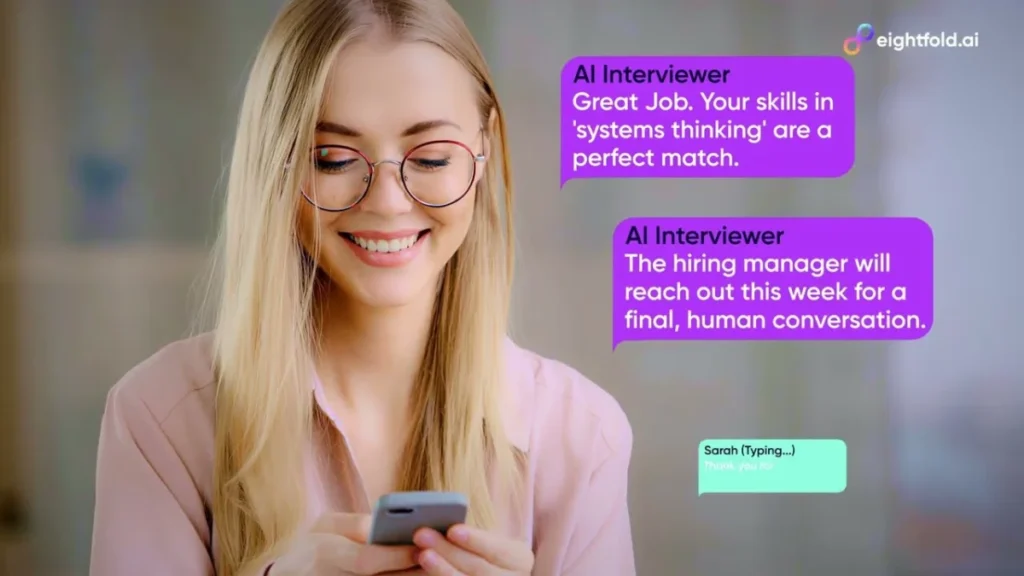
This is where AI-powered interviewing solutions emerge, not as a replacement for human judgment, but as a digital workforce designed for scalability. Instead of merely assisting a recruiter in scheduling interviews more efficiently, an AI interviewing agent can autonomously conduct initial screenings and structured interviews at any volume, operating 24/7 across different languages and time zones.
Early adopters of AI Interviewer technology have reported remarkable improvements, with hiring cycles compressing from an average of 42 days to under a week, and the time dedicated to initial interviews reduced by up to 90%. Interview completion rates have reached an impressive 92.5%. Furthermore, by automating up to 80% of manual recruiter work at the screening stage, these systems empower recruiters to shift their focus to strategic conversations that are critical for securing top talent.
Crucially, this type of advanced system is not built upon general-purpose AI. It is purpose-built for the specific demands of hiring, meticulously trained on billions of real-world career trajectories, and designed to evaluate skills rather than mere credentials. Its architecture is structured to mitigate bias, rather than inadvertently amplifying it. Research evaluating the efficacy of Large Language Models (LLMs) in making hiring decisions has found that general-purpose LLMs significantly underperform purpose-built models in fairness metrics, systematically disadvantaging certain candidate groups due to inherent biases present in uncurated training data. Therefore, scalable hiring is not solely about achieving speed; it is about obtaining accurate and equitable outcomes at that accelerated pace.
Returning to Monday Morning: A Scalable Solution
Consider again the hiring manager facing seven urgent open roles on a Monday morning. In a traditional, steady-state process, such a message would trigger a reactive scramble. However, in a process architected for scale, it initiates a streamlined workflow. Applications begin to be processed immediately. Initial screenings are conducted without the delay of waiting for a recruiter’s availability. Qualified candidates are identified and surfaced rapidly, consistently, and with clear, documented rationale. By the time a human interviewer engages with the candidate pool, they are focused on the critical aspects of the process that genuinely require their unique expertise and judgment.
The profound difference between these two scenarios is not a matter of effort or intent; it is a matter of fundamental architecture. The reality is that most traditional hiring processes were never designed to absorb sudden surges in volume. Recognizing this architectural limitation is the essential first step toward building a recruitment system that can not only withstand but thrive under such demands.
To delve deeper into the frameworks, research, and strategies required to construct a hiring process that scales without breaking, organizations are encouraged to explore resources such as "The Infinite Workforce" ebook, which offers comprehensive insights into building resilient and effective talent acquisition strategies.







