A groundbreaking new global study by Korn Ferry, the renowned talent and organizational consulting firm, has unveiled a significant and often overlooked financial burden plaguing businesses worldwide: the tangible cost of fragmented talent data. The comprehensive "2026 Global Talent Analytics Survey" reveals that 99% of senior leaders across various industries are experiencing a negative financial impact due to disconnected workforce information, with over 80% estimating these costs to be at least 3% of their total payroll. This stark finding underscores a critical operational inefficiency that is actively undermining strategic talent decisions and, consequently, hindering overall business performance.
The urgency of this issue is amplified by the considerable time lag in accessing actionable insights. The survey indicates that more than one in four leaders report it can take weeks to consolidate and analyze disparate talent data. By the time HR departments can identify a pressing issue or opportunity, the financial drain may have already become embedded within quarterly financial reports, leaving organizations playing a perpetual game of catch-up. This delay in insight generation means that crucial decisions, such as workforce restructuring, market adaptation, or leadership adjustments, are often made without the benefit of comprehensive and timely data, leading to suboptimal outcomes.
Workforce Underutilization: A Primary Driver of Financial Loss
A key revelation from the Korn Ferry study is the direct correlation between fragmented talent data and workforce underutilization, identified as a primary driver of the substantial financial impact. The survey, which canvassed the opinions of 1,600 C-suite and senior HR leaders across ten diverse countries, found that a significant 31% of leaders report that more than a quarter of their workforce is currently underutilized. This means a substantial segment of employees are not being deployed in roles that fully leverage their skills, capabilities, and potential.
Underutilization, however, is a complex issue that rarely appears as a discrete line item on a financial statement. Instead, its impact manifests subtly but significantly through decreased productivity, inconsistent performance across teams, and the regrettable departure of high-potential employees who seek out opportunities that better align with their ambitions and skill sets. These are the employees who, feeling their talents are not being fully recognized or utilized, begin to look elsewhere for roles that offer greater challenge and professional fulfillment.
Matias Spinetta, Senior Vice President of North America Commercial at Korn Ferry, articulated the business implications of this missed potential within the report: "When workers’ potential is missed, the business loses out. They end up buying what they might not need or missing innovations that could lead to growth. And their staff turnover rises, too, as those people get bored and look to spread their wings elsewhere." This highlights a dual financial burden: the cost of acquiring external resources that could have been developed internally, and the loss of valuable talent and the associated costs of recruitment and onboarding new staff. Often, the data necessary to identify these patterns of underutilization and attrition exists within an organization, but it remains siloed and disconnected, preventing leaders from taking proactive measures.
The Operational Bottleneck: Weeks of Delay in Talent Insights
The core of the problem lies in the fragmented nature of the HR technology stack. The Korn Ferry survey reveals that a staggering 84% of leaders operate across three to ten different talent management platforms. These platforms, designed for specific functions like payroll, recruitment, performance management, or learning and development, are frequently not integrated, creating significant data silos. Consequently, only a mere 5% of organizations report having fully connected talent systems, while a substantial 68% operate with only partial or minimal data integration.
This lack of integration transforms the process of gaining workforce insights into an arduous and time-consuming assembly line. Before an HR leader can extract meaningful information or identify emerging trends, they are often compelled to manually pull data from multiple, disparate systems and then reconcile it. For over a quarter of the surveyed leaders, this manual reconciliation process can stretch into weeks. In the fast-paced business environment, this delay is often too long. Critical workforce decisions, whether driven by economic shifts, competitive pressures, or internal strategic realignments, cannot afford to wait for HR reports to be compiled. When insights finally surface, the window of opportunity to act may have already closed, forcing leaders to make decisions based on incomplete or outdated information.

Jan Machtelinckx, Growth Leader for Digital Assessment, Succession and Development at Korn Ferry EMEA, emphasized the strategic peril of this situation: "As an executive, if you don’t have a clear picture of your own workforce, that should keep you up at night. It might be too late to do something about it when decisions need to be made." This statement underscores the critical need for real-time, accessible talent intelligence to inform executive decision-making and maintain organizational agility.
The Credibility Deficit: Eroding Trust in HR’s Analytical Capabilities
Beyond the direct financial implications, the persistent struggle with fragmented and delayed talent data has a significant secondary consequence: it erodes the credibility and influence of the HR function itself. When talent data is consistently slow to arrive or proves unreliable due to manual reconciliation and inconsistencies, other departments begin to question the accuracy and timeliness of HR’s analyses.
The survey findings are particularly striking in this regard: 55% of leaders admit they rely less on HR for critical decisions when they lack confidence in the underlying talent data. This creates a vicious cycle where a lack of trust in HR’s data capabilities leads to HR being consulted less on strategic initiatives, further marginalizing its role in high-stakes decision-making processes. The perception that HR cannot provide trustworthy, actionable insights undermines its position as a strategic partner within the organization.
Roger Philby, Global Lead of the People Strategy and Performance Practice at Korn Ferry U.K., highlighted this erosion of trust: "The business doesn’t believe HR because they don’t believe the data can be trusted. And that’s because HR isn’t always great at being data practitioners and communicators." This points to a dual challenge for HR departments: not only do they need to improve their data management and analytical capabilities, but they also need to effectively communicate the value and reliability of their insights to the wider business.
A Path Forward: The Power of Integrated Talent Data
Despite the widespread challenges, the Korn Ferry research also offers a clear and compelling vision of what is possible with integrated talent data. The study found a dramatic contrast between organizations struggling with fragmented systems and those that have successfully unified their talent information. In organizations with integrated talent data, confidence in workforce decision-making soars, rising from a mere 4% among those with disconnected systems to an impressive 55% among those with integrated platforms.
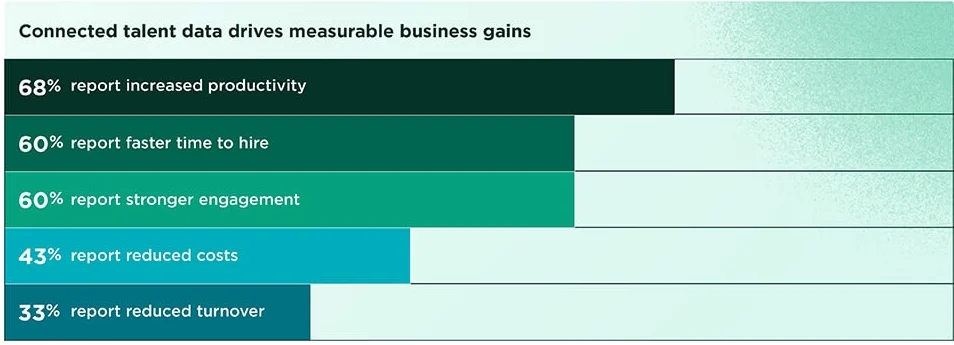
The benefits extend far beyond just increased confidence. These data-integrated organizations consistently report tangible improvements in key performance indicators. They experience significant gains in overall productivity, a demonstrable acceleration in hiring times, and stronger employee engagement. This suggests that a holistic, connected view of talent data not only prevents financial losses but actively drives business growth and operational excellence.
The implications of these findings are profound. In an era where talent is increasingly recognized as a primary competitive differentiator, the ability to understand, deploy, and develop that talent effectively is paramount. Organizations that continue to operate with siloed data systems are not only leaving money on the table but are also actively hindering their capacity for innovation, agility, and long-term success. The Korn Ferry "2026 Global Talent Analytics Survey" serves as a critical wake-up call, urging businesses to prioritize the integration and strategic utilization of their talent data to unlock their full workforce potential and secure a more prosperous future. The timeline for addressing this issue is now; the longer organizations delay, the greater the accumulated financial and strategic cost will become.