
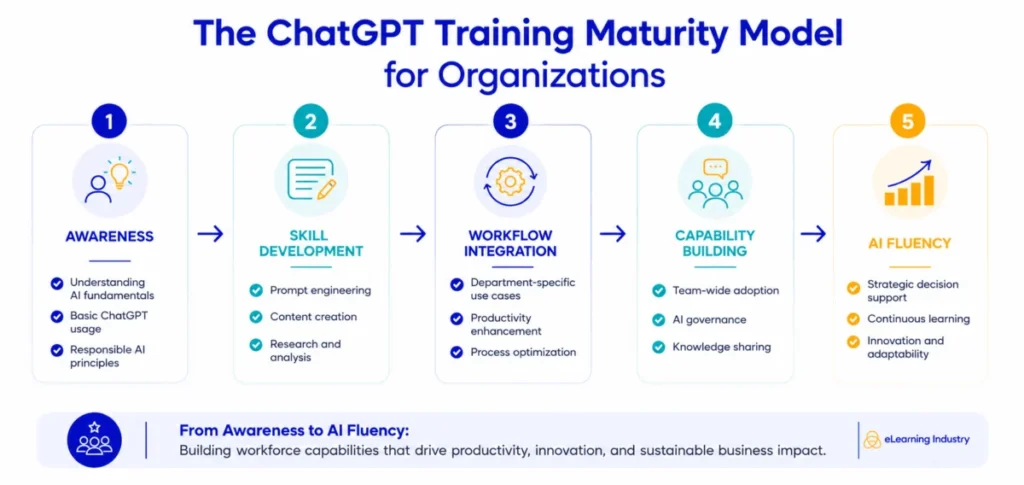
The emergence of generative artificial intelligence has fundamentally altered the corporate landscape, moving the conversation from speculative potential to immediate operational necessity. In a modern business setting, ChatGPT training is no longer merely an elective skill for the tech-savvy; it is a structured organizational strategy designed to guide employees in utilizing AI in ways that are effective, responsible, and aligned with long-term commercial success. Unlike individual efforts to learn the tool through trial and error, enterprise-level training aims to institutionalize skills across an entire workforce to catalyze productivity, foster innovation, and sharpen the quality of corporate decision-making.
The Evolution of AI in the Workplace: A Brief Chronology
The trajectory of ChatGPT from a viral novelty to a core business tool has been remarkably swift. In November 2022, OpenAI released ChatGPT to the public, marking the beginning of a period characterized by rapid, grassroots adoption. During the first half of 2023, many organizations responded with caution, with some even implementing temporary bans due to concerns over data privacy and intellectual property.
However, by late 2023, the narrative shifted from restriction to integration. Enterprises began to recognize that "shadow AI"—the unsanctioned use of AI tools by employees—posed a greater risk than structured adoption. Throughout 2024, the focus has transitioned toward building internal AI governance frameworks and comprehensive training programs. Today, AI literacy is viewed as the "new digital literacy," comparable to the widespread adoption of the internet or personal computers in previous decades.
Understanding the Technical Foundation of Generative AI
For Instructional Designers and corporate leaders, effective training must begin with a fundamental understanding of how Large Language Models (LLMs) operate. ChatGPT is trained on vast datasets comprising websites, books, articles, and proprietary sources. Through this process, the model identifies complex linguistic patterns, allowing it to generate responses that mimic human conversation and context.
However, a critical component of any training program is addressing the inherent limitations of the technology. Two primary challenges stand out:
- Data Cutoff Constraints: Standard versions of ChatGPT are limited by a "knowledge cutoff," meaning the model does not possess innate awareness of events or data generated after its last training update unless it is integrated with real-time browsing capabilities or internal company databases.
- The Phenomenon of Hallucination: AI systems can occasionally generate "hallucinations"—information that is factually incorrect but presented with a high degree of confidence. Training programs must emphasize that AI is a probabilistic engine rather than a deterministic database, requiring human oversight to verify all outputs.
The Five Pillars of Enterprise AI Literacy
To move beyond basic usage, organizations must focus on five core competencies that ensure AI tools provide measurable value.
1. Advanced Prompt Engineering
Prompt engineering is the art of crafting precise inputs to elicit high-quality outputs. Effective training moves employees away from using ChatGPT as a simple search engine. Instead, they are taught to provide context, define specific personas for the AI, set clear constraints, and utilize iterative prompting—the process of refining answers through follow-up questions.
2. AI-Assisted Content Synthesis
While ChatGPT can draft emails, summarize lengthy reports, and generate creative briefs, the goal of training is to position AI as a "co-pilot" rather than a replacement for human intellect. Employees must learn to use AI for the "first draft" while maintaining responsibility for the final "human-in-the-loop" edit, ensuring the brand voice and factual accuracy remain intact.
3. Critical Decision-Making and Verification
As AI becomes more integrated into workflows, the ability to think critically about AI-generated insights becomes paramount. Training programs should include modules on fact-checking, bias detection, and the logical evaluation of AI suggestions. This ensures that AI supports, rather than dictates, the company’s strategic direction.
4. Ethics, Privacy, and Responsible Use
Perhaps the most vital pillar is the establishment of ethical guidelines. Employees require clear instruction on what data can be shared with an LLM. Training must cover the nuances of data privacy, the protection of intellectual property, and the ethical implications of using AI in sensitive areas such as recruitment or performance reviews.
5. Seamless Workflow Integration
The final stage of literacy is moving from isolated tasks to integrated processes. This involves identifying specific "friction points" in daily operations—such as manual data entry or repetitive scheduling—and using AI to automate or streamline these functions.
Data-Driven Insights: The Impact of AI Training
Recent market data underscores the urgency of structured AI education. According to the World Economic Forum’s "Future of Jobs Report," nearly 44% of workers’ core skills are expected to change by 2027, with AI and big data ranking as the top priorities for company training strategies. Furthermore, a study by Gartner suggests that by 2026, over 80% of enterprises will have utilized generative AI APIs or deployed generative AI-enabled applications in production environments.

The economic implications are significant. Research from McKinsey & Company estimates that generative AI could add the equivalent of $2.6 trillion to $4.4 trillion annually to the global economy. However, this value can only be unlocked if the workforce is sufficiently skilled to navigate these tools. Organizations that fail to invest in training risk falling into a "productivity gap," where the technology exists but the human capital to leverage it effectively is missing.
Designing a Robust Internal Training Program
For Instructional Designers, building a ChatGPT training program requires a systematic approach that mirrors traditional learning and development (L&D) methodologies but accounts for the rapid pace of AI evolution.
Step 1: The Departmental Needs Analysis
A "one-size-fits-all" approach to AI training is rarely successful. The needs of a sales team—focusing on lead generation and personalized outreach—differ vastly from those of an HR department, which might use AI for drafting job descriptions or analyzing employee feedback.
Step 2: Modular Curriculum Development
Training should be segmented into manageable levels:
- Foundational: Basic interface navigation and simple prompting.
- Intermediate: Role-specific applications and workflow automation.
- Advanced: Strategic AI implementation and governance oversight.
Step 3: Multi-Modal Delivery
Successful programs often combine self-paced e-learning modules for theory with live, hands-on workshops for practice. This "blended learning" approach allows employees to experiment with the tool in a safe environment while receiving real-time feedback from experts.
Step 4: Measurable Assessment and Certification
To ensure the training is effective, organizations should implement competency-based assessments. Rather than testing theoretical knowledge, these assessments should require employees to solve real-world business problems using AI. Micro-credentials or internal certifications can serve as a powerful incentive for employees to complete the training.
Perspectives from Leadership
Industry leaders emphasize that AI literacy is no longer a luxury. Christopher Pappas, CEO and founder of eLearning Industry, notes the parallels between current AI adoption and the digital revolutions of the past. "At eLearning Industry, we have taken several AI courses to help us leverage this new technology to its fullest," Pappas stated. "This is because we know that AI literacy is now just as important as digital literacy was a generation ago. When companies invest in structured ChatGPT training, they do more than boost productivity. They help their teams learn, innovate, and adapt more quickly to change."
This sentiment is echoed across the tech sector, where the consensus is that while AI will not replace humans, "humans who use AI will replace humans who do not."
Navigating the Certification Landscape: Free vs. Paid Options
As demand for AI skills grows, a diverse marketplace of training options has emerged.
- Free Resources: Platforms like Coursera and various open-source initiatives offer introductory courses that are excellent for individual upskilling. They provide a low-barrier entry point for understanding the basics of prompting and AI history.
- Paid/Enterprise Programs: For organizations, paid programs offer several advantages, including customized content, progress tracking, and alignment with specific corporate policies. While OpenAI does not currently offer an "official" ChatGPT certification, many reputable third-party organizations provide rigorous programs that carry significant weight in the professional market.
The choice between free and paid options should be dictated by the scale of the organization and the level of risk management required. For large enterprises, the cost of a paid program is often offset by the reduction in risk related to data breaches or unethical AI use.
Conclusion: The Strategic Imperative of AI Fluency
The integration of ChatGPT and other generative AI tools represents a paradigm shift in how work is performed. It is no longer a question of if AI will be used in the workplace, but how it will be managed. By transitioning from ad-hoc usage to structured, enterprise-wide training, companies can transform AI from a source of potential risk into a formidable competitive advantage.
Instructional Designers and L&D professionals are at the forefront of this transformation. Their ability to create learning experiences that foster deep AI literacy—encompassing technical skill, ethical judgment, and creative application—will determine which organizations thrive in the AI-augmented economy. Ultimately, the goal of ChatGPT training is to empower the human workforce, ensuring that as tools become more intelligent, the people using them become more capable, innovative, and strategically aligned.






