In the current landscape of corporate governance and human capital management, a profound shift is occurring in how organizations perceive and measure the value of employee training. According to recent research sponsored by the Association for Talent Development (ATD), a staggering 96 percent of CEOs from Fortune 500 companies identify "business impact" as their primary metric for evaluating talent development programs. This preference places traditional measures of program success, such as participant satisfaction or completion rates, in the background, with Return on Investment (ROI) following closely as the number two priority for top-level executives. This data underscores a critical mandate for learning and development (L&D) professionals: training must move beyond the classroom and demonstrate a tangible connection to the organization’s bottom line.
The demand for business-aligned learning is not exclusive to the private sector. Leaders in nonprofit organizations and governmental agencies are increasingly seeking the same level of accountability. Every organization, regardless of its tax status, operates on "business" measures—whether those are defined as service output, quality of care, cost-per-unit, or time-to-delivery. The central purpose of any talent development initiative is now defined by its "why," which is almost universally rooted in impact. When executives are asked if they want talent programs to connect to the business, the answer is a resounding affirmative, yet the methodology to prove this connection has historically been elusive for many HR departments.
The Historical Context of Performance Measurement
The quest to quantify the value of training is not a new phenomenon, but its methodology has evolved through several distinct eras. The foundational logic for modern evaluation dates back to the 19th century, but it was Raymond Katzell who, in 1952, published a structured version of what we now recognize as the levels of evaluation. This model was later popularized by Don Kirkpatrick, whose four-level framework became the industry standard for decades.

However, as corporate budgets tightened and the role of the Chief Financial Officer (CFO) expanded into human resources oversight, the Kirkpatrick model was often criticized for stopping at "Results" without providing a specific financial ROI or a rigorous process to isolate the effects of training from other external factors. This gap led to the development of the ROI Methodology, a more comprehensive 12-step process that builds upon the classic logic model to provide the financial defensibility required by modern boards of directors. Today, this methodology is utilized by more than 10,000 organizations globally, making it the most widely adopted evaluation system in the world.
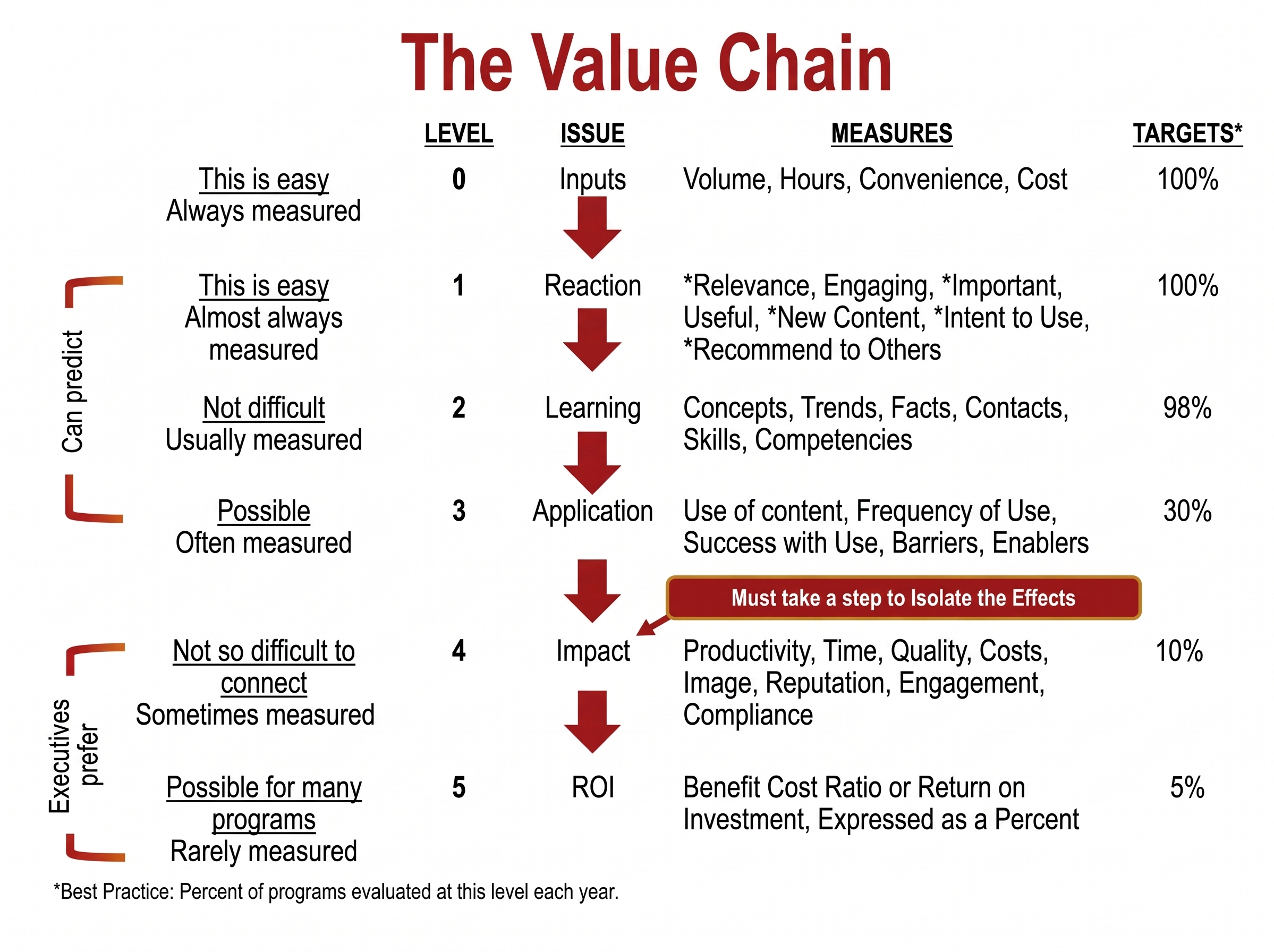
The Value Chain: From Input to ROI
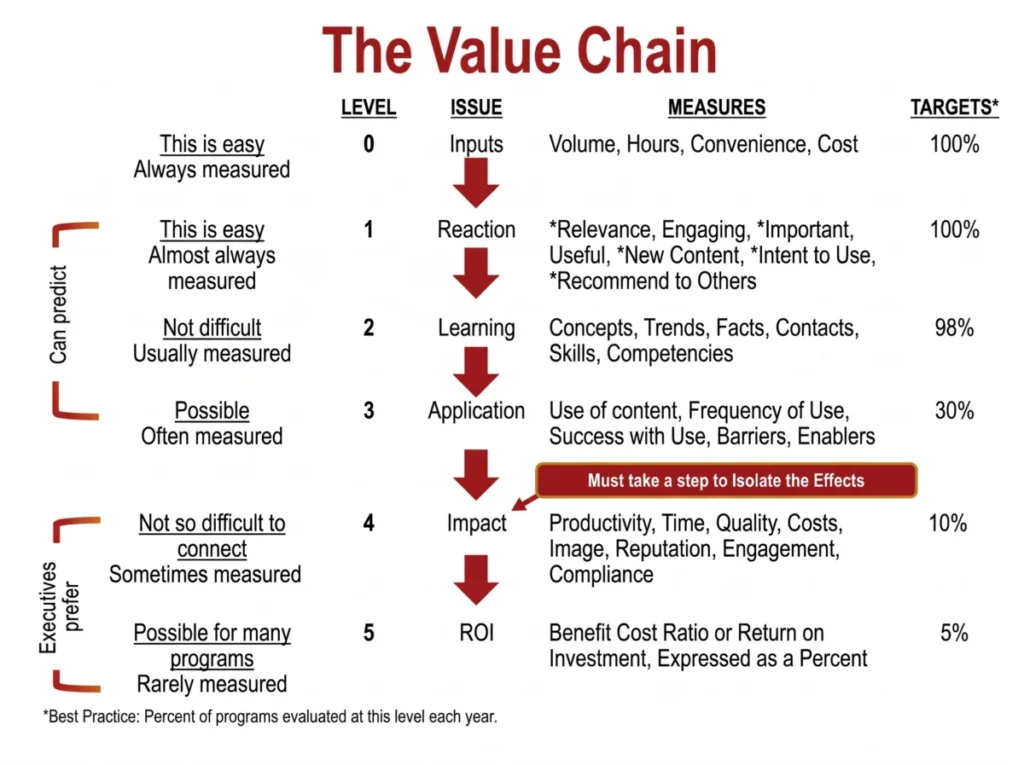
To understand how a program generates value, one must view it through a "value chain"—a series of data types that build upon one another in a linear progression. The ROI Methodology categorizes these into six distinct levels, starting from Level 0.
Level 0, or Input, measures the sheer volume of the initiative. This includes the number of participants, the total hours of training delivered, and the initial costs. While necessary for administrative tracking, Level 0 provides no information regarding the effectiveness of the program.
Level 1, Reaction, captures how participants perceive the value of the project. This is often dismissed as "smiley sheets," but the ROI Methodology posits that reaction is a critical leading indicator. If participants do not see a program as relevant or important to their specific roles, they are unlikely to apply the knowledge. An adverse reaction at this stage can effectively kill a new initiative before it has a chance to produce results.

Level 2, Learning, focuses on the acquisition of skills and knowledge. This level confirms that the "teaching" aspect of the program was successful. However, learning in a vacuum does not help a business; it must be followed by Level 3, Application. Here, evaluators look for the frequency and success of use in the actual work environment. This level also identifies the barriers—such as lack of manager support—and enablers that influence whether the new skills are actually put to work.
Level 4, Impact, represents the actual business consequence of the application. These are the measures CEOs care about: increased sales, reduced error rates, improved retention, or faster production cycles. To maintain credibility, the methodology requires that the effects of the program be isolated from other influences, such as market shifts or new technology.
Finally, Level 5 is the ROI itself. This is where the impact measures are converted into monetary values and compared against the total cost of the program, including both direct and indirect expenses. This calculation provides the answer to the ultimate executive question: "Was it worth it?"
A 12-Step Roadmap for Delivering Results
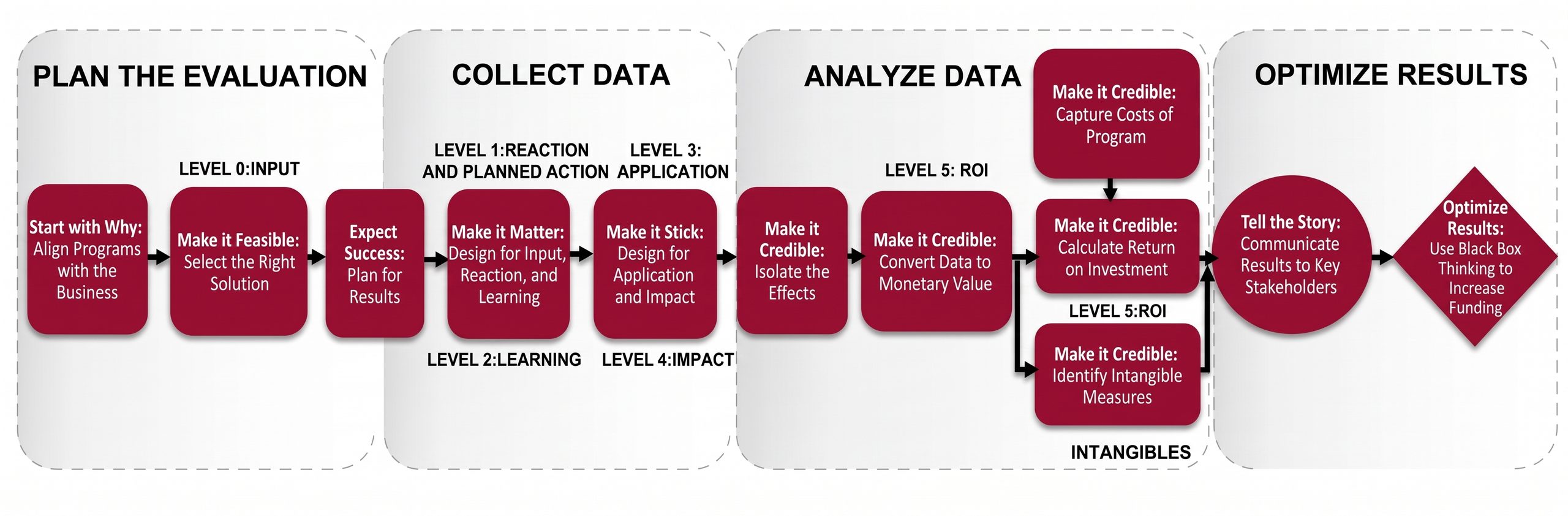
The ROI Methodology is structured into a 12-step process divided into four primary phases: Evaluation Planning, Data Collection, Data Analysis, and Optimizing Results.

The process begins with "Starting with Why." In the planning phase, Step 1 involves aligning the program with specific business measures. Instead of starting with a training topic (e.g., "Leadership Skills"), the process starts with a business need (e.g., "High Turnover in Mid-Management"). Step 2 ensures that the proposed program is the correct solution for that specific problem, while Step 3 involves setting clear expectations for success through design thinking.
Data collection follows in Steps 4 and 5. This involves gathering information on reaction and learning during the program, followed by application and impact data after the participants return to work. The methodology emphasizes the use of action plans, which serve as a roadmap for participants to implement what they have learned.
The analysis phase (Steps 6 through 10) is where the "credibility challenge" is met. Step 6 is perhaps the most critical: isolating the effects of the program. Using techniques such as experimental control groups, trend line analysis, or expert estimations, evaluators determine exactly how much of the business improvement was caused by the training versus other factors. Step 7 involves converting that data into monetary benefits, using a conservative philosophy of "when in doubt, leave it out." Step 8 identifies "intangibles"—valuable outcomes like brand reputation or job satisfaction that cannot be credibly converted to cash. Step 9 accounts for all costs, including the "opportunity cost" of the time employees spent away from their desks. Step 10 results in the final ROI calculation.
The final phase, Optimizing Results (Steps 11 and 12), involves storytelling and future-proofing. Stakeholders are presented with a narrative that combines hard financial data with the "intangible" human stories of growth. These results are then used to influence future funding and to refine the program for even greater efficiency.
The Role of Conservative Principles and Standards
The widespread adoption of the ROI Methodology by CFOs is largely due to its adherence to 12 guiding principles designed to prevent the overestimation of benefits. These standards act as a "conservative filter" for data. For example, one principle dictates that when a mathematical range is used in an estimate, the lowest value in the range should be utilized. Another requires that the costs of the evaluation itself be included in the total cost of the program.
These rules ensure that the final ROI figure is not a "marketing number" generated by HR, but a "financial number" that can withstand an audit. By being intentionally conservative, L&D professionals build trust with the executive suite, positioning themselves as strategic partners who understand the language of risk and return.
Broader Implications for the Future of Talent Development
The implications of adopting a rigorous ROI framework extend beyond simple budget justification. In an era where "upskilling" and "reskilling" are seen as essential for survival in the face of artificial intelligence and automation, the ability to prove the efficacy of these programs is a competitive advantage.
Organizations that fail to connect learning to impact risk seeing their L&D budgets viewed as discretionary expenses—the first to be cut during an economic downturn. Conversely, those that can demonstrate a clear line of sight from a training session to a business outcome often see increased investment. They move from being "cost centers" to "value creators."
Furthermore, this methodology encourages a culture of accountability. When trainers and participants know that the application of skills will be measured against business impact, the focus shifts from "attending a class" to "improving the business." This alignment of individual growth with organizational success creates a more motivated workforce and a more agile company.
As detailed in the methodology’s foundational literature, such as "The Business Case for Learning," the shift toward impact-based evaluation is not merely a trend but a fundamental change in corporate philosophy. By starting with "why" and ending with "ROI," talent development professionals can finally provide the data-driven evidence that CEOs and CFOs have long demanded, ensuring that the investment in human capital is both strategic and sustainable.