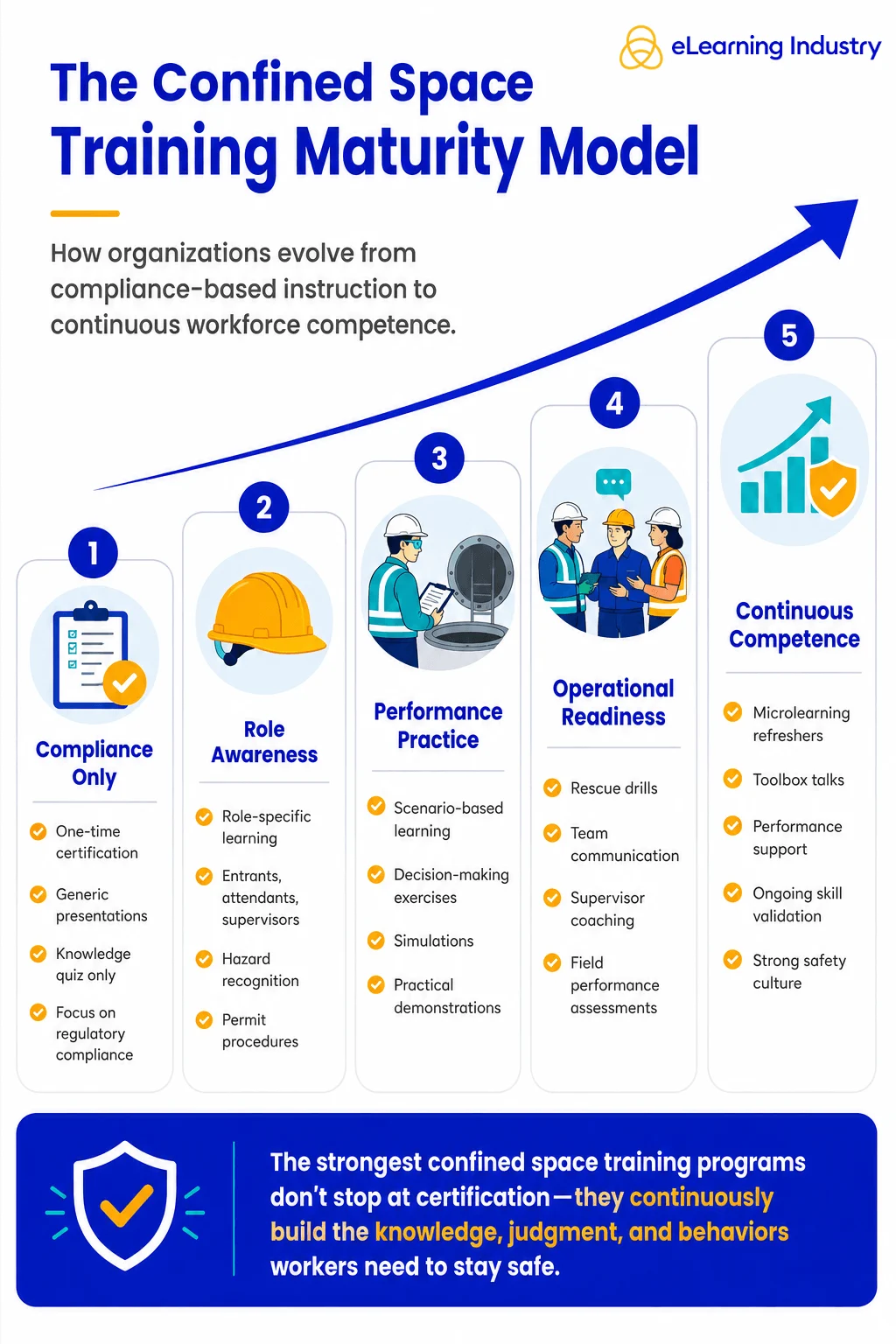
The landscape of industrial safety is undergoing a significant transformation as organizations shift from mere regulatory compliance toward a competency-based approach to confined space training. In sectors ranging from oil and gas and manufacturing to utilities and food processing, the risks associated with confined spaces—such as tanks, silos, vaults, and pipelines—remain among the most lethal threats to the modern workforce. While the Occupational Safety and Health Administration (OSHA) provides the legal framework for safety, the industry is increasingly recognizing that "checking a box" is insufficient to prevent fatalities. To truly protect workers, instructional designers and safety professionals are reimagining training as a dynamic, role-specific, and continuous process that prioritizes real-world decision-making over the memorization of rules.
The High Stakes of Confined Space Operations
Confined spaces are defined by three specific criteria: they are large enough for an employee to enter and perform work, they have limited or restricted means for entry or exit, and they are not designed for continuous occupancy. When these spaces contain additional hazards—such as a hazardous atmosphere, the potential for engulfment, or dangerous internal configurations—they are classified by OSHA as permit-required confined spaces (PRCS).
The necessity for rigorous training is underscored by harrowing statistics from the Bureau of Labor Statistics (BLS). Between 2011 and 2018, approximately 1,030 workers died in occupational confined space incidents in the United States. Perhaps more tragic is the "would-be rescuer" phenomenon: historical data suggests that roughly 60% of confined space fatalities involve individuals who attempted to rescue a colleague without proper training or equipment, only to succumb to the same hazards. These figures highlight a critical gap in traditional training models and emphasize the need for a more robust, analytical approach to safety education.
A Chronology of Safety Standards and Evolution
The history of confined space safety is marked by reactive legislation following industrial disasters.
- Pre-1990s: Confined space safety was largely managed through general industry standards, often leading to inconsistent protection levels across different states and sectors.
- 1993: OSHA implemented 29 CFR 1910.146, the "Permit-Required Confined Spaces" standard. This established the first comprehensive federal requirements for practices and procedures to protect employees in general industry.
- 2015: OSHA issued a new standard for the construction industry (Subpart AA of 29 CFR 1926), acknowledging that construction sites are more fluid and require different communication protocols than fixed manufacturing plants.
- The Present Day: The focus has shifted toward "Performance-Based Training," where the success of a program is measured by a worker’s ability to demonstrate specific skills in simulated high-pressure environments, rather than just passing a written exam.
The Four Pillars of the Entry Team: Roles and Responsibilities
Effective training cannot be a "one size fits all" solution. OSHA mandates that training must be tailored to the specific duties of the personnel involved.
Authorized Entrants
Entrants are the individuals physically entering the hazardous environment. Their training must focus on the immediate recognition of hazards, including atmospheric changes (oxygen deficiency, toxic gases like Hydrogen Sulfide, or flammable vapors). They must be proficient in the use of Personal Protective Equipment (PPE), including respirators and fall arrest systems, and must understand the critical importance of maintaining constant communication with the attendant.
Attendants
Often referred to as the "lifeline" of the operation, the attendant remains outside the space. Their primary duty is to monitor the status of entrants and the conditions around the entry point. Training for attendants emphasizes situational awareness and the "non-entry rescue" protocol. They must be empowered to order an immediate evacuation at the first sign of a prohibited condition or if they observe behavioral changes in the entrants that suggest chemical exposure.
Entry Supervisors
The supervisor holds the ultimate responsibility for the safety of the operation. They are tasked with verifying that all tests (such as atmospheric monitoring) have been conducted and that all procedures and equipment listed on the permit are in place before entry begins. Their training is centered on risk assessment, regulatory compliance, and the authority to terminate an entry if safety standards are not met.
Rescue Personnel
Rescue teams require the highest level of technical proficiency. Under OSHA 1910.146, rescue services must be evaluated for their ability to respond in a timely manner and their proficiency in technical rope rescue, retrieval systems, and advanced medical stabilization. Training for these teams involves frequent, high-fidelity drills that simulate the specific types of spaces found within their facility.
Modernizing Instructional Design for Safety
Instructional designers are now moving away from "death by PowerPoint" toward immersive, task-based learning. The goal is to build "muscle memory" and critical thinking skills.
Task-Based Curriculum
Instead of starting with the text of the law, modern programs start with a Job Hazard Analysis (JHA). By identifying the specific movements, tools, and environmental factors a worker will encounter, designers can create training that feels relevant. For example, if a worker is tasked with welding inside a stainless steel tank, the training should focus specifically on hexavalent chromium exposure and the depletion of oxygen caused by the welding process.
Scenario-Based Learning and Branching Paths
Scenario-based learning allows workers to practice in a risk-free environment. Digital or tabletop exercises might present a worker with a scenario where a gas monitor alarm sounds. The training then asks the learner to choose the next step. If they choose incorrectly—such as staying to finish a five-minute task—the scenario demonstrates the catastrophic consequences. This "branching" logic helps workers understand the why behind the rules.
The Role of Virtual Reality (VR) and Simulations
VR has emerged as a powerful tool in confined space training. It allows learners to experience the claustrophobia and sensory limitations of a confined space without actual danger. Studies indicate that VR training leads to higher retention rates compared to traditional classroom methods because it engages multiple senses and triggers the emotional responses associated with real-world hazards.
Comparative Analysis: Delivery Methods
Organizations must choose between online, in-person, and hybrid models. Each has distinct advantages and limitations.
- Online Training: Ideal for establishing a baseline of theoretical knowledge. It is scalable, cost-effective, and ensures a consistent message across multiple geographic locations. However, it cannot replace the tactile experience of calibrating a four-gas monitor or donning a harness.
- In-Person Training: Essential for hands-on skills. The presence of an experienced instructor allows for immediate feedback and the correction of unsafe habits. It also fosters a "safety culture" through team interaction.
- Hybrid (Blended) Learning: This is widely considered the gold standard. Workers complete the "head knowledge" modules online at their own pace and then attend a practical session to demonstrate physical competency. This maximizes the efficiency of the instructor’s time and ensures that everyone arrives at the practical session with the same foundational knowledge.
Regulatory Responses and the Cost of Non-Compliance
Industry experts and OSHA representatives emphasize that training records are more than just paperwork; they are legal documents. In the event of an accident, OSHA investigators will scrutinize training logs to determine if the training was "adequate" for the hazards present.
The financial implications of inadequate training are severe. As of 2024, OSHA’s maximum penalty for a "serious" violation is approximately $16,131, while "willful or repeated" violations can exceed $161,323 per instance. Beyond federal fines, the indirect costs—including workers’ compensation claims, increased insurance premiums, lost productivity, and the immeasurable impact on employee morale—can be devastating to an organization’s bottom line.
Conclusion: Building a Culture of Competency
The future of confined space safety lies in the transition from compliance to competency. As industrial environments become more complex with the introduction of new chemicals and technologies, the training must evolve accordingly.
By integrating role-based learning, leveraging new technologies like VR, and maintaining a cycle of continuous reinforcement through toolbox talks and microlearning, organizations can move beyond the minimum requirements of the law. The ultimate goal of confined space training is not just to satisfy an auditor, but to ensure that every worker who enters a high-risk environment possesses the skills and judgment to return home safely at the end of their shift. In the high-stakes world of industrial maintenance and operations, effective training is not an expense—it is the most critical investment a company can make.