In today’s dynamic labor market, the inclusion of salary information in job descriptions has transcended from a mere recruitment tactic to a fundamental strategic imperative for organizations aiming to attract top talent, streamline hiring processes, foster internal equity, and ensure long-term employee retention. The absence of clear compensation details in job postings not only deters a significant portion of potential applicants but also cultivates an environment of uncertainty and distrust, both externally among candidates and internally among existing staff. As regulatory landscapes evolve and employee expectations for transparency heighten, companies are increasingly recognizing that openly communicating salary ranges is not just a best practice but a critical component of a robust and ethical human resources framework.
The Pivotal Role of Salary Transparency in Talent Acquisition
The initial interaction between a prospective employee and an organization often occurs through a job description. In this crucial first impression, salary figures emerge as the foremost consideration for candidates evaluating whether a position aligns with their career aspirations and financial expectations. Research consistently highlights this critical factor: a study by Monster revealed that a striking 60% of U.S. workers would outright refuse to apply for a job that does not list a salary range. This statistic underscores a profound shift in candidate behavior, where transparency is no longer a bonus but a baseline expectation. In a competitive talent landscape, organizations that withhold this vital information risk being automatically disqualified by a large segment of qualified individuals.
This reticence to disclose pay can be particularly detrimental when considering the broader legal and competitive environment. With 15 U.S. states, along with Washington D.C., now mandating pay disclosure in job postings, employers who fail to adapt risk not only legal non-compliance but also a significant disadvantage in attracting talent from regions where transparency is the norm. The trend towards pay transparency is accelerating, signaling a future where such disclosure will likely become widespread, if not universal. Companies that proactively embrace this shift are better positioned to navigate the evolving regulatory landscape and build a reputation as progressive, fair employers.
Beyond mere application rates, salary transparency plays a crucial role in attracting better-fit candidates. When a salary range is clearly stated, candidates can self-select, ensuring that those who do apply are genuinely interested and financially aligned with the opportunity. Without this upfront information, companies face the risk of attracting applicants whose salary expectations are vastly out of sync with the allocated budget, leading to wasted time and resources for both parties. This initial filtering mechanism helps in cultivating a higher quality applicant pool, allowing HR teams and hiring managers to focus their efforts on candidates who are truly viable.
Efficiency Gains and Streamlined Hiring Processes
One of the most tangible benefits of including salary ranges in job descriptions is the significant enhancement of efficiency throughout the recruitment cycle. By setting clear expectations from the outset, organizations can drastically reduce the time and resources expended on unsuitable candidates. Consider a scenario where a candidate expects a salary of $95,000, but the maximum budget for the role is $80,000. Without a posted range, this substantial $15,000 discrepancy might only surface after multiple stages of screening, interviews, and even initial background checks. This protracted process, involving HR personnel, hiring managers, and potentially multiple team members, represents a considerable investment of time and effort that ultimately yields no successful hire.
When salary expectations are mismatched, prolonged negotiation processes can ensue, extending the time-to-hire and potentially souring the candidate experience. If a candidate is actively being courted by other employers, a delayed or difficult negotiation could easily lead them to accept another offer. Conversely, if the hiring team must then move on to other candidates, the role remains open for longer, incurring opportunity costs for the business. A simple posted range would have identified this gap before the first interview, allowing the candidate to opt out gracefully and the hiring team to focus on individuals whose expectations align.
Some hiring managers express reservations about disclosing salary ranges, often citing concerns about revealing their compensation packages to competitors, particularly if their offers are perceived to be below market value. However, this perspective overlooks the strategic advantages of transparency. As Vicki Salemi of Monster points points out, pay transparency helps attract candidates who are genuinely a good fit for the entire compensation package. If a company cannot compete on salary with industry leaders, it necessitates a critical review of its total rewards strategy, prompting a focus on other compelling benefits such as remote work flexibility, robust professional development opportunities, or comprehensive health and wellness allowances, which can offset salary disparities. Moreover, posting a range does not eliminate negotiation; it simply defines the boundaries within which negotiations can occur, leading to more focused and productive discussions. This approach ultimately contributes to a smoother, faster, and more cost-effective hiring process.
Fostering Internal Equity and Employee Retention
The impact of salary transparency extends far beyond external recruitment, profoundly influencing internal employee experience and retention. To publish a defensible salary range, organizations must first engage in rigorous salary benchmarking, a process that involves comparing their pay standards against market rates for similar roles and industries. This exercise is not merely about competitiveness but about establishing a foundation of fair compensation practices.
However, fair pay alone is often insufficient. Payscale’s 2025 research highlighted a significant perception gap: 68% of employees believed they were underpaid, even when their compensation was at or above market rates. Astonishingly, nearly half (47%) of employees actually paid above market still felt they were underpaid. This disconnect underscores the critical role of communication and transparency. When employees lack clarity on how their pay is determined or how it compares to others, perceptions of unfairness can fester, regardless of the actual pay level.
Perceived fairness is a powerful driver of employee retention. A 2026 survey by Zety involving over 1,000 U.S. workers found that 40% cited higher pay as the primary reason they would consider leaving their current job, surpassing better benefits (22%) and growth opportunities (17%). This data reinforces that while other factors contribute to job satisfaction, compensation remains a fundamental determinant of an employee’s decision to stay or leave.
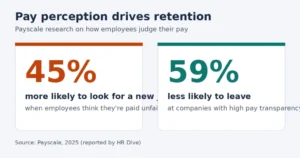
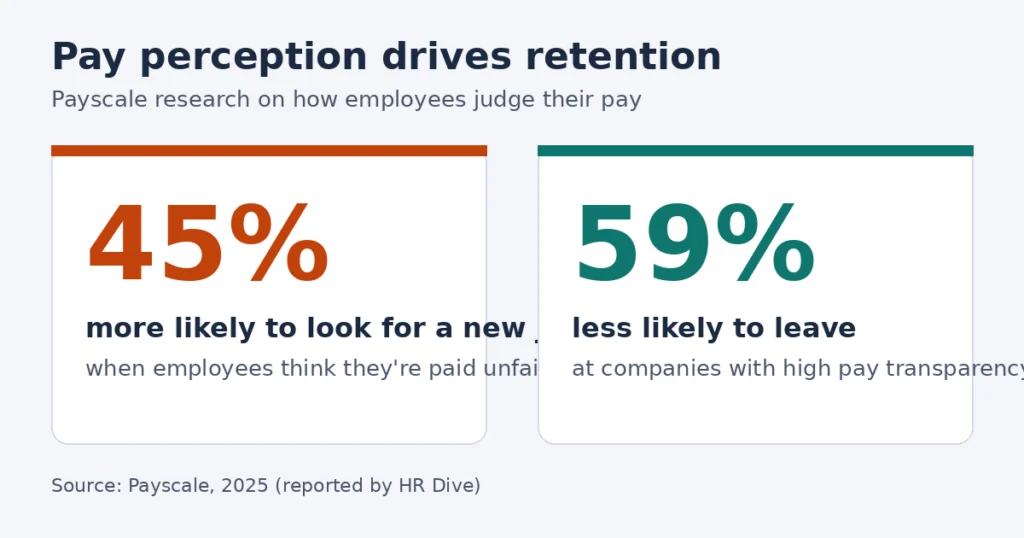
Payscale’s research further elucidated this link: employees who believe they are paid unfairly are 45% more likely to seek new employment. Conversely, at companies characterized by high pay transparency, employees are 59% less likely to leave. This dramatic difference illustrates that transparency fosters trust and reduces the likelihood of employees feeling undervalued, even if their salary isn’t at the absolute top of the market. When employees understand the logic behind their compensation, and perceive that the system is equitable, their commitment to the organization deepens.
Employee turnover is a notoriously expensive problem for businesses. The Work Institute’s 2025 Retention Report conservatively estimated the financial impact of turnover at 33% of an employee’s base pay. For an individual earning $50,000, this translates to an average cost of $16,500 or more, encompassing recruitment fees, onboarding expenses, lost productivity during the vacancy, and training for new hires. For senior or highly specialized roles, these costs can escalate dramatically. Proactive strategies like pay transparency, which enhance retention, therefore represent significant cost savings and contribute to organizational stability and productivity.
Addressing Pay Gaps and Promoting Equity
The act of publishing salary ranges serves as a powerful catalyst for organizations to critically examine their internal compensation structures, often bringing to light existing pay disparities. This internal audit is a crucial step toward achieving true pay equity, particularly in addressing long-standing issues such as the gender pay gap.
Payscale’s 2026 Gender Pay Gap Report revealed that, on an uncontrolled basis (comparing median pay for all men and all women), women earn $0.82 for every $1 men earn, a slight decrease from $0.83 the previous year. This translates to an average annual income difference of $14,300. While the controlled gap (comparing individuals doing similar work with similar qualifications) is narrower, it still exists in many sectors. Pay transparency laws are designed to mitigate these disparities by forcing employers to confront and justify their compensation practices.
However, transparency alone is not a panacea. The Payscale report noted that among the nine states with pay transparency laws, only some had managed to close the controlled gender pay gap, while others had not. This finding underscores that disclosure must be coupled with consistent, data-driven pay practices and a genuine commitment to rectifying inequities. Simply publishing a range without a robust internal process for fair compensation adjustment will not achieve the desired outcome.
Putting salary ranges in job advertisements sends a clear message to prospective and current employees: that the organization values their skills and time, irrespective of gender, race, or other protected characteristics. To ensure the integrity of this message, companies must conduct thorough pay audits before publishing ranges, ensuring that the advertised figures accurately reflect what they are prepared to pay and that these rates are consistent with internal equity principles. This commitment to auditing and adjusting pay structures in accordance with federal and state pay equity laws (such as those detailed in guides to pay equity laws by state) is paramount. It transforms transparency from a mere compliance exercise into a strategic tool for fostering an inclusive and equitable workplace culture.
Strategic HR Implementation: Key Takeaways and Best Practices
For human resources teams, the successful implementation of salary transparency requires a multi-faceted approach, moving beyond simple disclosure to embedding equity and clarity within the organizational culture.
- Conduct Thorough Salary Benchmarking: Regular, data-driven analysis of market rates is non-negotiable. HR teams must invest in robust compensation data sources to ensure that their salary ranges are competitive and justifiable. This benchmarking should be dynamic, reflecting changes in market demand and economic conditions.
- Develop a Clear Compensation Philosophy: Organizations need a well-defined and documented compensation philosophy that outlines the principles guiding pay decisions. This philosophy should explain how base pay, bonuses, and other benefits contribute to the total compensation package, and how performance, experience, and market value influence individual pay within established ranges.
- Perform Internal Pay Audits and Gap Analysis: Before publishing any salary ranges, HR must conduct comprehensive internal audits to identify and address existing pay disparities. This involves analyzing compensation data across demographics, roles, and performance levels to uncover and rectify any unintended biases or gaps.
- Train Hiring Managers and Leaders: Front-line managers and hiring leaders must be thoroughly trained not only on the mechanics of discussing salary ranges but also on the underlying compensation philosophy. They should be equipped to articulate how pay is determined and to answer candidate questions transparently and consistently.
- Craft a Comprehensive Communication Strategy: Transparency extends beyond job descriptions. Organizations should develop a communication plan for both internal and external stakeholders, explaining the rationale behind their pay transparency initiatives, the benefits, and the processes in place to ensure fairness.
- Ensure Continuous Review and Adjustment: The compensation landscape is constantly evolving. HR teams must commit to ongoing review of salary ranges, benchmarking data, and internal pay equity, making adjustments as needed to maintain competitiveness and fairness. This iterative process ensures that transparency remains a living, breathing aspect of the organization’s HR strategy.
Broader Implications and Future Outlook
The trajectory towards greater pay transparency is clear and accelerating. As more states enact disclosure laws, and as candidates increasingly demand openness, organizations that embrace this shift will gain a significant competitive advantage. This commitment to transparency bolsters employer branding, positioning companies as ethical, fair, and employee-centric, which is crucial for attracting talent in a values-driven workforce.
Furthermore, pay transparency is not merely a compliance issue; it is a fundamental pillar of the future of work. It signals a move towards greater accountability, fosters a culture of trust, and empowers employees with the information they need to make informed career decisions. By proactively adopting comprehensive pay transparency strategies, organizations are not just reacting to market demands or legal mandates; they are strategically investing in their talent, their culture, and their long-term success.
In conclusion, the decision to include salary in job descriptions is no longer a peripheral consideration but a core strategic choice with far-reaching implications. It is a powerful tool for attracting best-fit candidates, streamlining recruitment, enhancing internal equity, and significantly boosting employee retention. By embracing pay transparency, backed by robust data and a commitment to fair practices, organizations can build stronger, more equitable, and more resilient workforces capable of thriving in the modern economic landscape.